ERASMUS, DesideriusBiblio.com
4 852 résultats
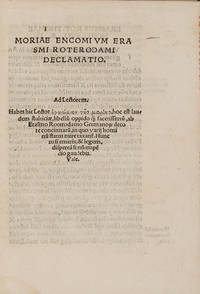
réf. 93719Argentorati Strassburg in aeidibus Matthiae Schurerii August 1511. . Second first dated edition; small 4to leaves measuring 19.4 x 13.8 cm; occasional minor coeval underlining and marginalia to earlier part of text very light stain to lower margin at gutter throughout not affecting text bibliographical clippings tipped onto front endpapers; bound in antique style calf; 96pp; A8 B4 C8 D4 E8 F4 G-H6 with the final blank leaf H6 present ff. First dated & earliest procurable edition of Erasmus' 'In Praise of Folly'. The scarce first dated edition of Erasmus' Moriae Encomium an important work of humanist rhetoric which satirised the corruption and religious hypocrisy of Europe's elite. Printed two months after the undated Paris edition by Gilles de Gourmont of which only a handful of copies survive all of them in institutional libraries. The present edition almost as rare is not merely a reprint of the Paris edition but contains additional material including an address and laudatory letter to Erasmus by his fellow humanist Jakob Wimpfeling. All early editions are exceedingly scarce with only three appearing at auction in the last 100 years that we could trace. The first English translation was not published until 1549 although there had been Czech French and German editions prior to this. An excellent example of a classic work of paradoxical satire in which folly is personified and holds up a mirror to mankind. An extremely significant work both in its own right and for its influence on the Protestant Reformation in general. Sir Thomas More's own magnum opus Utopia was at least in part written as a response to Moriae Encomium. 'The Praise of Folly was written when Erasmus was staying in the house of Thomas More in the winter of 150910. Its title is a delicate and complimentary play on the name of his host: its subject matter is a brilliant biting satire on the folly to be found in all walks of life. The book stemmed from the decision which Erasmus had taken when he left Rome to come to England that no form of preferment could be obtained at the sacrifice of his freedom to read think and write what he liked. The work was first secretly printed in Paris and as in other cases its immediate success safeguarded him from the consequences of his audacity. Whenever tyranny or absolute power threatened The Praise of Folly was re-read and reprinted. It is a sign of what was in the air that Milton found it in every hand at Cambridge in 1628. His inherent scepticism has led people to call Erasmus the father of eighteenth-century rationalism but his rationalist attitude is that of perfect common sense to which tyranny and fanaticism were alike abhorrent' PMM 43. Despite the risky nature of the work and its explicit and implicit attacks on established religion and authority figures of the time its rapid popularity ensured that the author and the work were left unmolested by church and state at least until Erasmus' death in 1536 after which his previously untainted reputation was diminished. By 1559 all of his works had been proscribed under the insidious Index Auctorum et Librorum Prohibitorum. We can trace copies in just 12 institutional collections worldwide: 3 in the British Isles BL University of Cambridge and Bodleian Library 2 in France BnF and Université de Strasbourg 43 in the USA Folger Shakespeare Library Harvard University Divinity School and Ohio State University 3 in Germany Staatsbibliothek zu Berlin Universitaet Goettingen and Wurttembergische Landesbibliotherk and 1 in Denmark Det Kgl. Bibliotek. Bezzel 1298; cf.PMM 43; Vander Haeghen 122. Argentorati (Strassburg), in aeidibus Matthiae Schurerii, August 1511. unknown
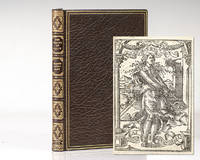
1549réf. 139476London: Thomas Berthelet 1549. First edition in English of one of the most notable and popular works of the Renaissance which played an important role in the beginnings of the Protestant Reformation and swiftly brought its author international fame. First printing with 'latine' and the printer's initials 'TB.' to the title page. Octavo bound in full crushed levant morocco by Sangorski and Sutcliffe gilt titles and elaborate gilt tooling to the spine in six compartments within raised gilt bands triple gilt ruling to the front and rear panels gilt turn-ins and inner dentelles all edges gilt wide woodcut border to the title page signed TB. woodcut printer's device to the final page. In near fine condition. Early ownership name to the title page and light marginalia. Small leather bookplate of Francis Kettaneh affixed to the verso of the front free endpaper. Exceptionally rare with only two other examples traced at auction in the last 100 years. This famous satire was first conceived on the road from Italy to England composed in the house of Erasmus's friend and the dedicatee Thomas More and then first printed under the Latin title Moriae encomium in Paris in 1511. Begun as a paradoxical joke between the two men who had been translating the ancient humorist Lucian together The Praise of Folly is a remarkable work by turns sharp and gentle—but always playful—in its learned treatment of the follies of the world and vision of a humanist life. “The Praise of Folly was written when Erasmus was staying in the house of Thomas More in the winter of 1509–10. Its title is a delicate and complimentary play on the name of his host: its subject matter is a brilliant biting satire on the folly to be found in all walks of life. The book stemmed from the decision which Erasmus had taken when he left Rome to come to England that no form of preferment could be obtained at the sacrifice of his freedom to read think and write what he liked … The work was first secretly printed in Paris and as in other cases its immediate success safeguarded him from the consequences of his audacity … Whenever tyranny or absolute power threatened The Praise of Folly was re-read and reprinted. It is a sign of what was in the air that Milton found it in every hand at Cambridge in 1628. His inherent scepticism has led people to call Erasmus the father of 18th century rationalism but his rationalist attitude is that of perfect common sense to which tyranny and fanaticism were alike abhorrent” PMM. Upon its initial publication in Paris in 1511 Moriae Encomium was hugely popular to Erasmus' astonishment and sometimes his dismay. Even Erasmus' close friends had been initially skeptical and warned him of possible dangers to himself from thus attacking the established religion. Even Pope Leo X and Cardinal Cisneros are said to have found it amusing. Before Erasmus' death it had already passed into numerous editions and had been translated into Czech French and German. An English edition soon followed translated by English poet and diplomat Sir Thomas Chaloner who was renowned among Elizabethans for his Latin verses and pastoral poems three volumes of which were printed during his lifetime by Thomas Berthelet the king’s printer who had published three translations of works by Erasmus in the 1520s. Thomas Berthelet hardcover