4836 resultados
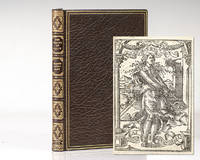
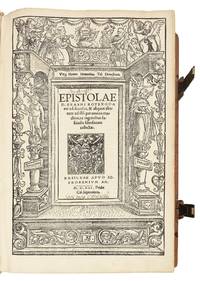
1522ref. 5299Basel: Johann Froben August 21 1521 - January 1522. FIRST EDITION. Hardcover. Fine. A superb copy bound in contemporary alum-tawed pigskin over beveled wooden boards ruled and tooled in blind with the original clasps catches and straps preserved. Binding mildly soiled a few scrapes mild surface wear. Internally crisp and bright with just a few lightly toned leaves and a few trivial stains. With 16th c. manuscript annotations scattered throughout and a 16th c. ownership inscription on the paste-down. The errata lvs. have been tipped in possibly indicating early issue. Excellent. Title page with the fine ‘Triumph of Humanitas’ historiated woodcut border by Urs Graf Lüthi 50a and Hieronymus Oberrheinische Buchillustration 172 enclosing Froben’s printer’s device; two preliminary pages with fine four- and five-piece woodcut borders by Ambrosius Holbein; white-on-black woodcut headpiece two 10-line woodcut initials and numerous smaller ones verso of final leaf with large printer’s device enclosed in five-piece woodcut border; some Greek printing. First edition of this collection of 671 letters of which 171 are newly printed. The majority of the new letters are from 1519-1521 but some are earlier the first dated 11 July 1513. The collection is far larger than its predecessors: the ‘Epistolae aliquot’ of January 1518 52 letters the ‘Auctarium’ of October 1518 63 letters and the ‘Farrago’ of Nov 1519 333 letters. Erasmus provides a preface to his correspondence for the first time in this edition. The letter to his editor Beatus Rhenanus Ep 1206 tells of his dislike of two earlier collections edited by him Beatus and published by Froben the ‘Auctarium’ of October 1518 and the ‘Farrago’ of Nov 1519 and implies that they were published surreptitiously without his consent. After the present edition no further collections were printed until the ‘Opus epistolarum’ of 1529. The introduction in the Collected Works to Erasmus’ prefatory letter to Beatus Rhenanus illustrates his personal involvement in the production of this collection: "Even as the Farrago was being printed Erasmus spoke of another edition with new letters added and others revised. The last thing he desired was a straight reprint either by Froben or another publisher. So in the summer of 1520 he was going through all his letters and in November the review of the ‘Farrago’ was apparently completed. Before the middle of January 1521 the revised copy together with a substantial number of new letters had reached Basel. When he sent the first part of the revised New Testament shortly afterwards he apparently asked to have all letters old and new back for another review but was sent none and told instead that a volume of 41 quires pages 1-490 was set in type lacking only a preface and an epilogue. So he wrote this preface as well as dispatching more letters to Basel. “Froben next prepared a preliminary quire containing the title-page dated 31 August Epp 1206 1225 and to fill some space left over on the last page Ep. 1239. All was printed and ready to be launched at the Frankfurt autumn fair but with the certain prospect of Erasmus’ return to Basel a delay was indicated. As Froben now preferred his volume not to reach the public and his rivals until the time of the spring fair of 1522 Erasmus could add more letters including the last in time dated from Basle 22 November 1521 which appears on page 639 but is followed by thirty more pages of letters. Presumably as a result of Erasmus’ review of the printed volume over three pages of corrigenda were added at the end" Collected Works vol. 8 pp. 215/7. The correspondents for the newly printed letters include Johann Reuchlin Justus Jonas Guillaume Bude Petrus Mosellanus Polydore Vergil Pope Leo X Cardinal Albert of Brandenburg Thomas More William Warham Thomas Wolsey and John Fisher. Many of the letters reflect Erasmus’ changing stance regarding Luther but at the same time continue his attacks on the friars and Louvain theologians. Bietenholz singles out a long letter of 10 May 1521 Ep 1202 to Justus Jonas as one of the finest of the period in which Erasmus expresses his alarm that Jonas as well as a whole group of German humanists especially Melanchthon are committing themselves irrevocably to the Lutheran cause Collected Works vol. 8 pp. 201. Another letter to Jonas of June 1521 Ep 1211 holds an important biography of his friend John Colet the humanist and educational pioneer who had died in September 1519 “Sixteenth-century Europe’s image of Colet owes everything to Erasmus. Much is still today known only from that source. Erasmus’ encomium is the fullest and most explicit portrait.” Contemporaries of Erasmus I p. 327. Also included in this collection and previously published in the Farrago is one of Erasmus’ most famous letters “which will always rank among his finest writing and the great accomplishments of Renaissance literature” Collected Works vol. 7 p. xii. Addressed to Ulrich von Hutten in July 1519 Ep 999 it contains Erasmus’ intimate pen portrait of his close friend Thomas More. It serves as earliest biographical account of More and is the most substantial of three letters the others Ep 1233 see below & Ep 2750 “which are indispensable for any historical assessment of More’s character” Contemporaries of Erasmus II p. 458. It is full of memorable phrases such as “in a word if you want a perfect model of friendship you will find it in no one better than in More” and “no one is less led by the opinions of the crowd yet no one departs less from common sense”. The friends met for the last time in Bruges in August 1521 and in his letter to Budé Ep 1233 first printed here Erasmus writes of the invigorating impact of their meeting and of the shining example set in More’s household for the education of women. Johann Froben, August 21 1521 - January hardcover books
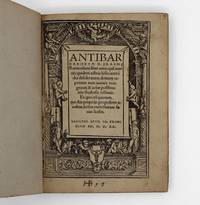
1520ref. 375736Basel: Froben 1520. First edition printed in May. Woodcut borders to title leaf and dedication by Hans Holbein printer's device on last page. 150 2 imprint pp. 4to. Eighteenth-century marbled boards ink label. Some toning to spine. Very good fresh copy. First edition printed in May. Woodcut borders to title leaf and dedication by Hans Holbein printer's device on last page. 150 2 imprint pp. 4to. Ignorantiam esse superbiae matrem. Eruditionem contra modestiam parere. Ignorance is the mother of pride; it is from learning on the contrary that modesty is born. First edition of Antibarbari Erasmus' manifesto "defending the arts against the scruples of the barbarians" Tracy. Erasmus argues for the primacy of poetry among the liberal arts for the importance of critical understanding of the writers of classical antiquity and for appropriating what is good in their work. He is also scornful of rote learning and blind repetition of earlier scholarship where "cuckoo calls to cuckoo". In Petro summus erat ardor fidei in Hieronymino summa doctrina: alterius animum alterius studia imitar. In Peter there was the ardour of faith at its highest; in Jeronme there was learning at its best. It is for you to imitate the spirit if the one and the scholarship of the other. This was a work of very long ripening. Erasmus began the earliest version circa 1490 when he was a newly ordained monk but that manuscript was left behind in his wanderings. Decades later when he came across his earlier work he was at the center of intellectual controversy following publication of of his edition of the New Testament. He revised his Antibarbari to assert the humanist position and Froben published it in May 1520. There were six editions of the work in the early 1520s Froben himself published another edition later the same year and ten editions in his lifetime. "it is ignorance rather than erudtion which makes men insolent" FIRST EDITION OF A KEY WORK BY ERASMUS. VD16 E1997; Valentina Sebastiani Johann Froben Printer of Basel 170; Bibliotheca Erasmiana p. 9; Adams E-463; Bezzel 157. The standard modern text iwith translation by Margaret Mann Phillips˜The Antibarbarians" is in the Toronto Collected Works vol. 23 1978 Froben unknown
1520ref. 375736Basel: Froben 1520. First edition printed in May. Woodcut borders to title leaf and dedication by Hans Holbein printer's device on last page. 150 2 imprint pp. 4to. Eighteenth-century marbled boards ink label. Some toning to spine. Very good fresh copy. First edition printed in May. Woodcut borders to title leaf and dedication by Hans Holbein printer's device on last page. 150 2 imprint pp. 4to. Ignorantiam esse superbiae matrem. Eruditionem contra modestiam parere. Ignorance is the mother of pride; it is from learning on the contrary that modesty is born. First edition of Antibarbari Erasmus' manifesto "defending the arts against the scruples of the barbarians" Tracy. Erasmus argues for the primacy of poetry among the liberal arts for the importance of critical understanding of the writers of classical antiquity and for appropriating what is good in their work. He is also scornful of rote learning and blind repetition of earlier scholarship where "cuckoo calls to cuckoo". In Petro summus erat ardor fidei in Hieronymino summa doctrina: alterius animum alterius studia imitar. In Peter there was the ardour of faith at its highest; in Jeronme there was learning at its best. It is for you to imitate the spirit if the one and the scholarship of the other. This was a work of very long ripening. Erasmus began the earliest version circa 1490 when he was a newly ordained monk but that manuscript was left behind in his wanderings. Decades later when he came across his earlier work he was at the center of intellectual controversy following publication of of his edition of the New Testament. He revised his Antibarbari to assert the humanist position and Froben published it in May 1520. There were six editions of the work in the early 1520s Froben himself published another edition later the same year and ten editions in his lifetime. "it is ignorance rather than erudtion which makes men insolent" FIRST EDITION OF A KEY WORK BY ERASMUS. VD16 E1997; Valentina Sebastiani Johann Froben Printer of Basel 170; Bibliotheca Erasmiana p. 9; Adams E-463; Bezzel 157. The standard modern text iwith translation by Margaret Mann Phillips˜The Antibarbarians" is in the Toronto Collected Works vol. 23 1978 Froben unknown books
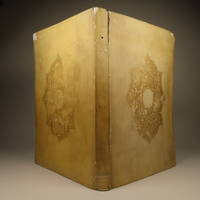
1653ref. 6648Full yapped vellum; large gilt arabesque decor to boards; particulars debossed in blind to spine. Encased in 1566 edition of J.L. Vives 1493-1540 De Officio Mariti published in Frankfurt. Text and plates from the original 1609 printing but now with the Frankfurt 1653 title page. Without additions or corrections but lacking two tables "amphitheatri aeternae" & "primordialiter constituunt mundum". Maintains same curious pagination as 1609 editon 61-42-63; 145-146-145-146-147; 190-192-193-193. No missing pages. Eleven plates from the 1609 edition 9 of which are folding attached to rear and twelfth plate at 1653 title page. Rear plates most wholly or partially rebacked include: original 1609 title page portrait of Khunrath Tablet of Jesus Tablet of Adam Table of Rebis Laboratorium Designation of the Pyramids or Designatio Porta Amphitheatri Adumbratio Gymnasii Hypotposis Arcis and Feinde Figure of the Panel of Enemies this last with creature-caused losses to top peripheral text see image. Minor loss to upper margin of center fold of plates 8 & 9. Peripheral dampstaining to upper margin of plates 3 4 & 7. Watermark of a crest with 3 towers in a shield over a moat to plate 5. This reissue bound without the elusive wise owl. Peripheral worming throughout margins with two exceptions; one of which travels without side-tracking from a2 through z4 see images. Wear and moderate soiling to boards. No previous owners' names or other markings. 222 pp. 1. 8 1/4 x 12 1/4 inches; 20 x 31 cm. Tobiam Gundermannum; Guilielmus Antonius hardcover
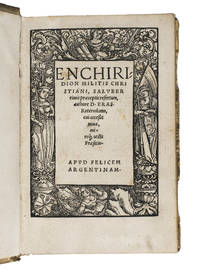
1523ref. ABC_49639Strassburg 1523. 8vo. Colophon: Johann Knobloch Contemporary elaborately blind-tooled pigskin over wooden boards remnants of brass anchor plates. Ad 1 with a woodcut frame on the title page 1 woodcut decorated initial and Knoblochs large woodcut device on the verso of the last blank leaf. Ads 2 and 3 with 1 woodcut decorated initial each. Ad 4 with a woodcut architectural frame on the title page and 1 large woodcut decorated initial. 4 works in 1 volume. 106; 57 1 blank; 49 1 blank ll.;158 pp. Four significant early 16th-century works that illuminate the intellectual and theological tensions of the Reformation. Ad 1: The Enchiridion militis christiani Poinard of the Christian Knight one of Erasmus most influential writings serves as a practical manual for inner reform and devout living. Emphasising moral integrity over ritual this widely reprinted work became a cornerstone of Christian humanist thought.Ad 2: The two homilies in De immensa Dei misericordia include a sermon on divine mercy likely composed for the dedication of a chapel in Basel and a second comparing virginity and martyrdom written for the Benedictine nuns of Cologne. Both reflect Erasmuss pastoral sensibilities and rhetorical skill.Ad 3: In De libero arbitrio Erasmus directly challenges Luthers doctrine of predestination in a pivotal treatise on free will. This foundational text marking the definitive break between the two reformers is one of the periods most significant theological works.Ad 4: The volume concludes with an early -and apparently rare- edition of Henry VIIIs Assertio septem sacramentorum a fierce rebuttal of Luthers De captivitate Babylonica. This work earned the English king the title Fidei Defensor from Pope Leo X. A splendid collection that captures the core tensions of the Reformation and the humanist response to it.Ad 1 with some of the text underlined. Ad 2 with manuscript annotations in the margins. Ad 3 with some marginal annotations and some of the text underlined. Ad 4 with a manuscript inscription on the title page and a few annotations in the margins. The binding shows signs of wear some small pieces of leather missing on the back board revealing the wood below remnants of fastenings along the fore-edge ads 2 and 3 with some minor worm holes in the paper barely affecting the text some staining and browning in places. Otherwise in good condition.l Ad 1: USTC 650175 7 copies; Vander Haeghen I 80; VD 16 E 2772; Ad 2: Bezzel 1131; VD 16 E 3041 and VD 16 E 3659; not in the USTC; Ad 3: VD 16 E 3151; not in the USTC; Ad 4: VD 16 H 2166; this ed. not in USTC. EARLY PRINTING & MANUSCRIPTS RELIGION & DEVOTION Church History & Missions Early Printing - 16th century Erasmus Humanism & Reformation Philosophy & Humanism Religion 16th Century ZZ 001 De Graaf Inkopen hardcover
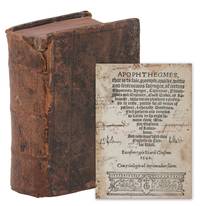
1542ref. 140949529London: Richard Grafton 1542. First Edition. Good. First English translation of Erasmus' collection of Classical wisdom. Small octavo -8 4 a-z8 A-X8 Y6 lacking leaf z1 p. 177 and blank leaf Y6. 376 leaves foliated. xx 176 178-345 12 pp. 62 '53' 64 '55' 83 '81' 100 '84' 119 '118' 122 '101' 144 '143' 222 '224' 224 '222' 225 '522' 273 '275' 275 '273' 277 '279' 279 '277' 311 '310'. Blackletter type on laid paper decorative capitals colophon with printer's device at rear. Bound in near-contemporary calf ruled in blind all edges stained red. Good with heavy wear to covers chipping at head of spine; lacking two leaves as noted. Margins tightly trimmed with frequent shaving to sidenotes slight worming to lower left margin corner through p. 112 light toning and dampstaining to contents. Evidence of bookplate removal to front pastedown round wax stain to p. 104 and facing page several inkstains. Generations of ownership signatures to title and colophon pages occasional ink marginalia. Devereux 3.3.1. The Dutch humanist Erasmus of Rotterdam was the greatest Renaissance scholar in Northern Europe. His Apophthegmata a collection of Greek and Latin adages and anecdotes was first published in Latin in 1531. The English playwright Nicolas Udall translated Books III and IV of the lengthy work into English intending his portion to be the first in a series of pocket-sized scholarly works. It was however a dangerous time to publish Erasmus. The humanist's criticism of clerical corruption had paved the way for Martin Luther's denunciation of the Catholic Church. There was a conservative backlash against reform after the 1540 execution of Henry VIII's fixer Thomas Cromwell who had patronized both Udall and his publisher Richard Grafton. In 1541 Grafton was imprisoned for publishing an epistle by a Lutheran reformer. He was sentenced again in 1543 'for printing off such bokes as wer thought to be unlawfull.' Grafton and Udall did better under Henry's successor Edward VI who after his ascension ordered that a copy of Erasmus's commentary on the New Testament edited by Udall be kept in every church in England. Among the faded names beautifully inscribed in this copy is that of Philemon Holland 1552-1637 whose fame as a translator surpassed that of Udall. He gave the world the first complete translation of Livy into English and followed it with Pliny the Elder's Natural History. Udall's rendering of Latin into English would have interested Holland professionally though he doubtless owned a copy of the original as well. Richard Grafton unknown
1542ref. 140949529London: Richard Grafton 1542. First Edition. Good. First English translation of Erasmus' collection of Classical wisdom. Small octavo -8 4 a-z8 A-X8 Y6 lacking leaf z1 p. 177 and blank leaf Y6. 376 leaves foliated. xx 176 178-345 12 pp. 62 '53' 64 '55' 83 '81' 100 '84' 119 '118' 122 '101' 144 '143' 222 '224' 224 '222' 225 '522' 273 '275' 275 '273' 277 '279' 279 '277' 311 '310'. Blackletter type on laid paper decorative capitals colophon with printer's device at rear. Bound in near-contemporary calf ruled in blind all edges stained red. Good with heavy wear to covers chipping at head of spine; lacking two leaves as noted. Margins tightly trimmed with frequent shaving to sidenotes slight worming to lower left margin corner through p. 112 light toning and dampstaining to contents. Evidence of bookplate removal to front pastedown round wax stain to p. 104 and facing page several inkstains. Generations of ownership signatures to title and colophon pages occasional ink marginalia. Devereux 3.3.1. The Dutch humanist Erasmus of Rotterdam was the greatest Renaissance scholar in Northern Europe. His Apophthegmata a collection of Greek and Latin adages and anecdotes was first published in Latin in 1531. The English playwright Nicolas Udall translated Books III and IV of the lengthy work into English intending his portion to be the first in a series of pocket-sized scholarly works. It was however a dangerous time to publish Erasmus. The humanist's criticism of clerical corruption had paved the way for Martin Luther's denunciation of the Catholic Church. There was a conservative backlash against reform after the 1540 execution of Henry VIII's fixer Thomas Cromwell who had patronized both Udall and his publisher Richard Grafton. In 1541 Grafton was imprisoned for publishing an epistle by a Lutheran reformer. He was sentenced again in 1543 'for printing off such bokes as wer thought to be unlawfull.' Grafton and Udall did better under Henry's successor Edward VI who after his ascension ordered that a copy of Erasmus's commentary on the New Testament edited by Udall be kept in every church in England. Among the faded names beautifully inscribed in this copy is that of Philemon Holland 1552-1637 whose fame as a translator surpassed that of Udall. He gave the world the first complete translation of Livy into English and followed it with Pliny the Elder's Natural History. Udall's rendering of Latin into English would have interested Holland professionally though he doubtless owned a copy of the original as well. Richard Grafton unknown books
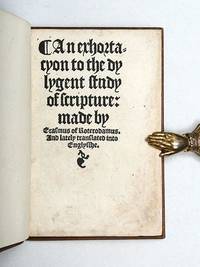
1534ref. 150904London: Robert Wyer c. 1534. Erasmus on reading the Bible in the vernacular Rare English translation of Erasmus's Paraclesis "a cogently argued text in support of the Bible in the vernacular and it is this particular thrust of the work that must have drawn the early English reformers to it since they too like Erasmus spoke eloquently and at length. in support of the Bible in English" Douglas H. Parker. Based on a translation variously attributed to either William Joy or George Joye which was first printed at Antwerp in 1529 this is one of two editions printed for the first time in England in 1534. While the 1529 Antwerp edition had included a translation of Martin Luther's commentary on 1 Corinthians 7 both 1534 editions replace Luther's text with another Erasmus text "An exhortacyon to the study of the Gospell". This is the only copy to have appeared in commerce in the past 45 years. Octavo 135 x 94 mm in two parts. Woodcut opening initials printer's devices McKerrow 67c and 68 69 "dieu et mon droit" woodcut on I8r. Twentieth-century brown pigskin spine lettered in gilt marbled endpapers. Fore-margins restored throughout affecting woodcuts on final leaf and occasional shoulder notes numerous short wormtracks filled some just into text some mostly marginal staining washed still a presentable copy carefully restored of a notably rare book. STC 10494 four copies only: British Library Oxford Huntington and the present copy. unknown
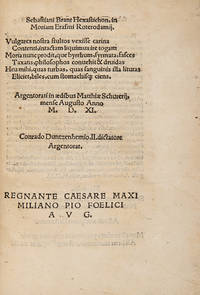
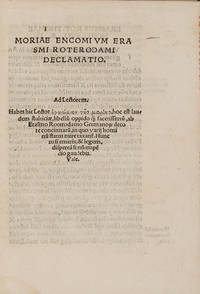
ref. 109061Argentorati Strassburg in aeidibus Matthiae Schurerii August 1511. . Second edition first dated edition; 4to 20.2 x 14.5 cm; dated ownership inscription in pen to title Roman and Greek type lower edge of G1 torn with loss not affecting text slight toning and soiling occasional underlining in ink; 19th-century vellum gilt spine gilt in compartments gilt lettering to second and fifth compartments on black morocco lettering-pieces edges stained red slight warping to upper board light soiling to boards; collation: A8 B4 C8 D4 E8 F4 G-H6 with final blank leaf H6 present ff. The scarce first dated edition of Erasmus' Moriae Encomium an important work of humanist rhetoric which satirised the corruption and religious hypocrisy of Europe's elite. Printed two months after the undated Paris edition by Gilles de Gourmont of which only a handful of copies survive all of them in institutional libraries. The present edition almost as rare is not merely a reprint of the Paris edition but contains additional material including an address and laudatory letter to Erasmus by his fellow humanist Jakob Wimpfeling. All early editions are exceedingly scarce with only three appearing at auction in the last 100 years that we could trace. The first English translation was not published until 1549 although there had been Czech French and German editions prior to this. 'The Praise of Folly was written when Erasmus was staying in the house of Thomas More in the winter of 1509-1510. Its title is a delicate and complimentary play on the name of his host: its subject matter is a brilliant biting satire on the folly to be found in all walks of life. The book stemmed from the decision which Erasmus had taken when he left Rome to come to England that no form of preferment could be obtained at the sacrifice of his freedom to read think and write what he liked The work was first secretly printed in Paris and as in other cases its immediate success safeguarded him from the consequences of his audacity Whenever tyranny or absolute power threatened The Praise of Folly was re-read and reprinted. It is a sign of what was in the air that Milton found it in every hand at Cambridge in 1628. His inherent scepticism has led people to call Erasmus the father of 18th-century rationalism but his rationalist attitude is that of perfect common sense to which tyranny and fanaticism were alike abhorrent' PMM 43. Despite the risky nature of the work and its explicit and implicit attacks on established religion and authority figures of the time its rapid popularity ensured that the author and the work were left unmolested by church and state at least until Erasmus' death in 1536 after which his previously untainted reputation was diminished. By 1559 all of his works had been proscribed under the insidious Index Auctorum et Librorum Prohibitorum. Bezzel 1298; cf. PMM 43; Vander Haeghen 122. Argentorati (Strassburg), in aeidibus Matthiae Schurerii, August 1511. hardcover
ref. 93719Argentorati Strassburg in aeidibus Matthiae Schurerii August 1511. . Second first dated edition; small 4to leaves measuring 19.4 x 13.8 cm; occasional minor coeval underlining and marginalia to earlier part of text very light stain to lower margin at gutter throughout not affecting text bibliographical clippings tipped onto front endpapers; bound in antique style calf; 96pp; A8 B4 C8 D4 E8 F4 G-H6 with the final blank leaf H6 present ff. First dated & earliest procurable edition of Erasmus' 'In Praise of Folly'. The scarce first dated edition of Erasmus' Moriae Encomium an important work of humanist rhetoric which satirised the corruption and religious hypocrisy of Europe's elite. Printed two months after the undated Paris edition by Gilles de Gourmont of which only a handful of copies survive all of them in institutional libraries. The present edition almost as rare is not merely a reprint of the Paris edition but contains additional material including an address and laudatory letter to Erasmus by his fellow humanist Jakob Wimpfeling. All early editions are exceedingly scarce with only three appearing at auction in the last 100 years that we could trace. The first English translation was not published until 1549 although there had been Czech French and German editions prior to this. An excellent example of a classic work of paradoxical satire in which folly is personified and holds up a mirror to mankind. An extremely significant work both in its own right and for its influence on the Protestant Reformation in general. Sir Thomas More's own magnum opus Utopia was at least in part written as a response to Moriae Encomium. 'The Praise of Folly was written when Erasmus was staying in the house of Thomas More in the winter of 150910. Its title is a delicate and complimentary play on the name of his host: its subject matter is a brilliant biting satire on the folly to be found in all walks of life. The book stemmed from the decision which Erasmus had taken when he left Rome to come to England that no form of preferment could be obtained at the sacrifice of his freedom to read think and write what he liked. The work was first secretly printed in Paris and as in other cases its immediate success safeguarded him from the consequences of his audacity. Whenever tyranny or absolute power threatened The Praise of Folly was re-read and reprinted. It is a sign of what was in the air that Milton found it in every hand at Cambridge in 1628. His inherent scepticism has led people to call Erasmus the father of eighteenth-century rationalism but his rationalist attitude is that of perfect common sense to which tyranny and fanaticism were alike abhorrent' PMM 43. Despite the risky nature of the work and its explicit and implicit attacks on established religion and authority figures of the time its rapid popularity ensured that the author and the work were left unmolested by church and state at least until Erasmus' death in 1536 after which his previously untainted reputation was diminished. By 1559 all of his works had been proscribed under the insidious Index Auctorum et Librorum Prohibitorum. We can trace copies in just 12 institutional collections worldwide: 3 in the British Isles BL University of Cambridge and Bodleian Library 2 in France BnF and Université de Strasbourg 43 in the USA Folger Shakespeare Library Harvard University Divinity School and Ohio State University 3 in Germany Staatsbibliothek zu Berlin Universitaet Goettingen and Wurttembergische Landesbibliotherk and 1 in Denmark Det Kgl. Bibliotek. Bezzel 1298; cf.PMM 43; Vander Haeghen 122. Argentorati (Strassburg), in aeidibus Matthiae Schurerii, August 1511. unknown
1549ref. 139476London: Thomas Berthelet 1549. First edition in English of one of the most notable and popular works of the Renaissance which played an important role in the beginnings of the Protestant Reformation and swiftly brought its author international fame. First printing with 'latine' and the printer's initials 'TB.' to the title page. Octavo bound in full crushed levant morocco by Sangorski and Sutcliffe gilt titles and elaborate gilt tooling to the spine in six compartments within raised gilt bands triple gilt ruling to the front and rear panels gilt turn-ins and inner dentelles all edges gilt wide woodcut border to the title page signed TB. woodcut printer's device to the final page. In near fine condition. Early ownership name to the title page and light marginalia. Small leather bookplate of Francis Kettaneh affixed to the verso of the front free endpaper. Exceptionally rare with only two other examples traced at auction in the last 100 years. This famous satire was first conceived on the road from Italy to England composed in the house of Erasmus's friend and the dedicatee Thomas More and then first printed under the Latin title Moriae encomium in Paris in 1511. Begun as a paradoxical joke between the two men who had been translating the ancient humorist Lucian together The Praise of Folly is a remarkable work by turns sharp and gentle—but always playful—in its learned treatment of the follies of the world and vision of a humanist life. “The Praise of Folly was written when Erasmus was staying in the house of Thomas More in the winter of 1509–10. Its title is a delicate and complimentary play on the name of his host: its subject matter is a brilliant biting satire on the folly to be found in all walks of life. The book stemmed from the decision which Erasmus had taken when he left Rome to come to England that no form of preferment could be obtained at the sacrifice of his freedom to read think and write what he liked … The work was first secretly printed in Paris and as in other cases its immediate success safeguarded him from the consequences of his audacity … Whenever tyranny or absolute power threatened The Praise of Folly was re-read and reprinted. It is a sign of what was in the air that Milton found it in every hand at Cambridge in 1628. His inherent scepticism has led people to call Erasmus the father of 18th century rationalism but his rationalist attitude is that of perfect common sense to which tyranny and fanaticism were alike abhorrent” PMM. Upon its initial publication in Paris in 1511 Moriae Encomium was hugely popular to Erasmus' astonishment and sometimes his dismay. Even Erasmus' close friends had been initially skeptical and warned him of possible dangers to himself from thus attacking the established religion. Even Pope Leo X and Cardinal Cisneros are said to have found it amusing. Before Erasmus' death it had already passed into numerous editions and had been translated into Czech French and German. An English edition soon followed translated by English poet and diplomat Sir Thomas Chaloner who was renowned among Elizabethans for his Latin verses and pastoral poems three volumes of which were printed during his lifetime by Thomas Berthelet the king’s printer who had published three translations of works by Erasmus in the 1520s. Thomas Berthelet hardcover