1978ref. 159224Moskva, 1978. M. 1 Portr. 235 S. OPp. Einbd. leicht bestoßen.
1968ref. 1258542Wiesbaden, Harrassowitz, 1968. 20, 460 S. (Kraus Reprint. Zentralblatt für Bibliothekswesen, Beiheft 27). OKart. (Rückensignatur, Stempel verso Titel).
1941ref. V20953München (Georg D.W. Callwey) 1941. 8°, Originalleinen mit Originalumschlag (Hardcover) 253 S., Bildtafeln 1
1790ref. 414338Zürich, Ziegler u. Söhne, 1790. M. gest. Portr. XII, 550 S. Pp. d. Zt. Einbd. etwas beschabt. St. a. Tit.
1936ref. 141081Basel, Braus-Riggenbach, 1936. M. 12 Taf. u. einigen Textabb. 325 S. OKart. Schnitt angeschmutzt.
1971ref. UERAPRA00araAnn Arbor 1971. Very Good. Erasmus Desiderius. The Praise of Folly. Ann Arbor MI: Ann Arbor 1971. 152pp. 8vo. Paperback. Book condition: Very good. Ann Arbor paperback books
1996ref. 215295Berlin Germany: Verlag der Kunst 1996. First edition and first printing. Oblong hardcover. 61 pages. Text in English and German. Features a contribution by Klaus Honnef. Includes numerous color images by Erasmus Schroter. A near fine copy in red cloth boards with some minor wear. No dust jacket as issued. Verlag der Kunst unknown books

ref. 634118 leaves. Small 4to attractive modern marbled boards red morocco lettering piece on spine. Wittenberg: C. Heyden 1619. First edition of this rare book which is considered by A.D.B. to be the author's most important scientific work; it is a careful record of the third of the three bright comets of 1618-19. Schmidt 1570-1637 was "one of the last of the scholars of Germany who taught the language and literature of Greece in the spirit of Melanchthon. Schmidt was professor first of Greek and next of Mathematics at Wittenberg. His principal work was an edition of Pindar with a Latin translation and a careful commentary 1616."-Sandys II p. 272. Fine copy. â§ A.D.B. Vol. 32 pp. 27-28. Zinner 4785. unknown books
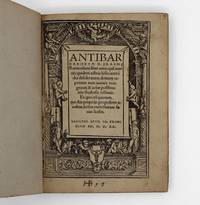
1520ref. 375736Basel: Froben 1520. First edition printed in May. Woodcut borders to title leaf and dedication by Hans Holbein printer's device on last page. 150 2 imprint pp. 4to. Eighteenth-century marbled boards ink label. Some toning to spine. Very good fresh copy. First edition printed in May. Woodcut borders to title leaf and dedication by Hans Holbein printer's device on last page. 150 2 imprint pp. 4to. Ignorantiam esse superbiae matrem. Eruditionem contra modestiam parere. Ignorance is the mother of pride; it is from learning on the contrary that modesty is born. First edition of Antibarbari Erasmus' manifesto "defending the arts against the scruples of the barbarians" Tracy. Erasmus argues for the primacy of poetry among the liberal arts for the importance of critical understanding of the writers of classical antiquity and for appropriating what is good in their work. He is also scornful of rote learning and blind repetition of earlier scholarship where "cuckoo calls to cuckoo". In Petro summus erat ardor fidei in Hieronymino summa doctrina: alterius animum alterius studia imitar. In Peter there was the ardour of faith at its highest; in Jeronme there was learning at its best. It is for you to imitate the spirit if the one and the scholarship of the other. This was a work of very long ripening. Erasmus began the earliest version circa 1490 when he was a newly ordained monk but that manuscript was left behind in his wanderings. Decades later when he came across his earlier work he was at the center of intellectual controversy following publication of of his edition of the New Testament. He revised his Antibarbari to assert the humanist position and Froben published it in May 1520. There were six editions of the work in the early 1520s Froben himself published another edition later the same year and ten editions in his lifetime. "it is ignorance rather than erudtion which makes men insolent" FIRST EDITION OF A KEY WORK BY ERASMUS. VD16 E1997; Valentina Sebastiani Johann Froben Printer of Basel 170; Bibliotheca Erasmiana p. 9; Adams E-463; Bezzel 157. The standard modern text iwith translation by Margaret Mann Phillips˜The Antibarbarians" is in the Toronto Collected Works vol. 23 1978 Froben unknown books
1521ref. 371922Basel: Froben 1521. Titles within ornamental woodcut borders; initials and headpieces throughout. Froben's Printer's device on PP10v. Collation: O-V8; Cc-Hh8 Ii4 Kk-Oo8 Pp10; X8-Bb10. Bound out of order lacking Kk8 blank; X2 is signed "X3". 1 vols. 8vo. Nineteenth century drab paper spine and marbled boards. Armorial bookplate: Ex libris Liechtensteinianis and bookplates of General Theological Seminary. Titles within ornamental woodcut borders; initials and headpieces throughout. Froben's Printer's device on PP10v. Collation: O-V8; Cc-Hh8 Ii4 Kk-Oo8 Pp10; X8-Bb10. Bound out of order lacking Kk8 blank; X2 is signed "X3". 1 vols. 8vo. Shortly after Erasmus' revolutionary edition of the Greek New Testament of 1516 he undertook the Paraphrases intending to "retell" the books of the New Testament in one uninterrupted voice without the clutter of textual commentary or critical interruption. It was a bold undertaking and in 1517 Erasmus began with the letters of Paul. They were first issued separately starting with Romans in 1517; and editions appeared in Louvain Thierry Martens Leipzig Valentin Schumann and Basel Johann Froben. Beginning in 1519 Froben began to publish groups of the Paraphrases and in 1521 a collected edition of all of the Pauline letters. This is a nonce volume containing the latter part of the 1521 Froben edition of the Paraphrases of Erasmus. The first half of the book is not present gatherings a-N comprising the Epistles to the Romans Corinthians Galatians Ephesians Philippians Colossians and Thessalonians. The colophon states the edition was completed in July 1521. Four complete sections with their individual title pages: A Paraphrases in Epistolas Pavli ad Timotheum duas ad Titum unam et ad Philemonem unam. Item In catholicas epistolas Apostolorum Petri duas Unam Iudae Unam Iacobi et Treis Ioannis et ad Hebraeos unam. Per Erasmum Roterodamum. Anno M.D.XXI. B Paraphrases Erasmi Roterodami in epistolas canonicas Unam Iacobi et Treis Ioannis. R. D. D. Matthaeo Cardinali Sedunensi Com. Valesij dedicatae. Woodcut border with date 1520 C In Epistolam ad Hebraeos paraphrasis per Erasmum Roterodamum exterma. R. P. ac D. D. Syluestro episcopo Vuigorniensi dedicatae. D Paraphrases Erasmi Roterodami in epistolas canonicas Duas Petri Unam Iudae Unam Iacobi et Treis Ioannis. Woodcut border with date 1520. Bound out of sequence: this section begins with leaf X1 and has a separate title page although it is a subsection of part B. Any of the lifetime editions of the Paraphrases whether from the spearate printings or the collected edition are rare in the market. VD16 E 3376 Froben unknown books
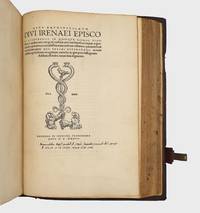
1534ref. 372762Basel: Froben 1534. Third revised Erasmus edition first 1526; second 1528 of Irenaeus' treatise "Against Heresies. Printer's device on titlepage and last page; head-pieces; initials; printed marginalia. 1 vols. Folio. Near contemporary dark calf over wooden boards stamped in blind upper board dated 1545 brass clasps. Headcaps worn one clasp perished. Third revised Erasmus edition first 1526; second 1528 of Irenaeus' treatise "Against Heresies". Printer's device on titlepage and last page; head-pieces; initials; printed marginalia. 1 vols. Folio. Third Erasmus edition of Irenaeus' treatise Against Heresies consisting of five books which are preserved in their entirety only in their Latin version. It is Irenaeus' principal literary work which had a significant impact on the development of the church during the first three centuries. Colophon: Basileae in officina Frobeniana per Hieronymum Frobenium et Nicolaum Episcopium An. M D XXXIIII mense Martio. The work is bound with an extensive commentary on the Gospel of Matthew by Wolgang Musculus 1544. The nicely preserved binding is dated M.D.XLV. 1545 on upper board. VD16 I 318. Provenance: Provenance: title page of Musculus signed: Ludovicus Rabus . 1544 and Iohannes Longlinus . 1550; bookseller's label on front paste-down: G. & B. Westermann Bros. Deutsche Buchhandlung 290 Broadway New-York; Bookplate of Rev. Edwin A. Dalrymple; Maryland Diocesan Library; General Theologiccal Seminary bookplates and stamps Froben unknown books
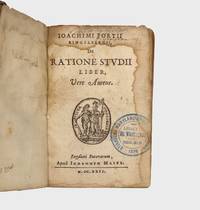
1622ref. 373794Leiden: Joannes Maire 1622. 8 198 pp. 1 vols. 12mo. Contemporary vellum. Worn and soiled some staining to textblock. Good. Owner signature of Thos. Fletcher 1693; H Wragham 1815; Henry D. Gilpin bookplate partly covered; "ex libris G.R.W. 1879" William R. Whittingham. 8 198 pp. 1 vols. 12mo. At the back of this book is the essay by Erasmus De ratione studii pp. 161-198. William R. Whittingham 1805-1879 graduated the General Theological Seminary in 1825 and was named librarian of the newly founded school. He later accepted a position on the faculty in 1836. Whittingham was consecrated the fourth Bishop of Maryland in 1840 and served in that capacity until his death. Bishop Whittingham's important theological library became the core of the Maryland Diocese library which was in turn transferred to the General Theological Seminary. The ownership signature of Bishop Whittingham is dated 1879 a very late acquisition for him. Provenance: William R. Whittingham; Maryland Diocesan Library; General Theological Seminary bookplates and inkstamps Joannes Maire unknown books
1534ref. 372192Basel: Froben 1534. Froben's printer's device on first and last leaf of each work. 415 1; 191 1pp. 8vo. Early half calf and pastepaper boards. Spine ends rubbed front joint cracked but cords holding. Very good. Froben's printer's device on first and last leaf of each work. 415 1; 191 1pp. 8vo. Early Froben edition of a pedagogical work by Erasmus "On the Writing of letters" first published in 1522 with a collection of aphorisms or "Parallels" gathered out of Plutarch's Moralia Seneca Lucian Xenophon Demosthenes Aristotle Pliny and Theophrastus. An edition was published in Cologne in the same year and the work was a standard throughout the sixteenth century. VD16 E2515 E3257. Provenance: Princes of Liechtenstein armorial bookplate; General Theological Seminary bookplate Froben unknown books
1843ref. 353481London: William Pickering. Frankfurt o/M. Jaeger's Library 1843. With engraved plate of the forms of Runes at end. viii 272 2 corrigenda & runes pp. 1 vols. 8vo. Later green cloth with the original green printed wrappers bound in. With engraved plate of the forms of Runes at end. viii 272 2 corrigenda & runes pp. 1 vols. 8vo. Uncommon Pickering title printed in Germany and a notable milestone in Icelandic scholarship by this dfamous Danish scholar and philologist. Not in Keynes; See PMM 266 William Pickering. Frankfurt o/M., Jaeger's Library unknown books
1877ref. 464591877. Autograph note signed to Thomas Madden Stone fl. 1838-82. 1 page on the blank leaf of Stone's letter to him. London 17 December 1877 both letter and note. 186 x 116 mm. A few minor spots but fine otherwise. From Erasmus Wilson one of the leading British dermatologists of the nineteenth century see Garrison-Morton.com 9921 who founded the chair and museum of dermatology at the Royal College of Surgeons; he also paid for the vast medical library at the RCS's Hunterian Museum. His correspondent Thomas M. Stone was the librarian at the RCS. Stone had sent Wilson "two Catalogues of the Autograph Sales where you will find the remainder of the Hunters which you told me to purchase for you. Let me know what to give per letter or will you leave it to me!!!" Wilson replied: "By all means leave it to you; you cannot fail to please; I will end as I began 'Buy all'." In a punning postscript Wilson wondered "if your autographs and music will ever fetch money-Not a bad mint not Badminton if they did." . unknown books
1757ref. 310656Frankfurt: J.A. Raspe 1757. Illustrated with 12 engraved portraits. 8 373; 2 448 pp. 8vo. Later vellum. Faint browning a nice copy. Illustrated with 12 engraved portraits. 8 373; 2 448 pp. 8vo. Later edition of this famous collection of humanist satirical letters illustrated with 12 full-page portraits of prominent humanists. A note in OCLC comments on the long running authorship debate: "Authorship of the Epistolae formerly attributed to Reuchlin Erasmus Hutten and others. More recent researches have made it almost certain that Crotus Rubeanus and Ulrich von Hutten were the main contributors. To Crotus are credited the first 41 letters: to Hutten the 7 letters added later to the original series and most of the 62 letters of the second series with the possible co-operation of a third person Hermann von dem Busche. The authorship of the rest remains doubtful J.A. Raspe unknown books
1791ref. 43999London: J. Johnson 1791. Darwin Erasmus 1731-1802. The botanic garden: A poem in two parts . . . 4to. xii 214 126 2; 2 ix 197 1pp. General title-leaf misbound before title-leaf to Part II. 20 engraved plates including 5 by William Blake 1757-1827; 2 of the plates are after drawings by John Henry Fuseli 1741-1825. London: J. Johnson 1791. 275 x 207 mm. Half calf gilt marbled boards in period style. Minor foxing and offsetting small marginal stains on two or three plates not affecting the images marginal tears in signature S and one plate repaired but very good. First Edition of Part I; third edition of Part II containing two more plates than the first edition of 1789. Darwin's first major literary work and the chief source of his fame during his lifetime. "The Botanic Garden an annotated scientific poem in Augustan couplets appeared in two parts of which the second The Loves of the Plants 1789 was published before the first The Economy of Vegetation 1791. Darwin decided to publish the second part of the work first because it was better suited 'to entertain and charm.' The first part of the work is more ambitious than the second covering all natural philosophy and embodying many of the researches and inventions of Wedgwood Watt Boulton and others. The design of the totality was Darwin wrote 'To enlist Imagination under the banner of Science . . . to induce the ingenious to cultivate the knowledge of botany . . . and recommending to their attention the immortal works of the celebrated Swedish naturalist-Linnaeus'" Dictionary of Scientific Biography. The Botanic Garden is also important for the five plates in Vol. I engraved by William Blake: four engravings of the Portland vase and the "Fertilization of Egypt" after a design by Fuseli. Keynes Blake 103. King-Hele Erasmus Darwin pp. 97-119. . J. Johnson unknown books
1520ref. 253908Basel: Johann Froben 1520. First collected editions. Titles within ornamental woodcut border initials printer's device in colophon. 465 i.e. 495 1; 167 1; and 141 3 pp. 1 vols. 8vo. Contemporary blindstamped pigskin over wooden boards spine in four compartments with raised bands over doubled cords ruled in blind and crossed floral ornaments boards tooled with floral borders about a central field edges ochre. Covers somewhat soiled one brass clasp missing upper joint just starting but quite firm; internally a SUPERB near flawless copy. Bookplate and ownership signature of scholar and author Nathan Comfort Starr. First collected editions. Titles within ornamental woodcut border initials printer's device in colophon. 465 i.e. 495 1; 167 1; and 141 3 pp. 1 vols. 8vo. First collected editions of these "Paraphrases" of the letters of Paul which were undertaken shortly after Erasmus's revolutionary edition of the Greek New Testament of 1516. As part of that monumental reconstruction of the New Testament Erasmus' intention was to "retell" the books of the New Testament in one uninterrupted voice without the clutter of textual commentary or critical interruption. It was a bold undertaking and in 1517 Erasmus began with the letters of Paul. They were first issued separately starting with Romans in 1517; and editions appeared in Louvain Thierry Martens Leipzig Valentin Schumann and Basel Johann Froben. The collected issues - such as the three which are bound together in this exquisite volume - began to be issued in Basel by Froben in 1519; and finally in 1521 Froben issued a collected edition of all of the Pauline letters. All of the lifetime editions both separate and collected are rare on the market; this copy is in a well preserved contemporary pigskin binding first binding. Adams E790; E792; E791; VD16 E 3060; E 3324; E 3328 Johann Froben unknown books
ref. 41242Margin: 75x44 mm. All sides trimmed. unknown books
1795ref. 41603London: J. Sewell 1795. Plate: 186x110 mm. Margin: 223x131 mm. Light soiling faint foxing edges trimmed. J. Sewell unknown books
ref. 41602Margin: 220x142 mm. Very minor tearing in bottom margin faint foxing. unknown books
1804ref. 41039London 1804. 468 x 376 mm. image size 282 x 241 mm. excluding caption. A few small marginal tears faint crease in lower margin but very good. Fine portrait of physician / naturalist Erasmus Darwin grandfather of Charles who himself included a statement of evolution in his poem "The Botanic Garden." The portrait was engraved by J. Heath after the portrait by James Rawlinson 1769-1848. unknown books
1745ref. 37491a Amsterdam: chez Francois l'Honore 1745. 6 folding plates 74 wood engravings. xxiv 340 20. 1 vols. 12mo. Full tan contemporary continental calf. some minor loss. Holbein Hans. 6 folding plates 74 wood engravings. xxiv 340 20. 1 vols. 12mo. This translation of Ersasmus's "In Praise of Folly is the most popular french translation by Nicolas Guedeville c. 1654-1721. The plates after Holbein 1497-1543 are equally famous. Probably a counterfeit imprint Biblio Eras. VII 1908 p. 166 or Lewine p. 170 chez Francois l'Honore unknown books
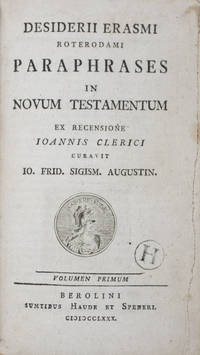
1780ref. 43177Berolini Berlin: Haude et Speneri 1780. Later edition. Hardcover. vg. Octavo 8 1/2 x 5". xxxvi 546pp Vol. 1; xxii 398pp Vol. 2; xliv 399-995 1pp. Modern full black cloth with gold lettering to spines. Title vignettes. Originally published in 1548 "Paraphrases in Novum Testamentum" were composed between May 1517 and January1524. They consist of a series of commentaries on every book of the New Testament except "Apocalypse" a book for which Erasmus had no great regard. The Paraphrases were successful beyond expectation and were quickly translated into French German English and other languages. Modern endpapers and fly leaves. Small letter "H" stamped on title pages of first and third volumes. Text in Latin. Bindings and interior in overall very good condition. The publication history of the "Paraphrases" is complicated. Erasmus began with the Pauline Epistles. The paraphrase of Romans was published in quarto by Dirk Martens in Louvain in November 1517 and reprinted by Erasmus's friend Johann Froben in January of the following year; it sold well and was soon reprinted in octavo. Corinthians was published by Martens in February 1519 and reprinted in Basel by Froben in March; Galatians appeared later that year with editions from both publishers. The remaining Epistles followed in 1520 and 1521 the last to appear being Hebrews. In the autumn of 1521 Erasmus moved from Louvain to Basel and from that time Froben published the first editions of the remaining Paraphrases. Erasmus now turned to the Gospels Matthew appearing in March 1522 in both folio and octavo - from now on there are no more quartos John in February folio and March octavo 1523 Luke in August 1523 and Mark in early 1524 with a title page dated 1523. Acts followed quickly the dedication copy being dated February 13 1524. Froben published a complete edition in two volumes the first "a stout octavo volume of 400 leaves dated 1523 and called Tomus secundus" contained the Epistles and the Tomus primus containing the Gospels and Acts appeared the following year. "This was a considerable investment and the firm kept it in their list for ten years" resetting portions as needed without a change of date. The Paraphrases were reissued in various formats and combinations during the following decades; Roger Mynors writes: "When one is faced with one of these editions in folio one has to remember that a purchaser would see them as composed of separable parts out of which sets could be made up in any way that supply might dictate." For more information see: R.A.B. Mynors "The Publication of the Latin Paraphrases" in Robert Dick Sider ed. New Testament Scholarship: Paraphrases on Romans and Galatians Collected Works of Erasmus University of Toronto Press 1984 pp. xx-xxix. About the author: Desiderius Erasmus Roterodamus 1466-1536 known as Erasmus or Erasmus of Rotterdam was a Dutch Renaissance humanist Catholic priest social critic teacher and theologian. Erasmus was a classical scholar and wrote in a pure Latin style. Among humanists he enjoyed the sobriquet "Prince of the Humanists" and has been called "the crowning glory of the Christian humanists." Using humanist techniques for working on texts he prepared important new Latin and Greek editions of the New Testament which raised questions that would be influential in the Protestant Reformation and Catholic Counter-Reformation. He also wrote On Free Will The Praise of Folly Handbook of a Christian Knight On Civility in Children Copia: Foundations of the Abundant Style Julius Exclusus and many other works. From Wikipedia. Haude et Speneri hardcover books
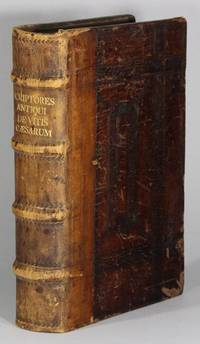
1546ref. 73674Basileae: Per Hieronymvm Frobenivm et Nic. Episcopivm 1546. Folio leaf 32.0 cm pp. 20 810 70; printer's woodcut device on title page and verso of last leaf; woodcut initials some historiated and ornaments; contemporary paneled calf over wooden boards sometime rebacked to match paneled spine in 5 compartments gilt-lettered direct in 1; clasps perished the whole rubbed and worn but the binding is sound and the text clean. Includes blank leaves Q8 and Xx6. Beginning with Suetonius's biographies of the Caesars and Roman emperors this volume brings together numerous "Historiae augustae scriptores" - the title of the first edition of the anthology published in Milan in 1475. A Venetian reprint of 1489 was followed in 1516 by a "nouvelle revision du texte" Graesse by the humanist scholar Giovanni Battista Egnazio and again in 1518 with a further revision by Erasmus. Added to this edition are the two books of Velleius Paterculus. Adams C 91. Graesse III 303. [Per Hieronymvm Frobenivm et Nic. Episcopivm] unknown books