Erasmus Darwin KeyesBiblio.com

4.791 resultados
ref. B9781163477625New. unknown
ref. B9781166335793New. unknown
ref. B9781168201133New. unknown
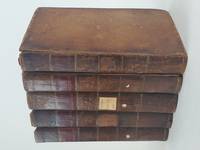
1774ref. 1359545London: J.ohn Murray 1774; 1776; 1778; 1783. Mixed Editions. Hardcover. Octavos iii-iv 5-458 Vol. 1; 2 iii-x 11-484 Vol. 4; 2 5-521 Vol. 5; 4 vii-xii 464 Vol. 7; iii-xii iii-v 7-457 Vol. 8. Good; all bound in contemporary leather with burgundy spine labels with gilt titling modern stickers added to three of the five volumes' spines some scratches and surface marks to covers and slight tears to spine edges and corners; front hinges to all volumes somewhat compromised but bindings else tight; text blocks age toned but clean; minor age toning to pages and some foxing throughout all volumes; ffeps torn out of Vol. 4; previous owner bookplate on front pastedowns "John Fletcher;" MF consignment. Volume I Parts 1-4 1774 Volume IV Parts 1-4 1776 Volume V Parts 1-4 1778 Volume VII 1783 2nd Edition Volume VIII 1783. 1359545. Special Collections. J.[ohn] Murray hardcover
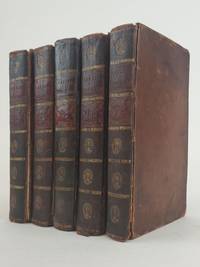
1774ref. 1359551London: J.ohn Murray 1774; 1775; 1777; 1779. Mixed Editions. Hardcover. Octavos iii-iv 5-458 Vol. 1; 2 iii-x 11-484 Vol. 4; 2 5-521 Vol. 5; 4 vii-xii 464 Vol. 7; iii-xii iii-v 7-457 Vol. 8. Good; all bound in contemporary leather with burgundy spine labels with gilt titling modern stickers added to three of the five volumes' spines some scratches and surface marks to covers and slight tears to spine edges and corners culaccino coffee ring on cover of Vol. 3; front hinges to all volumes somewhat compromised but bindings else tight; text blocks age toned but clean; minor age toning to pages and some foxing throughout all volumes; ffeps torn out of Vol. 4; previous owner bookplate on front pastedowns "John Fletcher;" MF consignment. Volume 1 Parts 1-4 1774 2nd Volume 2 Parts 1-4 1774 2nd Volume 3 Parts 1-4 1775 Volume 5 Parts 1-4 1777 Volume 6 Parts 1-4 1779 . 1359551. Special Collections. J.[ohn] Murray hardcover
ref. B9781169714731New. unknown
1940ref. 9788New York: Frederick A. Stokes Company 1940. Cloth. Very Good/No Jacket. Rose Carl. Black cloth binding. Spine slightly cocked to the right some very minor shelf-wear. Book itself in excellent condition. Frederick A. Stokes Company hardcover
1995ref. L3 box749 b6Erasmus von Rotterdam: Ausgewählte Schriften / Werke Sonderausgabe Acht Bänden. Lateinisch und Deutsch. Complete 8 Volumes in Latin and German. Herausgegeben von Werner Welzig. Dieser Sonderausgabe 1995 liegt die 1 2; 1967-1980 Wissenschaftlich Buchgesellschaft Darmstadt. Paperback complete 8 volumes total 4212 pp. Dieser Sonderausgabe 1995 liegt die 1, 2; 1967-1980 Wissenschaftlich Buchgesellschaft, Darmstadt. paperback
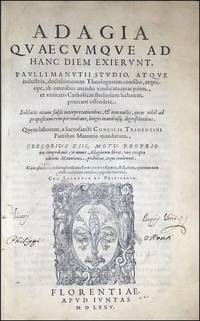
1575ref. 72FINE AND IMPORTANT ALDINE EDITION OF ERASMUS ADAGESErasmus Roterodamus. Adagia quaecumque ad hanc diem exierunt Paulli Manutii studio atque industria . ab omnibus mendis vindicata quae pium et veritatis Catholicae studiosum lectorem poterant offendere: sublatis etiam falsis interpretationibus & nonnullis . digressionibus. Quem laborem a sacrosanti Concilii Tridentini patribus Manutio mandatum Gregorius 13. motu proprio ita comprobauit vt omnes Adagiorum libros vna excepta editione Manutiana prohibeat atque condemnet. Cum plurimis ac locupletissimis indicibus Graecis & Latinis quorum nonnulli nusquam antheac impressi fuerunt. Florentiae apud Iuntas MDLXXV Florence Giunti for the Aldine Press 1575.2° later limp cartonnage handwritten title and library label at spine ff. 4 columns 1454 i.e.1440 ff. 36.Giunti device at title and final leaves. Woodcut headletters. Text in Latin on two columns with some passages in Greek.Aldus Manutius' dedicatory to pope Gregory XIII.Fine and important edition revised by Aldus Manutius the Younger of the renowned collection of Latin and Greek adages sayings proverbs mottos epygrams compiled by Erasmus.Paul Manutius was commissioned by the Fathers of the Council of Trent to correct the work reorder purge by false interpretations and doctrinal errors in order to make this edition the only one approved by the Church the bull of Gregory XIII as stated in the title prohibits and condemns the other editions.Desiderius Erasmus Roterodamus 1466 – 1536 known as Erasmus of Rotterdam or simply Erasmus was a Dutch Renaissance humanist Catholic priest social critic teacher and theologian.Amongst humanists he enjoyed the sobriquet "Prince of the Humanists"; he has been called "the crowning glory of the Christian humanists". Using humanist techniques for working on texts he prepared important new Latin and Greek editions of the New Testament. These raised questions that would be influential in the Protestant Reformation and Catholic Counter-Reformation.Provenance: Ownership signature Philippi Monti at title-page beside the printer device.References: Renouard 220. 14. STC Italian 236; Adams E-443. BMC 236. CNCE 18245 & 18247. Giunti for the Aldine Press paperback
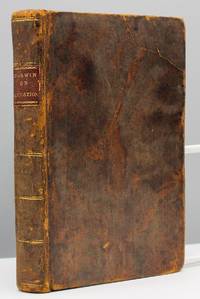
1798ref. 17365Philadelphia: Printed by John Omrod 1798 First American edition of this educational classic that shows the influence of Rousseau on the work of Erasmus Darwin 1731 – 1802. First published in London the previous year. Included in this edition is an American printing of Mrs. M. Peddle's Rudiments of Taste a popular conduct book was first published in London in 1789 and in the United States in 1790. Contemporary tree sheep with red morocco spine label. Gilt-ruled spine. Twelvemo. Separate title-page for Mrs. M. Peddle's The Rudiments of Taste. Some wear to binding and a couple cracks to sheep on upper board. Quite a fresh copy despite some foxing to first few leaves and some slight toning throughout. A very good tight copy of a fragile book. Darwin wrote the present work after helping his daughters Susan and Mary Parker establish a boarding school for young women in 1794. Here he draws on the theories of Rousseau Locke and Genlis to advocate for the education of women in schools in topics like philosophy the natural sciences history art manufacturing and language. Darwin believed that women should be educated for the purpose of becoming better wives and companions to men but promoted progressive notions that women's education would take place in well-resourced schools rather than in the home and that women should be educated in the concepts of finance industry and manufacturing. In Peddle's The Rudiments of Taste "Classical influence blends with Christian…Peddle recommends reading ancient and modern history travels biography science and good poetry not novels which leave their readers incapable of 'relishing anything superior'" Blain Grundy and Clements eds. The Feminist Companion to Literature in English p. 841. Printed by John Omrod,
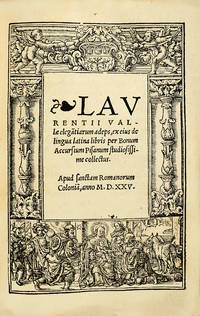
ref. TBF4Argentorati Iohannem Heruagium 1525. Followed by: Erasmus.De octo orationis partium constructione libellus tum elegans imprimis tum dilucida brevitate copiosissimus. Erasmo roterodamo autore. At the end "Augustae Vindelicorum in officina D. Sigismum Grim 11 Aout Anno 1523." Followed by: Valla.Laurentii vallae elegatiarum adeps exeius de lingua latina libris per Bonum Accursium Pisanum studiosissime collectus. Les élégances de la langue latine. Apud Sanctam Romanorum Colonia 1525. In total three texts bound in one 8vo volume 148 x 100 mm of: I/ 184 ll. the last one blank; II/ 28 ll. ; III/ 1 title-page 148 pp. 10 pp. of index 1 bl.p. Numerous handwritten notes on the last 2 ll. of the 1st text. Bound in blind-stamped pigskin over wooden boards brass clasps. Contemporary binding. Collection in quite rare and very early editions of 3 important founding works of the Renaissance in philology and grammar by Erasmus and by his master Laurent Valla. Laurent Valla "the greatest humanist of the first half of the 15th century" was born in Rome around 1407. Guilio Vallese. "Deeply convinced of the superiority of the antique culture renewed at the time in which he saw an incomparable ferment of regeneration Valla in order to defend it didn't hesitate to take the chance of being condemned in front of the Inquisition court. As other humanists of this time he claimed to be of the rationalist moral antique transmitted in the books of Wisdom when the Middle Ages had impoverished or lost the very meaning of it." Valla's most famous treatise "Des élégances de la langue latine"that had most contributed to his reputation in six books was quickly given in every school and kept on being a teaching text for the greatest part of the 16th century. Erasmus who professes many times in his letters a vivacious admiration for the author and for this particular work had made in his youth an extract for his personal use which was printed twice without his consent. Valla's observations are about the value of certain forms of words about the value of several difficult terms and even more about the synonymy of the Latin language. This work proves a great sagacity of researches and a great judgment. "King Alphonse who really liked this kind of studies didn't get tired of hearing Valla and let him sometimes battling with Antoine de Parlerme "inde ivae". He gave him a diploma enriched with a golden speech bubble in which he declared him illustrious in almost every science as well as in poetics." Are joined to this major work of Valla the two great founding texts it inspired to Erasmus: -The first oneDe Conscribendis epistolis in the second edition from Strasbourg of 1525. It was such a success that it was after this one reprinted 77 times in the 16th century alone. -The second one De Constructione octo partium orationis libellus printed for the first time in 1514 is here in the edition printed on August 11th 1523 at Sigismon Grim. It was followed by 61 editions in the 16th century alone. A magnificent copy with wide margins preserved in its first blind-stamped binding; the clasps and ties are intact. It comes from the collections Jacob Campana andGaspar Campana and bears these two handwritten ex-libris "Jacobi Campanae et Amicorum 1530" and "Gaspari Campanae et Amicorum". The Campanas illustrious Neapolitan family counted César Campana among their members a fine erudite from the 16th century. Français Argentorati Iohannem Heruagium 1525. Suivi de : Erasme. De octo orationis partium constructione libellus tum elegans imprimis tum dilucida brevitate copiosissimus. Erasmo roterodamo autore. A la fin " Augustae Vindelicorum in officina D. Sigismum Grim 11 Aout Anno 1523. " Suivi de : Valla. Laurentii vallae elegatiarum adeps exeius de lingua latina libris per Bonum Accursium Pisanum studiosissime collectus. Les élégances de la langue latine. Apud Sanctam Romanorum Colonia 1525. Soit trois textes reliés en un volume in-8 de I/ 184 ff. le dernier blanc ; II/ 28 ff. ; III/ 1 p. de titre 148 pp. 10 pp. d'index 1 p.bl. Nombreuses annotations manuscrites sur les 2 derniers ff. du 1er texte. Relié en peau de truie estampée à froid sur ais de bois dos à nerfs attaches et fermoirs de laiton. Reliure de l'époque. 148 x 100 mm. Réunion en éditions fort rares et très précoces de trois grands textes fondateurs de la Renaissance en philologie et grammaire d'Erasme et de son maître Laurent Valla. Laurent Valla " le plus grand humaniste de la première moitié du XVe siècle " naquit à Rome vers 1407. Guilio Vallese. " Profondément convaincu de la supériorité de la culture antique alors renaissante dans laquelle il voyait un ferment incomparable de régénération Valla pour la défendre n'hésita pas à courir le risque d'une condamnation devant le tribunal de l'Inquisition. Comme d'autres humanistes de ce temps il se réclamait de l'antique morale rationaliste transmise dans les livres de la Sagesse dont le Moyen Age avait appauvri ou perdu la signification même. " Le traité le plus célèbre de Valla qui avait le plus contribué à sa réputation" Des élégances de la langue latine " en six livres se répandit rapidement dans toutes les écoles et continua de faire texte d'enseignement pendant la plus grande partie du XVIe siècle. Erasme qui professe en beaucoup d'endroits de ses lettres une vive admiration pour l'auteur et pour cet ouvrage en particulier en avait fait dans sa jeunesse un extrait pour son usage qui fut imprimé deux fois sans son consentement. Les observations de Valla portent sur la valeur de certaines formes de mots sur celle de plusieurs termes difficiles et plus encore sur les synonymies de la langue latine. Ce travail atteste une grande sagacité de recherches et un rare discernement. " Le roi Alphonse auquel ce genre d'études plaisait singulièrement ne se lassait pas d'entendre Valla et le mettait quelquefois aux prises avec Antoine de Parlerme " inde ivae ". Il lui donna un diplôme enrichi d'une bulle d'or dans laquelle il le déclarait illustre en presque toutes les sciences ainsi qu'en la poétique. " Sont joints à cette œuvre phare de Valla les deux grands textes fondateurs qu'elle inspire à Erasme : -Le premierDe Conscribendis epistolis dans la seconde édition strasbourgeoise de 1525. Son succès fut tel qu'elle fut après celle-ci réimprimée 77 fois pour le seul XVIe siècle. -Le second texteDe Constructione octo partium orationis libellus imprimé pour la première fois en 1514 est ici dans l'édition achevée d'imprimer le 11 août 1523 chez Sigismon Grim. Elle fut suivie de 61 éditions pour le seul XVIe siècle. Magnifique exemplaire à belles marges conservé dans sa première reliure estampée à froid dont les fermoirs et les attaches sont conservés intacts. Il provient des bibliothèques Jacob Campanaet Gaspar Campana et porte ces deux ex-libris manuscrits " Jacobi Campanae et Amicorum 1530 " et " Gaspari Campanae et Amicorum ". Les Campana illustre famille napolitaine comptèrent parmi leurs membres César Campana fin lettré du XVIe siècle. hardcover
1966ref. 013803Pretoria: Departement van Inligting 1966. Hardcover. Very Good. Robust archival binding. Complete year's issues with occasional rubber stamps. Wraps included. Red boards. Extremely heavy. Afrikaans version. Departement van Inligting hardcover
1967ref. 013801Pretoria: Departement van Inligting 1967. Hardcover. Very Good. Robust archival binding. Year's issues complete. Wraps included. Red boards. Extremely heavy. Afrikaans version. Departement van Inligting hardcover
2005ref. 007322Bedfordshire: Bright Pen 2005. 1st Edition. Soft cover. Fine. 125pp. unblemished. Bright Pen paperback
ref. 003463Hardcover. Very Good/No Jacket. Ex-lib with usual stamps etc. mainly to ffep and front pastedown. Gilt to upper board and spine. 410pp unmarked except for some neat light pencil underlining to p. 2. 200 x 260mm glossy paper with full-page b/w photos. Heavy book. hardcover
ref. 010828Author. Hardcover. Fine. Signed by Authors. Gift inscrip and signed by author to ffep dd 3 Dec 2002. Blue skivertex boards clean and undamaged. 81pp. A4 with numerous tipped in illus. some with handwritten captions. Autobiographical account of medical practice in Fraserburg SWA Windhoek Rundu Caprivi Namaqualand and Malmesbury. Presumably no more than a handful of copies were produced. Author hardcover
ref. 0086981st Edition. Hardcover. Very Good/Good. Plastic protected dw intact but worn chapped and creased at edges. 410pp. illus. Signature of Piet 'Skiet' Rudolph to ffep o/w unmarked. Boards clean sl. bumped at bottom outer corners. Gilt device to upper board and gilt titling still vibrant. Heavy at 1.6kg. hardcover
1979ref. 006546Pretoria: Republic of South Africa 1979. Soft cover. Very Good. RP 113/1978. 1020 copies printed. Prev owner's signature to front with a couple of small blemishes. Sl. bump to top outer corner. Mild vertical crease to back wrap also affecting last few leaves. Developing crack at pp. 98/9. Bit of very light foxing to endpapers at back. 103pp A4 unmarked. Landmark apartheid history document. Very scarce. Republic of South Africa paperback
ref. 0089871st Edition. Hardcover. Very Good/Good. Boards clean and undamaged. The dw is shelfworn and rubbed along the edges and at the corners. 410pp. illus. No markings. Heavy book. hardcover
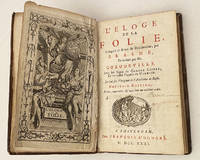
1731ref. bb_erasmus_eloge_folieErasmus Desiderius of Rotterdam: L'Eloge de la Folie In Praise of Folly … traduit par Mr. Gueudeville. Amsterdam: Francois L'Honore 1731. Engraved frontispiece partially wrinkled and detached also portrait with Erasmus Sir Thomas More and Hans Holbein six folding plates and 75 text engravings. These are the same copperplates as used in the first "counterfeit" edition of 1713/1714. Tall 12mo xxiv 234 pp. xvii index; vintage mottled calf gilt-titled label on spine. In 1509 Erasmus composed his famous essay as a satirical attack on superstitions and other unconventional traditions in European society. Since its inception it has been considered one of the most important works of the Renaissance and helped develop early stages of the Protestant Reformation. Erasmus uses satire to examine doctrine and corruption within the Catholic Church even though he was devoted deeply to Catholicism. He concludes with statements supporting Christian Protestantism and frequently references Greek mythological creatures and figures. Early printing of this popular translation from Latin into French. Francois l'Honore hardcover
1754ref. 016211Amsterdam: Jacob Wetstein 1754. Good. 32mo - over 4" - 5" tall. 524 4. Latin text. Engraved title page. His Coloquia Familaria was a collection of his satirical and sometimes biting criticism of the religious and cultural mores of the time. There is a four page biography of Erasmus. This was one of the most popular works of Erasmus in the 18th Century. Jacob Wetstein unknown
1857ref. mon0003139566Blanchard & Lea 1857. Hardcover. Acceptable. . Moderate shelf and edge wear. Pages are splitting but remain intact. Pages are tanning. Blanchard & Lea hardcover
1940ref. HUM0189New York: Frederick A. Stokes. Very Good with no dust jacket. 1940. First Edition. Hardcover. 107 pp. Illus. Spine corners bumped. Black cloth boards red lettering. Text is clean and unmarked. Illustrations by Carl Rose. Written as criticism of Mortimer Adler's work 'How to Read a Book' this volume provides a comic parody of the work. It iopens with the line "for readers who cannot think" and includes chapters on "How to Read in Bed" "Catching on from the Title" and its own list of the Great Books including the Sears Roebuck Catalog and the Telephone Directory. ; 8vo 8" - 9" tall . Frederick A. Stokes hardcover