DARWIN, ErasmusBiblio.com
4.806 resultados
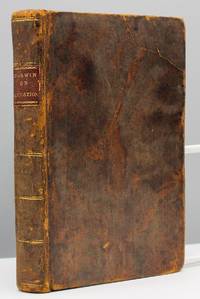
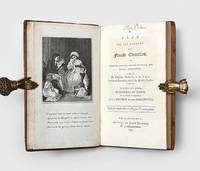
1798ref. 167893Philadelphia: Printed by John Ormrod 1798. A "determined stand against the nearly universal belief that women ought to be feather-brained and feeble-bodied" First American edition of Darwin's treatise on the education of women presented here in a well-preserved contemporary binding. This copy's title page is signed in a contemporary hand by one "Eliza Phelan". Although Darwin ultimately sought to educate women so as to make them useful companions for men his was a more equal "different but complementary" conception of the male-female relationship than was commonly held ODNB. The Plan advocated the creation of dedicated schools for girls where such subjects as botany and experimental philosophy would be taught. "In retrospect the most important feature of the book is his determined stand against the nearly universal belief that women ought to be feather-brained and feeble-bodied. He was taking the first crucial step along the path that has led to sexual equality and feminism" King-Hele p. 284. Darwin wrote from the start with practical applications in mind: the work originated as advice to his two illegitimate daughters for whom he had bought a converted inn to run as a school for girls. It is perhaps for this reason that the work has been described as "the most appealing of Darwin's prose publications" ibid. p. 282. The Plan was originally published in Derby in 1797: the US edition was published a year later with Darwin's slender tract bound with the unrelated Rudiments of Taste a work which had been published several times before in Philadelphia and London over the previous decade. Duodecimo 168 x 99 mm. Engraved frontispiece numerous engraved head and tailpieces in the text. Contemporary speckled sheep smooth spine ruled in gilt forming 5 compartments red morocco label to second. Late 19th-century book label of one "Jean Rouche" to front pastedown. Small hole to foot of spine very light bumping and wear to extremities small ink stain to p. 38 over text without affecting legibility slight separation within gatherings I-N: a very good copy. ESTC W27662. Desmond King-Hele Erasmus Darwin: a Life of Unequalled Achievement 1999. unknown
ref. 0548897425.Gpaperback. Good. Access codes and supplements are not guaranteed with used items. May be an ex-library book. paperback
ref. 1164180347.Gpaperback. Good. Access codes and supplements are not guaranteed with used items. May be an ex-library book. paperback
ref. 1340378531.Ghardcover. Good. Access codes and supplements are not guaranteed with used items. May be an ex-library book. hardcover
ref. 1436644879.Ghardcover. Good. Access codes and supplements are not guaranteed with used items. May be an ex-library book. hardcover
ref. 1379548640.Ghardcover. Good. Access codes and supplements are not guaranteed with used items. May be an ex-library book. hardcover
1798ref. 17365Philadelphia: Printed by John Omrod 1798 First American edition of this educational classic that shows the influence of Rousseau on the work of Erasmus Darwin 1731 – 1802. First published in London the previous year. Included in this edition is an American printing of Mrs. M. Peddle's Rudiments of Taste a popular conduct book was first published in London in 1789 and in the United States in 1790. Contemporary tree sheep with red morocco spine label. Gilt-ruled spine. Twelvemo. Separate title-page for Mrs. M. Peddle's The Rudiments of Taste. Some wear to binding and a couple cracks to sheep on upper board. Quite a fresh copy despite some foxing to first few leaves and some slight toning throughout. A very good tight copy of a fragile book. Darwin wrote the present work after helping his daughters Susan and Mary Parker establish a boarding school for young women in 1794. Here he draws on the theories of Rousseau Locke and Genlis to advocate for the education of women in schools in topics like philosophy the natural sciences history art manufacturing and language. Darwin believed that women should be educated for the purpose of becoming better wives and companions to men but promoted progressive notions that women's education would take place in well-resourced schools rather than in the home and that women should be educated in the concepts of finance industry and manufacturing. In Peddle's The Rudiments of Taste "Classical influence blends with Christian…Peddle recommends reading ancient and modern history travels biography science and good poetry not novels which leave their readers incapable of 'relishing anything superior'" Blain Grundy and Clements eds. The Feminist Companion to Literature in English p. 841. Printed by John Omrod,
2001ref. mon0002974221Woodstock Books 2001-03-01. Hardcover. Good. 0.7900 11.1000 8.4300. Woodstock Books hardcover
1797ref. 1978Derby: J. Drewry 1797. First edition. Contemporary quarter calf over marbled boards; spine ruled in gilt with red morocco label; all edges dyed yellow. Boards and spine rubbed; some chipping along edges. Original stab holes visible in gutter margins. Previous owner's bookplate on front pastedown; ink signature of Mary Wolley to front free endpaper; light foxing. Quarto collates complete with half title and engraved frontispiece: viii 9-128. Bound with: Fosbrooke T.D. The Economy of Monastic Life. Glocester: Printed by R. Raikes 1792. First edition dedicated to Edward Jenner who is also listed as a subscriber. Internally a copy in excellent condition. The grandfather of the illustrious Charles Darwin Erasmus Darwin wrote this treatise on the education of young women to support his own daughters' school at Ashbourne. Darwin's treatise takes a comprehensive view of women's education suggesting that it should reach beyond social skills such as the "perpetual appearance of attention" polite dancing and flattering dress and into formal intellectual pursuits including literature history mathematics and the natural sciences. While he promoted women's education in part to improve the likelihood of companionate marriages Darwin's text tentatively acknowledges that a marital partnership can only function happily when both parties have an intelligent understanding of the world and the ability to participate in it. "A radical campaigner for equality he condemned slavery supported female education and opposed conventional Christian ideas on creation" Farra. With a bookplate from the library of the Wolley family this particular copy has the ownership signature of female reader Mary Wolley. J. Drewry unknown
2008ref. DADAX1436644879Kessinger Publishing 2008-06-02. hardcover. New. 6.00x0.81x9.00. Buy with confidence. Excellent Customer Service & Return policy. Kessinger Publishing hardcover
2008ref. SONG0548897425Kessinger Publishing 2008-02-21. paperback. Used: Good. 6.00x0.68x9.00. Buy with confidence. Excellent Customer Service & Return policy. Kessinger Publishing paperback
ref. 0428572294.Ghardcover. Good. Access codes and supplements are not guaranteed with used items. May be an ex-library book. hardcover
ref. B9781164180340New. unknown
ref. B9781340378530Hardback. New. hardcover
1968ref. 40390S R Publishers 1968. Reprint. Hard Cover. V.gd.ex.acad.lib.usual Marks. S R Publishers Hardcover
1798ref. 17365Philadelphia: Printed by John Omrod 1798 First American edition of this educational classic that shows the influence of Rousseau on the work of Erasmus Darwin 1731 – 1802. First published in London the previous year. Included in this edition is an American printing of Mrs. M. Peddle's Rudiments of Taste a popular conduct book was first published in London in 1789 and in the United States in 1790. Contemporary tree sheep with red morocco spine label. Gilt-ruled spine. Twelvemo. Separate title-page for Mrs. M. Peddle's The Rudiments of Taste. Some wear to binding and a couple cracks to sheep on upper board. Quite a fresh copy despite some foxing to first few leaves and some slight toning throughout. A very good tight copy of a fragile book. Darwin wrote the present work after helping his daughters Susan and Mary Parker establish a boarding school for young women in 1794. Here he draws on the theories of Rousseau Locke and Genlis to advocate for the education of women in schools in topics like philosophy the natural sciences history art manufacturing and language. Darwin believed that women should be educated for the purpose of becoming better wives and companions to men but promoted progressive notions that women's education would take place in well-resourced schools rather than in the home and that women should be educated in the concepts of finance industry and manufacturing. In Peddle's The Rudiments of Taste "Classical influence blends with Christian…Peddle recommends reading ancient and modern history travels biography science and good poetry not novels which leave their readers incapable of 'relishing anything superior'" Blain Grundy and Clements eds. The Feminist Companion to Literature in English p. 841. Printed by John Omrod, books
1797ref. 1978Derby: J. Drewry 1797. First edition. Contemporary quarter calf over marbled boards; spine ruled in gilt with red morocco label; all edges dyed yellow. Boards and spine rubbed; some chipping along edges. Original stab holes visible in gutter margins. Previous owner's bookplate on front pastedown; ink signature of Mary Wolley to front free endpaper; light foxing. Quarto collates complete with half title and engraved frontispiece: viii 9-128. Bound with: Fosbrooke T.D. The Economy of Monastic Life. Glocester: Printed by R. Raikes 1792. First edition dedicated to Edward Jenner who is also listed as a subscriber. Internally a copy in excellent condition. The grandfather of the illustrious Charles Darwin Erasmus Darwin wrote this treatise on the education of young women to support his own daughters' school at Ashbourne. Darwin's treatise takes a comprehensive view of women's education suggesting that it should reach beyond social skills such as the "perpetual appearance of attention" polite dancing and flattering dress and into formal intellectual pursuits including literature history mathematics and the natural sciences. While he promoted women's education in part to improve the likelihood of companionate marriages Darwin's text tentatively acknowledges that a marital partnership can only function happily when both parties have an intelligent understanding of the world and the ability to participate in it. "A radical campaigner for equality he condemned slavery supported female education and opposed conventional Christian ideas on creation" Farra. With a bookplate from the library of the Wolley family this particular copy has the ownership signature of female reader Mary Wolley. J. Drewry unknown books
ref. 0461203766.Gpaperback. Good. Access codes and supplements are not guaranteed with used items. May be an ex-library book. paperback
ref. 0428626157.Ghardcover. Good. Access codes and supplements are not guaranteed with used items. May be an ex-library book. hardcover
ref. 46575London: In flete-strete: by me Robert Redman dwellynge at the sygne of the George next to Saynt Dunstones churche 1533 but later c. 1726. 18th-century edition hardback. 12mo 20cm by 12cm 178 folios. 19th-century binding of full brown calf title label to the spine. This copy lacks leaf A1 the title page a small number of leaves have been professionally repaired there is some damage to leaf A2 and there is some scattered foxing of the contents. Overall this copy is in good condition. The colophon on the final page reads "Imprinted at London in Flete-Strete by me Robert Redman dwellynge at the sygne of the George next to Saynt Dunstones churche" and the book is dated 1533 on leaf A2. However this is an 18th-century edition the type is not set in gothic script. COPAC lists four copies of this edition with estimated publication dates varying between 1720 and 1730. London: In flete-strete: by me Robert Redman, dwellynge at the sygne of the George, next to Saynt Dunstones churche, 1533 [but l hardcover
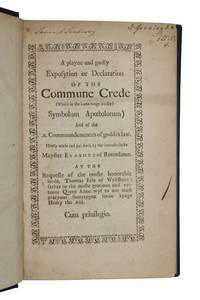
ref. AQ36008London: Imprinted at London: by me Robert Redman 1726 187 i.e. 178 leaves. Modern navy library cloth red calf lettering-piece. Labels of General Theological Seminary to pastedowns their occasional blind-stamps throughout ownership inscriptions of 'Samuel Seabury' and 'J. Gunning A. M.' to head of title page leaves toned occasional marginal tears neat marginal paper repair to head of leaf A2. A handsome reprint of Redman's rare 1534 edition translated by William Marshall of an examination of the Apostle's Creed by Renaissance scholar Erasmus of Rotterdam first printed in 1533 at the behest of Thomas Boleyn 1st Earl of Wiltshire. Written from a Roman Catholic perspective the work illuminates the ongoing theological disputes between Erasmus and Martin Luther in the early years of the Reformation. Constructed as a discourse between a master of the Catholic faith and a disciple wishing to enter the church frequently referenced sections include the master's four signifiers for identify the 'true Church': primarily the 'authorite of the olde Synodes' secondly the 'authorite of the interpretoures or expositoures' evaluating 'the bredthe or largenesse' and finally considering that 'the maner of lyuynge living is to be well aduised'. This eighteenth-century reprint substitutes the volume's original Gothic font for Roman type. ESTC T138059. 8vo. [Imprinted at London: by me Robert Redman], [1726?] hardcover
ref. 0428153127.Gpaperback. Good. Access codes and supplements are not guaranteed with used items. May be an ex-library book. paperback
ref. 1355287774.Ghardcover. Good. Access codes and supplements are not guaranteed with used items. May be an ex-library book. hardcover
ref. 0428983464.Ghardcover. Good. Access codes and supplements are not guaranteed with used items. May be an ex-library book. hardcover
ref. 1331105331.Gpaperback. Good. Access codes and supplements are not guaranteed with used items. May be an ex-library book. paperback