ERASMUS, DESIDERIUSBiblio.com

4766 resultados
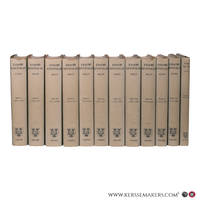
ref. 57443SAmsterdam-New York-Oxford-Tokyo Elsevier Science Publishers bv-North Holland Publishing Company. 1969-2008. Original publisher's blue-gray cloth hardback gilt lettering spine blind-stamp portrait Erasmus frontcover thick large 8vo: Volume I. Writings on Philological and Educational Questions: nrs 1-7: xxij 682pp. / viij 726pp. / viij 774pp. / viij 362pp. / viij 432pp. / viij 314pp. / viij 532pp. Volume II. Proverbs and Sayings Adagia: nrs 1-9: viij 620pp. / xij 546pp. / x 528pp. / viij 386pp. / viij 346pp. / vi 347-652pp. / xij 338pp. / xiv 378pp. / xiv 490pp. Volume IV. Writings on Moral Questions: nrs 1-3 & 1A: viij 204pp. / x 330pp. / viij 224pp. / viij 382pp. Volume V Writings Relating to Religious Instruction: nrs. 1 - 6: s. viij 410pp. / x 400pp. / viij 450pp. / viij 496pp. / viij 422pp. / viij 356pp. Volume VII. Paraphrases of the New Testament: nr 6: x 330pp. Volume VIII. Writings Relating to Church Fathers including several translations from Greek: nrs 2 and 3 & 5 and 6 & 8: xiij 516pp. / xij 694pp. / xij 654pp. / xij 404pp. / xij 508pp. Volume IX. Apologies: nrs 1-4: viij 506pp. / x 292pp. / xxvi 250pp. / viii 424pp. Very fine copies. Complete set of volumes published by Elsevier & North Holland Publishers. From 2009 on the series is continued by Brill and still running. Â Amsterdam-New York-Oxford-Tokyo, Elsevier Science Publishers bv-North Holland Publishing Company. 1969-2008 hardcover
2018ref. WW5130Brill 2018. As new. ~Robust packaging. All UK orders trackable others on request. Used books are exempt from USA tariffs. Hardback. Fine. 466pp. No dustwrapper. No ownership marks. Brill Hardcover
1983ref. 275055Amsterdam ; Oxford : North-Holland 1983. First Edition. Hardcover. Fine copy in the original gilt-blocked cloth. Corners sharp with an overall tight bright and clean impression. Physical description; viii 292 p. : ill. facsim. ; 26 cm. Subjects; Philosophy — Early works to 1800. Essays journals letters & other prose works. PHILOSOPHY / History & Surveys / Medieval. PHILOSOPHY / History & Surveys / Modern. Philosophy and religion ; Philosophy Renaissance. Erasmus Desiderius. Amsterdam ; Oxford : North-Holland hardcover
1962ref. 146903London: Gregg Press 1962. Hardcover. Prof. Schoeck's tidy ownership information in each volume and very minor pencil markings light cover soil and wear corners lightly bumped and several have corner protectors V.1: crumpled and torn back flyleaf V.6: front cover board bent small tear to top of spine V.7: back hinge just beginning to crack but still sturdy V.8: front hinge just beginning to crack but still sturdy V.9: front and back hinges just beginning to crack but still sturdy V.10: pale splatters to bottom of front cover and fore-edge not affecting the interior all volumes in very good sound condition. From the library of Prof. Richard J. Schoeck. Size: 10.5"x15.5" 10 vols in 11 sturdy tan cloth bindings with red spine labels. Gregg Press hardcover
2003ref. 2678Elsevier Science & North-Holland. Fine with no dust jacket. Hardcover. Contents: Apologia Qua Respondet Duabus Invectivis Edvardi Lei ed. Erika Rummel ; Responsio ad Annotationes Edvardi Lei ed. Erika Rummel ; Manifesta mendacia Rummel ; Responsio ad disputationem cuiusdam phimostomi de divortio ed. Edwin Rabbie.; Erasmi Opera Omnia; IX-4; 1.34 x 10.16 x 6.61 Inche; 424 pages; Hardbound. . 2003. 0444510559 . Elsevier Science & North-Holland hardcover
2018466pp., 27cm., publisher's hardcover in full cloth, very good condition (looks unread), weight: 1.4kg., [This volume IX-9 contains a critical Latin text edition of Erasmus' Apologiae, with introduction and notes in English], R113091
2018vii + 615pp., 27cm., publisher's hardcover in full cloth, very good condition (looks unread), weight: 1.8kg., [This volume VII-2 contains a critical Latin text edition of Erasmus' "In Evangelium Lucae Paraphrasis", with introduction and notes in English], R113092
2003Contents: Apologia Qua Respondet Duabus Invectivis Edvardi Lei (ed. Erika Rummel) ; Responsio ad Annotationes Edvardi Lei (ed. Erika Rummel) ; Manifesta mendacia (Rummel) ; Responsio ad disputationem cuiusdam phimostomi de divortio (ed. Edwin Rabbie). ; Erasmi Opera Omnia; 1.34 x 10.16 x 6.61 Inche; 424 pages; Hardbound.
2003Contents: In evangelivm ioannis annotationes. Annotationes in acta apostolorvm. ; Erasmi Opera Omnia; 1.4 x 9.8 x 6.8 Inches; 416 pages; Hardbound.
ref. 4240412° half perkament 16 411 2 480 pag. Met handtekening van M. Buisman 1926 op schutblad. Met gegraveerde titelpagina. Tekst in Latijn en Nederlands; schoolboek. unknown
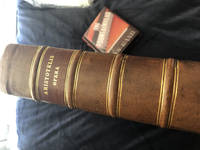
1550ref. P8126The Works of Aristotle "per Des. Eras Roterordamvm" 1550. 2 volumes in one folio 323 x 192mm. Third Edition of The Works of Aristotle of the original text in 1831 prepared by Simon Grynaeus. This edition retains the original letter from Erasmus to Thomas More's son John. Woodcut initials a few woodcut illustrations old calf a few early annotations numerous notes in Latin Greek and English on front and rear flyleaves probably nineteenth-century and in text in ink pencil and red crayon neat annotations in Greek in second volume Greek quotation from Aristotle written on first title-page occasional light staining T5 torn in margin binding rubbed rebacked. Two of history's greatest minds converge. Book #P8126. $6500. We specialize in Rare Ayn rand erotica history and science. Johann Bebel and Michael Isengrin, 1550 hardcover
15241 32,5 x 21 cm., cc. (22) 347, legatura in mezza pergamena con titoli al dorso, stupendi capilettera grandi e piccoli, figurati, prima pagina prologo "de bello Judaico" con ricca cornica figurata e capilyteera grande figurata, in latino, leggere bruniture, mancano frontespizio e prime pagine Index (A-A8), nel complesso buon esemplare. Il testo di Erasmo risulta censurato, reso poco leggibile da righe in penna passate sopra.
ref. ria9780470744611_inpHardback. New. New Book; Fast Shipping from UK; Not signed; Not First Edition; "This is an engaging and informative book on the modern practice of experimental design. The authors' writing style is entertaining the consulting dialogs are extremely enjoyable and the technical material is presented brilliantly but hardcover
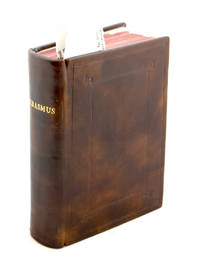
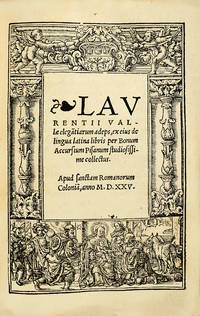
ref. LCS-17326conservées dans leur première reliure estampée à froid. Strasbourg, 1523, 1525. Cologne, 1525. Argentorati, Iohannem Heruagium, 1525. [Suivi de] : Erasme. De octo orationis partium constructione libellus, tum elegans imprimis, tum dilucida brevitate copiosissimus. Erasmo roterodamo autore. A la fin « Augustae Vindelicorum, in officina D. Sigismum Grim, 11 Aout Anno 1523. » [Suivi de] : Valla. Laurentii vallae elegatiarum adeps, exeius de lingua latina libris per Bonum Accursium Pisanum studiosissime collectus. (Les élégances de la langue latine). Apud Sanctam Romanorum Colonia, 1525. Soit trois textes reliés en un volume in-8 de I/ 184 ff., le dernier blanc ; II/ (28) ff. ; III/ (1) p. de titre, 148 pp., (10) pp. d’index, (1) p.bl. Nombreuses annotations manuscrites sur les 2 derniers ff. du 1er texte. Relié en peau de truie estampée à froid sur ais de bois, dos à nerfs, attaches et fermoirs de laiton. Reliure de l’époque. 148 x 100 mm.
ref. 27345Bâle, Johann Froben, 1526. 1 vol. in-folio, parchemin, dos à nerfs, titre écrit à la plume au dos, filets à froid soulignant les nerfs, double encadrement de triples filets à froid sur les plats reliés entre eux par des triples filets. Reliure du XVIIe siècle, coins usés, manques de peau le long des coupes en gouttière. Bon exemplaire. Ex-libris ms. (XVIIe s.) sur le titre et cachet du Grand Séminaire de Tours sur le titre. Titre orné de la grande marque de Froben gravée sur bois, répétée au v° du feuillet F8, premier feuillet de dédicace dans un encadrement de vignettes gravées sur bois, qq. belles lettrines ornées, (6) ff., 338 pp., (1) f. portant la marque de Froben, (6) ff. d'index. Signatures : [a-z]6 [A-E]6 F8 G6. Mouillures à partir de la p. 301 s'aggravant jusqu'à la fin du volume. Les ff. d'index ont particulièrement souffert de l'humidité, sont remmargés et présentent quelques lacunes. L'exemplaire est très frais par ailleurs. Quelques annotations marginales à l'encre dans une écriture du XVIe siècle.
1603ref. 114251Witebergae, Impensis Zacharia Schüreri, impr. Typis Cratontanis 1603 In-16 15,5 x 9,5 cm. Reliure de l’époque vélin ivoire, dos lisse, titre manuscrit illisible, [50]-268-[10] pp. Ouvrage d’une relative rareté. Reliure patinée, pages de garde et de titre déchirées, en coin de pied, 50 premières pages sensiblement jaunies, 1 cahier délié, intérieur correct.
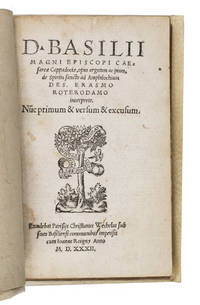
1532ref. ABC_49897Paris 1532. Small 8vo 9.5 x 14.9 cm. Chréstien Wechel and Jean Roigny Modern limp overlapping vellum sewn on 3 supports laced through the joints red edges and with 2 sets of green cloth ties. With Wechels woodcut printers device on the title page and the verso of the otherwise blank last leaf and 2 woodcut decorated initials. 124 3 blank1 pp. Very rare second edition of Erasmus translation of a theological treatise attributed to Basil of Caesarea 330-379 CE.It was published shortly after the first edition published in May of the same year by Froben and Episcopius in Basel May 1532. The work is very rare we have traced only one other copy in sales records of the past 100 years. Erasmus' translation is accompanied by a dedicatory epistle to Joannes Dantiscus 1485-1548 Bishop of Culm and a prominent diplomat of the Polish court. The letter dated April 30 1532 reflects Erasmus conviction that direct engagement with the texts of the Church Fathers rather than with flawed Latin intermediaries was vital for the renewal of Christian piety. As Erasmus himself declared: "It would be of great benefit to sacred letters and Christian devotion if Basil himself in Greek and not the shadow of Basil a Latin translation were made available to all."His source text was a Greek edition he had published just two months prior. According to Julián 2022 Erasmus wanted to publish everything they could find from Basil lamenting that in the existing Latin versions "the greater part of him is missing." Interestingly the legacy of this work can be traced further back to the 15th century when George of Trebizond 1395-1486 a Greek scholar from Crete was commissioned by Cardinal Bessarion 1403-1472 in 1440 to translate both De spiritu sancto and Contra eunomium into Latin. George struggled with the theological complexity of the material confessing in his preface 1442 that he lacked the necessary theological training and fluency in Latin. Erasmus' later effort can be seen as a corrective and a fulfilment of that earlier humanist ambition to make the Greek Church Fathers accessible to a Western audience in an accurate and readable form.Small tear in title page not affecting the text lightly water-stained margin and slightly browned throughout. Overall in very good.l Colón 11; no. 158; Vander Haeghen II 13; Moreau IV 338; V.P. Julián Erasmo traductor y editor de los Padres de la Iglesia: Crisóstomo Basilio y Orígenes. Salmanticensis 691-22022 039-075; USTC 185205 lost book; WorldCat 150413518 913004144 3 copies; not in Adams BM STC German De Reuck; Index Aureliensis; cf. for the Basel 1532 edition: USTC 640558 1 copy; WorldCat 257292311 1374477181 150413518 3 copies. hardcover
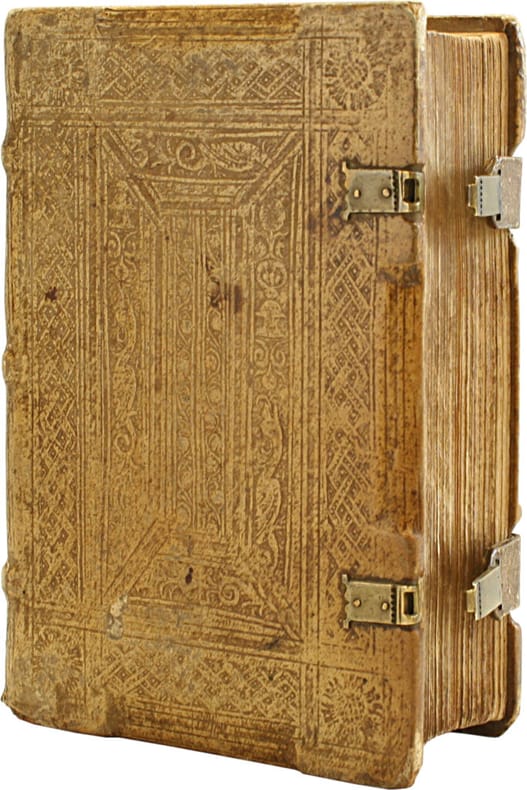
1525ref. LCS-17326Erasmus and his master Laurent Valla: three founding works of the Renaissance preserved in their contemporary blind-stamped binding. Strasbourg 1523 1525. Cologne 1525. From the Campana collection with this 16th century handwritten ex-libris "Jacobi Campana et Amicorum 1530". In total three texts bound in one 8vo volume 148 x 100 mm of: I/ 184 ll. the last one blank; II/ 28 ll. ; III/ 1 title-page 148 pp. 10 pp. of index 1 bl.p. Numerous handwritten notes on the last 2 ll. of the 1st text. Bound in blind-stamped pigskin over wooden boards brass clasps. Contemporary binding. Collection in quite rare and very early editions of 3 important founding works of the Renaissance in philology and grammar by Erasmus and by his master Laurent Valla. Laurent Valla "the greatest humanist of the first half of the 15th century" was born in Rome around 1407. Guilio Vallese. "Deeply convinced of the superiority of the antique culture renewed at the time in which he saw an incomparable ferment of regeneration Valla in order to defend it didn't hesitate to take the chance of being condemned in front of the Inquisition court. As other humanists of this time he claimed to be of the rationalist moral antique transmitted in the books of Wisdom when the Middle Ages had impoverished or lost the very meaning of it." Valla's most famous treatise "Des élégances de la langue latine"that had most contributed to his reputation in six books was quickly given in every school and kept on being a teaching text for the greatest part of the 16th century. Erasmus who professes many times in his letters a vivacious admiration for the author and for this particular work had made in his youth an extract for his personal use which was printed twice without his consent. Valla's observations are about the value of certain forms of words about the value of several difficult terms and even more about the synonymy of the Latin language. This work proves a great sagacity of researches and a great judgment. "King Alphonse who really liked this kind of studies didn't get tired of hearing Valla and let him sometimes battling with Antoine de Parlerme "inde ivae". He gave him a diploma enriched with a golden speech bubble in which he declared him illustrious in almost every science as well as in poetics." Are joined to this major work of Valla the two great founding texts it inspired to Erasmus: -The first one De Conscribendis epistolis in the second edition from Strasbourg of 1525. It was such a success that it was after this one reprinted 77 times in the 16th century alone. -The second one De Constructione octo partium orationis libellus printed for the first time in 1514 is here in the edition printed on August 11th 1523 at Sigismon Grim. It was followed by 61 editions in the 16th century alone. A magnificent copy with wide margins preserved in its first blind-stamped binding; the clasps and ties are intact. It comes from the collections Jacob Campana and Gaspar Campana and bears these two handwritten ex-libris "Jacobi Campanae et Amicorum 1530" and "Gaspari Campanae et Amicorum". The Campanas illustrious Neapolitan family counted César Campana among their members a fine erudite from the 16th century. FRANCAIS Erasme et son maître Laurent Valla : trois uvres fondatrices de la Renaissance conservées dans leur première reliure estampée à froid. Strasbourg 1523 1525. Cologne 1525. De la bibliothèque Campana avec cet ex-libris manuscrit du XVIe siècle " Jacobi Campana et Amicorum 1530 ". Soit trois textes reliés en un volume in-8 de I/ 184 ff. le dernier blanc ; II/ 28 ff. ; III/ 1 p. de titre 148 pp. 10 pp. d'index 1 p.bl. Nombreuses annotations manuscrites sur les 2 derniers ff. du 1er texte. Relié en peau de truie estampée à froid sur ais de bois dos à nerfs attaches et fermoirs de laiton. Reliure de l'époque. 148 x 100 mm. Réunion en éditions fort rares et très précoces de trois grands textes fondateurs de la Renaissance en philologie et grammaire d'Erasme et de son maître Laurent Valla. Laurent Valla " le plus grand humaniste de la première moitié du XVe siècle " naquit à Rome vers 1407. Guilio Vallese. " Profondément convaincu de la supériorité de la culture antique alors renaissante dans laquelle il voyait un ferment incomparable de régénération Valla pour la défendre n'hésita pas à courir le risque d'une condamnation devant le tribunal de l'Inquisition. Comme d'autres humanistes de ce temps il se réclamait de l'antique morale rationaliste transmise dans les livres de la Sagesse dont le Moyen Age avait appauvri ou perdu la signification même. " Le traité le plus célèbre de Valla qui avait le plus contribué à sa réputation" Des élégances de la langue latine " en six livres se répandit rapidement dans toutes les écoles et continua de faire texte d'enseignement pendant la plus grande partie du XVIe siècle. Erasme qui professe en beaucoup d'endroits de ses lettres une vive admiration pour l'auteur et pour cet ouvrage en particulier en avait fait dans sa jeunesse un extrait pour son usage qui fut imprimé deux fois sans son consentement. Les observations de Valla portent sur la valeur de certaines formes de mots sur celle de plusieurs termes difficiles et plus encore sur les synonymies de la langue latine. Ce travail atteste une grande sagacité de recherches et un rare discernement. " Le roi Alphonse auquel ce genre d'études plaisait singulièrement ne se lassait pas d'entendre Valla et le mettait quelquefois aux prises avec Antoine de Parlerme " inde ivae ". Il lui donna un diplôme enrichi d'une bulle d'or dans laquelle il le déclarait illustre en presque toutes les sciences ainsi qu'en la poétique. " Sont joints à cette uvre phare de Valla les deux grands textes fondateurs qu'elle inspire à Erasme : -Le premier De Conscribendis epistolis dans la seconde édition strasbourgeoise de 1525. Son succès fut tel qu'elle fut après celle-ci réimprimée 77 fois pour le seul XVIe siècle. -Le second texte De Constructione octo partium orationis libellus imprimé pour la première fois en 1514 est ici dans l'édition achevée d'imprimer le 11 août 1523 chez Sigismon Grim. Elle fut suivie de 61 éditions pour le seul XVIe siècle. Magnifique exemplaire à belles marges conservé dans sa première reliure estampée à froid dont les fermoirs et les attaches sont conservés intacts. Il provient des bibliothèques Jacob Campana et Gaspar Campana et porte ces deux ex-libris manuscrits " Jacobi Campanae et Amicorum 1530 " et " Gaspari Campanae et Amicorum ". Les Campana illustre famille napolitaine comptèrent parmi leurs membres César Campana fin lettré du XVIe siècle. Iohannem Heruagium.
1522ref. 032982Coloniae: Heronem Alopeciu 1522 An extremely scarce early edition published in September 1522 - a month after the authorised Basel edition - by Hero Alopecius in Cologne. We have only been able to find one reference to it University of Toronto. Erasmus arranged publication of the Basel edition in August 1522 in response to the appearance of an unauthorised version in Cambridge in 1521. He had originally worked on the content in 1509-1511 and this work developed from his earlier writing and lectures became a popular and important text book on the writing of letters. It was much reprinted. This copy is newly rebound in full calf with panelled design to boards and gilt titles to spine. The page edges are red although this may not be contemporary. New endpapers. Contents with 2 initial blanks - the first with ink notation on the edition - this looks likely to be 1800's in date and the paper does not look contemporary. Title with elaborate design including 2 cherubs holding a shield with 3 crowns with contemporary latin note at the top; letter from Erasmus to Nicolao Beraldo pp 2-4; text with beautiful decorative initial capitals pp 5-414 Finis. No final blanks. There is some scholarly annotation in latin and gentle underlining - this could be contemporary. There are a number of mispaginations but the ties work in all cases: 47-74-75-50; 51-78-79-54; 55-82-83-58; 59-98-87-62-63-90-65; 170-117-172; 177-168-179; 192-191-192-193. There are a number of professional paper repairs: to the side of the title page and page 13/14; from p 357 onwards where the top corner tips had been burnt out - this begins with the just the tip but towards the end of the work includes some page numbers and just clips a couple of margin notes - the final 2 leaves have repair to sides. These corners do not have the red edges. Towards the end of the work there are a few pages with some grubbiness at the bottom corners. Otherwise the work is very clean with high quality paper. Please enquire if you would like to see additional images Heronem Alopeciu hardcover
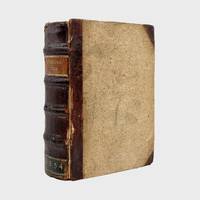
1534ref. 372192Basel: Froben 1534. Froben's printer's device on first and last leaf of each work. 415 1; 191 1pp. 8vo. Early half calf and pastepaper boards. Spine ends rubbed front joint cracked but cords holding. Very good. Froben's printer's device on first and last leaf of each work. 415 1; 191 1pp. 8vo. Early Froben edition of a pedagogical work by Erasmus "On the Writing of letters" first published in 1522 with a collection of aphorisms or "Parallels" gathered out of Plutarch's Moralia Seneca Lucian Xenophon Demosthenes Aristotle Pliny and Theophrastus. An edition was published in Cologne in the same year and the work was a standard throughout the sixteenth century. VD16 E2515 E3257. Provenance: Princes of Liechtenstein armorial bookplate; General Theological Seminary bookplate Froben unknown
1529ref. 1832Coloniae: Iohannem Gymnicum 1529. Rare edition a sound complete copy lacking only the final blank. Title within pictorial woodcut border. Octavo contemporary blind-tooled calf over wooden boards dated 1534 in blind brass clasps minor statins and soiling and some early penned marginalia. Also bound in are three additional works De Civilitate Morum Puerilium; Plutarch. De Liberis Educandis; and Horatius Flaccus. Iohannem Gymnicum hardcover
1534ref. 372192Basel: Froben 1534. Froben's printer's device on first and last leaf of each work. 415 1; 191 1pp. 8vo. Early half calf and pastepaper boards. Spine ends rubbed front joint cracked but cords holding. Very good. Froben's printer's device on first and last leaf of each work. 415 1; 191 1pp. 8vo. Early Froben edition of a pedagogical work by Erasmus "On the Writing of letters" first published in 1522 with a collection of aphorisms or "Parallels" gathered out of Plutarch's Moralia Seneca Lucian Xenophon Demosthenes Aristotle Pliny and Theophrastus. An edition was published in Cologne in the same year and the work was a standard throughout the sixteenth century. VD16 E2515 E3257. Provenance: Princes of Liechtenstein armorial bookplate; General Theological Seminary bookplate Froben unknown books
ref. TBF4Argentorati Iohannem Heruagium 1525. Followed by: Erasmus.De octo orationis partium constructione libellus tum elegans imprimis tum dilucida brevitate copiosissimus. Erasmo roterodamo autore. At the end "Augustae Vindelicorum in officina D. Sigismum Grim 11 Aout Anno 1523." Followed by: Valla.Laurentii vallae elegatiarum adeps exeius de lingua latina libris per Bonum Accursium Pisanum studiosissime collectus. Les élégances de la langue latine. Apud Sanctam Romanorum Colonia 1525. In total three texts bound in one 8vo volume 148 x 100 mm of: I/ 184 ll. the last one blank; II/ 28 ll. ; III/ 1 title-page 148 pp. 10 pp. of index 1 bl.p. Numerous handwritten notes on the last 2 ll. of the 1st text. Bound in blind-stamped pigskin over wooden boards brass clasps. Contemporary binding. Collection in quite rare and very early editions of 3 important founding works of the Renaissance in philology and grammar by Erasmus and by his master Laurent Valla. Laurent Valla "the greatest humanist of the first half of the 15th century" was born in Rome around 1407. Guilio Vallese. "Deeply convinced of the superiority of the antique culture renewed at the time in which he saw an incomparable ferment of regeneration Valla in order to defend it didn't hesitate to take the chance of being condemned in front of the Inquisition court. As other humanists of this time he claimed to be of the rationalist moral antique transmitted in the books of Wisdom when the Middle Ages had impoverished or lost the very meaning of it." Valla's most famous treatise "Des élégances de la langue latine"that had most contributed to his reputation in six books was quickly given in every school and kept on being a teaching text for the greatest part of the 16th century. Erasmus who professes many times in his letters a vivacious admiration for the author and for this particular work had made in his youth an extract for his personal use which was printed twice without his consent. Valla's observations are about the value of certain forms of words about the value of several difficult terms and even more about the synonymy of the Latin language. This work proves a great sagacity of researches and a great judgment. "King Alphonse who really liked this kind of studies didn't get tired of hearing Valla and let him sometimes battling with Antoine de Parlerme "inde ivae". He gave him a diploma enriched with a golden speech bubble in which he declared him illustrious in almost every science as well as in poetics." Are joined to this major work of Valla the two great founding texts it inspired to Erasmus: -The first oneDe Conscribendis epistolis in the second edition from Strasbourg of 1525. It was such a success that it was after this one reprinted 77 times in the 16th century alone. -The second one De Constructione octo partium orationis libellus printed for the first time in 1514 is here in the edition printed on August 11th 1523 at Sigismon Grim. It was followed by 61 editions in the 16th century alone. A magnificent copy with wide margins preserved in its first blind-stamped binding; the clasps and ties are intact. It comes from the collections Jacob Campana andGaspar Campana and bears these two handwritten ex-libris "Jacobi Campanae et Amicorum 1530" and "Gaspari Campanae et Amicorum". The Campanas illustrious Neapolitan family counted César Campana among their members a fine erudite from the 16th century. Français Argentorati Iohannem Heruagium 1525. Suivi de : Erasme. De octo orationis partium constructione libellus tum elegans imprimis tum dilucida brevitate copiosissimus. Erasmo roterodamo autore. A la fin " Augustae Vindelicorum in officina D. Sigismum Grim 11 Aout Anno 1523. " Suivi de : Valla. Laurentii vallae elegatiarum adeps exeius de lingua latina libris per Bonum Accursium Pisanum studiosissime collectus. Les élégances de la langue latine. Apud Sanctam Romanorum Colonia 1525. Soit trois textes reliés en un volume in-8 de I/ 184 ff. le dernier blanc ; II/ 28 ff. ; III/ 1 p. de titre 148 pp. 10 pp. d'index 1 p.bl. Nombreuses annotations manuscrites sur les 2 derniers ff. du 1er texte. Relié en peau de truie estampée à froid sur ais de bois dos à nerfs attaches et fermoirs de laiton. Reliure de l'époque. 148 x 100 mm. Réunion en éditions fort rares et très précoces de trois grands textes fondateurs de la Renaissance en philologie et grammaire d'Erasme et de son maître Laurent Valla. Laurent Valla " le plus grand humaniste de la première moitié du XVe siècle " naquit à Rome vers 1407. Guilio Vallese. " Profondément convaincu de la supériorité de la culture antique alors renaissante dans laquelle il voyait un ferment incomparable de régénération Valla pour la défendre n'hésita pas à courir le risque d'une condamnation devant le tribunal de l'Inquisition. Comme d'autres humanistes de ce temps il se réclamait de l'antique morale rationaliste transmise dans les livres de la Sagesse dont le Moyen Age avait appauvri ou perdu la signification même. " Le traité le plus célèbre de Valla qui avait le plus contribué à sa réputation" Des élégances de la langue latine " en six livres se répandit rapidement dans toutes les écoles et continua de faire texte d'enseignement pendant la plus grande partie du XVIe siècle. Erasme qui professe en beaucoup d'endroits de ses lettres une vive admiration pour l'auteur et pour cet ouvrage en particulier en avait fait dans sa jeunesse un extrait pour son usage qui fut imprimé deux fois sans son consentement. Les observations de Valla portent sur la valeur de certaines formes de mots sur celle de plusieurs termes difficiles et plus encore sur les synonymies de la langue latine. Ce travail atteste une grande sagacité de recherches et un rare discernement. " Le roi Alphonse auquel ce genre d'études plaisait singulièrement ne se lassait pas d'entendre Valla et le mettait quelquefois aux prises avec Antoine de Parlerme " inde ivae ". Il lui donna un diplôme enrichi d'une bulle d'or dans laquelle il le déclarait illustre en presque toutes les sciences ainsi qu'en la poétique. " Sont joints à cette œuvre phare de Valla les deux grands textes fondateurs qu'elle inspire à Erasme : -Le premierDe Conscribendis epistolis dans la seconde édition strasbourgeoise de 1525. Son succès fut tel qu'elle fut après celle-ci réimprimée 77 fois pour le seul XVIe siècle. -Le second texteDe Constructione octo partium orationis libellus imprimé pour la première fois en 1514 est ici dans l'édition achevée d'imprimer le 11 août 1523 chez Sigismon Grim. Elle fut suivie de 61 éditions pour le seul XVIe siècle. Magnifique exemplaire à belles marges conservé dans sa première reliure estampée à froid dont les fermoirs et les attaches sont conservés intacts. Il provient des bibliothèques Jacob Campanaet Gaspar Campana et porte ces deux ex-libris manuscrits " Jacobi Campanae et Amicorum 1530 " et " Gaspari Campanae et Amicorum ". Les Campana illustre famille napolitaine comptèrent parmi leurs membres César Campana fin lettré du XVIe siècle. hardcover
1963ref. 78653Oxonii: In Typographeo Clarendoniano 1963. 23.5 x 15 cm. original cloth with gilt lettering with dust jackets. 12 volumes. Over 6000 pages illustrated with plates. Text in Latin. Some edges with few stains; paper browned due to aging; dust jackets slightly damaged price clipped dust-jackets. Previous owner's names in first volume; some notes and underlinings in pencil and some notes in ink in the margins not very disturbing. Still good set see pictures. ¶ P.S. Allen began to work on his edition of Erasmus' correspondence in 1893 and the first volume was published in 1906. He died in 1933 with the edition more than half complete. His wife the late Mrs. H.M. Allen and his friend Professor Garrod continued the work; and the last volume of the text Volume XI appeared in 1947. - Reprinted lithographically in Great Britain at the University Press Oxford. In Typographeo Clarendoniano hardcover
ref. 1391549023.Ghardcover. Good. Access codes and supplements are not guaranteed with used items. May be an ex-library book. hardcover