4.719 resultados
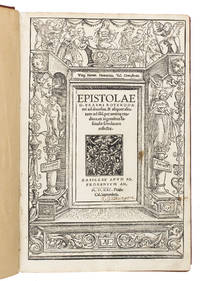
1522ref. 5299Basel: Johann Froben August 21 1521 - January 1522. FIRST EDITION. Hardcover. Fine. A superb copy bound in contemporary alum-tawed pigskin over beveled wooden boards ruled and tooled in blind with the original clasps catches and straps preserved. Binding mildly soiled a few scrapes mild surface wear. Internally crisp and bright with just a few lightly toned leaves and a few trivial stains. With 16th c. manuscript annotations scattered throughout and a 16th c. ownership inscription on the paste-down. The errata lvs. have been tipped in possibly indicating early issue. Excellent. Title page with the fine ‘Triumph of Humanitas’ historiated woodcut border by Urs Graf Lüthi 50a and Hieronymus Oberrheinische Buchillustration 172 enclosing Froben’s printer’s device; two preliminary pages with fine four- and five-piece woodcut borders by Ambrosius Holbein; white-on-black woodcut headpiece two 10-line woodcut initials and numerous smaller ones verso of final leaf with large printer’s device enclosed in five-piece woodcut border; some Greek printing. First edition of this collection of 671 letters of which 171 are newly printed. The majority of the new letters are from 1519-1521 but some are earlier the first dated 11 July 1513. The collection is far larger than its predecessors: the ‘Epistolae aliquot’ of January 1518 52 letters the ‘Auctarium’ of October 1518 63 letters and the ‘Farrago’ of Nov 1519 333 letters. Erasmus provides a preface to his correspondence for the first time in this edition. The letter to his editor Beatus Rhenanus Ep 1206 tells of his dislike of two earlier collections edited by him Beatus and published by Froben the ‘Auctarium’ of October 1518 and the ‘Farrago’ of Nov 1519 and implies that they were published surreptitiously without his consent. After the present edition no further collections were printed until the ‘Opus epistolarum’ of 1529. The introduction in the Collected Works to Erasmus’ prefatory letter to Beatus Rhenanus illustrates his personal involvement in the production of this collection: "Even as the Farrago was being printed Erasmus spoke of another edition with new letters added and others revised. The last thing he desired was a straight reprint either by Froben or another publisher. So in the summer of 1520 he was going through all his letters and in November the review of the ‘Farrago’ was apparently completed. Before the middle of January 1521 the revised copy together with a substantial number of new letters had reached Basel. When he sent the first part of the revised New Testament shortly afterwards he apparently asked to have all letters old and new back for another review but was sent none and told instead that a volume of 41 quires pages 1-490 was set in type lacking only a preface and an epilogue. So he wrote this preface as well as dispatching more letters to Basel. “Froben next prepared a preliminary quire containing the title-page dated 31 August Epp 1206 1225 and to fill some space left over on the last page Ep. 1239. All was printed and ready to be launched at the Frankfurt autumn fair but with the certain prospect of Erasmus’ return to Basel a delay was indicated. As Froben now preferred his volume not to reach the public and his rivals until the time of the spring fair of 1522 Erasmus could add more letters including the last in time dated from Basle 22 November 1521 which appears on page 639 but is followed by thirty more pages of letters. Presumably as a result of Erasmus’ review of the printed volume over three pages of corrigenda were added at the end" Collected Works vol. 8 pp. 215/7. The correspondents for the newly printed letters include Johann Reuchlin Justus Jonas Guillaume Bude Petrus Mosellanus Polydore Vergil Pope Leo X Cardinal Albert of Brandenburg Thomas More William Warham Thomas Wolsey and John Fisher. Many of the letters reflect Erasmus’ changing stance regarding Luther but at the same time continue his attacks on the friars and Louvain theologians. Bietenholz singles out a long letter of 10 May 1521 Ep 1202 to Justus Jonas as one of the finest of the period in which Erasmus expresses his alarm that Jonas as well as a whole group of German humanists especially Melanchthon are committing themselves irrevocably to the Lutheran cause Collected Works vol. 8 pp. 201. Another letter to Jonas of June 1521 Ep 1211 holds an important biography of his friend John Colet the humanist and educational pioneer who had died in September 1519 “Sixteenth-century Europe’s image of Colet owes everything to Erasmus. Much is still today known only from that source. Erasmus’ encomium is the fullest and most explicit portrait.” Contemporaries of Erasmus I p. 327. Also included in this collection and previously published in the Farrago is one of Erasmus’ most famous letters “which will always rank among his finest writing and the great accomplishments of Renaissance literature” Collected Works vol. 7 p. xii. Addressed to Ulrich von Hutten in July 1519 Ep 999 it contains Erasmus’ intimate pen portrait of his close friend Thomas More. It serves as earliest biographical account of More and is the most substantial of three letters the others Ep 1233 see below & Ep 2750 “which are indispensable for any historical assessment of More’s character” Contemporaries of Erasmus II p. 458. It is full of memorable phrases such as “in a word if you want a perfect model of friendship you will find it in no one better than in More” and “no one is less led by the opinions of the crowd yet no one departs less from common sense”. The friends met for the last time in Bruges in August 1521 and in his letter to Budé Ep 1233 first printed here Erasmus writes of the invigorating impact of their meeting and of the shining example set in More’s household for the education of women. Johann Froben, August 21 1521 - January hardcover books
1541ref. 1903140038Basel: Westhemerus 1541. Hardcover. Good. 2nd ed. First published in 1538. Contemporary vellum-backed pasteboard binding. Solid binding some wear to cover extremities. All edges red. Printer's snake device verso colophon. Internally clean and unmarked. Early signature of Robert Guyard Roberti Guyardi and "Carmelus Cadomensis". A collection of Erasmus letters for the use in Latin schools. Refs: Index Aurel. 163.109 9. VD-16 E-2958. Vanderhaeghen I 101. Bezzel 1043. Cat. Rotterdam 121. De Reuck 220. Not in Adams. "Adiecimus in Calcem proverbiorum & graecarum vocum interpretationem floresq ; in elocutione latina selectissimos que omnia commentarii vice esse possunt ; opus novum et recens natum. Basel: Westhemerus hardcover
1551ref. C75168Antwerp: J. Loeus Joannis Loei 1551. First Edition Thus. Hardback. Hardback Hardcover. Very Good. First Edition Thus. Hardback. Small 8vopp 288-8 ff.160 by 105 mms. Very good copy with very clean text. Title with woodcut device Annotated selection of letters by and to Erasmus for the use at Latin schools. A more common second edition appeared in 1552. Title page slight soiled with slight chip at corner not affecting text. Bookplate of Thomas Parker of the Inner Temple dated 1704. Earlier notes in various hands on last blank in latin. Half dark bown leather later binding lettered and decorated gilt at the spine with some slight restoration at spine ends. Ref. B.T. 1046. Vanderhaeghen I 101. De Reuck 225. Cat. Rotterdam 121. Thomas PARKER a distinguished lawyrer and major book collector was 1st Earl of Macclesfield 1667-1732. In 1710 he was appointed Lord Chief Justice and in 1718 Lord Chancellor; he was created Earl of Macclesfield in 1721. In 1725 the political tide turned against him and he was impeached for financial corruption and selling offices; although he protested his innocence the trial did seem to establish that he had indulged in venal practices beyond the accepted conventions of the time. He then retired to his estate at Shirburn Castle to spend more time with his books.He was known for his wide range of interests and intellectual pursuits; he patronised numerous scholars and had an extensive network of contacts and correspondents among leading thinkers and scientists. He was elected a fellow of the Royal Society in 1712. Parker acquired books all his life and developed an extensive library augmented by his son to 20000 books. J. Loeus ( Joannis Loei) hardcover
1719ref. 17566Basilea 1719. Experptae ex majori Volumine quibus aliunde plurimae accessere Erste S. mit Wassersp.ansonsten guter Zustand Brandmüller Kl.-8°. Pbd. d. Zt. Varia unknown
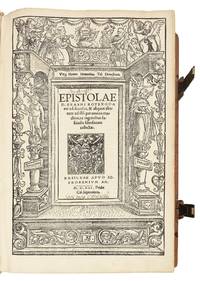
1521ref. ABC_49922Basel 1521. Folio. Johann Froben Modern blind-tooled red morocco with the author title and year of publication lettered in gold on the spine a single fillet border on both boards red edges. With a decorative woodcut border on the title page by Urs Graf 2 decorative woodcut borders in the text by Ambrosius Holbein numerous decorated woodcut initials and a woodcut printer's device at the end of the work. 12 "668" =618 6 pp First complete edition of the letters of Desiderius Erasmus containing 171 letters which had never been published before with correspondence with many of the most prominent figures of the 16th century. The work has been beautifully illustrated with a splendid large woodcut title border by Urs Graf ca. 1485-1528 known as "The triumph of Humanitas" and two fine borders by Ambrosius Holbein ca. 1494-1519. The present copy has been annotated in several contemporary hands and was owned by Ralph Widdrinton d. 1688 the Regius professor of Greek at Cambridge University.The Epistolae ad diversos contains 617 letters in total and is far larger than any of the earlier collections of Erasmus' correspondence namely the Epistolae aliquot of January 1518 52 letters the Auctarium of October 1518 63 letters and the Farrago of November 1519 333 letters. The present letter collection is also the first with a preface by Erasmus. The majority of the letters date to 1519-1521 but some are earlier with the first dated to 11 July 1513. They reflect Erasmus' changing stance towards Luther and Protestantism but also continue his attacks on friars and the theologians of Louvain. Among the authors correspondents are prominent humanists and other important figures including Beatus Rhenanus Ulrich Zasius Johann Eck Guillaume Budé Jean Grolier Georg Spalatin Hermann von dem Busche Konrad Peutinger John Colet Thomas More John Fisher Thomas Linacre William Grocyn Luther Melanchton Pope Leo X and Henry VIII King of England. Erasmus later made many editorial changes to the letters making the present edition of particular importance.With a later ownership annotation "R. Widdrington" on the title page. The binding is very lightly soiled. The work is slightly browned throughout with contemporary and later manuscript annotations in the margins in three different hands a vertical tear in the upper part of the first errata leaf without loss of text. Otherwise a very good copy with ample margins.l Adams E 852; BM STC German p. 276; Erasmus Online 2069; USTC 651629 34 copies; Vander Haeghen I 99; VD 16 VD16 E 2925. hardcover
1522ref. 5299Basel: Johann Froben August 21 1521 - January 1522. FIRST EDITION. Hardcover. Fine. A superb copy bound in contemporary alum-tawed pigskin over beveled wooden boards ruled and tooled in blind with the original clasps catches and straps preserved. Binding mildly soiled a few scrapes mild surface wear. Internally crisp and bright with just a few lightly toned leaves and a few trivial stains. With 16th c. manuscript annotations scattered throughout and a 16th c. ownership inscription on the paste-down. The errata lvs. have been tipped in possibly indicating early issue. Excellent. Title page with the fine ‘Triumph of Humanitas’ historiated woodcut border by Urs Graf Lüthi 50a and Hieronymus Oberrheinische Buchillustration 172 enclosing Froben’s printer’s device; two preliminary pages with fine four- and five-piece woodcut borders by Ambrosius Holbein; white-on-black woodcut headpiece two 10-line woodcut initials and numerous smaller ones verso of final leaf with large printer’s device enclosed in five-piece woodcut border; some Greek printing. First edition of this collection of 671 letters of which 171 are newly printed. The majority of the new letters are from 1519-1521 but some are earlier the first dated 11 July 1513. The collection is far larger than its predecessors: the ‘Epistolae aliquot’ of January 1518 52 letters the ‘Auctarium’ of October 1518 63 letters and the ‘Farrago’ of Nov 1519 333 letters. Erasmus provides a preface to his correspondence for the first time in this edition. The letter to his editor Beatus Rhenanus Ep 1206 tells of his dislike of two earlier collections edited by him Beatus and published by Froben the ‘Auctarium’ of October 1518 and the ‘Farrago’ of Nov 1519 and implies that they were published surreptitiously without his consent. After the present edition no further collections were printed until the ‘Opus epistolarum’ of 1529. The introduction in the Collected Works to Erasmus’ prefatory letter to Beatus Rhenanus illustrates his personal involvement in the production of this collection: "Even as the Farrago was being printed Erasmus spoke of another edition with new letters added and others revised. The last thing he desired was a straight reprint either by Froben or another publisher. So in the summer of 1520 he was going through all his letters and in November the review of the ‘Farrago’ was apparently completed. Before the middle of January 1521 the revised copy together with a substantial number of new letters had reached Basel. When he sent the first part of the revised New Testament shortly afterwards he apparently asked to have all letters old and new back for another review but was sent none and told instead that a volume of 41 quires pages 1-490 was set in type lacking only a preface and an epilogue. So he wrote this preface as well as dispatching more letters to Basel. “Froben next prepared a preliminary quire containing the title-page dated 31 August Epp 1206 1225 and to fill some space left over on the last page Ep. 1239. All was printed and ready to be launched at the Frankfurt autumn fair but with the certain prospect of Erasmus’ return to Basel a delay was indicated. As Froben now preferred his volume not to reach the public and his rivals until the time of the spring fair of 1522 Erasmus could add more letters including the last in time dated from Basle 22 November 1521 which appears on page 639 but is followed by thirty more pages of letters. Presumably as a result of Erasmus’ review of the printed volume over three pages of corrigenda were added at the end" Collected Works vol. 8 pp. 215/7. The correspondents for the newly printed letters include Johann Reuchlin Justus Jonas Guillaume Bude Petrus Mosellanus Polydore Vergil Pope Leo X Cardinal Albert of Brandenburg Thomas More William Warham Thomas Wolsey and John Fisher. Many of the letters reflect Erasmus’ changing stance regarding Luther but at the same time continue his attacks on the friars and Louvain theologians. Bietenholz singles out a long letter of 10 May 1521 Ep 1202 to Justus Jonas as one of the finest of the period in which Erasmus expresses his alarm that Jonas as well as a whole group of German humanists especially Melanchthon are committing themselves irrevocably to the Lutheran cause Collected Works vol. 8 pp. 201. Another letter to Jonas of June 1521 Ep 1211 holds an important biography of his friend John Colet the humanist and educational pioneer who had died in September 1519 “Sixteenth-century Europe’s image of Colet owes everything to Erasmus. Much is still today known only from that source. Erasmus’ encomium is the fullest and most explicit portrait.” Contemporaries of Erasmus I p. 327. Also included in this collection and previously published in the Farrago is one of Erasmus’ most famous letters “which will always rank among his finest writing and the great accomplishments of Renaissance literature” Collected Works vol. 7 p. xii. Addressed to Ulrich von Hutten in July 1519 Ep 999 it contains Erasmus’ intimate pen portrait of his close friend Thomas More. It serves as earliest biographical account of More and is the most substantial of three letters the others Ep 1233 see below & Ep 2750 “which are indispensable for any historical assessment of More’s character” Contemporaries of Erasmus II p. 458. It is full of memorable phrases such as “in a word if you want a perfect model of friendship you will find it in no one better than in More” and “no one is less led by the opinions of the crowd yet no one departs less from common sense”. The friends met for the last time in Bruges in August 1521 and in his letter to Budé Ep 1233 first printed here Erasmus writes of the invigorating impact of their meeting and of the shining example set in More’s household for the education of women. Johann Froben, August 21 1521 - January hardcover
ref. 1247204847.Gpaperback. Good. Access codes and supplements are not guaranteed with used items. May be an ex-library book. paperback
ref. 1175854549.Gpaperback. Good. Access codes and supplements are not guaranteed with used items. May be an ex-library book. paperback
1968ref. 157136Darmstadt: Wissenschaftliche Buchgesellschaft 1968. XXV, 375 Seiten. Lateinisch-deutscher Paralleltext. 8° (17,5-22,5 cm). Orig.-Leinenband mit goldgeprägtem Rückentitel. [Hardcover / fest gebunden].
1990ref. 157137Darmstadt: Wissenschaftliche Buchgesellschaft 1990. XXV, 375 Seiten. Lateinisch-deutscher Paralleltext. 8° (17,5-22,5 cm). Orig.-Leinenband mit goldgeprägtem Rückentitel. [Hardcover / fest gebunden].
1962ref. 440509New York : Russell & Russell 1962. First Edition. Hardcover. Near fine copies in the original gilt-blocked cloth. Slightest suggestion only of dust-dulling to the spine bands and panel edges. Remain particularly well-preserved overall; tight bright clean and strong. Physical description; 3 v ; 23 cm. Notes; Subtitle varies. New York : Russell & Russell hardcover
1549ref. 9472Cologne, Mart. Gymnicus, 1549 ; in-8 ; plein vélin estampé sur ais de bois, dos à trois gros nerfs, fermoirs de cuivre (reliure de l'époque) ; (16) y compris le titre, 632, [634], (76) pp. index, (1) f. blanc (*, AZ, Aa-Xx - 8, Yy - 4).
1523ref. 44374Cologne, Eucharius Cervicornus pour Gottfried Hittorp, s.d. , (1523). In-8 de 139-(13) ff., (sign. a-s8, *8), table, titre à encadrement gravé, bois gravé, caractères grecs et romains.ÉRASME. Parabolarum, seu Similium liber elegantissimus. Argentinae, apud J. Knoblouchum (Strasbourg, Johann Knobloch) 1521. 103-(5) ff., (sign. A-O8), titre à encadrement gravé, caractères italiques.ÉRASME. Opus de conscribendis epistolis, quod quidam & mendosum & mutilum ediderant, recognitum ab authore, & locupletatum. Argentorati (Strasbourg) Knobloch, 1522. 178 (i.e. 180) ff., (sign. A-Y8, Z4), titre à encadrement gravé, caractères italiques.3 pièces reliées en 1 vol. in-8 (105 x 170 mm), peau de truie sur ais de bois biseautés, décor estampé à froid à encadrement de motifs floraux et animaliers, dos à trois nerfs, titre manuscrit au dos, deux fermoirs (reliure de l'époque).
2026ref. x-1032903910Chapman & Hall 2026. Hardcover. New. 344 pages. 10.00x7.00x10.00 inches. Chapman & Hall hardcover
2014ref. 3457992Madrid.: RBA. 2014. Hardcover. Good. 23 cm. CXI 428 p. Encuadernación en tapa dura de editorial con sobrecubierta ilustrada. Colección 'Grandes pensadores'. Obra selecta. Estudio introductorio por Jordi Bayod y Joaquim Parellada ; traducción Pedro Rodríguez Santidrián Oliveri Nortes Valls. En la portada: Gredos. Bayod Jordi. 1959-. editor literario. Parellada Casas Joaquim. Rodríguez Santidrián Pedro. traductor. Nortes Valls Oliveri. Erasmus Desiderius. 1467-1536. Colloquia. Elogio a la locura . ISBN: 9788447377893 Obras completas. Colecciones generales 081 Erasmus Desiderius RBA. hardcover
1795ref. 41603London: J. Sewell 1795. Plate: 186x110 mm. Margin: 223x131 mm. Light soiling faint foxing edges trimmed. J. Sewell unknown books
ref. 41602Margin: 220x142 mm. Very minor tearing in bottom margin faint foxing. unknown books
1795ref. 41603London: J. Sewell 1795. Plate: 186x110 mm. Margin: 223x131 mm. Light soiling faint foxing edges trimmed. J. Sewell unknown
ref. 41602Margin: 220x142 mm. Very minor tearing in bottom margin faint foxing. unknown
2006Volledig in 3 delen: [viii + 168] + 196 + 162pp., 24cm., blauwlinnen uitgeversbanden met titel in goudpdruk, in blauwlinnen uitgeverscassette, zeer goede staat, Uitgave in opdracht van Stichting Erasmusfestival 's-Hertogenbosch en de stad Leuven, [bevat deel I: facsimile-uitgave van de Lof der Zotheid, II: vertaalde, geannoteerde en ingeleide tekst, III: werk van Torfs: "op Erasmiaanse wijze worden hedendaagse zotheden beschouwd, verguisd, geprezenen zonodig gefileerd"], gewicht: 2kg., T100340
1851ref. BOOKS 53624 ILight scattered foxing otherwise clean internally. Binding worn at corners otherwise sound. Noothoven Van Goor Leiden 1851 Hardback Cloth 8vo. xl 233 pp. Latin. With two Holbein lithograph portraits: Erasmus frontis and Hans Holbein. Vignette ills throughout. 3/4 pebbled calf. Noothoven Van Goor hardcover
ref. 003516Basle: Henning Oppermann 1931. Soft cover. Very Good. Octavo. Facsimile volume. Limited to 750 copies; this is No. 117. Grey boards. Exquisitely illustrated with Holbein's drawings. 0 Basle: Henning Oppermann, 1931. paperback
ref. 910877Leuven Peeters. 2006. Gebonden. Mooi. l Drie delen gebonden in blauw linnen in cassette unknown
ref. 1019742135.Ghardcover. Good. Access codes and supplements are not guaranteed with used items. May be an ex-library book. hardcover
1907ref. 127791907. Opuscula Selecta Neerlandicorum de Arte Medica 1. - Amstelodami 1907 8° 265 pp. 7 Taf. orig. Leinenband. Weitere Arbeiten von A.v.Leeuwenhoek J.Swammerdam H.Boerhaave H.D.Gaubius u. F.C.Donders. unknown