Erasmus, Desiderius (1466-1536)Biblio.com
4719 resultados
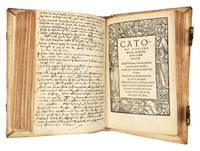
1522ref. 5333Mainz: Johann Schöffer February 1522. Hardcover. Fine. Bound with: Erasmus Desiderius 1466-1536; Cato Dionysius ca. 3rd c.; Colet John 1467-1519 et al. Catonis disticha moralia cum scholiis auctis Erasmi Roterodam. Isocratis paraenesis ad Demonicum. dennuo cum Graecis collata per Erasmum Strasbourg: Johann Knobloch 1523 Octavo: 15.5 x 10.1 cm. I. Adagia: 8 lvs 234 pp. 15 lvs. Collation: A-R8 S4 with final blank leaf present. II. Disticha: 56 lvs. Collation: A-G8 Bound with: Erasmus Desiderius 1466-1536; Cato Dionysius ca. 3rd c.; Colet John 1467-1519 et al. Catonis disticha moralia cum scholiis auctis Erasmi Roterodam. Isocratis paraenesis ad Demonicum. dennuo cum Graecis collata per Erasmum Strasbourg: Johann Knobloch 1523 Octavo: 15.5 x 10.1 cm. I. Adagia: 8 lvs 234 pp. 15 lvs. Collation: A-R8 S4 with final blank leaf present. II. Disticha: 56 lvs. Collation: A-G8 Bound in contemporary blind-stamped pigskin with a very early paper label to the spine. In fine condition. The text bound a bit tight. Minor soiling and a few marginal tears or worming. First t.p. working loose at foot. With fine woodcut borders to the title pages of both works woodcut initials. Knobloch's device on the final leaf of the second work. The leaf between the two volumes has handwritten German translations or German equivalents of certain adages. There are about 25 other translations in the course of the text. See below. This rare edition of the Erasmus' "Adagiorum Collectanea"Collection of Adages was printed by Johann Schöffer grandson of Gutenberg's backer Johann Fust and son of Fust's partner Peter Schöffer. The fine woodcut border on the title page incorporates Schöffer's arms. The book is bound with Erasmus' edition of the "Distichs of Cato" the "Apothegms of the Greek Sages" and other moralizing texts for use in schools. An unidentified 16th c. reader has provided German renderings for approximately 65 adages some within the text but the majority written -densely- on both sides of a blank leaf. These are not literal translations but idiomatic equivalents - German sayings and turns of phrase that the reader judged to carry the same sense as the Latin in the way a modern annotator might pair "actions speak louder than words" with "facta non verba" lit. deeds not words rather than translate it word for word. Here are five examples: 1. Ultra septa transilire is glossed in German as "das heist zu vil machen" "To leap over the fences" i.e. to overshoot the bounds. 2. Oculatus testis unus pluris est quam decem auriti is glossed in German as "von hörensagen leugt man gern" "One eyewitness is worth more than ten ear-witnesses". 3. Genu sura propius is glossed in German as "ich schau auff mein spill" "The knee is nearer than the shin" i.e. one's own concerns come first - "I mind my own game." 4. Arcus non semper feriet quod minabitur is glossed in German as "alle tag ist jagtag aber nit fangtag" Adapted from Horace Ars poetica "nec semper feriet quodcumque minabitur arcus". Not everything one undertakes comes off - "every day is hunting day but not catching day." 5. The Latin lemma In lapidicinas / ad corvos is glossed in German as "zum galgen mit dir" Both classical imprecations "to the quarries!" / "to the crows!" i.e. "go hang" rendered literally in the German as "to the gallows with you." 6. Haec Helena est - "das ist die praut darumb man dantzt" "this is the bride around whom the dance goes". 7. Homo effreni oris - "sein zung schneidt wie ein messer" "his tongue cuts like a knife". There is also a long marginal note explaining the adage "Cave Thoracem" "Beware of the Thorax" - Erasmus Adagia 2.4.52. It refers to Mount Thorax near Magnesia-on-the-Maeander where the grammarian Daphitas is said to have been crucified after mocking the Attalid kings in a scurrilous couplet this exact episode is told by Strabo Geography 14.1.39 and an oracle had reportedly warned Daphitas to "beware of the Thorax" - a pun since thorax also means "breastplate" in Greek. THE ADAGES: The "Adagia" one of Erasmus' greatest achievements is a collection of proverbs taken from both Latin and Greek authors. The work was already conceived during his first stay in England and was first printed at Paris in 1500. The present edition is a reprint of the 1506 edition which had been expanded by 18 adages. It retains however the dedication letter to William Blount Lord Mountjoy Allen 126 from the first edition. Although it was eclipsed by the massively expanded Aldine edition that was to follow in 1508 the "Adagiorum Chiliades" "Thousands of Adages" to which Erasmus would add up until his death in 1536 the much shorter "Collectanea Adagiorum" would continue to be printed as well. "Erasmus' 'Adagiorum Collectanea' is a collection of about eight hundred proverbial sayings drawn from the Latin authors of antiquity and elucidated for the use of those who aspired to write an elegant Latin style. In the dedication Erasmus pointed out the profit an author may derive both in ornamenting his style and in strengthening his argumentation from having at his disposal a good supply of sentences hallowed by their antiquity. He proposes to offer such a help to his readers. What he actually gave was much more. He familiarized a much wider circle than the earlier humanists had reached with the spirit of antiquity. "Until this time the humanists had to some extent monopolized the treasures of classic culture in order to parade their knowledge of which the multitude remained destitute and so to become strange prodigies of learning and elegance. With his irresistible need of teaching and his sincere love for humanity and its general culture Erasmus introduced the classic spirit in so far as it could be reflected in the soul of a sixteenth-century Christian among the people. Not he alone; but none more extensively and more effectively. Not among all the people it is true for by writing in Latin he limited his direct influence to the educated classes which in those days were the upper classes. "Erasmus made current the classic spirit. Humanism ceased to be the exclusive privilege of a few. According to Beatus Rhenanus he had been reproached by some humanists when about to publish the Adagia for divulging the mysteries of their craft. But he desired that the book of antiquity should be open to all." Huizinga p. 39-40 THE DISTICHS OF CATO: The literature of edifying proverbs and "sententiae" enjoyed enormous success during the early Middle Ages. The "Distichs of Cato" were a particularly successful example of this genre being read widely from the Carolingian period up to the 16th century. The book's misattributed to the great Roman statesman Cato the Elder the book is now believed to be a late antique work by a Dionysius Cato gave the book the weight of authority. From the 12th century onward the readership broadened and it began to be used outside of the "collective" settings of the schools and universities as edifying reading for private personal contemplation. "Erasmus would return to the subjects taught in his own education through his publications on childhood education. One of these topics would be the Distichs of Cato. Although he had been working with dicta over several years in the beginning of the 16th century Erasmus claimed that his actual writing of his version of the Distichs took significantly less time. Its first edition was published around 1514 in a book which also included the sayings of Mimus Publianus Publilius Syrus and the seven sages and Erasmus' translation of the poem Institutum christiani hominis by John Colet. Once published the edition quickly spread to schools in both England and the Low Countries. "Erasmus began his edition of the Distichs of Cato with an address to the educator Jean de Nève. In this letter he criticized two earlier commentaries on the Distichs one by Robert of Euremodio ca. 1375 and the other by Philip of Bergamo also late 14th c. He believed that Robert's version was excessively rhetorical in fact it reflects Robert's Cistercian intellectual milieu. Philip he chastised for pointless philosophizing. Erasmus wrote in a straightforward classicizing style without adducing parallels to scripture and patristic and medieval theologians so that students could easily comprehend the text. Erasmus focused on the ethical and linguistic education of the student. "Although his edition of the Distichs was a smaller work than his other publications Erasmus valued its widespread usefulness in early childhood education. In addition to his polemics against earlier editions and corrections to the text Erasmus also included aphorisms often taken from his magnum opus the Adagia. He also briefly clarified historical context but this often was used to criticize the present rather than provide an understanding of the past. His criticism of errant laity and churchmen and a general suspicion of his sympathy for the Reformation led to the censuring of his commentary which nonetheless prospered."Ortega DSB -Digital School Book- online. Johann Schöffer, February hardcover
ref. JCC740Paris, Wittmann, 1946. In-12 broché. Exemplaire numéroté sur vélin.
ref. QWA-10876Paris, A l'enseigne du pot cassé, 1927, in-8 br., XIII-222 p., coll. "Scripta Manent, 19", N° 94/2500 sur papier Chesterfield, traduit du latin par Samuel Chappuzeau, bois dessinés et gravés par Henry Chapron (portrait frontispice, bandeaux, culs de lampe), couverture et dos passés avec traces de mouillure en bordure, intérieur propre avec rares rousseurs, assez bon état.
ref. 2256Amsterdam. Elzévir, 1662. In-12, 9ff.-672 pages. Veau brun, dos à nerfs orné. Reliure d'époque. (Manque de cuir sur les coiffes, petite galerie de vers dans la marge inférieure des 10 derniers feuillets). Reliure d'époque.
1927ref. 3142Paris A l'enseigne du pot cassé, "Scripta manent" 1927
1927ref. 49311927 Paris A l'enseigne du pot cassé, Scripta manent 1927 In-12 carré, broché, couverture illustrée. Exemplaire numéroté sur papier Chesterfield. Illustrations de Henry Chapront.
1927ref. 50981927 Paris A l'enseigne du pot cassé, Scripta manent 1927 In-12 carré, broché, couverture illustrée. Exemplaire numéroté sur papier Chesterfield. Illustrations de Henry Chapront.
1564ref. MERACOL1Antuerpiae (Anvers) Excudebat Christophorus Plantinus 1564 1 volume petit in-8 (124 x 83 mm), reliure velin ancienne, dos à 4 nerfs, étiquettes titre et auteur, date d'impression manuscrite, 782 pp. dont la page de titre, ff. de privilège et d'index. Ex-libris armorié Bibliothèque de Mr Em. Mancel.
ref. 42231Einaudi Gallimard ,2002, in-12 de 1534 pages ,relié plein cuir, étui ,Très bon état ,texte latin et traduction en italien .Isbn : 8844600501.(3 photos du livre sur mon site https://www.vieuxlivre.fr) .Les frais de port pour la France sont offerts à partir de 25 euros d'achat (Mondial relay ). (colissimo suivi +6,90 ).
ref. 134771aafLeide Pierre vander Aa & Baudouin Janson vander Aa, 1720, in-8vo, 192 p., ill. de 10 gravures à mi-page (un pour chaque dialogue), cachet sur titre, reliure en cuir d’époque
ref. 134772aafLeide Pierre vander Aa & Baudouin Janson vander Aa, MDCCXX., (1720), in-8vo, 358 p., ill. de 10 gravures à mi-page (un pour chaque dialogue), cachet sur titre, reliure en cuir d’époque
ref. 134773aafLeide Pierre vander Aa & Baudouin Janson vander Aa, MDCCXX., (1720), in-8vo, 224 p., ill. de 10 gravures à mi-page (un pour chaque dialogue), cachet sur titre, reliure en cuir d’époque.
1693ref. 105751693 1693 Amsterdam. Ex Typographia Blaviana. 1693. 1 volume in-8, plein maroquin bleu début XIXème à longs grains, filet doré en encadrement sur les plats, dos lisse orné, frise intérieure dorée. Reliure signée Thouvenin. [6] ff. ; 784 pp. ; [10] ff.
1946ref. 115134Paris chez Jacques et René Wittmann 1946 1 vol. broché in-8, broché, 188 pp. Tirage limité à 825 exemplaires, celui-ci l'un des 25 hors commerce (justifié E). Très bon exemplaire, non coupé.
1946ref. 115134Paris chez Jacques et René Wittmann 1946 1 vol. broché in-8, broché, 188 pp. Tirage limité à 825 exemplaires, celui-ci l'un des 25 hors commerce (justifié E). Très bon exemplaire, non coupé.
ref. 65856Paris, à l’enseigne du pot cassé. 1927, 180x120mm, XIII - 222pages, broché. Exemplaire sur papier de Chesterfield numéroté 630/2’500. Très bel exemplaire.
ref. 102065Paris, A l’enseigne du pot cassé 1927, 190x120mm, XII - 222pages, illustré, broché. déchirure de 9cm entre le bas du dos et la couverture inférieure, autrement bon état, intérieur propre. Exemplaire sur papier impérial du Japon, numéroté n.° XVI / L, premier tirage avant 75 exemplaires sur papier de Hollande Van Gelder et 2500 exemplaires sur papier Chesterfield.
ref. cROU-1268Paris, A l'enseigne du Pot cassé,1927 ; petit in-8 broché, couverture illustrée;222pp.,2ff. Ornements et vignettes par Henry Chapront. Très bon exemplaire.
ref. 213443Paris, veuve de Claude Thiboust, Pierre Esclassan, 1691 in-12, [5] ff. n. ch. (titre, dédicace, préface), 22 pp., 536 pp., [6] ff. n. ch. de table, basane brune modeste, dos à nerfs cloisonné et fleuronné, pièce de titre cerise, tranches mouchetées de rouge (reliure de l'époque). Accrocs aux coiffes, coins abîmés, des mouillures claires infra-paginales.
1946ref. fj215Wittmann Jacques, Wittmann René Broché 1946 In-12 (19x13.5 cm), dos broché, 188 pages non coupées, tirage sur vélin (ici le n°156/825) ; petits défauts à la couverture, bon état. Livraison a domicile (La Poste) ou en Mondial Relay sur simple demande.
1712ref. 35884Ulm, Dan. Bartholomaeus, 1712. 8vo. Contemp. full vellum. Title written in ink on spine. Engraved frontispiece. (14),869,(23) pp. + 88 pp.
1643ref. 50089Lugd. Batavorum (Leiden), Ex Officina Elzeviriana, 1643. 12mo. Contemp. full vellum. Some browning to spine and covers. Ms title on spine. Engraved title-page (mounted). (22),672,44 pp. Some old underlining to the first 150 pp. A faint dampstain to some upper right corners of some leaves in the middle of the book. A few scattered brownspots. Angraved medaillon of Ersamus in the text (foreword).
1982ref. 167035Editions d'aujourd'hui Editions d'aujourd'hui, 1983. 4 volumes In-12 carrés brochés de 276 + 286 + 252 + 254 pages. Collection les Introuvables.Illustrations de Albert Puyplat pour les livres I et II et de A F Cosÿns pour lers livres III et IV. Très bon état
1946ref. 174748Wittmann Paris, Wittmann 1946. In-12 broché de 188 pages. Tirage limité numéroté à 825 exemplaires ; celui ci n° 607 sur vélin. Bon état
ref. 32222A Paris, chez Brocas & Humblot, 1763. Un vol. au format gd in-16 (147 x 88 mm) de 1 f. bl., 2 ff. n.fol., 233 pp., 1 f. n.fol. et 1 f. bl. Reliure de l'époque de pleine basane glacée et marbrée havane, plats jansénistes, dos à nerfs orné de filets gras à froid, caissons d'encadrement dorés, filets verticaux dorés, fleurons dorés, titre doré, palette dorée en queue, tranches rouges.


