4802 resultados
ref. DADAX0199582661New unknown
ref. DADAX1436649579New unknown
ref. DADAX0802071775New unknown
ref. DADAX0802036422New unknown
ref. DADAX1436547873New unknown
ref. DADAX0548721459New unknown
ref. DADAX0802077404New unknown
ref. DADAX0802053661New unknown
ref. DADAX0548104360New unknown
ref. DADAX0548136564New unknown
1969ref. 16299Kirchenrat des Kantons Zürich, 1969. Ansprachen und Vorträge an den Feiern des 20. und 22. Januars 1969 (=Sonderdruck aus "Zwingliana", Band XIII (13), Heft 1, 1969). 92 S. (23 cm) Broschur / Fadenheftung
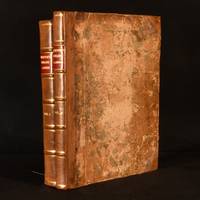
1789ref. 1014H20Lichfield; London: J. Johnson; Printed by J. Jackson 1789-1791. First edition. Leather. Very Good. 11" by 9". William Blake; John Henry Fuseli. A particularly desirable pairing of the first editions of Erasmus Darwin"s complete Botanic Garden transforming botanical science into verse illustrated with engravings by William Blake after Fuseli. In a contemporary half calf binding with marbled paper boards later rebacked and recornered with spine labels. First editions of both parts: The Loves of the Plants although designated Part II was published first in 1789; The Economy of Vegetation followed in 1791 completing The Botanic Garden. The second volume is slightly taller than the first. Part II is seldom encountered in its first edition making its presence here particularly desirable. A fantastic poetic rendering of contemporary botany and science in which Erasmus Darwin 1731-1802 physician naturalist inventor and grandfather of Charles Darwin. In The Economy of Vegetation Darwin celebrates natural philosophy invention and technological progress; in The Loves of the Plants he popularises the Linnaean sexual system of botanical classification through the romances of personified flowers stamens and pistils. The verse is accompanied throughout by extensive philosophical and scientific notes. Volume I is illustrated with an engraved frontispiece engraved by Anker Smith after Henry Fuseli and nine further plates one of which is folding. This copy includes William Blake"s engraving "The Fertilization of Egypt" after a design by Henry Fuseli depicting Anubis and the Nile; the British Museum identifies the plate as Blake"s work. The four Portland Vase engravings are also by Blake produced for The Economy of Vegetation. The four Portland Vase plates are bound at variance with the directions to the binder at the rear: "The Whole Vase" facing p. 53 "The First Compartment" facing p. 54 "The Second Compartment" facing p. 55 and "The Handles" facing p. 58 rather than all four facing p. 88 as called for. Volume II is illustrated with aesigned by Emma Crewe and engraved by Samuel Alken seven further engraved plates and a vignette. The directions to the binder and errata leaf at the end of volume II have been neatly cut down and pasted to the foot of page 184. The first part also includes Darwin"s abolitionist passage inspired by Josiah Wedgwood"s celebrated medallion of the kneeling chained slave invoking the appeal: "Are we not Brethren" Collated complete. Volume I ESTC No.: T82160 Volume II: ESTC No.: T82159 4 b2 B4-2E4 A4-S4; 7 B4-Z4 2A2-2B2 In a contemporary half calf binding with marbled paper boards later rebacked and recornered with spine labels. Externally a little worn. Slight rubbing and bumping to extremities. Rubbing to boards resulting slight surface loss to paper. Worcester Library bookplate to front pastedowns with contemporary ink annotations marked "Fourteen Days" to the first volume. Hinges reinforced. Slight ink offsetting to front free endpaper of volume II. Slight discolouration from binder's glue and light scattered spotting to endpapers. Small ink mark to fore edge of front free endpaper of volume I. Internally firmly bound. Pages characteristically age toned with light scattered spotting heavier to fore edge margins of plates and first and last few leaves more pronounced to volume I notably to the frontispiece and pp. 184-202. Discreet archival repairs to the margins of the plates and first leaves of volume I; slight cropping to the margins of the Portland Vase plates. Small closed tear to lower margins of plates facing pp. 58 and 54 in the additional notes of volume I. Slight cockling to fore edge. Minor edge wear resulting in one or two very small closed tears and chips. Directions to the binder and errata leaf to end of volume II laid down to the foot of pp. 184. Very Good J. Johnson; Printed by J. Jackson hardcover
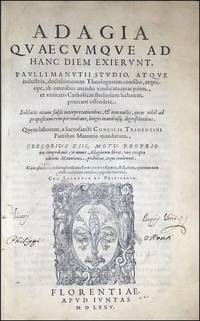
1575ref. 72FINE AND IMPORTANT ALDINE EDITION OF ERASMUS ADAGESErasmus Roterodamus. Adagia quaecumque ad hanc diem exierunt Paulli Manutii studio atque industria . ab omnibus mendis vindicata quae pium et veritatis Catholicae studiosum lectorem poterant offendere: sublatis etiam falsis interpretationibus & nonnullis . digressionibus. Quem laborem a sacrosanti Concilii Tridentini patribus Manutio mandatum Gregorius 13. motu proprio ita comprobauit vt omnes Adagiorum libros vna excepta editione Manutiana prohibeat atque condemnet. Cum plurimis ac locupletissimis indicibus Graecis & Latinis quorum nonnulli nusquam antheac impressi fuerunt. Florentiae apud Iuntas MDLXXV Florence Giunti for the Aldine Press 1575.2° later limp cartonnage handwritten title and library label at spine ff. 4 columns 1454 i.e.1440 ff. 36.Giunti device at title and final leaves. Woodcut headletters. Text in Latin on two columns with some passages in Greek.Aldus Manutius' dedicatory to pope Gregory XIII.Fine and important edition revised by Aldus Manutius the Younger of the renowned collection of Latin and Greek adages sayings proverbs mottos epygrams compiled by Erasmus.Paul Manutius was commissioned by the Fathers of the Council of Trent to correct the work reorder purge by false interpretations and doctrinal errors in order to make this edition the only one approved by the Church the bull of Gregory XIII as stated in the title prohibits and condemns the other editions.Desiderius Erasmus Roterodamus 1466 – 1536 known as Erasmus of Rotterdam or simply Erasmus was a Dutch Renaissance humanist Catholic priest social critic teacher and theologian.Amongst humanists he enjoyed the sobriquet "Prince of the Humanists"; he has been called "the crowning glory of the Christian humanists". Using humanist techniques for working on texts he prepared important new Latin and Greek editions of the New Testament. These raised questions that would be influential in the Protestant Reformation and Catholic Counter-Reformation.Provenance: Ownership signature Philippi Monti at title-page beside the printer device.References: Renouard 220. 14. STC Italian 236; Adams E-443. BMC 236. CNCE 18245 & 18247. Giunti for the Aldine Press paperback
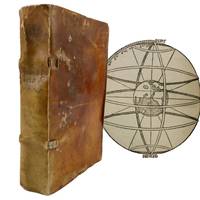
1558ref. 800Wittenberg: Krafft 1558. Softcover. Fair. Misc. A remarkable survivor clearly a student's copy of Sacrobosco's Libellus de Sphaera printed in 1558 with the student's inscription at the bottom of the title page and a question and answer styled study guide bound at the rear 1560 by Hartmann Beyer. The shared shelfmark from the title page to the binding indicates the wallet-style binding may be contemporary to the book. Also this copy still retaining its broadside with the locations of the sun updated since the 365.25 days per calendar year causes yearly drift in the location of the sun by day since the true day is slightly shorter. Sacrobosco's work was first produced around 1230 a text book dedicated to spherical astronomy. Although Sacrobosco did use the Earth as central to all rotation his methods of finding the locations of stars the sun and moon based on elliptical patterns was fairly reliable and became the standard of students for centuries to come. He also correctly identified the world as a sphere. By 1558 the idea of the Earth as the center of the universe was largely dispelled but Sacrobosco's calculations and tables were so good that they were yet to be replaced so academies were updating to accommodate the new science. This copy has the commentary and editing of several 16th century scholars Philip Melanchthon and Erasmus Reinhold as well as a second book with commentary of Hartmann Beyer. The university usage of this copy is clear and to be noted. The scholar one Wolfgang notes at the bottom of the title page that he is studying physics. The 17th century date of study denotes that an older book was still acceptable in studies. Yet despite the later date the binding contains both the 1558 Sacrobosco and essentially a 1560 study guide posing the question ""Has this book been used for study before Wolfgang wrote in it"" A mystery is the Cistercian monastery also holding the work. Did they possess the book before or after Wolfgang Or was it from a different Cistercian monastery that was dissolved during the protestant reformation years leading up to Wolfgang's study Bibliographic Details - 1558 Sacrobosco - Universal Short Title Catalogue USTC number 668014 6 copies recorded in the world's libraries. 1560 Quaestiones. - Universal Short Title Catalogue USTC number 689026 5 copies recorded in the world's libraries and USTC 689025 recording four more copies. Physical Attributes - Measures approx. 15 x 9 x 3 cm. Vellum wallet-style wrapper. Spine with two bands. Spine with author/title in old hand. Sacrobosco's work is illustrated throughout some with diagrams that could be used as the base for moving parts. Sacrobosco - Pages - Not paginated Collation - A-R8 with last two blank leaves present. Collates complete. Beyer - Pages - xxxii 302 2 blank pages last leaf blank Collation - aa8 a8 b-u8 collates complete. Condition - See pictures. Wallet-style vellum binding with wear and cockling waviness. Bottom of flap corner chipped away. Top front strap missing from binding to text block causing looseness still connected in back. No pastedowns used. Matching library number to title page written on front board inner as well as bookseller notes of date/publication and ex libris of Gingerich. 1st gathering almost loose chipping to top edge. Title page heavily annotated with two ex libris. One is the library of a Cistercian monastery and the other is of an early 16th century student. The title page has heavy toning and some chipping along edges. Bottom corner of front of text block dog eared. Throughout text block there is use consistent with student usage. Occasional thumbing dog-eared corners annotations page-edge chips/tears fox spots candle ember marks etc. Occasional moisture mark from edge second half from upper corner worst at last page. Occasional faded page E gathering ink light. Krafft
ref. 1105616592.Gpaperback. Good. Access codes and supplements are not guaranteed with used items. May be an ex-library book. paperback
ref. DADAX0268159408New unknown
ref. DADAX0268020094New unknown
ref. DADAX0268178569New unknown
ref. DADAX0268025525New unknown
ref. DADAX0268044074New unknown
ref. DADAX0195115295New unknown
ref. DADAX0268040516New unknown
ref. DADAX0268040532New unknown
ref. DADAX0268021783New unknown
ref. #[42899]12° geheel leren band uit de tijd 1 6176 pag. 2 91 pag. 3 8229 pag. 3 Bevat ook 'De ratione studii' van Erasmus. Het convoluut bevat ook een vierde werk: Querela pacis. Maire 1641 waarvan de laatste twee bladen D1 en D2 missen. unknown