BERKELEY, GEORGEBiblio.com

2.769 Ergebnisse
1713Best.-Nr. 55993London Printed by G. James for Henry Clements 1713. 8vo. Contemporary marbled full calf boards prettily rebacked in period style with gilt title-label raised bands and gilt ornamentations to spine. During the re-backing new end-papers have been inserted but the original front end-paper containing old owners' inscriptions has been preserved and is still withbound. Three old owners' names to title-page two of them crossed out. The title-page had been repaired at the outer margin affecting three letters in the last three lines of the subtitle To open a Method for rendering the/ SCIENCES more easy useful and/ compensious namely the "he" in "the" and the "d" in "and" as well as part fo the double-ruled border which has been drawn up again. The final leaf with a somewhat crode repair causing loss of some words towards the hinge. A small hole in A3 not repaired. A bit of brownspotting mostly at beginning and end. With its flaws still and overall acceptable copy of this extremely rare title. 10 166 pp. The very scarce first edition of Berkeley's other magnum opus his great work of metaphysics second in importance only to his "Treatise Concerning the Principles of Human Knowledge" 1710. The present work is not only a popularized version of the "Treatise" though it is a fact that it was more widely studied and more easily understood - being written as an almost Platonian dialogue between Hylas Greek for "matter" - thought to be the representative for John Locke and Philonous Greek for "the lover of reason" - Berkeley's spokesman - it also constitutes a thorough and elaborated explanation of Berkeley's central ideas and the emergence of many of the principal thoughts that we now associate with him and his anti-materialist philosophy."In this Treatise which does not presuppose in the Reader any Knowledge of what was contained in the former i.e. the "Treatise" it has been my Aim to Introduce the Notions I advance into the Mind in the most easy and familiar manner; especially because they carry with them a great Opposition to the Prejudices of Philosophers which have so far prevailed against the common Sense and natural Notions of Mankind.If the principles which I here endeavour to propagate are admitted true; the Consequences which I think evidently flow from thence are that Atheism and Scepticism will be utterly destroyed many intricate Points made plain great Difficulties solved several useless Parts of Science retrenched Speculation referred to Practise and Men reduced from Paradoxes to common Sense" Preface pp. 7-8.In the present work Berkeley one of the greatest thinkers of early modern philosophy sets out to alter the direction of philosophy and set straight the boundaries of man's knowledge of himself and the world around him. He seeks to bring back man to common sense and to bring back science and knowledge to that which is essential and factual. In the present work he famously defends the idealism because of which he is still considered one of the greatest metaphysicians ever. As his "Treatise" is remembered today for the famous phrase "Esse est percipi" - to be is to be perceived - so his "Dialogues" is remembered for the introduction of the perceptual relativity argument stating that the same object can have different characteristics e.g. shape colour etc. depending on the perspective of the observer e.g. distance angle light etc. Furthermore as Berkeley had used God in the "Principles" as the CAUSE or originator of our ideas of sense in the "Dialogues" he brings God a very important step further stating that our ideas must EXIST IN God when not perceived by us thus seeing this as the warrant for the continuity of our ideas God being unchanging. This leap from claiming that God must cause our ideas to claiming that our ideas must exist in God that Berkeley thus takes in the "Dialogues" is among the most important within his philosophy guaranteeing continuous existence to physical objects. The work is considered the foremost representative of Berkeley's phenomenalism."George Berkeley Bishop of Cloyne was one of the great philosophers of the early modern period. He was a brilliant critic of his predecessors particularly Descartes Malebranche and Locke. He was a talented metaphysician famous for defending idealism that is the view that reality consists exclusively of minds and their ideas. Berkeley's system while it strikes many as counter-intuitive is strong and flexible enough to counter most objections. His most-studied works the Treatise Concerning the Principles of Human Knowledge Principles for short and Three Dialogues between Hylas and Philonous Dialogues are beautifully written and dense with the sort of arguments that delight contemporary philosophers. He was also a wide-ranging thinker with interests in religion which were fundamental to his philosophical motivations the psychology of vision mathematics physics morals economics and medicine. Although many of Berkeley's first readers greeted him with incomprehension he influenced both Hume and Kant and is much read if little followed in our own day." SEP.Berkeley published his first important philosophical work "Essay Toward a New Theory of Vision" in 1709 aged 24. The book was well-received and a second edition came out later that same year. The following year he published "A Treatise Concerning the Principles of Human Knowledge" in which he sought to lay out a complete philosophical system based on the idea that the only existing entities in the world are ideas and the mind that perceives them. The work was not very well received however. This did not affect his search for truth though and he continued the outlay of his philosophical system in his "Three Dialogues between Hylas and Philonous" which was printed in 1713. Though neither of the two works were well received and appeared in small numbers they are by far the most important and enduring of all of his works. The view that he presents in the "Dialogues" is that which he called "immaterialism" now "idealism". He considered this anti-materialism the perfect answer to and refutation of skepticism and atheism and his theories later became the foundation of much idealistic philosophy."Upon the common Principles of Philosophers we are not assured of the Existence of Things from their being perceived. And we are taught to distinguish their real Nature from that which falls under our Senses. Hence arise Scepticism and Paradoxes. It is not enough that we see and feel that we taste and smell a thing. Its true Nature its absolute external Entity is still concealed. For tho it be the Fiction of our own Brain we have made it inaccessible to all our Faculties. Sense is fallacious Reason defective. We spend our Lives in doubting of those things which other Men evidently know and believing those things which they laugh at and despise." Preface p. 6.The first edition of this important work is very difficult to find. It was published in an edition together with the "Treatise" in 1734 which though also scarce is the edition of the work that most libraries and institutions have in their holdings seeing that the first editions of both works are of even greater scarcity. We have only been able to locate three copies in libraries worldwide. hardcover
1994Best.-Nr. DADAX1565920805Brand: O'Reilly Media 1994-06-01. 1. paperback. New. 7.25x1.25x9.00. Buy with confidence. Excellent Customer Service & Return policy. Brand: O'Reilly Media paperback
2012Best.-Nr. DADAX052115863XCambridge University Press 2012-03-29. Reissue. paperback. New. 5.51x1.06x8.50. Buy with confidence. Excellent Customer Service & Return policy. Cambridge University Press paperback
2000Best.-Nr. DADAX0521498066Cambridge University Press 2000-07-27. paperback. New. 6.00x0.78x9.00. Buy with confidence. Excellent Customer Service & Return policy. Cambridge University Press paperback
Best.-Nr. DADAX03951210350000-00-00. First Edition. hardcover. New. xx. Buy with confidence. Excellent Customer Service & Return policy. hardcover
Best.-Nr. DADAX03957334560000-00-00. Revised Updated. paperback. New. 7.75x1.25x11.25. Buy with confidence. Excellent Customer Service & Return policy. paperback
1991Best.-Nr. DADAX0792315200Springer 1991-11-30. 1992. hardcover. New. 6.56x0.81x9.56. Buy with confidence. Excellent Customer Service & Return policy. Springer hardcover
2009Best.-Nr. DADAX0807896187The University of North Carolina Press 2009-10-14. paperback. New. 5.75x0.77x9.00. Buy with confidence. Excellent Customer Service & Return policy. The University of North Carolina Press paperback
2007Best.-Nr. SONG0230521649MACMILLAN 2007-04-17. 2007. hardcover. Used: Good. 5.87x0.73x8.62. Buy with confidence. Excellent Customer Service & Return policy. MACMILLAN hardcover
Best.-Nr. SONG0811852547Chronicle Books 0000-00-00. Cards. Used: Good. 1.00x1.00x1.00. Buy with confidence. Excellent Customer Service & Return policy. Chronicle Books unknown
2003Best.-Nr. SONG0742526720Rowman & Littlefield Publishers 2003-05-28. paperback. Used: Good. 5.30x0.31x8.44. Buy with confidence. Excellent Customer Service & Return policy. Rowman & Littlefield Publishers paperback
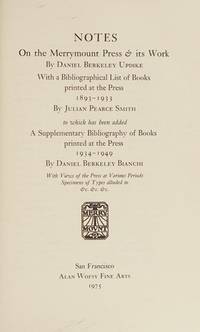
1975Best.-Nr. SONG0915346109Brand: Alan Wofsy Fine Arts 1975-05-01. hardcover. Used: Good. 0.00x0.00x0.00. Buy with confidence. Excellent Customer Service & Return policy. Brand: Alan Wofsy Fine Arts hardcover
Best.-Nr. A12OS-00501American Philosophical Society. Used - Very Good. Very Good condition. Good dust jacket. A copy that may have a few cosmetic defects. May also contain light spine creasing or a few markings such as an owner’s name short gifter’s inscription or light stamp. American Philosophical Society unknown
1931Best.-Nr. 1031H37London: Hodder & Stoughton 1931. First edition. Cloth. Very Good. 7.5" by 5". None Stated. The very scarce first edition of this Golden Age detective novel collaboratively written by Agatha Christie Dorothy L. Sayers G. K. Chesterton and eleven fellow members of the Detection Club. In the publisher's original blue cloth binding. First edition. Complete with the half-title and full-page map to the verso. Undated. Daed here using Jisc from copies helf at the University of Oxford Libraries and the National Library of Wales. A remarkable collaborative detective novel by fourteen leading members of the Detection Club including Agatha Christie Dorothy L. Sayers G. K. Chesterton and Anthony Berkeley among others. Each chapter was written by a different author who was required to develop the mystery while accounting for the clues and complications introduced by their predecessors The novel follows Inspector Rudge's investigation into the mysterious death of a man discovered in a rowing boat near the sleepy seaside village of Whynmouth. In the publisher's original cloth binding. Externally generally smart. Spine faded; slight fading to extremities. Slight rubbing and bumping to extremities more so to spine ends and corners. Cloth faded and discoloured to spine and extremities with one or two light marks. The odd light mark to rear board. Slight offsetting to endpapers with the odd small light spot. Internally firmly bound. Pages bright and clean if slightly age toned. Light scattered spotting to fore edge heavier to first and last few leaves. Very Good Hodder & Stoughton hardcover
1744Best.-Nr. 1028Y10London: W. Innys and C. Hitch 1744. Leather. Good. 8" by 5". None. One of the last publications from "the father of idealism" George Berkeley in which he argues for the medicinal properties of tar-water. A new London edition published the same year as the first and second London editions. ESTC No.T45794Register: A-Y4. Collated complete. With the final contents leaf. In a contemporary quarter calf biniding with marbled paper covered boards. Original endpapers. One of the last two publications of Anglo-Irish philosopher writer and clergyman George Berkeley noted for developing the theory which later came to be known as subjective idealism. In this work Berkeley advocates for the medicinal uses of tar water claiming it acted as a panacea and health tonic for ailments ranging from smallpox and fevers to everyday illnesses. Though the method was regarded by medical experts to be a quackery Siris became immensely popular and tar-water spread all around Europe and even reached America. The craze remained a famous cultural and literary reference well into the 19th century. In a contemporary quarter calf biniding with marbled paper covered boards. Externally sond with rubbing to the extremities and fading to the marbled boards. Minor loss to the head and tail of the spine. Hinges are starting but firm. Internally front free endpaper working loose slightly to the head otherwise firmly bound. Pages are bright and clean with the odd spot. Small closed tear to the title page. Good W. Innys and C. Hitch hardcover
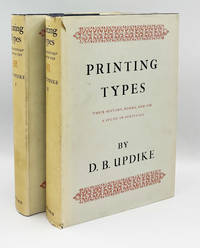
1962Best.-Nr. 009808Cambridge Massachusetts: The Belknap Press of Harvard University Press 1962 2 vols. 8vo 24 cm XLVI 292 pp. 192 plates; XIX 326 pp. plates 193-367. Publisher's cloth and dust jacket jackets slightly sunned and rubbed at extremities jacket of vol. 2 somewhat creased at head. Third edition first published 1922 at the Merrymount Press of Updike's monumental and enduring survey of Western printing types from the invention of printing to the early twentieth century. With a preface by Lawrence C. Wroth of the John Carter Brown Library. Volume I covers the invention of printing the development of the Latin alphabet casting and point systems and the types of the fifteenth and sixteenth centuries surveyed country by country -- Germany the Netherlands and Belgium France Italy Spain and England -- together with discussions of Aldine italic early roman and black-letter traditions and German foundries; Volume II continues with Netherlandish Spanish English including Caslon Baskerville and other founders Italian and French types through the eighteenth century followed by studies of the Didot family Bodoni the nineteenth-century classical revival and English and American types from 1800 to 1844 concluding with chapters on industrial conditions of the printing trade censorship production rates and a chronological list of specimens notes and index. Extensively illustrated with 367 plates reproducing type specimens title-pages and typographic details the work combines historical narrative with detailed typographical analysis and remains a foundational reference for typographers book historians and students of printing. The Belknap Press of Harvard University Press hardcover
1972Best.-Nr. 232591972. Prison and IncarcerationSocial activism Prison reform organizing conference broadside. Attica and San Quentin prison organizing stand at the center of this January 1972 Berkeley conference broadside which opens with a Brecht quote "Slave who is it that shall free you.all of us or none" and declares that "no one in America today is more a slave than the inmates in American prisons." The text ties prison struggle to "class and racial oppression" names the murders at Attica and San Quentin and frames the prison system as a site of beatings drugs "behavior modification" and brain surgery schemes. The conference was held just a few months after the 1971 Attica uprising during which prisoners revolted against inhumane treatment and racial discrimination in a violent struggle that left 39 dead. The conference roster grounds the prison rights moment Bay Area Black liberation featuring figures including Afeni Shakur Fay Stender and former Soledad Prison chief psychiatrist Frank Rundle. "Slave Who Is It Shall Free You . . . All of Us or None." The Struggle Inside. Prison Action Conference. Berkeley 1972. Single-sheet broadside 8.5 x 11 inches for a prison action conference scheduled for January 28-30 in Pauley Ballroom UC Berkeley printed on both sides. Recto features two halftone prison photographs and a dense typed manifesto arguing that prisoner demands had moved "from traditional demands for food and shelter to demands for civil and religious rights and finally to a general challenge to the prison system and the society which fosters it." It announces the conference as "a forum for self education and exploration of potential action to assist the prison movement" with key speakers Afeni Shakur a defendant in the Panther 21 trial Fay Stender a Berkeley attorney with years of prison movement experience and Frank Rundle former chief psychiatrist at Soledad Prison. Verso gives the full three-day program: Friday evening remarks by Stender and Shakur; Saturday sessions on "Medical Repression in Prisons" "Adult Authority and Indeterminate Sentencing" "Economics of Prisons" "Juvenile Reformatories and Detention" and "Prisoners Demands"; and Sunday sessions on "Women in Prison" "Defense of Political Prisoners" "Military Prisons" "Prison-Community Communications" "Prisoners Organizations" "County Jails and Pre-trial Detention" plus a closing "Panel Discussion on Racism." The broadside illustrates the actions and intentions of the Berkeley prison movement at a time when prison rebellion legal defense anti-racist analysis and ex-prisoner testimony were being brought before public audiences in the aftermath of the Attica Uprising. Afeni Shakur's appearance links the handbill to the political world of the Black Panther movement while the inclusion of sessions on women in prison political prisoners juvenile detention county jails and medical repression demonstrate the intersectional goals of the movement and the broadening of post-Attica activism from outrage over one massacre to a larger indictment of prison administration and criminal punishment. Some light staining; otherwise very good condition. A Bay Area prison movement piece that preserves both the rhetoric and the working program of organizing against U.S. imprisonment in the immediate aftermath of the 1971 Attica Uprising. unknown
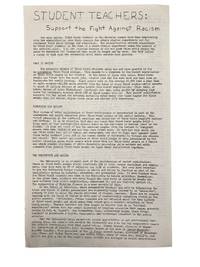
1969Best.-Nr. 232621969. Student ActivismAnti-Racism UC Berkeley student organizing broadside advocating for Third World Studies and against racist education policy. "Third World students" voice a demand for "an autonomous Third World college" and the rejection of a Black Studies department "under the control of the administration." The broadside ties those demands to the School of Education and the political responsibilities of future teachers naming "the suppression of Eldridge Cleaver" as an example of how the university functioned within "the perpetuation of racist exploitation." Its argument is built section by section through "What Is Racism" "Education and Racism" "The University and Racism" "Third World Fight Against Racism" "Student Teachers" and "The Education Caucus" moving from campus labor and admissions policy to housing wage inequality Vietnam era military service and public school teaching. Student Teachers: Support the Fight Against Racism. Education Caucus. Berkeley circa 1969. Mimeographed leaflet 2 pages on one sheet printed recto and verso 8.5 x 14 inches. The text opens by stating that "for nine months Third World students on the Berkeley campus have been negotiating with the administration" then argues that administrative concessions left control of curriculum and hiring in university hands. Subsequent sections sharpen that claim through specific figures and institutions asserting that Black people make "on the average $2500 less a year than do white workers" that "44% of black people live" in inadequate housing and that "over 70% of the combat deaths of California in Vietnam are chicano and black." The School of Education material is especially pointed arguing that future teachers receive "no courses dealing with the basis of racism or with ways of realistically combatting racism in the public schools" and calling on student teachers to "boycott all classes on campus" and join picketing "at the Sather Gate picket line from 11:00-2:00 every day." The leaflet closes with meeting information for the Education Caucus and three telephone numbers for organizing support. The piece belongs to the Berkeley strike wave that produced the most consequential campus battle over Third World Studies and Ethnic Studies in the United States. By directing an appeal to student teachers invoking New York teachers' strikes and proposing "a 199 course next quarter" and ultimately "a permanent course on racism and teaching Third World students" it documents a concrete goal of anti-racist student protest to improve the training and awareness of educators in racial inequality. Light toning and a few light ink marks; clean and sound overall; overall very good condition. A Berkeley student broadside linking the Third World Liberation Front strike to teacher training curriculum and the formation of anti-racist educational practice. unknown
2010Best.-Nr. DADAX1164922378Kessinger Publishing 2010-09-10. paperback. New. 6.00x0.72x9.00. Buy with confidence. Excellent Customer Service & Return policy. Kessinger Publishing paperback
2010Best.-Nr. DADAX1164642227Kessinger Publishing 2010-09-10. paperback. New. 6.00x0.76x9.00. Buy with confidence. Excellent Customer Service & Return policy. Kessinger Publishing paperback
2010Best.-Nr. DADAX1165162962Kessinger Publishing 2010-09-10. paperback. New. 6.00x0.88x9.00. Buy with confidence. Excellent Customer Service & Return policy. Kessinger Publishing paperback
2010Best.-Nr. DADAX1165345412Kessinger Publishing 2010-09-10. paperback. New. 6.00x0.74x9.00. Buy with confidence. Excellent Customer Service & Return policy. Kessinger Publishing paperback
2022Best.-Nr. DADAX1684059283IDW 2022-10-18. paperback. New. 11.06x0.88x8.56. Buy with confidence. Excellent Customer Service & Return policy. IDW paperback
1874Best.-Nr. 69444Philadelphia: J.B. Lippincott & Co 1874. Philadelphia: J.B. Lippincott & Co. 1874. Full Description: BERKELEY George. A Treatise Concerning the Principles of Human Knowledge. With Prolegomena and with Annotations Select Translated and Original by Charles P. Krauth D.D. Philadelphia: J.B. Lippincott & Co. 1874. First American edition of the book which shook the intellectual world with its theory of immaterialism. Octavo 8 3/4 x 5 3/4 inches; 222 x 144 mm. 2 blank 424 2 blank pp. Publisher's full orange cloth. Boards ruled in blind. Spine stamped and lettered in gilt. Brown coated endpapers. Previous owner's ink name on front and back pastedown. Some minor rubbing to head and tail of spine and corners. Otherwise about fine. "The principle which underlay all Berkeley's philosophical writing was based on a rejection of all speculation such as Locke's about the meaning and necessity of matter as a primal necessity to any theory of human understanding. Briefly Berkeley maintained that no existence is conceivable or possible which is not conscious spirit or the ideas of which such a spirit is conscious. This presupposes complete equation of subject and object: no object can exist without a Mind to conceive it. Without the pre-existence of the Mind mater and substance cause and effect can have no meaning. In the Principles externality absolutely independent of all mind is shown to be an unreal impossible conception: true substance is the conscious spirit and true causality the free action of such a spirit. Physical substance and causes are relations among phenomena arbitrary though by the action of the Mind constant. Connexions between them are viewed subjectively as the suggestion or associations of the human mind and objectively as the operation of the Universal Mind. Thus the universe is the sum of human experience and forms a symbol of the divine universal intelligence: esse est percipi" Printing and the Mind of Man. Norman Library 196. PMM 176. HBS 69444. $1500. J.B. Lippincott & Co unknown
2010Best.-Nr. DADAX1160807256Kessinger Publishing 2010-03-19. paperback. New. 6.00x0.77x9.00. Buy with confidence. Excellent Customer Service & Return policy. Kessinger Publishing paperback