213 résultats
2010réf. 1396097Dublin: University College of Dublin Press 2010. Hardcover. Octavo ix 211 pages. In Very Good condition with a Very Good dust jacket. Spine is orange with white print. Boards in black cloth. Illustrated: 1 b&w plate portrait. Inscribed in ink by the author on the title page. NOTE: Shelved in Netdesk Column R. 1396097. FP New Rockville Stock. University College of Dublin Press hardcover books
1969réf. 180251969. Distributed by the Radical Student Union at UC Berkeley. Outcry! from Occupied Berkeley. Vol. 2. May 1969. Quadruple folded. This newsletter gives the chronology of the clash over People's Park that occurred on May 15 1969 which was precipitated by the University's desire to turn a lot near campus that it had razed and purchased into a sports arena. The University aggressively acquired this land and razed the buildings on it due to concerns about growing crime. However in the months that followed hippies and other people in the community started to repurpose the land which had fallen into disrepair to create a community space with functional gardens and leisure areas and thus People's Park was born. The Park was soon enclosed and patrolled by National Guardsmen until the tension reached a fever pitch on May 15 when an Alameda County Sheriff's Deputy fired upon a peaceful onlooker James Rector who later died from his wounds. This newsletter gives this history in greater details and calls upon people to rally to People's Park. It denounces capitalist property relations the Vietnam War and imperialism police brutality and sexism. On verso is a print of a fist emerging from a rose that has sundered the earth around it with the slogan "Let a thousand parks bloom." In very good condition. unknown books
1973réf. 194179Berkeley CA: Berkeley Committee for a Shorter Work Week 1973. Pamphlet. 16p. wraps staples rusted with some staining 8.5x11 inches. Cartoon on cover shows three workers leaving at 5 PM exhausted then four workers in the same office leaving at 3 PM smiling. Support for the Shorter Work Week Initiative which was on the Berkeley City ballot in April 1973. Berkeley Committee for a Shorter Work Week unknown books
1968réf. ZZ1076New York:: Burt Franklin 1968. 1968. Reprint of the 1934 edition. Series: Burt Franklin: Bibliography & Reference Series 234; Philosophy Monographs Series 21. 8vo. xvi 99 pp. Index. Red cloth gilt-stamped spine title. Fine. Over 500 separate entries recorded. Burt Franklin, 1968. hardcover books
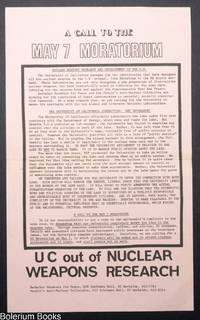
1970réf. 340519Berkeley CA: UC Berkeley 1970. Handbill. 8.5x13.5 inch handbill on pink paper; minor midcrease otherwise in very good condition. "For more than two years BSP Berkeley Students for Peace pressured the university to take an active stand in favor of converting the labs and opening them up to public review. We resisted for that time calling for severance. Now we believe it is quite clear that the university will not not exert even the most minimal amount of control or influence over the labs needed to make the accountable. [UC Berkeley] unknown books
réf. 8876pamphlet. 24 pages. Slim 8vo original blue printed wrappers. London 1876. A very good copy. unknown books
1970réf. 143592Berkeley: Boalt Hall Action Committee 1970. 72p. staplebound pamphlet 6.75x9.75 inches minor handling wear very good condition. Boalt Hall Action Committee unknown books
1952réf. 625240Chicago: William Benton / Encyclopedia Britannica 1952. Hardcover. Fine. Reprint. Volume 35 in the series. Tall octavo. x 509pp. Spine mildly age-toned else fine. William Benton / Encyclopedia Britannica hardcover books
1752réf. 67002Dublin: George Faulkner 1752. First Dublin edition. 12mo. 265 i.e. 262 pp. Pages 55-58 and 77-84 are cancels pages 85-86 omitted in numbering. Eleven tracts published separately 1721-1752 each with a separate title page. Includes A Proposal for the better supplying of Churches in our Foreign Plantations and for converting the savage Americans to Christianity by a College to be erected in the Summer-Islands otherwise called the Isles of Bermuda 1725. Berkeley 1685-1753 born in Kilkenny and an Anglican bishop served on a mission to America living in Rhode island 1728-1732 and afterward was named the Bishop of Cloyne 1734 to his death; his writings placed him among the important 18th-century British philosophers. Keynes Bibliography of George Berkeley 140. Contemporary calf rubbed some wear to joints and spine ends leather label between raised bands on spine. Very good. George Faulkner unknown books
1725réf. 371588London: H. Woodfall 1725. 24pp. 8vo. Nineteenth century half red morocco and marbled boards minor wear. Numerical stamp on verso of title bookplate. 24pp. 8vo. Proposes the creation of a college in Bermuda for training young American Indians to serve as missionaries throughout the British colonies. First published the year prior. Scarce. ESTC T14337; Sabin 4878 H. Woodfall unknown books
1938réf. 70676NY: Doubleday 1938. Hardcover. Good. Hardcover. Reprint. Boards lightly rubbed corners bumped spine sunned else a good example in publisher's black cloth lettered in red. Doubleday hardcover books
1995réf. 215264Pa: Dorrance 1995. Softcover. Fine. First edition. Fine in wrappers. Paper covers clean text and covers publisher's info laid in very mild wear on top cover corner. Dorrance unknown books
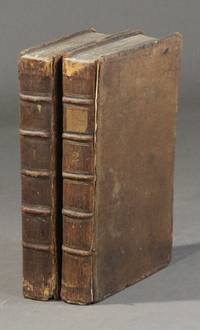
1732réf. 2329641London: Printed for J. Tonson in the Strand 1732. Second Edition. Full-Leather. Good/No Jacket. Second edition. Neatly rebacked with new gilt titles original boards and endsheets retained. Discolored 2 inch declivity on front board boards rubbed with corners exposed first volume lacks leaf A4 ink owner stamps on front endpapers William Harris Mar 1944 light stain to marginal edges of first gathering in volume two front and end matter lightly foxed rear free endpaper of first volume loosening. 1732 Full-Leather. 356; 351 pp. Alciphron is a Christian apologetic in answer to the 'minute philosophers' of Berkeley's day who sought to minimize the the dignity of man. Berkeley is known as an advocate of subjective idealism which he called immaterialism which states that objects do not exist unless they are perceived. "A Treatise Concerning the Principles of Human Knowledge 1710 is the classic exposition of his philosophy of immaterialism as an antidote to infidelity prefaced with an influential essay in the philosophy of language; part two was later lost in manuscript with other papers in Italy." - Oxford Dictionary of National Biography Perhaps his most well-known work is Three Dialogues between Hylas and Philonous in which two characters representing himself and John Locke discuss various philosophical questions. Berkeley was a fellow at Trinity College and in the 1720s turned his attention to the project of opening St. Paul's College in Bermuda though skepticism about the chances of success in this endeavor caused the funding to come into question. "To prevent a threatening decline in private support Berkeley sailed for Newport Rhode Island with a small advance party on 6 September 1728; this included Smibert who painted several well-known portraits of Berkeley and of his party before settling for life in Boston. The journey was hazardous and protracted. They made an unscheduled landfall on the Virginia coast about the turn of the year and were officially received at Williamsburg before reaching Rhode Island on 23 January 1729. By the spring Berkeley had bought a farm of 96 acres at Middletown 'with two fine groves and winding rivulet upon it' Works 8.194 whose produce would support the college. He employed slaves and was apparently indifferent to the institution of slavery provided that it was humane seeing the moral need rather as one of conversion and baptism. He built a new house Whitehall which is now maintained as a historic site although the adjoining farmland has given way to urban development. Berkeley often preached at Newport Rhode Island in the winter and in remoter outposts in the summer. The strongest and longest friendship he established among New England churchmen was with Samuel Johnson 1696 - 1772 of Stratford Connecticut a refugee from Calvinism who later became first president of King's College New York later Columbia University and lent support to Berkeley's philosophy through his Elementa philosophica 1752 and other writings. Throughout his career Berkeley had little time for dissenters although he abhorred the use of violence against them. The religious tolerance characteristic of Rhode Island induced a degree of ecumenicism in his social practice that was not always maintained in the pulpit. Reports of growing infidelity in English society to which he was always liable to give credence were fuelled by the continuing bad faith of the government in failing to lodge the funds he considered legally his. This was a factor in his writing Alciphron a set of dialogues located notionally in England but drawing much of the landscape description from Rhode Island which was to sell well and stimulate controversy after his return. In this theist and immaterialist combine their defences against a medley of intellectual trends derived primarily but not exclusively from Locke Bernard Mandeville and the third earl of Shaftesbury that Berkeley regarded as obstructive to religion. The work includes Berkeley's second foray into moral philosophy." - Oxford Dictionary of National Biography Printed for J. Tonson in the Strand hardcover books
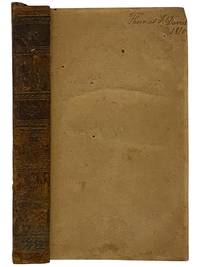
1803réf. 2353260New-Haven Connecticut: For Increase Cooke & Co 1803. First American Edition. Full-Leather. Fair/No Jacket. First American edition from the fourth London edition. Lacks front board spine and rear board rubbed and drying two light spots on fore edge ink name and date on front endpaper brief pencil notes on rear endpaper. 1803 Full-Leather. xiii 2 16-388 2 pp. Complete in one volume. Alciphron is a Christian apologetic in answer to the 'minute philosophers' of Berkeley's day who sought to minimize the the dignity of man. Berkeley is known as an advocate of subjective idealism which he called immaterialism which states that objects do not exist unless they are perceived. "A Treatise Concerning the Principles of Human Knowledge 1710 is the classic exposition of his philosophy of immaterialism as an antidote to infidelity prefaced with an influential essay in the philosophy of language; part two was later lost in manuscript with other papers in Italy." - Oxford Dictionary of National Biography Perhaps his most well-known work is Three Dialogues between Hylas and Philonous in which two characters representing himself and John Locke discuss various philosophical questions. Berkeley was a fellow at Trinity College and in the 1720s turned his attention to the project of opening St. Paul's College in Bermuda though skepticism about the chances of success in this endeavor caused the funding to come into question. "To prevent a threatening decline in private support Berkeley sailed for Newport Rhode Island with a small advance party on 6 September 1728; this included Smibert who painted several well-known portraits of Berkeley and of his party before settling for life in Boston. The journey was hazardous and protracted. They made an unscheduled landfall on the Virginia coast about the turn of the year and were officially received at Williamsburg before reaching Rhode Island on 23 January 1729. By the spring Berkeley had bought a farm of 96 acres at Middletown 'with two fine groves and winding rivulet upon it' Works 8.194 whose produce would support the college. He employed slaves and was apparently indifferent to the institution of slavery provided that it was humane seeing the moral need rather as one of conversion and baptism. He built a new house Whitehall which is now maintained as a historic site although the adjoining farmland has given way to urban development. Berkeley often preached at Newport Rhode Island in the winter and in remoter outposts in the summer. The strongest and longest friendship he established among New England churchmen was with Samuel Johnson 1696 - 1772 of Stratford Connecticut a refugee from Calvinism who later became first president of King's College New York later Columbia University and lent support to Berkeley's philosophy through his Elementa philosophica 1752 and other writings. Throughout his career Berkeley had little time for dissenters although he abhorred the use of violence against them. The religious tolerance characteristic of Rhode Island induced a degree of ecumenicism in his social practice that was not always maintained in the pulpit. Reports of growing infidelity in English society to which he was always liable to give credence were fuelled by the continuing bad faith of the government in failing to lodge the funds he considered legally his. This was a factor in his writing Alciphron a set of dialogues located notionally in England but drawing much of the landscape description from Rhode Island which was to sell well and stimulate controversy after his return. In this theist and immaterialist combine their defences against a medley of intellectual trends derived primarily but not exclusively from Locke Bernard Mandeville and the third earl of Shaftesbury that Berkeley regarded as obstructive to religion. The work includes Berkeley's second foray into moral philosophy." - Oxford Dictionary of National Biography For Increase Cooke & Co hardcover books
2010réf. NF3401Alciphron or The Minute Philosopher. In Seven Dialogues. Containing an Apology for the Christian Religion against those who are called Free-thinkers From Sidney's Press for Increase Cooke & Co. 1803 first American edition both covers detached spine starting to join them staining to the text block but with all contents still easily readable else there in what most certainly looks like the original leather binding speaking of which a new one here vouldn't hurt. An important book in the Philosophy Canon by this author from which came the name of a certain city in Northern California not to mention an university of some renown as well. From the library of the former premier Walt Whitman collector bibliophile and philanthropist Charles Feinberg. From Sidney's Press, for Increase Cooke & Co. hardcover books
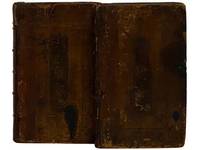
1732réf. 369350London: Printed for J. Tonson in the Strand 1732. Hardcover. Fair. Second edition. Two volumes. Octavos. Volume two includes: "An Essay Towards a New Theory of Vision" with a separate title page. Illustrated with engraved title vignettes woodcut headpieces and tailpieces including one signed tailpiece in volume one. Contemporary calf over boards edges stained red. "G: Berkeley" written in ink on front free endpaper of Vol. 1. Ex-library with bookplates and paper shelf label on spines boards are worn and detached the lower right corner of the title page in Vol. 1 is torn away effecting the final two numerals of the letterpress date and the corner of the double-ruled letterpress border; small three-digit number stamp on the bottom margin of the first Contents page in each volume else a good only sound set with scattered foxing. Both text blocks are suitable for rebinding. A classic philosophical work written when Berkeley was resident in America. ESTC T86055. Printed for J. Tonson in the Strand hardcover books
1732réf. 26337London: J. Tonson 1732. 2 vols. 8vo pp. 14 356; 8 218; engraved vignette title-pp.; bound with as issued An Essay towards a New Theory of Vision pp. 12 215-351; several woodcuts in the text; full contemporary calf double gilt rules on covers unlettered spines in 6 compartments volume designations in 1; some moderate chipping and cracking of the spines but all in all a good and reasonably sound set. Rothschild 372 citing the first edition of the same year: "Alciphron was written in America where Berkeley had gone to await funds which never came for his projected College in the Bermudas. J. Tonson unknown books
1917réf. 5752fdPhiladelphia: W. B. Saunders 1917. First Edition. Octavo green cloth hardcover 143 15 ads pp. Fine. W. B. Saunders, 1917. First Edition. hardcover books
1974réf. 46231Berkeley CA: Committee for Arts and Lectures UC Berkeley 1974. Pamphlet. Fine. Octavo 23 cm program consisting of a single folded sheet. Friday April 26th 1974. Dame Judith read from the works of Robinson Jeffers and Shakespeare. List of coming events on back of program includes a performance by Marcel Marceau. Committee for Arts and Lectures, UC Berkeley unknown books
1800réf. 25312Philadelphia: Way & Groff 1800. First edition. 34pp. 1 vols. 8vo. Disbound and resewn. Apart from some staining a very good copy. First edition. 34pp. 1 vols. 8vo. The author argues that the class of medicines commonly known as 'sedatives' are actually stimulants. He considers the likes of digitalis opium nitre and saccharum. Scarce: OCLC locates 5 copies. Evans 36942 Way & Groff unknown books
réf. 281741Unbound. Near Fine. Two pages on both sides of a single leaf. Near fine. "Mr. Berkeley Paget requests W. Jeffery will procure for him and send to the above address 'Dufieff's Nature Displayed' and also his dictionary in French." Paget served as Lord High Commissioner. Paget requests the new edition in five volumes so this letter was written after 1811. unknown books
1978réf. 84948New York: Charles Scribners's Sons 1978. 1st ed. Paperback. Near Fine/Very Good. illustrations index xviii 565p. Original cloth. dj. 24cm. Two errata sheets laid in. Charles Scribners's Sons paperback books
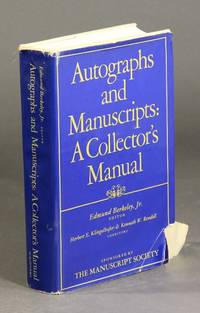
1978réf. 19381New York: Charles Scribner's Sons 1978. cloth dust jacket. thick 8vo. cloth dust jacket. xx 565 pages. First edition. Fine in fine dust jacket. Introduction by Clifton Waller Barrett followed by sections on the Fundamentals Rudiments and Areas in Which to Collect. Includes sections on forgery and forgers. Charles Scribner's Sons unknown books
1978réf. 28549New York: Charles Scribner's Sons 1978. First edition; 8vo; pp. xviii 2 565; numerous illustrations in the text; very good in good jacket with tears no loss and wrinkles on extremities. Co-edited by Herbert E. Klingelhofer and Kenneth W. Rendell. Sponsored by The Manuscript Society. Inscribed by Ken Rendell and contributor Diana Rendell "for 'the girls of Chicago' with best wishes 12/20/78." A comprehensive work valuable to any collector. Charles Scribner's Sons unknown books
1939réf. 137986Beverly Hills CA: Metro-Goldwyn-Mayer MGM 1939. Vintage photograph from the 1939 film musical based on the 1937 Rogers and Hart Broadway musical play of the same name. With a printed snipe on the verso along with the stamp of Culver Pictures photo bureau a date stamp of "Dec 1939" and manuscript annotations regarding layout. Rooney and Garland sing "God's Country" from the finale of the musical in a scene spoofing Franklin and Eleanor Roosevelt and the FDR's fireside chats. This scene was cut from the film after Roosevelt's death and believed lost until it was rediscovered and restored in 1990s. Rooney received a Best Actor nomination for his role in the film. 10 x 8 inches. Very Good. Pinholes to the corners with pinholes at the corners and light wear to the margins. Hirschhorn p. 167. Metro-Goldwyn-Mayer [MGM] unknown books