Jung Michael WilhelmBiblio.com

8 297 résultats
2014réf. __363948522XAV Akademikerverlag 2014. Paperback. New. 148 pages. German language. 8.66x5.91x0.34 inches. AV Akademikerverlag paperback
2014réf. 1-363948522XAV Akademikerverlag 2014. Paperback. New. 148 pages. German language. 8.66x5.91x0.34 inches. AV Akademikerverlag paperback
réf. 363948522X.Gpaperback. Good. Access codes and supplements are not guaranteed with used items. May be an ex-library book. paperback
réf. 115021Gios Inc. paperback. Like New. 6x0x8. Looks unread with just a touch of shelf wear. D63 Please email for photos. Gios Inc paperback
1951réf. 4987Paris, Payot (Bibliothèque Scientifique), 1951 ; in-8, broché ; 352 pp.
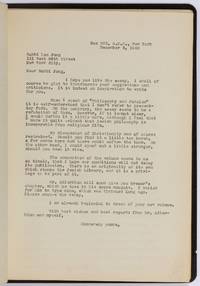
1942réf. 611483New York 1942. Softcover. Very Good. Carbon typescript with manuscript edits. Small quarto.2 2-34pp. printed and paginated rectos only. Clothbacked plastic Accopress biding with metal fastener. Binding modestly worn and metal fastener a bit oxidized very good or better. The document opens with an unsigned letter from Adlerblum to New York City Rabbi Leo Jung. In the letter dated December 9 1942 Adlerblum expresses her gratitude for being able to write for Jung and that she is very much open to her suggestions. One interesting passage concerning her discussion of Christianity which she describes as "restrained": "Should you find it a little too harsh a few words here and there could soften the tone. On the other hand I could speak out a little stronger should you deem it wise." The book Adlerblum is referring to is the anthology In Israel of Tomorrow edited by Rabbi Jung and published in 1946 by Herald Square Press. The essay was published as "Gersonides in Jewish Thinking of Tomorrow." Adlerblum was a suitable candidate to write on the great Mediaeval philosopher Talmudist and scientist Gersonides born Levi ben Gershon and also known as Magister Leo Hebraeus: she wrote her PhD dissertation on him and it was published by Columbia University Press in 1926. According to the Jewish Women's archive among much other writing Adlerblum contributed to several volumes of Rabbi Jung's Jewish Heritage Series. After her death Rabbi Jung called Adlerblum's life "a unique manifestation of the human spirit.". unknown
1942réf. 611483New York 1942. Softcover. Very Good. Carbon typescript with manuscript edits. Small quarto.2 2-34pp. printed and paginated rectos only. Clothbacked plastic Accopress biding with metal fastener. Binding modestly worn and metal fastener a bit oxidized very good or better. The document opens with an unsigned letter from Adlerblum to New York City Rabbi Leo Jung. In the letter dated December 9 1942 Adlerblum expresses her gratitude for being able to write for Jung and that she is very much open to her suggestions. One interesting passage concerning her discussion of Christianity which she describes as "restrained": "Should you find it a little too harsh a few words here and there could soften the tone. On the other hand I could speak out a little stronger should you deem it wise." The book Adlerblum is referring to is the anthology In Israel of Tomorrow edited by Rabbi Jung and published in 1946 by Herald Square Press. The essay was published as "Gersonides in Jewish Thinking of Tomorrow." Adlerblum was a suitable candidate to write on the great Mediaeval philosopher Talmudist and scientist Gersonides born Levi ben Gershon and also known as Magister Leo Hebraeus: she wrote her PhD dissertation on him and it was published by Columbia University Press in 1926. According to the Jewish Women's archive among much other writing Adlerblum contributed to several volumes of Rabbi Jung's Jewish Heritage Series. After her death Rabbi Jung called Adlerblum's life "a unique manifestation of the human spirit.". unknown books
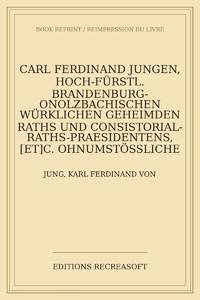
2026réf. LRB28002715Paris: Editions Recreasoft 2026 Sprache: Deutsch. Ca. 755 Seiten. Deutsch : Nachdruck auf Anfrage. Originalausgabe : 1759. Werk auf Deutsch. Dieses Werk von Karl Ferdinand von Jung ist eine bedeutende juristische Abhandlung die die Hoheitsrechte des kaiserlichen Landgerichts Nürnberg detailliert behandelt. Es enthält zahlreiche historische Urkunden und Dokumente die zuvor nie veröffentlicht wurden und bietet wertvolle Einblicke in das alte deutsche Justizwesen. Die Studie ist von großer historischer und rechtlicher Bedeutung und beleibt ein zentraler Referenzpunkt für die Erforschung der mittelalterlichen und frühneuzeitlichen Rechtspraxis. Buchbilder sind unverbindlich English: Print-on-demand reprint. Original edition : 1759. Text in German. This work by Karl Ferdinand von Jung is a significant legal treatise that meticulously examines the sovereign rights of the imperial court of Nuremberg. It contains numerous historical documents and charters previously unpublished offering valuable insights into the old German judicial system. The study is of great historical and legal importance and remains a central reference point for the study of medieval and early modern legal practice. Book images are non-contractual. Editions Recreasoft. Softcover. New. Editions Recreasoft paperback
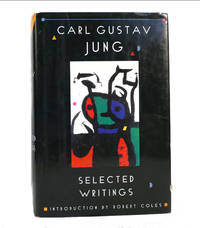
1997réf. 154191New York: Book-Of-The-Month Club 1997. Book-Of-the-Month-Club. Hardcover. Very Good in a Very Good dust jacket. Book-Of-The-Month Club hardcover
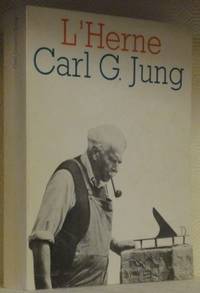
1984réf. 61360Paris : L’Herne 1984. broché. JUNG Carl Gustav. - CAZENAVE Michel.Carl Gustav Jung. Cahier de L’Herne. Paris L’Herne1984 270x210mm 515 pages photos n/b broché. Bel exemplaire. No hidden customs fees for orders shipped to the U.S.A with a value of up to 800 USD PDDP shipping we pay the VAT in advance L’Herne unknown
2016br. Ogni vita umana chiede di essere salvata. Ogni vita umana si fa strada nel mondo impersonale delle convenzioni, si scava nella pietra refrattaria dei conformismi, si mette in cerca della voce segreta che la chiama a spogliarsi di ciò che è noto ma non le appartiene, per assumere fino in fondo ciò che le appartiene ma non conosce ancora. È sull'onda di questa idea di salvezza che Romano Màdera rivisita il pensiero di Carl Gustav Jung, mettendo al centro della sua rilettura il documento più enigmatico dell'intera opera junghiana, quel Libro rosso che lo psicoanalista svizzero aveva composto in una stagione segnata dal travaglio interiore e dalla necessità drammatica della trasformazione della propria vita come del proprio pensiero. Màdera rilegge con pazienza e audacia queste pagine sconcertanti e personalissime regalandoci una rivisitazione filosofica e quasi sapienziale del lascito junghiano. E ci dona un libro capace di misurarsi in maniera radicale con gli enigmi tutti umani del sacro come potenza di trasformazione, della morte interiore come fuga dai pericoli della metamorfosi, della rinascita come incalcolabile avventura del divenire se stessi.
1961AA. VV. Carl Gustav Jung 1875 - 1961. A memorial meeting. New York, December 1, 1961. [New York], The Analytical Psychology Club of New York 1961 english, 50 Opera con copertina morbida in brossura. LF71
2021Jung dal maggio del 1934 fino al febbraio del 1939 dedica a "Così parlò Zarathustra" una serie di conferenze, che sono trascritte in quattro volumi. In esse interpreta vari capitoli dell'opera di Nietzsche alla luce delle sue categorie psicologiche, che illustra in saggi precedenti, come "Psicologia dell'inconscio" e "L'Io e l'inconscio". Per delucidare i principali nuclei tematici del filosofo, si serve anche di idee che acquisisce dallo gnosticismo, dall'alchimia rinascimentale e dalle religioni orientali. Il saggio di Berlato si accosta al commento junghiano con l'obiettivo di esplorare e risolvere progressivamente i nodi tematici più complessi. Il saggio si offre come una duplice introduzione: una conduce al cuore di molte teorie junghiane, l'altra consente al lettore di scoprire il fascino di alcune delle più suggestive pagine di Nietzsche che proprio in "Così parlò Zarathustra" hanno trovato la loro più congeniale collocazione. Autori: Roberto Berlato.
1984réf. 652251984 P., L'Herne, 1984, in 4° broché, 516 pages ; illustrations hors-texte ; couverture illustrée, légèrement fanée.
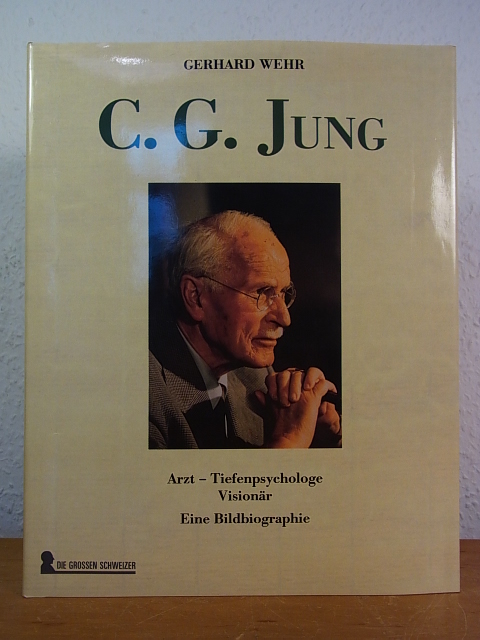
1989réf. 113685Zürich: SV International, Schweizer Verlagshaus, 1989. 29,5 x 23,5 cm ; Leinen
réf. 61360Paris, L’Herne 1984, 270x210mm, 515pages, broché. Bel exemplaire.
1995réf. 26448ABZch., Conzett & Huber, 1995. 4°. 107 S., mit vielen Abb. OKart.
2009réf. 1037394Guido Pressler Vlg., 2009. 78 S.; Abb.; Faksimile. Fadengehefteter Originalpappband.
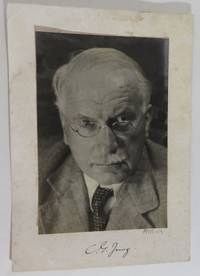
réf. 18421No date . Scarce photograph of C. G. Jung signed by Jung the psychoanalyst with perhaps the broadest influence across the humanities and an influence that remains active broad and deep across clinical psychology. Matte silver gelatin photograph signed in black fountain pen by Jung. Photo and matte are a bit bowed foxing and some staining two creases to corners; silvering to photo. Photo measures 6 7/8"h x 4 5/8"w matte measures 9"h x 6 3/8"w. Photograph taken by Eranos Foundation photographer Margarita Margarethe Fellerer circa 1940s also signed in pencil by Fellerer. Photo accompanied by Certificate of Authenticity. unknown
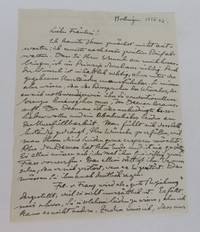
1942réf. 173331942. Group of three items: An ALS from Jung to his mentee psychoanalyst Dr. Rivkah Scharf; an ALS from Dr. Sharf to Jung responding to the aforementioned letter; and one envelope with Jung hand-writting the address of Dr. Sharf. The two were working on Jung's "Psychology and Alchemy" at the time of the present correspondence. Jung lettter includes wonderful clinical and relational content; while perhaps under the influence of the book material Jung refers with vigor to the activity of Scharf's "daemon" and it's influence on their collaborative process providing perhaps an informal definition stated with directness and ultimately empathy: ".expressing this wish which in itself necessarily must go beyond the conventional limits will awawken the daemon. The daemon is the absolute wanting-to-have-it-this-way and hideous suffering from the impossibility of fulfillment. Hence since one would like to spare you this suffering one feels under constant pressure to grant your wishes. However the daemon is endless and it is never satisfied. You alone with have to voluntarily throw yourself to him every time. Nothing will satisfy him. He must see that by destroying you he will destroy himself. And you will have to make this plain to him.knowing you are suffering so much is difficult for me but I cannot help it. Besides I know that this amount of suffering is necessary to make you as hard as you need to be in your life." Scharf in her reply is thankful for Jung's empathy and also refers to the initial state of emotional reception: "deeply injured and initially almost broken by the inexorable truth contained in your letter." Jung letter measures 8 3/4"h x 7"w 2pp expected folds and toning to paper two small unobtrusive stains to letter. Letter is addressed from Bollingen 1942. Letter accompanied by Certificate of Authenticity. unknown
in-8, 395 pp., index, broché, couverture illustrée. Bon etat. [CA29-3]
in-8°, 212 pages, broche, couverture illustree plast. Bel exemplaire. [SC-3]
1997réf. 13194Romain Pages 1997 In-16 cartonnage éditeur, 96 pp. Index. Illustrations couleurs.
réf. SLIVCN-9782757891001POINTS
réf. 9788532628398-11-130240Vozes. New. Vozes unknown