2 556 résultats
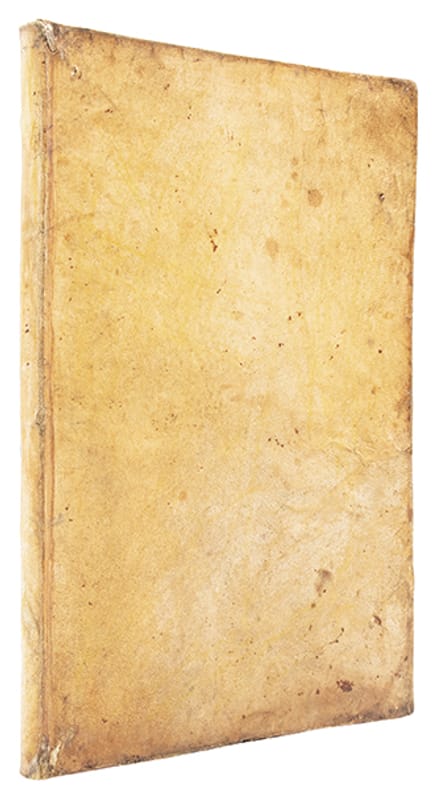
1641In-4°, (8), occhietto, frontespizio in cornice xilografica, 528pp, legatura in piena pergamena, nervature, titolo in oro al dorso su tassello in marocchino rosso, tagli in blu, buona copia. Edizione originale di questa raccolta di lettere di Luigi Lollino (1557-1625), letterato e prelato veneto nato a Candia, legato ai più eminenti eruditi del suo tempo. La corrispondenza tratta dei soggetti più svariati, dalla storia alla letteratura, alle scienze, etc., contiene anche una lettera indirizzata a Lorenzo Pignoria sul telescopio (cfr. Eileen Reeves ‘Galileo Glassworks’, n.4). Tra gli altri destinatari figurano Andrea Morosini, Nicolò Contarini, Roberto Bellarmino, Fortunio Liceti, etc. Edizione molto rara stampata a Belluno, dove la stampa non fu introdotta che nel 1625. In-4 °, (8), half-title, woodcut framed frontispiece , 528pp, contemporary full vellum binding, bands, gilt title on the spine on red morocco label, blue edges, good copy. Original edition of this collection of letters by Luigi Lollino (1557-1625), a Venetian scholar and prelate born in Candia, linked to the most eminent scholars of his time. The correspondence deals with the most varied subjects, from history to literature, science, etc., it also contains a letter addressed to Lorenzo Pignoria on the telescope (see Eileen Reeves 'Galileo Glassworks', n.4). Other recipients include Andrea Morosini, Nicolò Contarini, Roberto Bellarmino, Fortunio Liceti, etc. Very rare edition printed in Belluno, where printing was not introduced until 1625.
1524In-folio; ff. (392), in caratteri romani; il titolo, tranne le prime due righe, è in caratteri gotici; pelle marrone ottocentesca firmata Bedford, con decorazione dorata ai piatti entro doppia cornice, titolo in oro al dorso, fregi, nervature, tagli dorati. Ex libris John Fairfax Crowder. Al frontespizio sotto al titolo una xilografia raffigura "Petrus Delphinus Generalis" inginocchiato di fronte a A. Romualdo; la pagina è inquadrata in una cornice a grottesche su legno che reca il monogramma "I C", che era stata impiegata nel 1521 per Sallustio, e poi per l'edizione delle Vite de SS. Padri del 1532. Raro epistolario del generale dei camaldolesi, fonte ricchissima per la vita storica e artistica fiorentina del XV secolo. PIETRO DELFIN, (Venezia 1444-1525), venne eletto generale dei camaldolesi nel 1480, e coltivò costantemente le lettere e la teologia, tenendosi in relazione con gli uomini più illustri del suo tempo, soprattutto con gli umanisti. Irriducibile avversario del Savonarola, nel suo Dialogus in Ieronymum Ferrariensem arrivò a chiedere la condanna al rogo del frate. Prima edizione del suo epistolario, una ricchissima fonte per la dottrina teologica ma anche per i dettagli storici di cui le sue lettere sono corredate. L'argomento principale che è al centro degli scritti di Delfin è certamente la disputa teologica o comunque religiosa, oggetto di fitti scambi epistolari con i rappresentanti del clero e gli umanisti di tutta Italia; tra gli altri argomenti vi rientra anche una disquisizione piuttosto lunga (l. II ep.LXXVII) circa l'azione corruttrice delle rappresentazioni teatrali, in particolare delle commedie, con un richiamo ai ludi scaenici degli antichi romani. Ma dati i rapporti con gli umanisti del tempo, la raccolta contiene anche scambi epistolari con questi ultimi: Ugolino Verino, Ermolao Barbaro, Francesco Guicciardini ecc. Ad esempio proprio in una di queste missive si esprime l'augurio che si ponga mano ad una edizione completa delle opere di Leon Battista Alberti. In folio; ff. (392), in Roman characters; the title, except for the first two lines, is in gothic characters; 19th century brown calf binding signed Bedford, with gilt decoration on the plates within a double frame, gilt title on the spine, friezes, bands, gilt edges. Ex libris John Fairfax Crowder. On the title page, under the title, a wood plate depicts "Petrus Delphinus Generalis" kneeling in front of A. Romualdo; the page is framed in a grotesque frame on wood bearing the monogram "I C", which had been used in 1521 for Sallustio, and then for the edition of the Vite dei SS. Padri 1532. Rare epistolary of the general of the Camaldolese order, a very rich source for the historical and artistic life of Florence in the 15th century. PIETRO DELFIN, (Venice 1444-1525), was elected general of the Camaldolese order in 1480, and constantly cultivated literature and theology, keeping in touch with the most illustrious men of his time, above all with the humanists. Irreducible opponent of Savonarola, in his Dialogus in Ieronymum Ferrariensem he came to ask for the friar to be condemned to the stake. First edition of his epistolary, a very rich source for theological doctrine but also for the historical details with which his letters are accompanied. The main topic that is at the center of Delfin's writings is certainly the theological or religious dispute, the subject of dense exchanges of letters with representatives of the clergy and humanists from all over Italy; among the other topics there is also a rather long disquisition (l. II ep.LXXVII) about the corrupting action of theatrical representations, in particular of comedies, with a reference to the ludi scaenici of the ancient Romans. Given the relationships with the humanists of the time, the collection also contains correspondence with the latter: Ugolino Verino, Ermolao Barbaro, Francesco Guicciardini etc. For example, precisely in one of these letters the wish is expressed that a complete edition of the works of Leon Battista Alberti be put to work.
réf. 38964In-4 (224 x 155 mm), vélin rigide à recouvrement (reliure moderne), 156, (14) pages. A Lion, par Ian de Tournes et Guil. Gazeau [Lyon, Jean de Tournes et Guillaume Gazeau], 1557.
réf. 395078 parties en un volume in-8 (165 x 103 mm), maroquin rouge cerise, dos à 5 faux-nerfs rehaussés d’un filet au noir, titre doré, daté en pied, coiffes guillochées, triple filet doré sur les coupes, large dentelle intérieure, tranches dorées (reliure signée Bernasconi début XXe s.). Paris, de l'imprimerie de Frederic Morel (…), 1569.
réf. 464021131 - HEGESIPPUS. Aegesippi Historiographi Fidelissimi ac disertissimi et inter Christiansos Antiquissimi Historia. De bello Judaico. Sceptri sublatione. Judeorum dispersione. Et Hierosolymitano Excidio. A divo Ambrosio Mediolanen. Antistite e Graeca Latina facta... Alphabetica serie ab Ascensio collectoParis, Josse Badius 30 déc. 1511 - 1er janv. 1512 ; petit in-folio.4 ff. limin., LXXVII ff. chiffrés et 5 ff. n. chiffrés - grandes lettres ornées sur fonds criblés.Seconde édition donnée par Josse Bade, copie de l’édition de 1510 du même, avec, en plus, l’index à trois colonnes, rédigé par Bade, qui paraît ici pour la première fois.Renouard. Josse Badius II p. 488 n°2. - Moreau 107.Traduction latine de l’Histoire des Juifs de Flavius Josèphe, attribuée à Hégésippe. Elle fut attribuée à Saint-Ambroise, mais les Bénédictins ne l’ont jamais insérée dans les édition du saint prélat. Cette précieuse édition fut établie par Josse Bade, Michel Hamel-Burgins (auteur de 5 tableaux de concordance) et Jacques Lefevre d’Etaples.2 - GEILER von KAYSERSBERG (Johann.) Navicula penitencie sive sermones quadragesimales de navicula penitencieAugsbourg, J. Ottmar, 1511 ; in-folio.5 ff. n. ch. (sur 6) et 80 ff. chiffrés (incomplet de la page de titre).Première édition donnée par Jean Ottmar à Augsbourg. Le recueil sera ensuite publié à Strasbourg en 1512. Graesse p. 42.La Nef de pénitence du grand prédicateur Geiler, est la contre-partie des sermons sur la Nef des fous. Elle contient des idées neuves sur le christianisme et l’Église.3 - POGGIO (Giovani.) Orationes, Invectivae, Epistolae, Descriptiones quaedam et Faceciarum liber.Strasbourg, Joh. Knobloch, 1511 ; petit in-folio.LXXII ff. chiffrés (sans les 4 ff. de table ni les 29 ff. paginés à part pour les Facéties.)Titre dans un superbe encadrement sur bois avec ceps de vigne, putti, ourson et tireur à l’arc, texte en rouge et noir.ÉDITION ORIGINALE EXTÊMEMENT, ornée de quelques grandes initiales illustrées. - Ritter 1900 ou 1901 - Cette première édition fut donnée par les soins de Thomas Aucuparius. Les 29 derniers ff. qui renfermaient les célèbres facéties de l’humaniste florentin ont été arrachées par les Capucins auxquels le volume a appartenu, ceux-ci les trouvaient sans doute trop licencieuses.4 - SABELLICUS (Marcus Antonius Coccius.) Exemplorum Libri Decem...Strasbourg, Matthias Schürer, 1511 ; petit in-folio.4 ff. n. ch., XCIX ff. (le dernier chiffré par erreur XCXIX) caract. romains. Deuxième édition strasbourgeoise, la première ayant paru chez le même éditeur en 1509. Une édition avait d’abord paru à Venise en 1507. - Ritter 2048 (qui ne signale pas les 4 ff. du début.) - L’ouvrage est dû aux soins d’Egnatius qui en avait reçu le manuscrit de l’auteur mourant. L’érudit italien Sabellicus est né à Vicovaro près de Rome en 1436 et mort à Venise en 1506. Dans sa jeunesse il fut l’élève de Pomponius Laetus. Il vécut longtemps à Venise et publia une histoire de cette cité. “Ses infirmités, qui étaient plus le fruit de ses débauches que de ses travaux, l’obligèrent à se démettre en 1505 de son poste de bibliothécaire de Saint-Marc.” Il mourut de maladie vénérienne “gallica tabe ex vaga Venere quaesita, non obscure consumptus” dit P. Jove.Les ff. liminaires de cette édition portent une lettre de Beatus Rhenanus, un poème de D. Palladius Soranus et l’épître dédicatoire de J. B. Egnatius au doge de Venise Leonardus Lauretanus.Beau volume, dans un intéressante reliure monastique du début du XVIe siècle. Grandes marges. Quelques trous de vers marginaux sur certains cahiers.Ex-libris manuscrit sur le 1er titre : Jacobi Röchlinet Couvent des Capucins de Cella Ratsol (...?)
1544réf. 37931In-folio (309 x 200 mm), vélin souple de l’époque, dos lisse, (5), (1) blanc, LVI [ie. LXV] feuillets, (5) pages de table, (1) feuillet avec la marque d’imprimeur de Denis Janot [sign. a6, A-K6, L-M4]. Avec Privilège du Roy. 1544. De l'imprimerie de Denys Janot imprimeur du Roy en langue Francoyse, & libraire juré de l'Université de Paris.