SCHOPENHAUER, ARTHURBiblio.com
2 377 résultats
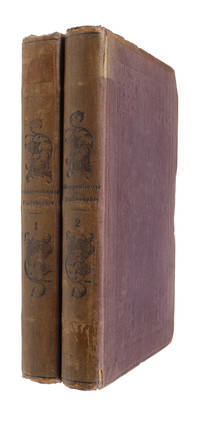
1851réf. 62019Berlin Hayn 1851. 8vo. Uniformly bound in two uniform contemporary - possibly original! - embossed full cloth bindings. Embossed lettering and ornamentation to spine. Spines and borders of boards slightly faded. Spines with repairs. Front free end-paper in vol. 2 with repair. Previous owner's label Julius Kotrtsch pasted on to lower margin of title-pages. Previous owner's name in contemporary hand to upper margin of title-pages. Verso of last leaf in vol. 2 annotated in pencil. Vol. 1 with light occasinal marginal browspotting. 6 465 1 pp.; IV 531 pp. The scarce first edition of Schopenhauer's most influential work his final masterpiece which consists in his seminal philosophical reflections. The Parerga and Paralipomena was the first of his works to gain recognition and the work that propelled the then obscure figure into lasting philosophical prominence. Seeing that all of Schopenhauer's previous publications had been complete failures it was only with great difficulty and reluctance that Hayn of Berlin was pesuaded to print the work which they then only did in a small printrun of merely 750 copies which now makes the first edition very difficult to find. The work is is two parts with the first "parerga"-part consisting in six extended essays intended as supplementary to the author's thought whereas the second "paralipomena"-part consists in shorter elaborations divided by topic into thirty-one subheadings that cover material hitherto unaddressed by Schopenhauer but complementary to the "parerga". In spite of the poor reception of his earlier works somehow the “Parerga and Paralipomena attracted the attention of John Oxenford a noted observer and translator of German literary culture who contributed a favourable review of the work in 1852 and in 1853 wrote an article on Schopenhauer's philosophy entitled "Iconoclasm in German Philosophy" which through its German translation in Vossische Zeitung sparked in immediate interest of Schopenhauer's work in Germany and propelled him into philosophical fame. “The effect was dramatic and almost overnight Schopenhauer in his own country passed from obscurity to fame and from then till his death in 1860he basked in the sunshine of belated recognition and eminence.” Payne in the Preface to his translation of Parerga and Paralipomena into English Oxford 2000p. xii The work greatly influenced later philosophers most notably Nietzsche whose fondness of aphorism is directly inspired by “Parerga and Paralipomena”. “One of the most significant and fascinating works of the great philosopher Arthur Schopenhauer 1788-1860. The Parerga Volume 1 are six long essays; the Paralipomena Volume 2 are shorter writings arranged under thirty-one different subject-headings. These works won widespread attention with their publication in 1851 helping to secure lasting international fame for Schopenhauer. Indeed their intellectual vigor literary power and rich diversity are still extraordinary even today.” Payne. hardcover
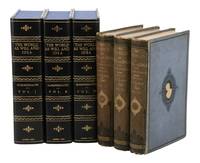
1886réf. 140948846London: Truebner & Co 1886. First British Edition. Very Good. First British edition and first English translation. Three volumes. 8 ads dated 7/11/83 4 xxxii 532; 8 ads viii 496 pp.; 8 ads viii 506 pp. Foldout table to Volume I facing p. 64. Bound in publisher's blue cloth stamped in black and gilt brown coated endpapers. Very Good with sunned spines rubbed at the extremities soiling and light stains to covers light foxing to cloth and textblock edges. Volume I: hinges starting front free endpaper detached. Volume II: hinges tender tidemark to lower front endpapers second ad leaf torn vertically in half with marginal loss to separated half fourth ad leaf torn from binding with loss of lower two-thirds. Volume III: lacking final ad leaf hinges tender tidemark to lower gutter of front endpapers. Housed in custom clamshell cases quarter navy morocco over blue marbled boards decorative gilt stamping to spines. The first British edition of Schopenhauer's magnum opus Die Welt als Wille und Vorstellung which he first published in 1818 and spent a lifetime revising. Schopenhauer's depiction of life as eternal struggle met with a chilly reception from German idealists and the pessimist was not recognized as a major philosopher until 1851. It took another thirty years for Schopenhauer's most important work to be translated into English by R. B. Haldane and J. Kemp but many of his theories were widely accepted by the end of the 19th century. His faith in art as a means to perceive the underlying truth of all things "the Will" influenced the French Decadent movement and the works of Wagner Kafka and Borges. Thomas Mann championed Schopenhauer's clear-eyed rationalism as a necessary counter to the twentieth century's glorification of instinct including bad instincts: "We have seen instead of pessimistic conviction deliberate malice." His work is as relevant now as it was when these books were first printed. Truebner & Co unknown