CHARRON (Pierre)Livre Rare Book

6.365 Ergebnisse
1783Best.-Nr. 002461Paris, Bastien, 1783
1902[20], 644 pages. Index. Twenty-six black and white photographic plates. Leather binding. "Comprising a history of Egypt, with a comprehensive and authentic account of the antiquity of masonry resulting from many years of personal investigation and exhaustive research in India, Persia, Syria and the Valley of the Nile." - title page. After first receiving the Light in India, the author was moved to "investigate, to the fullest extent, the meaning and purport of the numerous hieroglyphic inscriptions, symbols and characters found upon the ancient tombs and temples, so that the Masonic Fraternity might understand, appreciate and apply the teachings of the hierophants and sages of bygone days." - Preface. Chapters: Alexandria - the Antiquity of Masonry; Ruined Temples - Masonry and Masonic Symbols; Ancient Cities - Soirian Myth - Karma; the Nile - Origin of the Name Free Mason - Scottish Rite Philosophy; Ancient Mysteries - Scottish Rite philosophy; Suez Canal - The Druses, Their Manners and Customs; Agriculture - Irrigation - Lotus - Papyrus; The Supreme Architect of the Universe; Mosques - Tombs - Massacre of Mamelukes - Heliopolis; Esoteric Teaching of the Scottish Rite - Brain and Thought; Pyramids - Sphinx - Tombs; Solomon - Death of Hiram - Cross - Swastica; Mummification - Transmigration - Re-incarnation; Sixteen Saviours - Lost Knowledge; The Golden Fleece - Roman Eagle - Masonic Apron - What it Teaches; Pyramids of Sakkarah - Lisht - Medum - The Fayum - Labyrinth; Sun Worship - Zodiac - Masonic Allegories; A Voyage up the Nile - Description of Tombs and Temples - Pro Doric Columns; Ineffable degrees - Thoughts on Ecclesiastes - I.N.R.I. - Voyaging up the Nile - examining Tombs and Temples - Paintings - Sculptures; Masonic teachings - Hindu beggar - Roman Catholicism; Thebes - Colossi - Der-El-Bahari - Luxor - Karnak; Ceremonies - Initiation - Blue Lodge - Transmigration - Mystery Language; The Gawazee - exploring Temples and tombs - Philae and its ruins - Nubia; Jewish Traditions and customs - Cable tow - Ceremonies of ancient Initiation - book of the Law; Circumsision - upon what the Ancient Craftsmen were obligated - the lost word. All edges gilt. Protected frontis portrait of author. Ornately embossed boards. Raised bands to spine. Partially rubbed gilt lettering and decoration upon back strip. Marbled endpapers. Hinges intact internally, open or opening externally. Front board partially detached. Somewhat above-average wear to boards. Unmarked. A worthy original copy of this monumental work. 12" x 9.5" x 2.5". 11 pounds. Book
Best.-Nr. 127885aafBasel, (u.a.) Getruckt bey - Jacob Werenfels - J. Bertsche - J.-J. Decker - G. Decker - J.R Genath - J.H. Meyer / Auch (n° XVI:) Winterthur J. R, Meyers / (XXXIX) Frankfurt, Jonae Rosen 1617 / (n° XL, Tauffprädigt) Heidelberg, J. Lancellot, 1618, 28 S. + 2 Bl., um 1655-68, in-4to, Vorgebunden 3 Bl. mit hs. ‘Index Textum - Index Authorum - Nomina Defunctorum’ + 2 Bl. leer + 879 Bl. (= 1758 S.) + 2 Bl. mit handschr. Notizen, teils etwas gebräunt u. fleckig, hs. auf Spiegel ‘Tomus XX’ & ‘Ex Bibliotheca Johann Leonhardi Schopferi, V.D.M. collectus Sangalli Ao 1668’, Prgt. d. Zt. (Bestossen, gebräunt u. fleckig, Kanten tls. etw. beschabt).
Best.-Nr. 059-Ao.J. Kupferstich, 1614, nach Barthel Beham, auf Bütten. 5,7:8,2 cm. Im rechten Rand gering flecking. Literatur: Hollstein 559. Ganz ausgezeichneter und klarer Abdruck mit leichtem Plattenton und mit Rand um die Plattenkante.
1662In-4to piccolo, (36), 121, (1) pp., 10 tavole. Completo delle 56 silografie nel testo (molte delle quali a piena pagina) e delle 10 tavole incise in rame fuori testo, una delle quali (cuore) con volvelle. Vitello coevo, dorso ben restaurato.
1784Best.-Nr. 3603426London: Sold in Spur Street Leicester Square 1784. Small crease in lower corner in good condition. Oval engraving 350 x 265 mm. image size; mounted. Rare variant of the famous engraving of Cook's death showing as the caption notes "Part of the Original Plate after Webber" and presumably quite literally printed from an oval cut from the fuller engraved copper. This is only very rarely seen: the single example noted by Joppien and Smith was in the British Museum. The full-size engraving was first issued early in 1784. Based on the oil painting executed by Webber soon after he returned to London in 1780 the figures were engraved by Francesco Bartolozzi and the landscape by William Byrne. Quickly becoming the most famous of all eighteenth-century depictions of the massacre the view appeared at about the same time as the official third voyage account was published. This was no coincidence: although lavishly illustrated by Webber the official account did not include any depiction of the most famous scene of the entire voyage the death of Captain Cook. As a result the iconic engraving is often seen bound into extra-illustrated editions of the third voyage account. Reflecting the general opinion prevailing in published accounts of the voyage the original image as Joppien and Smith argue appeared to show Cook as 'an innocent victim killed in the act of pleading for peace'. This is here heightened by the changed composition as the oval shape dictates a radically different impact to that of the original engraving omitting the dramatic conflict between the British sailors and the Hawaiians and thus implying a scene in which Cook his arm raised in supplication to his men offstage stands alone and is overwhelmed by a seething crowd. The only copy noted among Australian holdings appears to be the heavily clipped copy in the National Library of Australia part of the Nan Kivell collection. . Sold in Spur Street, Leicester Square unknown
1728Best.-Nr. 17444Troyes 1728. 4to. Jean-Antoine Garnier 19th-century half cloth. With 60 woodcuts in text including 3 repeats most of them half-page. 76 pp. 18th-century French chapbook edition of one of the most popular picture books in Europe since the Middle Ages. It depicts two Dances of Death: first the Dance of Death of men of all ranks and professions followed by the Dance of Death of women of various ranks and stations in life. These Dances of Death were meant to remind people that everybody was mortal however powerful in life and to warn people to be prepared to die at any moment.Browned throughout some occasional foxing and a small piece torn from the margin of page 19 not affecting text or illustration. Overall a good copy.l Oberlé La Bibl. Bleue 1; Nisard II p. 284: "Le plus beau des livres de la Bibliothèque Bleue". ART ARCHITECTURE & PHOTOGRAPHY EUROPE LITERATURE & LINGUISTICS Caricature & Satire France French Literature hardcover
Best.-Nr. 10850Wien / Baden bei Wien, Gesellschaft für vervielfältigende Kunst / Verlag Rudolf Rohrer, 1889 bis 1938. 39 volumes (36 in-folio et 3 in-4). Les 5 premiers pleine percaline brune, titre et décors dorés et noirs aux dos, premiers plats richement décorés (doré, noir et à froid), plats biseautés, tranches dorées pour le volume 5. Du 6e au 36e, pleine toile grège d'éditeur, titre et décors rouges jusqu'au 23e, vert pour les suivants, tranches marbrées ou teintées. Les 3 volumes in-4 sont reliés pleine percaline bordeaux, titre doré aux dos, têtes dorées (plats un peu tachés). La toile de certains volumes est un peu poussiéreuse. Intérieur très frais, quelques rousseurs extrêmement rares, 1 planche et 1 cahier déboîtés. Les années 1909, 1917 et 1918 non reliées mais sous cartonnage toilé normal, 1917 en 3 numéros / 2 cahiers (sur 4 / 3), 1918 en 3 numéros / 2 cahiers (sur 4 / 3).
1696Best.-Nr. 5532Frankfurt: Heirs of Matthäus Merian 1696. SECOND EDITION THUS. Fifth edition overall. This edition is based on Merian's own 1649 edition which was the first to include these revised images and a number of the supplementary texts. Hardcover. Fine. Bound in original tanned sheepskin light surface wear corners bumped lower edge of rear board abraded faithfully and almost imperceptibly rebacked the new spine richly tooled in gold and with a red morocco label. Internally an attractive copy with minor soiling and discoloration to margins of the title page scattered mild soiling in the text mainly marginal a few small rust spots and light blemishes a discreet contemporary repair to one blank margin a small tear in the margin no loss of leaf G1 a clean tear barely entering the image no loss on leaf M1; Memento Mori plate lightly soiled. There is a curious feature in this copy: there is light offsetting -from the text of different book- on one side of the 3 sheets that made up gatherings H S and Cc probably the result of those sheets having been laid upon sheets of the other book while still damp. With the collector's stamp of Johann Carl Conrad Oelrichs 1722-1798 on the title verso. A series of engravings with accompanying text by Matthäus Merian the Elder depicting the Grossbasler Totentanz the 60-meter long Dance of Death mural painted circa 1439 which adorned the inner face of the cemetery wall adjoining the Dominican convent and Predigerkirche in Basel. It was along with the Danse Macabre murals painted in the arcades of the Paris Cimetière des Innocents one of the two earliest painted Dance of Death fresco cycles. The Basel frescoes were lost in 1805 when the wall was destroyed. Only 19 fragments survive. The murals depicted a communal dance between cadavers and people from all strata of society from pope to peasant including members of various trades and professions from physician to fool. The list of those who join -unwillingly- their macabre dance masters in this dance to the grave are in order of appearance: pope emperor empress king queen cardinal bishop duke duchess count abbot knight lawyer councilman church canon physician nobleman noblewoman merchant abbess lame man hermit young man usurer maiden minstrel herald mayor executioner fool peddler blind man Jew heathens a man and a woman cook peasant painter and a mother holding her child. The dance is preceded by the images of a preacher delivering a sermon and a group of skeletons emerging from a charnel house playing instruments this image was probably added over the actual ossuary in the cloister during the restoration of 1616. "The figures of Death were depicted in all kinds of contortions suggesting movement and presumably intended to evoke an association between the represented action and the variety of dance being performed particularly round dances Reigen popular at that time. This is all the more probable because the introductory part of the dance of death which did not survive quite likely depicted figures of Death making music."Dreier Der Totentanz p. 47 "Beneath the pictures was a band containing addresses by Death and replies by the individual representatives of the estates each of four lines in Basel or eight lines in Paris. These verses were written in the local idiom generally in iambic rhyming couplets or alternating rhyme. In the verses the encounter between Death and the human representative was cast as a dialogue in which Death reminded human beings that in the face of mortality everything worldly was transitory and vain. Following Erwin Koller's outstanding philological investigations. it may be assumed that the blockbook produced in Basel around 1460 now preserved in Heidelberg University Library under the shelfmark cpg 438 is a contemporary virtually identical transcription of the original Basel text."Dreier p. 48 Merian made his engravings based on his drawings of the Basel frescoes in 1616. He then either gave or sold his engravings to his nephew Johann Jakob Merian. The first two editions appeared in 1621 one of them printed by Johann Schröter the other by Matthäus Mieg who re-published the book in 1625. The artist himself reworked the plates in 1649 adding atmospheric elements and background details and printed them with a greatly expanded text. This 1696 edition by Merian's heirs reprints the images and text of that edition. For the 1649 expanded edition Merian added a 10-page history of the Basel mural the now-iconic Memento Mori engraving an hourglass with a skull a burning candle and wilting flowers the Adam and Eve engraving and the dual-portrait engraving which when viewed right side up shows a bearded man and when turned upside down show a death's head. Merian also added as announced on the title 42 pages of "Admonitions concerning Human Mortality the Fleeting Nature of This Present Life and the Vanity of All Earthly Things; concerning the Burial and Resurrection of the Dead; concerning the Last Judgment; concerning Hell and the Damnation of the Godless; and concerning Eternal Life.". Heirs of Matthäus Merian hardcover
In Lausanna [i.e. Livorno] / In Siena, [tipografia Coltellini] / per Francesco Rossi stamp. del pubblico, 1765 / [1786], due titoli legati in un volume, in-8 piccolo, legatura coeva in piena pergamena, titolo manoscritto al dorso, tagli screziati. Beccaria: pp. [2], 141, [3], 135-229, [3], l'ultima carta bianca. Con antiporta incisa in rame, vignetta calcografica (bilancia in equilibrio su spada spezzata) sul frontespizio, e fregio xilografico al recto di carta A2, con i simboli delle arti. L'irregolarità della paginazione fu causata dalla volontà del tipografo di reintegrare, rispetto ad una prima composizione a stampa, le numerose pagine omesse nel Giudizio del De Soria. Terza edizione assoluta di questa "pietra miliare" del pensiero giuridico e prima in assoluto a recare l'antiporta allegorica incisa in rame immaginata dal Beccaria. Edizione pubblicata dalla tipografia Coltellini: cfr. L. Firpo, Le edizioni del "Dei delitti e delle pene", p. 544-547, n. 4 in Edizione nazionale delle opere di Cesare Beccaria, v. 1, Milano 1984. Var. C: vignetta calcografica sul front. (bilancia in equilibrio su spada spezzata) e fregio a p. 3. Atti del Convegno Internazionale su Cesare Beccaria, Torino, 4-6 ottobre 1964, pp. 399-403. Riforma della legislazione criminale toscana: pp. 80. Con stemma xilografico di Pietro Leopoldo granduca di Toscana sul frontespizio. Il 30 novembre del 1786 il Gran Ducato di Toscana sotto Pietro Leopoldo promulgò il nuovo codice criminale; per la prima volta nella storia degli stati moderni, con questo documento, furono abolite la pena di morte e la tortura. Timbretto di possesso privato sul frontespizio dell'opera del Beccaria. Volume unico che riunisce il testo teorico fondativo dell'abolizione della pena capitale e la sua prima applicazione pratica nella storia. Ottime condizioni di conservazione.
1900Best.-Nr. 4922N.p. France: No printer for Joseph Vitta 1900. FIRST STATE of two before the addition of the artist's signature in the plate. Hardcover. Fine. Printed on laid paper with watermarks "A. Portabeuf" and "Arches". Most margins untrimmed with their deckled edges preserved. Light marginal soiling to some plates one plate with light foxing in lower margin not touching the image one plate with foxing to blank verso not visible on the printed recto final plate with light crease to blank margin and soiling to blank verso. Very light dust-soiling to the tips of the deckles and occasional very small tears in the margins. Housed in a custom box. This copy formerly with David Carritt Limited Artemis Group Ltd. London. A complete set of Albert Besnard's striking suite of 26 etchings on the theme of death signed by the artist in graphite. The edition was limited to nine impressions five of them on paper. At least one paper set and one vellum set were dispersed the National Gallery of Art Washington D.C. has a set comprising a single vellum leaf the other 25 are mixed states on paper. In this set nine prints Delteil 131 136 139 148 150-152 155 156 have watermark "Arches"; the others have the watermark "A. Portabeuf". "Les épreuves de ce premier état tirées 'à fleur de métal' sont d'une remarquable qualité Elles sont toutes signées de l'artiste."Delteil "The title of the series of prints Elle refers to Death La Mort. The series is considered one of Albert Besnard's most significant works in printmaking and depicts the omnipresence of death among the living. In this series Death is shown in several scenes in the disguise of the mistress of the household of a courtesan or of a lover. Death appears in all aspects of daily life striking when one least expects it on the path of a horse rider or as a couple embraces in a garden. One scene is particularly cruel as Death stands in front of a mother with two young children on her lap and the title of the print elucidates what is at stake: Lequel Which One. In Après sa visite After the Visit a man and a woman hide their faces in despair. On the other hand in L'Importune Importunate a doctor by a patient's bedside pushes her away. In Danger passé Danger Passed a horse rider continues on unscathed. Other prints demonstrate the benevolence of Death who can bring relief. In one scene Death brings together a couple under her cloak. "In 1900 the French banker collector and patron Baron Joseph Vitta 1860-1940 commissioned the series Elle from Besnard. The series was to include 50 plates of which only 26 were editioned. A 27th plate titled L'homme suivant la Mort was realized but destroyed after only two proofs were pulled. Vitta controlled the preliminary drawings the plates and the printed impressions and limited the size of the edition. The first printing of the series comprised only nine proofs of each plate. A second state of the series with the addition of Besnard's monogram was printed in nineteen impressions in 1921. An additional set of impressions of the 1921 issue was offered to the printer of the series Auguste Vernant. The plates were then cancelled impressions of the cancelled plates are at the Bibliothèque nationale in Paris. "Born in Paris Albert Besnard entered the École des Beaux-Arts in 1866. He exhibited at the Salon of 1868 and won the Prix de Rome in 1874. While in Rome he met Charlotte Dubray 1854-1931 the daughter of the sculptor Vital Dubray 1813-1892 and a sculptor herself who benefited from the sponsorship of the Duke and Duchess of Sutherland to study sculpture in Rome. After their marriage in 1879 the couple moved to London. There Dubray had numerous contacts and Besnard received numerous commissions as a portrait painter. He also studied printmaking with Alphonse Legros. Their four children three sons and a daughter became artists. Besnard was the director of the Académie de France in Rome from 1913-1921 and the director of the École des Beaux-Arts in Paris from 1922 to 1932. He became the first painter to be given a state funeral in France."Getty "With Elle Besnard resurrected and modernized the ancient dance of death adapting its imagery to current tastes while retaining the themes of the power of death and the equality of all before it. Death portrayed by Besnard the eponymous 'She' of the title is an omnipresent force that circulates among the members of modern society. Lurking in the bushes and gutters she occasionally takes on the features of a prostitute or a lover. She is a tenacious and patient adversary usually triumphing over her prey through trickery or duplicity. She is everywhere at once; she strikes arbitrarily and mercilessly. "Besnard's images illustrate only a few of the countless occasions when Death manifests itself. Many scenes are imbued with black humor the effect of surprise and macabre turns of events. Some are poignant others terrifying. All remind us that death plays a very real and very active role in every aspect of our lives."Musée des Beaux-Arts du Canada www.beaux-arts.ca Besnard himself established the order of the prints: Exigeante D. 131; Dans la Foule D. 132; L'Accident D. 133; L'Obstacle D. 134; Danger Passé D. 135; L'Inconnue D. 136; Importune D. 137; L'Enigme D. 138; Le Mystère D. 139; Après sa Visite D. 140; Ponctuelle D. 141; Aux Aguets D. 142; Le Coup de Filet D. 143; Musicienne D. 144; Le Vertige D. 145; Lequel D. 146; La Possession D. 147; Discrète D. 148; Le Duel D. 149; la Présentation D. 150; L'Orgie D. 151; Charitable D. 152; Coquette D. 153; L'Avertissement D. 154; Elle consacre l'Amour D. 155; Indifférente D. 156. No printer [for Joseph Vitta] hardcover
1750Best.-Nr. 31151750. DBI s.v. Albani; G. Cucco ed. Papa Albani e le arti a Urbino e a Roma 1700-1721 2001. Highly finished preparatory design for a fresco or tapestry connected to the Albani family whose coat of arms appears under the left-hand arch crowned with a cardinal’s hat. Under the central arch of the drawing preceded by a palafreniero four servants in blue and white livery carry a red baldacchino that covers two figures processing on horseback. One is clearly a secular prince with his garland crown and red cape while the other figure is a cardinal wearing a black hat and a red robe. It is possible that the cardinal depicted is either Annibale 1682-1751 or Alessandro 1692-1779 Albani or their nephew Cardinal Giovan Francesco Albani II 1720-1803. Under the right arch of the fictive architecture two buildings appear. While three commedia dell’arte figures who are commonly associated with the Venetian carnevale appear the carriage in the background contradicts the possibility that the setting for this event is Venice. Below these three arches a series of nine crests appear. The personification of death reclines with his scythe behind the coat of arms of the Corsini family blue and yellow diagonal stripes with a white band through the center. The crown which signified the rank of the family has been wrenched off. The Corsini were made dukes by Urban VIII in the seventeenth century and princes by Clement XII in 1730 This act of vandalism fits well within the long history of enmity between the Corsini and Albani families in the papal court. We have been unable to connect the sheet to a specific project at any Albani residence but future research should consider the Villa Castelbarco Albani in Vaprio d’Adda northeast of Milan whose documentation has proved difficult to obtain. unknown books
1773Best.-Nr. 5488Troyes: chez Jean-Antoine Garnier ca. 1766 to 1773. Hardcover. Fine. Bound with: Le Grand Calendrier et Compost des bergers composé par le berger de la Grande Montagne Avec le Compôt naturel reformé selon le retranchement des dix jours par le Pape Gregoire III. Ensemble la manière comme se doit gouverner le Berger pour empêcher qu'aucun Sorciers ne fassent mourir leurs troupeaux avec toutes choses nécessaire pour se régler en leur art. Troyes: Chez Jean-A. Garnier Imp. Lib. No date ca. 1776 Quarto: II. 144 pp. A-S4. TWO RARE EDITIONS. Bound in contemporary tanned sheep the boards framed by a triple gold rule the spine ruled in gold and with rampant lions tooled in the compartments. The Privilege at end is granted to Pierre Garnier and dated 21 May 1728. It gives also a list of his other publications. Unusually fine copies printed on delicate paper of these works which are rarely found in such nice condition bound in a strictly contemporary binding. The bottom line of the first t.p. "avec permission" has been shaved off. In the second work leaf N1 has marginal stains; the last few leaves are lightly foxed. The Dance of Death "Les trois vifs et les Trois Morts" and the other accompanying texts are illustrated with 60 woodcuts of the Dance of Death copied from the original designs which appeared in the edition of the Danse Macabre of G. Marchant 1490. That of the Moor on p. 32 may be a very close copy of the same subject in the Compost. Another version of it appears on p. 27 and is a very close copy of that in the Bradwardine No. 64. N. B. - the two blocks of this subject appearing respectively on pp. 24 & 27 of the present Danse Macabre are not identical. Two works bound together both examples of important literary genres dating to the late-Medieval and early-Renaissance periods. The "Danse macabre" is a pictorial cycle and poem first painted at a Paris cemetery about 1425. Woodcuts copied from the Paris fresco along with the accompanying verses were first printed by Guy Marchant at Paris in 1485. "Le Grand Calendrier" an illustrated almanac and calendar was first printed in 1491 by Guy Marchant. The book remarkable for both its text and its illustrations was a kind of encyclopedia of meteorological agricultural hygienic and moral knowledge. I. The Dance of Death One of the earliest examples of the pictorial cycle and poem known as the Danse Macabre was painted between August 1424 and Lent 1425 in the arcades of the Cimetière des Saints-Innocents Cemetery of the Holy Innocents in Paris. These arcades constructed as charniers to house bones from earlier mass burials were demolished in 1669 along with their frescoes. The images of the Danse in this book were directly inspired by the Paris Danse. Woodcuts of the Danse copied from the Paris fresco along with the 67 verses that accompanied the images were first printed by Guy Marchant at Paris in 1485 with woodcuts designed by Pierre le Rouge. While there were no women in the original Danse in 1486 Marchant published an all-female version "La Danse Macabre des Femmes". Later Marchant united these two texts in the two-volume "Miroer Salutaire". While Marchant followed the sequence from the Cimetière des Saints-Innocents he introduced numerous changes adding new pictorial elements and verses including 20 additional dancers and the woodcut of the four skeleton musicians. From the 16th through the 18th centuries editions of the Danse appeared outside of Paris printed -with various changes- by French provincial printers in Lyon Rouen and Troyes. Over the years the woodblocks used to print the illustrations in the various Paris editions worn or damaged from repeated use and in some instances lost were re-cut with the images reproduced with varying degrees of fidelity to the originals. The printing history of the Danse in Troyes began in 1493 when Pierre le Rouge's woodblocks were acquired by his nephew Nicolas le Rouge who printed editions of the text into the 1530s. It is in Troyes that the woodcuts were first copied and further changes were introduced by successive printers. In 1610 the Troyes printer Noël Moreau began printing editions of the Danse using copies of the woodcuts from the Parisian edition published by Marchant 1490. Moreau added several new images at this point including the Black man blowing a horn and carrying a spear. According to Mortimer Moreau also used several original 15th c. blocks in this edition e.g. p. 26 the Punishment of the Sin of Luxury also used in the "Compost et kalendrier des bergiers" of 1497. and one of the Occupations of the Months May from the "Compost" of 1499. In 1641 Nicolas Oudot's son Nicolas Oudot II printed a new edition using Moreau's woodcuts. The last Oudot edition with the text largely re-written was printed by Nicolas II's son and widow in 1729 under the title "La Grande Danse Macabée sic!". It is this edition that would set the template for the next publishers the Garniers. The dating of this edition /- 1773 is based on the dates during which the publisher is known to have been active. A number of early bibliographers following the printed privilege on the last page dated this edition to 1728 and numerous cataloguing records have this date. However the publisher to whom the privilege was granted Pierre Garnier died in 1738. Further Jean-Antoine Garnier who is named as publisher on the title page was active between 1766 and 1773. Alexis Socard "Livres Populaires de Troyes" 1864 p. 126-127 tells us that the Garniers continued to print the book up until 1820 with the same imprint and privilege. See also: Corrard de Breban "Recherches sur l'établissement et l'exercice de l'imprimerie à Troyes" Paris 1873 4th ed. p.73-74. The additional texts: Already in the late 15th c. editions of the Danse had begun to include supplemental texts. Those included in this edition are: "Le débat du corps et de l'ame" "La complainte de l'ame damnée" "L'exhortation de bien vivre et de bien mourir" "La vie du mauvais Antechrist" and "Les quinze signes du jugement." Of these "La Vie du mauvais Antechrist" pp. 70-72 is antisemitic. The Antichrist is born of incest by "Un paillard Juif abominable" who knows his own daughter carnally is nursed by a whore before embarking on his career of destroying Christianity. He comes to Jerusalem where the Jews adore him he himself is circumcised but when he attempts a second Ascension from the Mount of Olives he is cast down into a sepulchre at the bottom of hell and "dix millions . De ces Juifs l'accompagneront". Marquand Library Notes: Fairfax Murray 108; see a reproduction of one of J.A. Marchant's editions in Claudin's Hist. de l'Impr. I. 339 sq. A brief description of those editions with some reproductions is found in Nisard Hist. des Livres populaires 1854 II 303 sq. A few of the images in these editions are new e.g. p. 26 the Punishment of the Sin of Luxury which originated in the Compost of 1497 see No. 103 and reproduction in Claudin I. 375 and one of the Occupations of the Months May from the Compost & Kal. Des Bergères 1499 see note to No. 103 and Claudin I. 379 sq. Langlois Essai Historique Philosophique et Pittoresque sur les Danses des Morts I p.340 31; Douce p.60 26; Reichelt 96 II. The Shepherd's Calendar and Compost Le Grand Calendrier et Compost des bergers A Troyes chés P. Garnier s.d. ca. 1776 Illustrated with 49 woodcuts including 12 full-page cuts one for each month of the calendar. Like the Danse Macabre many popular editions of this calendar were printed into the 18th c. particularly in Troyes and Paris. The Kalendrier des Bergiers an illustrated almanac and calendar was first printed on 2 May 1491 by Guy Marchant. On 18 April 1493 he printed an entirely new edition under the title: "Compost et Kalendrier des Bergiers" and on 18 July Marchant completed yet another edition further expanded in both text and illustrations: "Here is the Compost et Kalendrier des Bergiers. to which many new items have been added as those who look at it will be able to discover." The book remarkable for both its text and its illustrations was a kind of encyclopedia of meteorological agricultural hygienic and moral knowledge. "What we have here" says Monceaux "is the first almanac ever printed in France and one can readily understand the appeal of a work that addressed itself to the rural and popular masses and gave them advice of every kind on the health and hygiene of men and animals on agriculture on how to conduct oneself in this world with a view to arriving safely in the next - while at the same time giving those who could not read some basic knowledge of astronomy and the measurement of time via explanatory images." The beautiful incunabula editions of the Shepherd's Calendar were transformed into popular booklets in the mid-17th century notably by Nicolas Oudot. All the printers of the Bibliothèque bleue Blue Library published an edition of this Compost. "This undoubtedly means that the Compost was to be considered an introduction to popular literature because it contained presented-one might even say in their purest form the essential themes of the popular library." G. Bollème Les almanachs populaires p. 41. The book opens with a brief verse to the reader explaining the Gregorian calendar reform followed by a prologue in which the shepherd-author presents his central argument: that the natural human lifespan is seventy-two years demonstrable through a parallel between the twelve months of the year and twelve successive stages of human life six years to each month. The heart of the book is the compost and the almanac proper. The compost material includes mnemonic verses and tables for calculating the moveable feasts of the church year - Easter Pentecost and the rest - along with the Golden Number a nineteen-year cycle used to predict the date of the new moon the Dominical Letter a device for finding the day of the week on which any given feast falls and Epact tables the Epact being a number expressing the age of the moon on 1 January used to calculate Easter under the Gregorian reform. The almanac proper gives each month its own full-page woodcut a verse in the month's own voice describing its character and principal feasts and a calendar table. Part Two is devoted to the vices and the torments of Hell. It opens with the "Exhortation pour le Salut de l'Ame faite par maniere de double ballade" a poem calling the reader to repentance. The moral center of this section is an extended account of the punishments awaiting sinners in Hell introduced through the figure of Lazarus. It is illustrated with seven woodcuts depicting the punishments of the damned one for each of the deadly sins - the proud hung from spinning wheels fitted with iron cramps; the envious plunged to the waist in a freezing river; the wrathful pierced by swords in a dark and blood-soaked hall; the slothful assailed by serpents; the avaricious submerged in cauldrons of boiling oil and molten metal; the gluttonous forced to eat toads and drink from a foetid river; the lustful tormented in pits of fire and sulphur. Part Three - headed "La Troisième Partie du Compost des Bergers qui est science salutaire ou champ des vertus" - is devoted to religious and moral instruction. One notable section is the Field of Virtues "Jardin ou Champ des Vertus" which contains a poem of the soul adrift at sea guided by God to port two shepherd songs a verse catalogue of the pains of Hell a long poem in the voice of a rotting corpse meditating on the vanity of earthly honor a poem spoken by Death mounted on the pale horse of the Apocalypse and the Tree of Virtues with Humility as root and seven cardinal virtues - Charity Faith Hope Prudence Temperance Justice and Force - as its branches each with named sub-branches. Immediately following and without a new Part heading comes the Anatomical Man - a figure illustrated with a woodcut showing which of the twelve zodiac signs governs which part of the body with the practical implication that one should not apply a surgical instrument to any part of the body while the moon is passing through its governing sign - followed by the four human complexions or temperaments choleric sanguine phlegmatic and melancholic a month-by-month health regimen giving dietary and practical advice for each season and a comprehensive phlebotomy guide treating every vein in the body from forehead to groin. The book closes with the comic poem "Les débats des Gens d'Armes & d'une Femme contre un Limaçon" in which a woman armed with her distaff and two soldiers with their swords attempt to drive away a snail that has been eating her garden while the snail defies them all by threatening them with its horns. chez Jean-Antoine Garnier, ca. 1766 to hardcover
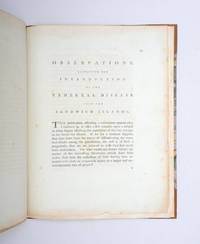
1786Best.-Nr. 5000990London: Printed for G.G.J. and J. Robinson 1786. Some foxing light marginal toning to endleaves: a very good copy. Quarto 300 x 232 mm. pp. iv 34 without final blank; recently bound in speckled half calf to style smooth spine with triple gilt fillets gilt floral motif at foot red morocco label contemporary marbled paper sides top edge cut others uncut. First edition: one of the rarest and most desirable of all Pacific voyage narratives and among the earliest books devoted to Hawaii. We have traced only five copies at auction in the past fifty years confirming its reputation as one of the most elusive of all eighteenth-century voyage accounts. The catalogue of the Hill Collection aptly describes it as "the highlight of a Cook collection". David Samwell 1751-1798 a Welsh surgeon who sailed on Cook's final voyage joined the Resolution as surgeon's mate before becoming surgeon of the Discovery in 1778. His account of Cook's death at Kealakekua Bay is of exceptional importance providing what Sir Maurice Holmes described as "the fullest most detailed and most objective" narrative of the event. Drawing carefully on eyewitness testimony Samwell's work fills significant gaps left by the official account and remains a cornerstone source for understanding the circumstances surrounding Cook's death. The book was written in part to correct the impression created by the official narrative of the voyage published under the editorship of James King in 1784. As Samwell observed in his preface public opinion had come to attribute Cook's death "in some measure to rashness or too much confidence on his side; whereas nothing can be more ill-founded or unjust" p. iii. Holmes later remarked that the work is particularly valuable because it addresses matters "suppressed in the official account" especially regarding responsibility for Cook's death and because Samwell's assessment of Cook's character coming from "an educated man who knew him well" must be read alongside King's in order to gain a balanced view of the navigator as he appeared to those who served under him. Samwell provides a detailed reconstruction of the fatal encounter at Kealakekua Bay. In several respects his account differs from the official version. Discussing Cook's first wound he notes that although one eyewitness supported the claim made in the official voyage that Cook had been stabbed first the testimony of numerous other witnesses convinced him that Cook was initially struck with a club a conclusion later confirmed to him by the Hawaiian priest Kaireekea pp. 15-16. Samwell also places considerable responsibility on Lieutenant John Williamson whom he accuses of failing to support Cook during the attack. The narrative of Cook's death is followed by a biographical memoir largely reverential in tone and concludes with observations on the spread of venereal disease among the indigenous peoples of the Pacific. As a surgeon Samwell was particularly well placed to discuss the subject although his contention that there was insufficient proof that Europeans first introduced the disease to Hawaii is now generally regarded as doubtful. He records that despite Cook's efforts to prohibit intercourse between his sailors and Polynesians during the first visit in 1778 the disease had become widespread by the expedition's return later that year. Apart from its rarity the work exercised considerable influence. It provided a major source for Andrew Kippis's Life of Captain James Cook 1788 and his contribution to Biographia Britannica 1789. Unlike many contemporary accounts of Cook's third voyage which appeared in numerous European editions and piracies Samwell's narrative was published only in this English edition and a French translation. Not until David Magee's Captain Cook and Hawaii 1957 introduced by Sir Maurice Holmes was the text reprinted. Holmes noted on that occasion that the original printing was "of great rarity and correspondingly expensive". The book holds a prominent place in Hawaiian bibliography. The Hill catalogue observes that among the earliest books relating to Hawaii it ranks alongside Zimmermann's Reise um die Welt 1781 and Shaw's Catalogue of the Different Specimens of Cloth 1787 as one of the most significant publications of the eighteenth century. Combining exceptional rarity with fundamental historical importance Samwell's account remains one of the indispensable primary sources for Cook's final voyage and death. . Printed for G.G.J. and J. Robinson unknown
1,00