6 387 résultats
1938réf. 612015New York: Better Publications 1938. Softcover. Very Good. Pulp magazine. Cover art by Howard V. Brown. Small quarto. Pictorial wrappers. Chips and tears at extremities very good. Includes: " The Star Parade" by Henry Kuttner "The Great Adventure" by Ray Cumming "The Loot of Time" by Clifford D. Simak "Tidal Moon" by Helen Weinbaum and Stanley G. Weinbaum and more. Better Publications unknown books
1937réf. 612007New York: Better Publications 1937. Softcover. Very Good. Pulp magazine. Cover art by Howard V. Brown. Small quarto. Pictorial wrappers. Small tear on one page of ads tiny nicks and tears at edges of wraps small abrasions on spine very good. Includes: "The Hothouse Planet" by Arthur K. Barnes "The Space-Time-Size Machine" by Ray Cummings "The Immortality Seekers" by John W. Campbell Jr. "The Cavern of the Shining Pool" by Arthur Leo Zaga and more. Better Publications unknown books
1938réf. 612012New York: Better Publications 1938. Softcover. Very Good. Pulp magazine. Cover art by Howard V. Brown. Small quarto. Pictorial wrappers. Small tears at the edge of a few pages chips and tears on wraps and spine very good. Includes: "Murder in the Void" by Edmond Hamilton "The Reinmuth Rider" by John Victor Peterson "The Dual World" by Arthur K. Barnes "Terror in Utopia" by Paul Ernst and more. Better Publications unknown books
1940réf. 612067New York: Better Publications 1940. Softcover. Very Good. Pulp magazine. Cover art by Howard V. Brown. Small quarto. Pictorial wrappers. Chips and tears at edges of fragile wraps very good. Includes: "Prisoner's Base" by Nelson S. Bond "Gems of Life" by Otto Binder "The Seven Sleepers" by Arthur K. Barnes and Henry Kuttner " Dictators of Creation" by Edmond Hamilton and more. Better Publications unknown books
1996réf. 449078New York: North Point Press 1996. Hardcover. Near Fine/Fine. First edition. Small quarto. Slight foxing on the foredge else fine in price-clippled else fine dustwrapper. North Point Press hardcover books
1970réf. 449612San Francisco: Two Windows Press 1970. Softcover. Near Fine. First edition. Small octavo. Perfectbound in photographic wrappers. Near fine with rubbing to the wraps. One of 1050 copies. Two Windows Press unknown books
1985réf. 383805New York: Harry N. Abrams Inc 1985. Hardcover. Fine/Fine. First edition. Foreword by Dr. Armand Hammer. Large folio. Fine in fine dustwrapper and fine slipcase. Copy number 173 of 500 numbered copies Signed by the author and additionally Inscribed by him. Harry N. Abrams, Inc hardcover books
1985réf. 380849Los Angeles: PR 1985. Hardcover. Fine. Photomechanically reproduced oblong flyer on 8.5" x 11" blue paper. Fine. An original flyer promoting a Dead Kennedys gig at The Balboa Theater with MIA and Death Science. Artwork of a graveyard with LA venues listed on the tombstones. The Dead Kennedys 1978 - 1986 were a West coast hardcore band known for blending music experimentation with satirical lyrics written by their infamous front man Jello Biafra. PR hardcover books
1985réf. 380848Los Angeles: PR 1985. Unbound. Near Fine. Photomechanically reproduced oblong flyer on 8.5" x 11" pink paper. Some creasing else near fine. An original flyer promoting a Dead Kennedys gig at The Balboa Theater with MIA and Death Science. Artwork of a graveyard with LA venues listed on the tombstones. The Dead Kennedys 1978 - 1986 were a West coast hardcore band known for blending music experimentation with satirical lyrics written by their infamous front man Jello Biafra. PR unknown books
réf. 380840Arcadia California: No Publisher no date. Unbound. Fine. Photomechanically reproduced flyer on 8.5" x 11" paper. Fine. An original flyer promoting a gig at Chexx Club in Los Angeles with Final Conflict with very special guest stars Generic Response Death Youth Foundation Corrupted Ideal and Evol. [No Publisher unknown books
1985réf. 380847Los Angeles: PR 1985. Unbound. Fine. Photomechanically reproduced oblong flyer on 8.5" x 11" green paper. Fine. An original flyer promoting a Dead Kennedys gig at The Balboa Theater with MIA and Death Science. Artwork of a graveyard with LA venues listed on the tombstones. The Dead Kennedys 1978 - 1986 were a West coast hardcore band known for blending music experimentation with satirical lyrics written by their infamous front man Jello Biafra. PR unknown books
réf. 13504scsCoimbra 1960. Quarto softbound stiff white illus. wrappers xv 485 pp. Very Good with minor foxing age darkened spotting to covers lightly rubbed spine. paperback books
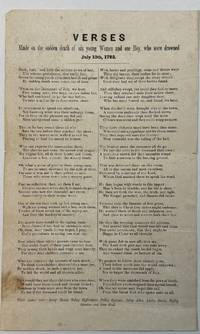
1815réf. 42321Rhode Island 1815. Folio broadside 8-1/2" x 14." Twenty-four four line stanzas printed in two twelve-stanza columns separated by a rule. Names of the dead children printed in italics at the bottom . No imprint. One spot. Else Very Good. This is a later printing of a 1782 tragedy originally printed at Newport in 1782. The tragedy occurred in Jamestown Rhode Island; its initial printings included illustrations of seven coffins. unknown books
2000réf. 232574The Easton Press 2000. First Edition. hardcover. Very Good. 0x0x0. Signed. Signed First Edition issued by Easton Press. Full dark gray leather with gilt board design and page edges. Five raised bands to the spine. Clean has a good binding no marks or notations. Quarto. ep/cw The Easton Press hardcover books
1976réf. 149763N.p.: N.p. 1976. Two vintage color reference photographs from the 1976 film one showing actor Jodie Foster the other showing actor Scott Jacoby and the back of Connie Foster Jodie's older sister and body double for the scene. One with a collector label on the verso and manuscript ink annotations noting the film's German title the other with a printed mimeo snipe specific to the film's Dutch release. Based on Laird Koenig's 1974 novel wherein a teenage girl living alone attempts to hide a dark familial secret from her upper-crust neighbors. To the displeasure of several producers Jodie Foster who was 13 years old at the time of filming refused to appear in a sex scene with Jacoby leading director Nicolas Gessner to call in Foster's 21 year-old sister as a nude body double. Set in Wells Harbor Maine and shot on location in Montreal and Knowlton Quebec. 10 x 8 inches. Very Good plus with pinholes to the corners and light fading overall. N.p. unknown books
1970réf. 59585New York: All-Slavic Publishing House 1970. 8vo pp. 364 4; text in Russian; orange printed paper wrappers; light soiling to wrappers text clean and sound signed by the author on page 3 very good. All-Slavic Publishing House unknown books
1696réf. 5532Frankfurt: Heirs of Matthäus Merian 1696. SECOND EDITION THUS. Fifth edition overall. This edition is based on Merian's own 1649 edition which was the first to include these revised images and a number of the supplementary texts. Hardcover. Fine. Bound in original tanned sheepskin light surface wear corners bumped lower edge of rear board abraded faithfully and almost imperceptibly rebacked the new spine richly tooled in gold and with a red morocco label. Internally an attractive copy with minor soiling and discoloration to margins of the title page scattered mild soiling in the text mainly marginal a few small rust spots and light blemishes a discreet contemporary repair to one blank margin a small tear in the margin no loss of leaf G1 a clean tear barely entering the image no loss on leaf M1; Memento Mori plate lightly soiled. There is a curious feature in this copy: there is light offsetting -from the text of different book- on one side of the 3 sheets that made up gatherings H S and Cc probably the result of those sheets having been laid upon sheets of the other book while still damp. With the collector's stamp of Johann Carl Conrad Oelrichs 1722-1798 on the title verso. A series of engravings with accompanying text by Matthäus Merian the Elder depicting the Grossbasler Totentanz the 60-meter long Dance of Death mural painted circa 1439 which adorned the inner face of the cemetery wall adjoining the Dominican convent and Predigerkirche in Basel. It was along with the Danse Macabre murals painted in the arcades of the Paris Cimetière des Innocents one of the two earliest painted Dance of Death fresco cycles. The Basel frescoes were lost in 1805 when the wall was destroyed. Only 19 fragments survive. The murals depicted a communal dance between cadavers and people from all strata of society from pope to peasant including members of various trades and professions from physician to fool. The list of those who join -unwillingly- their macabre dance masters in this dance to the grave are in order of appearance: pope emperor empress king queen cardinal bishop duke duchess count abbot knight lawyer councilman church canon physician nobleman noblewoman merchant abbess lame man hermit young man usurer maiden minstrel herald mayor executioner fool peddler blind man Jew heathens a man and a woman cook peasant painter and a mother holding her child. The dance is preceded by the images of a preacher delivering a sermon and a group of skeletons emerging from a charnel house playing instruments this image was probably added over the actual ossuary in the cloister during the restoration of 1616. "The figures of Death were depicted in all kinds of contortions suggesting movement and presumably intended to evoke an association between the represented action and the variety of dance being performed particularly round dances Reigen popular at that time. This is all the more probable because the introductory part of the dance of death which did not survive quite likely depicted figures of Death making music."Dreier Der Totentanz p. 47 "Beneath the pictures was a band containing addresses by Death and replies by the individual representatives of the estates each of four lines in Basel or eight lines in Paris. These verses were written in the local idiom generally in iambic rhyming couplets or alternating rhyme. In the verses the encounter between Death and the human representative was cast as a dialogue in which Death reminded human beings that in the face of mortality everything worldly was transitory and vain. Following Erwin Koller's outstanding philological investigations. it may be assumed that the blockbook produced in Basel around 1460 now preserved in Heidelberg University Library under the shelfmark cpg 438 is a contemporary virtually identical transcription of the original Basel text."Dreier p. 48 Merian made his engravings based on his drawings of the Basel frescoes in 1616. He then either gave or sold his engravings to his nephew Johann Jakob Merian. The first two editions appeared in 1621 one of them printed by Johann Schröter the other by Matthäus Mieg who re-published the book in 1625. The artist himself reworked the plates in 1649 adding atmospheric elements and background details and printed them with a greatly expanded text. This 1696 edition by Merian's heirs reprints the images and text of that edition. For the 1649 expanded edition Merian added a 10-page history of the Basel mural the now-iconic Memento Mori engraving an hourglass with a skull a burning candle and wilting flowers the Adam and Eve engraving and the dual-portrait engraving which when viewed right side up shows a bearded man and when turned upside down show a death's head. Merian also added as announced on the title 42 pages of "Admonitions concerning Human Mortality the Fleeting Nature of This Present Life and the Vanity of All Earthly Things; concerning the Burial and Resurrection of the Dead; concerning the Last Judgment; concerning Hell and the Damnation of the Godless; and concerning Eternal Life.". Heirs of Matthäus Merian hardcover books
1970réf. 25137San Francisco: twowindows press 1970. First edition. 52 pp. Fine in glossy illustrated wrappers. One of 1000 copies. San Francisco: twowindows press unknown books
1773réf. 5488Troyes: chez Jean-Antoine Garnier ca. 1766 to 1773. Hardcover. Fine. Bound with: Le Grand Calendrier et Compost des bergers composé par le berger de la Grande Montagne Avec le Compôt naturel reformé selon le retranchement des dix jours par le Pape Gregoire III. Ensemble la manière comme se doit gouverner le Berger pour empêcher qu'aucun Sorciers ne fassent mourir leurs troupeaux avec toutes choses nécessaire pour se régler en leur art. Troyes: Chez Jean-A. Garnier Imp. Lib. No date ca. 1776 Quarto: II. 144 pp. A-S4. TWO RARE EDITIONS. Bound in contemporary tanned sheep the boards framed by a triple gold rule the spine ruled in gold and with rampant lions tooled in the compartments. The Privilege at end is granted to Pierre Garnier and dated 21 May 1728. It gives also a list of his other publications. Unusually fine copies printed on delicate paper of these works which are rarely found in such nice condition bound in a strictly contemporary binding. The bottom line of the first t.p. "avec permission" has been shaved off. In the second work leaf N1 has marginal stains; the last few leaves are lightly foxed. The Dance of Death "Les trois vifs et les Trois Morts" and the other accompanying texts are illustrated with 60 woodcuts of the Dance of Death copied from the original designs which appeared in the edition of the Danse Macabre of G. Marchant 1490. That of the Moor on p. 32 may be a very close copy of the same subject in the Compost. Another version of it appears on p. 27 and is a very close copy of that in the Bradwardine No. 64. N. B. - the two blocks of this subject appearing respectively on pp. 24 & 27 of the present Danse Macabre are not identical. Two works bound together both examples of important literary genres dating to the late-Medieval and early-Renaissance periods. The "Danse macabre" is a pictorial cycle and poem first painted at a Paris cemetery about 1425. Woodcuts copied from the Paris fresco along with the accompanying verses were first printed by Guy Marchant at Paris in 1485. "Le Grand Calendrier" an illustrated almanac and calendar was first printed in 1491 by Guy Marchant. The book remarkable for both its text and its illustrations was a kind of encyclopedia of meteorological agricultural hygienic and moral knowledge. I. The Dance of Death One of the earliest examples of the pictorial cycle and poem known as the Danse Macabre was painted between August 1424 and Lent 1425 in the arcades of the Cimetière des Saints-Innocents Cemetery of the Holy Innocents in Paris. These arcades constructed as charniers to house bones from earlier mass burials were demolished in 1669 along with their frescoes. The images of the Danse in this book were directly inspired by the Paris Danse. Woodcuts of the Danse copied from the Paris fresco along with the 67 verses that accompanied the images were first printed by Guy Marchant at Paris in 1485 with woodcuts designed by Pierre le Rouge. While there were no women in the original Danse in 1486 Marchant published an all-female version "La Danse Macabre des Femmes". Later Marchant united these two texts in the two-volume "Miroer Salutaire". While Marchant followed the sequence from the Cimetière des Saints-Innocents he introduced numerous changes adding new pictorial elements and verses including 20 additional dancers and the woodcut of the four skeleton musicians. From the 16th through the 18th centuries editions of the Danse appeared outside of Paris printed -with various changes- by French provincial printers in Lyon Rouen and Troyes. Over the years the woodblocks used to print the illustrations in the various Paris editions worn or damaged from repeated use and in some instances lost were re-cut with the images reproduced with varying degrees of fidelity to the originals. The printing history of the Danse in Troyes began in 1493 when Pierre le Rouge's woodblocks were acquired by his nephew Nicolas le Rouge who printed editions of the text into the 1530s. It is in Troyes that the woodcuts were first copied and further changes were introduced by successive printers. In 1610 the Troyes printer Noël Moreau began printing editions of the Danse using copies of the woodcuts from the Parisian edition published by Marchant 1490. Moreau added several new images at this point including the Black man blowing a horn and carrying a spear. According to Mortimer Moreau also used several original 15th c. blocks in this edition e.g. p. 26 the Punishment of the Sin of Luxury also used in the "Compost et kalendrier des bergiers" of 1497. and one of the Occupations of the Months May from the "Compost" of 1499. In 1641 Nicolas Oudot's son Nicolas Oudot II printed a new edition using Moreau's woodcuts. The last Oudot edition with the text largely re-written was printed by Nicolas II's son and widow in 1729 under the title "La Grande Danse Macabée sic!". It is this edition that would set the template for the next publishers the Garniers. The dating of this edition /- 1773 is based on the dates during which the publisher is known to have been active. A number of early bibliographers following the printed privilege on the last page dated this edition to 1728 and numerous cataloguing records have this date. However the publisher to whom the privilege was granted Pierre Garnier died in 1738. Further Jean-Antoine Garnier who is named as publisher on the title page was active between 1766 and 1773. Alexis Socard "Livres Populaires de Troyes" 1864 p. 126-127 tells us that the Garniers continued to print the book up until 1820 with the same imprint and privilege. See also: Corrard de Breban "Recherches sur l'établissement et l'exercice de l'imprimerie à Troyes" Paris 1873 4th ed. p.73-74. The additional texts: Already in the late 15th c. editions of the Danse had begun to include supplemental texts. Those included in this edition are: "Le débat du corps et de l'ame" "La complainte de l'ame damnée" "L'exhortation de bien vivre et de bien mourir" "La vie du mauvais Antechrist" and "Les quinze signes du jugement." Of these "La Vie du mauvais Antechrist" pp. 70-72 is antisemitic. The Antichrist is born of incest by "Un paillard Juif abominable" who knows his own daughter carnally is nursed by a whore before embarking on his career of destroying Christianity. He comes to Jerusalem where the Jews adore him he himself is circumcised but when he attempts a second Ascension from the Mount of Olives he is cast down into a sepulchre at the bottom of hell and "dix millions . De ces Juifs l'accompagneront". Marquand Library Notes: Fairfax Murray 108; see a reproduction of one of J.A. Marchant's editions in Claudin's Hist. de l'Impr. I. 339 sq. A brief description of those editions with some reproductions is found in Nisard Hist. des Livres populaires 1854 II 303 sq. A few of the images in these editions are new e.g. p. 26 the Punishment of the Sin of Luxury which originated in the Compost of 1497 see No. 103 and reproduction in Claudin I. 375 and one of the Occupations of the Months May from the Compost & Kal. Des Bergères 1499 see note to No. 103 and Claudin I. 379 sq. Langlois Essai Historique Philosophique et Pittoresque sur les Danses des Morts I p.340 31; Douce p.60 26; Reichelt 96 II. The Shepherd's Calendar and Compost Le Grand Calendrier et Compost des bergers A Troyes chés P. Garnier s.d. ca. 1776 Illustrated with 49 woodcuts including 12 full-page cuts one for each month of the calendar. Like the Danse Macabre many popular editions of this calendar were printed into the 18th c. particularly in Troyes and Paris. The Kalendrier des Bergiers an illustrated almanac and calendar was first printed on 2 May 1491 by Guy Marchant. On 18 April 1493 he printed an entirely new edition under the title: "Compost et Kalendrier des Bergiers" and on 18 July Marchant completed yet another edition further expanded in both text and illustrations: "Here is the Compost et Kalendrier des Bergiers. to which many new items have been added as those who look at it will be able to discover." The book remarkable for both its text and its illustrations was a kind of encyclopedia of meteorological agricultural hygienic and moral knowledge. "What we have here" says Monceaux "is the first almanac ever printed in France and one can readily understand the appeal of a work that addressed itself to the rural and popular masses and gave them advice of every kind on the health and hygiene of men and animals on agriculture on how to conduct oneself in this world with a view to arriving safely in the next - while at the same time giving those who could not read some basic knowledge of astronomy and the measurement of time via explanatory images." The beautiful incunabula editions of the Shepherd's Calendar were transformed into popular booklets in the mid-17th century notably by Nicolas Oudot. All the printers of the Bibliothèque bleue Blue Library published an edition of this Compost. "This undoubtedly means that the Compost was to be considered an introduction to popular literature because it contained presented-one might even say in their purest form the essential themes of the popular library." G. Bollème Les almanachs populaires p. 41. The book opens with a brief verse to the reader explaining the Gregorian calendar reform followed by a prologue in which the shepherd-author presents his central argument: that the natural human lifespan is seventy-two years demonstrable through a parallel between the twelve months of the year and twelve successive stages of human life six years to each month. The heart of the book is the compost and the almanac proper. The compost material includes mnemonic verses and tables for calculating the moveable feasts of the church year - Easter Pentecost and the rest - along with the Golden Number a nineteen-year cycle used to predict the date of the new moon the Dominical Letter a device for finding the day of the week on which any given feast falls and Epact tables the Epact being a number expressing the age of the moon on 1 January used to calculate Easter under the Gregorian reform. The almanac proper gives each month its own full-page woodcut a verse in the month's own voice describing its character and principal feasts and a calendar table. Part Two is devoted to the vices and the torments of Hell. It opens with the "Exhortation pour le Salut de l'Ame faite par maniere de double ballade" a poem calling the reader to repentance. The moral center of this section is an extended account of the punishments awaiting sinners in Hell introduced through the figure of Lazarus. It is illustrated with seven woodcuts depicting the punishments of the damned one for each of the deadly sins - the proud hung from spinning wheels fitted with iron cramps; the envious plunged to the waist in a freezing river; the wrathful pierced by swords in a dark and blood-soaked hall; the slothful assailed by serpents; the avaricious submerged in cauldrons of boiling oil and molten metal; the gluttonous forced to eat toads and drink from a foetid river; the lustful tormented in pits of fire and sulphur. Part Three - headed "La Troisième Partie du Compost des Bergers qui est science salutaire ou champ des vertus" - is devoted to religious and moral instruction. One notable section is the Field of Virtues "Jardin ou Champ des Vertus" which contains a poem of the soul adrift at sea guided by God to port two shepherd songs a verse catalogue of the pains of Hell a long poem in the voice of a rotting corpse meditating on the vanity of earthly honor a poem spoken by Death mounted on the pale horse of the Apocalypse and the Tree of Virtues with Humility as root and seven cardinal virtues - Charity Faith Hope Prudence Temperance Justice and Force - as its branches each with named sub-branches. Immediately following and without a new Part heading comes the Anatomical Man - a figure illustrated with a woodcut showing which of the twelve zodiac signs governs which part of the body with the practical implication that one should not apply a surgical instrument to any part of the body while the moon is passing through its governing sign - followed by the four human complexions or temperaments choleric sanguine phlegmatic and melancholic a month-by-month health regimen giving dietary and practical advice for each season and a comprehensive phlebotomy guide treating every vein in the body from forehead to groin. The book closes with the comic poem "Les débats des Gens d'Armes & d'une Femme contre un Limaçon" in which a woman armed with her distaff and two soldiers with their swords attempt to drive away a snail that has been eating her garden while the snail defies them all by threatening them with its horns. chez Jean-Antoine Garnier, ca. 1766 to hardcover books
1774réf. 6518Mexico 1774. Very good. Broadside 23.5 x 16.5 inches. Untrimmed. Printed on two joined sheets. Previously folded. Contemporary manuscript docketing on blank verso. Minor edge wear and scattered faint foxing. A rare ecclesiastical edict addressing the burial of deceased infants issued by the Archdiocese of Mexico on March 15 1774. The broadside responds to complaints from parish priests that numerous baptized children were being buried without notification to their parishes depriving the churches of both jurisdictional oversight and the burial fees set by the ecclesiastical tariff. The document sheds light on the social realities of infant mortality and poverty in eighteenth-century Mexico City. It notes that many families were unable to afford burial expenses resulting in unrecorded deaths and in some cases the abandonment of children's bodies at the doors of churches. Particularly noteworthy is its condemnation of the custom of dressing deceased children as angels clerics bishops or cardinals and displaying them publicly before burial. The edict denounces these practices as abuses and orders that all burials whether of children or adults be conducted only with the knowledge and authorization of the proper parish priest. The present copy bears the manuscript rubrics of Josef Ruiz de Conejares Vicar General of the Archdiocese and Joaquín de Sasturain Chief Notary and the complete wafer seal of Archbishop Alonso Núñez de Haro. unknown books
1750réf. 323461750. unknown books
1811réf. 8017Augsburg: M Rieger 1811. Fifth Edition stated. Contemporary three-quarter leather. A very good copy. 8vo. A most unusual and little known book. The aim is to advise individuals on how to approach and deal with those that are sick and dying. The text is specific in how to make inquiries dealing with incoherent replies what to say how to say it providing medical assistance and comfort simple rules to follow etc. M Rieger hardcover books
1987réf. 126192San Diego: Harcourt Brace Jovanovich 1987. First. hardcover. very good/very good. Black & white photo illustrations. 326pp. 8vo cloth-backed bds. dust wrapper; d.w. lightly soiled. San Diego: Harcourt Brace Jovanovich 1987. Very good. Harcourt Brace Jovanovich unknown books
1950réf. 50266Munich: Philipp Rauscher 1950. First edition. Softcover. Good condition. Sextodecimo. 59 1 1 folding plan. Original tan illustrated wraps with black lettering and double frame on cover. Guide through the memorial sites of the former Concentration Camp Dachau. Pictorial and written reports on the suffering and death of uncounted prisoners from countries around the world. "The booklet was written without any thought of hatred or revenge; it shall give the visitors of the Dachau memorial sites information on everything that has happened here without any exaggeration but also without any extenuating phrases. The attached plans will give detailed orientation on the memorial sites at the Crematory on "Leitenberg" and "Waldfriedhof" in Dachau." Introduction. Profusely illustrated with b/w reproduction of photographs artistic renderings and tables conveying overwhelmingly the horror and suffering that took place in the concentration camp. Includes photographs of the postwar tribunal the memorial sites and plaques and a folding map of the Crematory and the surrounding area at the camp. All images with captions. Text in English and French. Booklet age-toned and back cover with mostly closed tear small chips half way down the spine repaired with japan tissue. Philipp Rauscher unknown books
1988réf. 1401383N.S.: Stabur Press 1988. First Edition. Softcover. Quarto 96 pages. In Very Good minus condition with the illustrated bag in Good plus condition. Spine has black lettering on a red/orange background. Illustrated wraps. Lower right hand corner of the front cover and first six pages are curved. Spine is slightly faded. Text block is white with no edge toning. Promotional Burger King bag is from 1980 and has Mort Drucker caricatures front and back. Bag has discoloration and staining. There is a fold across the top and the overall bag is heavily creased. NOTE: Shelved in Locked Annex Area Oversized Ephemera Shelf. 1401383. FP New Rockville Stock. Stabur Press unknown books