6 302 résultats
réf. 5623Chez Ad. Lainé et J. Havard. 1864. Plaquette in-8° cousue. 56 pages. 2e édition, corrigée et augmentée. Très propre. Rare.
réf. 201709638, Glénat, 1982 ; in-4, 48 pp., cartonnage de l'éditeur. Très bon état.
réf. 200601861, Glénat, 1982 ; in-4, 48 pp., cartonnage de l'éditeur.
réf. 200601860, Glénat, 1982 ; in-4, 48 pp., cartonnage de l'éditeur.
réf. 202403521Paris, Stardom, 1995 ; in-4, cartonnage de l'éditeur. Ce surprenant coffret, en hommage aux indiens, comprends 18 images offset de couleur (6 de chaque auteur) + 2 planches de justificatif de tirage (dont une numérotée sur 500 exemplaires et signée par les différents auteurs, ici numéro 190/500) Le tout emballé dans un beau tissu + 6 CD (Barney Bush, Tony Hymas…) emballés également dans un beau tissu aux mêmes motifs.
réf. 1416Catalogue de monuments funéraires de la Société Granitière du Nord "Gaudier-Rembaux". Aulnoy. 1925. Grand in-8° broché. Couverture cartonnée, dos toilé. 96 pages. Photographies de l'usine d'Aulnoy (Nord) et des carrières de granit de Saint-Pierre de Plesguen (Ille & Vilaine), suivies de 90 planches hors texte de monuments funéraires (en héliogravure).
réf. 014286[Monument Catulle Mendès] Fernand Desmoulin (1853-1914), peintre et graveur. Il était chez Catulle Mendès dès le lendemain de sa mort et semble avoir vécu avec Jane Catulle-Mendès. P.A.S., mai 1909, 1p in-8 oblong. Billet de souscription pré-imprimé pour la soirée de Gala pour l'érection du monument Catulle Mendès (1841-1909), mort le 8 février 1909. Lors de cette soirée, au théâtre Sarah-Bernhardt, la grande actrice joua le rôle de Cyrano de Bergerac et le sculpteur Emile Guillaume (1867-1954) y présenta son buste du poète (il avait aussi fait un masque mortuaire). [341]
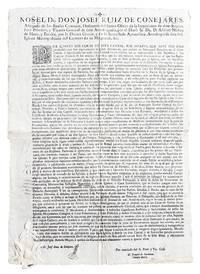
1774réf. 6518Mexico 1774. Very good. Broadside 23.5 x 16.5 inches. Untrimmed. Printed on two joined sheets. Previously folded. Contemporary manuscript docketing on blank verso. Minor edge wear and scattered faint foxing. A rare ecclesiastical edict addressing the burial of deceased infants issued by the Archdiocese of Mexico on March 15 1774. The broadside responds to complaints from parish priests that numerous baptized children were being buried without notification to their parishes depriving the churches of both jurisdictional oversight and the burial fees set by the ecclesiastical tariff. The document sheds light on the social realities of infant mortality and poverty in eighteenth-century Mexico City. It notes that many families were unable to afford burial expenses resulting in unrecorded deaths and in some cases the abandonment of children's bodies at the doors of churches. Particularly noteworthy is its condemnation of the custom of dressing deceased children as angels clerics bishops or cardinals and displaying them publicly before burial. The edict denounces these practices as abuses and orders that all burials whether of children or adults be conducted only with the knowledge and authorization of the proper parish priest. The present copy bears the manuscript rubrics of Josef Ruiz de Conejares Vicar General of the Archdiocese and Joaquín de Sasturain Chief Notary and the complete wafer seal of Archbishop Alonso Núñez de Haro. unknown books
1774réf. 6518Mexico 1774. Very good. Broadside 23.5 x 16.5 inches. Untrimmed. Printed on two joined sheets. Previously folded. Contemporary manuscript docketing on blank verso. Minor edge wear and scattered faint foxing. A rare ecclesiastical edict addressing the burial of deceased infants issued by the Archdiocese of Mexico on March 15 1774. The broadside responds to complaints from parish priests that numerous baptized children were being buried without notification to their parishes depriving the churches of both jurisdictional oversight and the burial fees set by the ecclesiastical tariff. The document sheds light on the social realities of infant mortality and poverty in eighteenth-century Mexico City. It notes that many families were unable to afford burial expenses resulting in unrecorded deaths and in some cases the abandonment of children's bodies at the doors of churches. Particularly noteworthy is its condemnation of the custom of dressing deceased children as angels clerics bishops or cardinals and displaying them publicly before burial. The edict denounces these practices as abuses and orders that all burials whether of children or adults be conducted only with the knowledge and authorization of the proper parish priest. The present copy bears the manuscript rubrics of Josef Ruiz de Conejares Vicar General of the Archdiocese and Joaquín de Sasturain Chief Notary and the complete wafer seal of Archbishop Alonso Núñez de Haro. unknown
1905réf. 9447Bullfrog Nye County Nevada 1905. Two broadsheet menus 26 x 13.5 cm. 1 page each. Illustrated. Two holiday menus for Thanksgiving and Christmas of 1905 from the height of the Nevada Gold Rush. The Christmas menu assembled by Robert Brogelman Chef included Blue Point Oysters Mock Turtle Soup Lobster Mayonaise Oyster Fritters English Plum Pudding Malaga Grapes Hennesy 3 Star Brandy and Josyni Key West Cigars. The Thanksgiving menu included Roast Young Turkey a la Malcolm MacDonald Pumpkin Pie and a Manhattan Cocktail. The Montgomery-Shoshone Mine was a Death Valley gold and silver site discovered in 1904 and in operation by 1905 the year of these Thanksgiving and Christmas celebrations. In April of the same year the Salt Lake Mining Review declared "the story of . the Mine's company's property at Bullfrog Nevada is so incredible that the bare facts seem clear out of the range of possibilities" page 8. In June of the same year the LA Times reported there were 1300 head of horses and mules on the Bullfrog-Las Vegas hauling freight. These holiday dinners were offered by the founder of the mine the already ridiculously wealthy Mr. E.A. Montgomery and his major partner Malcolm L. MacDonald. A year later the mine was sold to Charles Schwab the steel magnate not the financier Bullfrog was the definition of a boom town. Within a year of the original discovery 10000 people sought gold and pleasure there. "The town citizens had an active social life including baseball games dances basket socials whist parties tennis a symphony Sunday school picnics basketball games Saturday night variety shows at the opera house and pool tournaments. In 1906 Countess Morajeski opened the Alaska Glacier Ice Cream Parlor to the delight of the local citizenry. That same year an enterprising miner Tom T. Kelly built a Bottle House out of 50000 beer and liquor bottles" nps.gov "Rhyolite Ghost Town". By 1908 mine productivity was dwindling and by March 1911 the mine was shut. The Thanksgiving menu has some small grease stains and tape repairs to the verso at two folds. The Christmas menu has one short tape repair to the edge. Still near very good and a rare survival from the apex moment of a town that lasted little more than six years. unknown books
1905réf. 9447Bullfrog Nye County Nevada 1905. Two broadsheet menus 26 x 13.5 cm. 1 page each. Illustrated. Two holiday menus for Thanksgiving and Christmas of 1905 from the height of the Nevada Gold Rush. The Christmas menu assembled by Robert Brogelman Chef included Blue Point Oysters Mock Turtle Soup Lobster Mayonaise Oyster Fritters English Plum Pudding Malaga Grapes Hennesy 3 Star Brandy and Josyni Key West Cigars. The Thanksgiving menu included Roast Young Turkey a la Malcolm MacDonald Pumpkin Pie and a Manhattan Cocktail. The Montgomery-Shoshone Mine was a Death Valley gold and silver site discovered in 1904 and in operation by 1905 the year of these Thanksgiving and Christmas celebrations. In April of the same year the Salt Lake Mining Review declared "the story of . the Mine's company's property at Bullfrog Nevada is so incredible that the bare facts seem clear out of the range of possibilities" page 8. In June of the same year the LA Times reported there were 1300 head of horses and mules on the Bullfrog-Las Vegas hauling freight. These holiday dinners were offered by the founder of the mine the already ridiculously wealthy Mr. E.A. Montgomery and his major partner Malcolm L. MacDonald. A year later the mine was sold to Charles Schwab the steel magnate not the financier Bullfrog was the definition of a boom town. Within a year of the original discovery 10000 people sought gold and pleasure there. "The town citizens had an active social life including baseball games dances basket socials whist parties tennis a symphony Sunday school picnics basketball games Saturday night variety shows at the opera house and pool tournaments. In 1906 Countess Morajeski opened the Alaska Glacier Ice Cream Parlor to the delight of the local citizenry. That same year an enterprising miner Tom T. Kelly built a Bottle House out of 50000 beer and liquor bottles" nps.gov "Rhyolite Ghost Town". By 1908 mine productivity was dwindling and by March 1911 the mine was shut. The Thanksgiving menu has some small grease stains and tape repairs to the verso at two folds. The Christmas menu has one short tape repair to the edge. Still near very good and a rare survival from the apex moment of a town that lasted little more than six years. unknown
1781réf. 35765Wien, Joseph von Kurzbeck, 1781. 8°. Mit einigen Holzschn.-Vignetten. 4 nn. Bll. (das letzte weiß), Mod. Brosch.
réf. L14602Jérusalem. " Jérusalem Post Press ". In-12 br. à l'italienne. Textes, photos. E.O.
réf. 14154Ed. Payot, 1960. In-8 br. Coll. " Bibliothèque historique ". Deuxième édition revue et augmentée. Édition en partie originale, n.c.
1970réf. LFA-126748221Un ouvrage de 112 pages, format 150 x 210 mm, illustré, broché, publié en 1970, Impr. Rapp, bon état
1999réf. LFA-126727459La nouvelle revue d'idées chrétiennes : 262 pages, format 170 x 240 mm, brochée, bon état
1903réf. AQ29269London: Published for the Early English Text Society by Kegan Paul Trench Trubner & Co. 1903. xxx 148pp. Bound for the University College Reading in contemporary gilt-stamped half-morocco brown cloth boards T.E.G. Lightly rubbed. Marbled endpapers prize plate to FEP bookplate of Eric Gerald Stanley to FFEP A re-edit of from MS. Harley 2252 held by the British Museum of Le Morte Arthur with an introduction and notes by Arthurian scholar James Douglas Bruce 1862-1923. From the recently dispersed library of Eric Gerald Stanley 1923-2018 scholar of Old English literature Rawlinson and Bosworth Professor of Anglo-Saxon at the University of Oxford. . 8vo. Published for the Early English Text Society by Kegan Paul, Trench, Trubner & Co. hardcover
2005réf. LFA-126716661Une revue de 80 pages, format 205 x 280 mm, illustrée, broché couverture couleurs, bon état
2007réf. LFA-126716668Une revue de 80 pages, format 205 x 280 mm, illustrée, broché couverture couleurs, bon état
1982réf. LFA-126740626Une revue de 100 pages, format 215 x 285 mm, illustrée, brochée couverture couleurs, bon état
réf. 200601872, Glénat, 1991 ; in-4, 48 pp., cartonnage de l'éditeur. Eo.
réf. 200601871, Glénat, 1991 ; in-4, 48 pp., cartonnage de l'éditeur. Eo.
1976réf. LFA008d9N° 65 - Mars 1976 Une revue d'environ 140 pages, format 295 x 220 mm, brochée, illustrée
1881réf. 5571Glasgow: John S. Marr and Sons 1881. First edition. 18x14cm 5 128 plus 1 8pp publisher's ads. Color frontis 2 black and white plates vignette chapter ornamentation. Publisher's brown cloth stamped in black and gilt beveled edges rear cover ruled and decorated in blind. Rubbing along joints and corners light moisture staining and school presentation stamp to ffep front hinge cracked at title and first signature else clean and sound. Very good. Very uncommon juvenile work from Scotland about which scant information is to be found. The story concerns Mabel Minnie and Mona two schoolgirl friends and their archenemy who develop and undertake a mission to educate the poor children of the miners living in the row houses down by the pit. The idea is to use gentler methods of introducing Christianity at which the local missionaries and curates have failed: "We will take lessons from them and try to avoid what seems to have been their great mistake - injudiciousness; and perhaps showing a little too plainly that they considered them heathen and were determined to convert them at any cost." The book contains themes of friendship and antagonism philanthropy and stewardship faith and hope. However perhaps most interestingly the story explores death and loss as the young protagonists first grapple with the passing of a miner's wife from consumption. SPOILER ALERT Then Mabel becomes ill and Minnie must provide her and others hope as the young girl dies from fever due to a ruptured blood vessel. OCLC locates perhaps 3 physical copies of this rare book for the young 19th century reader. . John S. Marr and Sons unknown
1822réf. 46405001Epinal, Pellerin, (1822) ; 31 x 41 cm., épreuve sur vergé., Texte de la chanson sur 2 colonnes, illustration coloriée au pochoir. - Garnier, ATP, 1990, n°1048 - Perrout p. 42 - Dumont pl. III.