6.279 resultados
1773ref. 5488Troyes: chez Jean-Antoine Garnier ca. 1766 to 1773. Hardcover. Fine. Bound with: Le Grand Calendrier et Compost des bergers composé par le berger de la Grande Montagne Avec le Compôt naturel reformé selon le retranchement des dix jours par le Pape Gregoire III. Ensemble la manière comme se doit gouverner le Berger pour empêcher qu'aucun Sorciers ne fassent mourir leurs troupeaux avec toutes choses nécessaire pour se régler en leur art. Troyes: Chez Jean-A. Garnier Imp. Lib. No date ca. 1776 Quarto: II. 144 pp. A-S4. TWO RARE EDITIONS. Bound in contemporary tanned sheep the boards framed by a triple gold rule the spine ruled in gold and with rampant lions tooled in the compartments. The Privilege at end is granted to Pierre Garnier and dated 21 May 1728. It gives also a list of his other publications. Unusually fine copies printed on delicate paper of these works which are rarely found in such nice condition bound in a strictly contemporary binding. The bottom line of the first t.p. "avec permission" has been shaved off. In the second work leaf N1 has marginal stains; the last few leaves are lightly foxed. The Dance of Death "Les trois vifs et les Trois Morts" and the other accompanying texts are illustrated with 60 woodcuts of the Dance of Death copied from the original designs which appeared in the edition of the Danse Macabre of G. Marchant 1490. That of the Moor on p. 32 may be a very close copy of the same subject in the Compost. Another version of it appears on p. 27 and is a very close copy of that in the Bradwardine No. 64. N. B. - the two blocks of this subject appearing respectively on pp. 24 & 27 of the present Danse Macabre are not identical. Two works bound together both examples of important literary genres dating to the late-Medieval and early-Renaissance periods. The "Danse macabre" is a pictorial cycle and poem first painted at a Paris cemetery about 1425. Woodcuts copied from the Paris fresco along with the accompanying verses were first printed by Guy Marchant at Paris in 1485. "Le Grand Calendrier" an illustrated almanac and calendar was first printed in 1491 by Guy Marchant. The book remarkable for both its text and its illustrations was a kind of encyclopedia of meteorological agricultural hygienic and moral knowledge. I. The Dance of Death One of the earliest examples of the pictorial cycle and poem known as the Danse Macabre was painted between August 1424 and Lent 1425 in the arcades of the Cimetière des Saints-Innocents Cemetery of the Holy Innocents in Paris. These arcades constructed as charniers to house bones from earlier mass burials were demolished in 1669 along with their frescoes. The images of the Danse in this book were directly inspired by the Paris Danse. Woodcuts of the Danse copied from the Paris fresco along with the 67 verses that accompanied the images were first printed by Guy Marchant at Paris in 1485 with woodcuts designed by Pierre le Rouge. While there were no women in the original Danse in 1486 Marchant published an all-female version "La Danse Macabre des Femmes". Later Marchant united these two texts in the two-volume "Miroer Salutaire". While Marchant followed the sequence from the Cimetière des Saints-Innocents he introduced numerous changes adding new pictorial elements and verses including 20 additional dancers and the woodcut of the four skeleton musicians. From the 16th through the 18th centuries editions of the Danse appeared outside of Paris printed -with various changes- by French provincial printers in Lyon Rouen and Troyes. Over the years the woodblocks used to print the illustrations in the various Paris editions worn or damaged from repeated use and in some instances lost were re-cut with the images reproduced with varying degrees of fidelity to the originals. The printing history of the Danse in Troyes began in 1493 when Pierre le Rouge's woodblocks were acquired by his nephew Nicolas le Rouge who printed editions of the text into the 1530s. It is in Troyes that the woodcuts were first copied and further changes were introduced by successive printers. In 1610 the Troyes printer Noël Moreau began printing editions of the Danse using copies of the woodcuts from the Parisian edition published by Marchant 1490. Moreau added several new images at this point including the Black man blowing a horn and carrying a spear. According to Mortimer Moreau also used several original 15th c. blocks in this edition e.g. p. 26 the Punishment of the Sin of Luxury also used in the "Compost et kalendrier des bergiers" of 1497. and one of the Occupations of the Months May from the "Compost" of 1499. In 1641 Nicolas Oudot's son Nicolas Oudot II printed a new edition using Moreau's woodcuts. The last Oudot edition with the text largely re-written was printed by Nicolas II's son and widow in 1729 under the title "La Grande Danse Macabée sic!". It is this edition that would set the template for the next publishers the Garniers. The dating of this edition /- 1773 is based on the dates during which the publisher is known to have been active. A number of early bibliographers following the printed privilege on the last page dated this edition to 1728 and numerous cataloguing records have this date. However the publisher to whom the privilege was granted Pierre Garnier died in 1738. Further Jean-Antoine Garnier who is named as publisher on the title page was active between 1766 and 1773. Alexis Socard "Livres Populaires de Troyes" 1864 p. 126-127 tells us that the Garniers continued to print the book up until 1820 with the same imprint and privilege. See also: Corrard de Breban "Recherches sur l'établissement et l'exercice de l'imprimerie à Troyes" Paris 1873 4th ed. p.73-74. The additional texts: Already in the late 15th c. editions of the Danse had begun to include supplemental texts. Those included in this edition are: "Le débat du corps et de l'ame" "La complainte de l'ame damnée" "L'exhortation de bien vivre et de bien mourir" "La vie du mauvais Antechrist" and "Les quinze signes du jugement." Of these "La Vie du mauvais Antechrist" pp. 70-72 is antisemitic. The Antichrist is born of incest by "Un paillard Juif abominable" who knows his own daughter carnally is nursed by a whore before embarking on his career of destroying Christianity. He comes to Jerusalem where the Jews adore him he himself is circumcised but when he attempts a second Ascension from the Mount of Olives he is cast down into a sepulchre at the bottom of hell and "dix millions . De ces Juifs l'accompagneront". Marquand Library Notes: Fairfax Murray 108; see a reproduction of one of J.A. Marchant's editions in Claudin's Hist. de l'Impr. I. 339 sq. A brief description of those editions with some reproductions is found in Nisard Hist. des Livres populaires 1854 II 303 sq. A few of the images in these editions are new e.g. p. 26 the Punishment of the Sin of Luxury which originated in the Compost of 1497 see No. 103 and reproduction in Claudin I. 375 and one of the Occupations of the Months May from the Compost & Kal. Des Bergères 1499 see note to No. 103 and Claudin I. 379 sq. Langlois Essai Historique Philosophique et Pittoresque sur les Danses des Morts I p.340 31; Douce p.60 26; Reichelt 96 II. The Shepherd's Calendar and Compost Le Grand Calendrier et Compost des bergers A Troyes chés P. Garnier s.d. ca. 1776 Illustrated with 49 woodcuts including 12 full-page cuts one for each month of the calendar. Like the Danse Macabre many popular editions of this calendar were printed into the 18th c. particularly in Troyes and Paris. The Kalendrier des Bergiers an illustrated almanac and calendar was first printed on 2 May 1491 by Guy Marchant. On 18 April 1493 he printed an entirely new edition under the title: "Compost et Kalendrier des Bergiers" and on 18 July Marchant completed yet another edition further expanded in both text and illustrations: "Here is the Compost et Kalendrier des Bergiers. to which many new items have been added as those who look at it will be able to discover." The book remarkable for both its text and its illustrations was a kind of encyclopedia of meteorological agricultural hygienic and moral knowledge. "What we have here" says Monceaux "is the first almanac ever printed in France and one can readily understand the appeal of a work that addressed itself to the rural and popular masses and gave them advice of every kind on the health and hygiene of men and animals on agriculture on how to conduct oneself in this world with a view to arriving safely in the next - while at the same time giving those who could not read some basic knowledge of astronomy and the measurement of time via explanatory images." The beautiful incunabula editions of the Shepherd's Calendar were transformed into popular booklets in the mid-17th century notably by Nicolas Oudot. All the printers of the Bibliothèque bleue Blue Library published an edition of this Compost. "This undoubtedly means that the Compost was to be considered an introduction to popular literature because it contained presented-one might even say in their purest form the essential themes of the popular library." G. Bollème Les almanachs populaires p. 41. The book opens with a brief verse to the reader explaining the Gregorian calendar reform followed by a prologue in which the shepherd-author presents his central argument: that the natural human lifespan is seventy-two years demonstrable through a parallel between the twelve months of the year and twelve successive stages of human life six years to each month. The heart of the book is the compost and the almanac proper. The compost material includes mnemonic verses and tables for calculating the moveable feasts of the church year - Easter Pentecost and the rest - along with the Golden Number a nineteen-year cycle used to predict the date of the new moon the Dominical Letter a device for finding the day of the week on which any given feast falls and Epact tables the Epact being a number expressing the age of the moon on 1 January used to calculate Easter under the Gregorian reform. The almanac proper gives each month its own full-page woodcut a verse in the month's own voice describing its character and principal feasts and a calendar table. Part Two is devoted to the vices and the torments of Hell. It opens with the "Exhortation pour le Salut de l'Ame faite par maniere de double ballade" a poem calling the reader to repentance. The moral center of this section is an extended account of the punishments awaiting sinners in Hell introduced through the figure of Lazarus. It is illustrated with seven woodcuts depicting the punishments of the damned one for each of the deadly sins - the proud hung from spinning wheels fitted with iron cramps; the envious plunged to the waist in a freezing river; the wrathful pierced by swords in a dark and blood-soaked hall; the slothful assailed by serpents; the avaricious submerged in cauldrons of boiling oil and molten metal; the gluttonous forced to eat toads and drink from a foetid river; the lustful tormented in pits of fire and sulphur. Part Three - headed "La Troisième Partie du Compost des Bergers qui est science salutaire ou champ des vertus" - is devoted to religious and moral instruction. One notable section is the Field of Virtues "Jardin ou Champ des Vertus" which contains a poem of the soul adrift at sea guided by God to port two shepherd songs a verse catalogue of the pains of Hell a long poem in the voice of a rotting corpse meditating on the vanity of earthly honor a poem spoken by Death mounted on the pale horse of the Apocalypse and the Tree of Virtues with Humility as root and seven cardinal virtues - Charity Faith Hope Prudence Temperance Justice and Force - as its branches each with named sub-branches. Immediately following and without a new Part heading comes the Anatomical Man - a figure illustrated with a woodcut showing which of the twelve zodiac signs governs which part of the body with the practical implication that one should not apply a surgical instrument to any part of the body while the moon is passing through its governing sign - followed by the four human complexions or temperaments choleric sanguine phlegmatic and melancholic a month-by-month health regimen giving dietary and practical advice for each season and a comprehensive phlebotomy guide treating every vein in the body from forehead to groin. The book closes with the comic poem "Les débats des Gens d'Armes & d'une Femme contre un Limaçon" in which a woman armed with her distaff and two soldiers with their swords attempt to drive away a snail that has been eating her garden while the snail defies them all by threatening them with its horns. chez Jean-Antoine Garnier, ca. 1766 to hardcover books
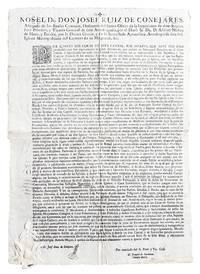
1774ref. 6518Mexico 1774. Very good. Broadside 23.5 x 16.5 inches. Untrimmed. Printed on two joined sheets. Previously folded. Contemporary manuscript docketing on blank verso. Minor edge wear and scattered faint foxing. A rare ecclesiastical edict addressing the burial of deceased infants issued by the Archdiocese of Mexico on March 15 1774. The broadside responds to complaints from parish priests that numerous baptized children were being buried without notification to their parishes depriving the churches of both jurisdictional oversight and the burial fees set by the ecclesiastical tariff. The document sheds light on the social realities of infant mortality and poverty in eighteenth-century Mexico City. It notes that many families were unable to afford burial expenses resulting in unrecorded deaths and in some cases the abandonment of children's bodies at the doors of churches. Particularly noteworthy is its condemnation of the custom of dressing deceased children as angels clerics bishops or cardinals and displaying them publicly before burial. The edict denounces these practices as abuses and orders that all burials whether of children or adults be conducted only with the knowledge and authorization of the proper parish priest. The present copy bears the manuscript rubrics of Josef Ruiz de Conejares Vicar General of the Archdiocese and Joaquín de Sasturain Chief Notary and the complete wafer seal of Archbishop Alonso Núñez de Haro. unknown books
1811ref. 8017Augsburg: M Rieger 1811. Fifth Edition stated. Contemporary three-quarter leather. A very good copy. 8vo. A most unusual and little known book. The aim is to advise individuals on how to approach and deal with those that are sick and dying. The text is specific in how to make inquiries dealing with incoherent replies what to say how to say it providing medical assistance and comfort simple rules to follow etc. M Rieger hardcover books
1987ref. 126192San Diego: Harcourt Brace Jovanovich 1987. First. hardcover. very good/very good. Black & white photo illustrations. 326pp. 8vo cloth-backed bds. dust wrapper; d.w. lightly soiled. San Diego: Harcourt Brace Jovanovich 1987. Very good. Harcourt Brace Jovanovich unknown books
1950ref. 50266Munich: Philipp Rauscher 1950. First edition. Softcover. Good condition. Sextodecimo. 59 1 1 folding plan. Original tan illustrated wraps with black lettering and double frame on cover. Guide through the memorial sites of the former Concentration Camp Dachau. Pictorial and written reports on the suffering and death of uncounted prisoners from countries around the world. "The booklet was written without any thought of hatred or revenge; it shall give the visitors of the Dachau memorial sites information on everything that has happened here without any exaggeration but also without any extenuating phrases. The attached plans will give detailed orientation on the memorial sites at the Crematory on "Leitenberg" and "Waldfriedhof" in Dachau." Introduction. Profusely illustrated with b/w reproduction of photographs artistic renderings and tables conveying overwhelmingly the horror and suffering that took place in the concentration camp. Includes photographs of the postwar tribunal the memorial sites and plaques and a folding map of the Crematory and the surrounding area at the camp. All images with captions. Text in English and French. Booklet age-toned and back cover with mostly closed tear small chips half way down the spine repaired with japan tissue. Philipp Rauscher unknown books
1988ref. 1401383N.S.: Stabur Press 1988. First Edition. Softcover. Quarto 96 pages. In Very Good minus condition with the illustrated bag in Good plus condition. Spine has black lettering on a red/orange background. Illustrated wraps. Lower right hand corner of the front cover and first six pages are curved. Spine is slightly faded. Text block is white with no edge toning. Promotional Burger King bag is from 1980 and has Mort Drucker caricatures front and back. Bag has discoloration and staining. There is a fold across the top and the overall bag is heavily creased. NOTE: Shelved in Locked Annex Area Oversized Ephemera Shelf. 1401383. FP New Rockville Stock. Stabur Press unknown books
1960ref. 11351THE DUDE / THE MAGAZINE DEVOTED TO PLEASURE for November 1960 Mystery Publishing Co. first edition vg in full color pictorial wraps. Contains original contributions by William Lindsay Gresham William Tenn Sam Elkin and others as well as an interview with Mort Sahl not too mention photos of ladies in various poses. Mystery Publishing Co. paperback books
1975ref. 3548Berkeley: Twowindows Press 1975. First edition. . 32mo. 12 pp. Fine in sewn wrappers. Cover art by d.t. tremons. One of 300 copies on Curtis Rag paper. A long poem. Berkeley: Twowindows Press unknown books
1900ref. 4922N.p. France: No printer for Joseph Vitta 1900. FIRST STATE of two before the addition of the artist's signature in the plate. Hardcover. Fine. Printed on laid paper with watermarks "A. Portabeuf" and "Arches". Most margins untrimmed with their deckled edges preserved. Light marginal soiling to some plates one plate with light foxing in lower margin not touching the image one plate with foxing to blank verso not visible on the printed recto final plate with light crease to blank margin and soiling to blank verso. Very light dust-soiling to the tips of the deckles and occasional very small tears in the margins. Housed in a custom box. This copy formerly with David Carritt Limited Artemis Group Ltd. London. A complete set of Albert Besnard's striking suite of 26 etchings on the theme of death signed by the artist in graphite. The edition was limited to nine impressions five of them on paper. At least one paper set and one vellum set were dispersed the National Gallery of Art Washington D.C. has a set comprising a single vellum leaf the other 25 are mixed states on paper. In this set nine prints Delteil 131 136 139 148 150-152 155 156 have watermark "Arches"; the others have the watermark "A. Portabeuf". "Les épreuves de ce premier état tirées 'à fleur de métal' sont d'une remarquable qualité Elles sont toutes signées de l'artiste."Delteil "The title of the series of prints Elle refers to Death La Mort. The series is considered one of Albert Besnard's most significant works in printmaking and depicts the omnipresence of death among the living. In this series Death is shown in several scenes in the disguise of the mistress of the household of a courtesan or of a lover. Death appears in all aspects of daily life striking when one least expects it on the path of a horse rider or as a couple embraces in a garden. One scene is particularly cruel as Death stands in front of a mother with two young children on her lap and the title of the print elucidates what is at stake: Lequel Which One. In Après sa visite After the Visit a man and a woman hide their faces in despair. On the other hand in L'Importune Importunate a doctor by a patient's bedside pushes her away. In Danger passé Danger Passed a horse rider continues on unscathed. Other prints demonstrate the benevolence of Death who can bring relief. In one scene Death brings together a couple under her cloak. "In 1900 the French banker collector and patron Baron Joseph Vitta 1860-1940 commissioned the series Elle from Besnard. The series was to include 50 plates of which only 26 were editioned. A 27th plate titled L'homme suivant la Mort was realized but destroyed after only two proofs were pulled. Vitta controlled the preliminary drawings the plates and the printed impressions and limited the size of the edition. The first printing of the series comprised only nine proofs of each plate. A second state of the series with the addition of Besnard's monogram was printed in nineteen impressions in 1921. An additional set of impressions of the 1921 issue was offered to the printer of the series Auguste Vernant. The plates were then cancelled impressions of the cancelled plates are at the Bibliothèque nationale in Paris. "Born in Paris Albert Besnard entered the École des Beaux-Arts in 1866. He exhibited at the Salon of 1868 and won the Prix de Rome in 1874. While in Rome he met Charlotte Dubray 1854-1931 the daughter of the sculptor Vital Dubray 1813-1892 and a sculptor herself who benefited from the sponsorship of the Duke and Duchess of Sutherland to study sculpture in Rome. After their marriage in 1879 the couple moved to London. There Dubray had numerous contacts and Besnard received numerous commissions as a portrait painter. He also studied printmaking with Alphonse Legros. Their four children three sons and a daughter became artists. Besnard was the director of the Académie de France in Rome from 1913-1921 and the director of the École des Beaux-Arts in Paris from 1922 to 1932. He became the first painter to be given a state funeral in France."Getty "With Elle Besnard resurrected and modernized the ancient dance of death adapting its imagery to current tastes while retaining the themes of the power of death and the equality of all before it. Death portrayed by Besnard the eponymous 'She' of the title is an omnipresent force that circulates among the members of modern society. Lurking in the bushes and gutters she occasionally takes on the features of a prostitute or a lover. She is a tenacious and patient adversary usually triumphing over her prey through trickery or duplicity. She is everywhere at once; she strikes arbitrarily and mercilessly. "Besnard's images illustrate only a few of the countless occasions when Death manifests itself. Many scenes are imbued with black humor the effect of surprise and macabre turns of events. Some are poignant others terrifying. All remind us that death plays a very real and very active role in every aspect of our lives."Musée des Beaux-Arts du Canada www.beaux-arts.ca Besnard himself established the order of the prints: Exigeante D. 131; Dans la Foule D. 132; L'Accident D. 133; L'Obstacle D. 134; Danger Passé D. 135; L'Inconnue D. 136; Importune D. 137; L'Enigme D. 138; Le Mystère D. 139; Après sa Visite D. 140; Ponctuelle D. 141; Aux Aguets D. 142; Le Coup de Filet D. 143; Musicienne D. 144; Le Vertige D. 145; Lequel D. 146; La Possession D. 147; Discrète D. 148; Le Duel D. 149; la Présentation D. 150; L'Orgie D. 151; Charitable D. 152; Coquette D. 153; L'Avertissement D. 154; Elle consacre l'Amour D. 155; Indifférente D. 156. No printer [for Joseph Vitta] hardcover books
1998ref. 114491London: Verso 1998. Paperback. 237p. wraps illus. very good condition. Verso paperback books
1970ref. 203252New York: World Publishing Co 1970. Hardcover. Very Good/Very Good. First edition. Very good in very good dust jacket. Dustwrapper has minor rubbings. World Publishing Co hardcover books
1980ref. 244786New York: Warner Books 1980. Softcover. Very Good. First paperback. Very good in wrappers. Softcover. Warner Books unknown books
1968ref. 209777New York: Groset & Dunlap 1968. Softcover. Very Good. Later. Very good in wrappers. Groset & Dunlap unknown books
1969ref. 234284New York: Cowles Book Co 1969. Hardcover. Good/Good. First edition. Good in good dust jacket. Hardcover and dust jacket have damage from mold text is clean. Cowles Book Co hardcover books
1989ref. 184932New York: Morrow 1989. Hardcover. Very Good/Very Good. First edition. Very good in very good dust jacket. Pages are clean. Illustrated with black and white photos. Clean cover. A couple very small dots of white paint on bottom edge of front cover. Dustwrapper price clipped. Clean dust jacket. Morrow hardcover books
1786ref. 4439France 1786. Hand-colored etched folding paper fan printed on the recto of two joined sheets backed in plain paper mounted on 15 later plain wooden sticks the open leaf measuring approx. 112 x 460 mm. total fan height 260 mm. The etching shows two couples and a small dog and table with wine carafe and glass flanking a female figure in white Grecian robes and a green wreath holding in one hand a heart at her breast and with the other hand ceremoniously setting alight a bundle of wood a fagot on a small pedestal or altar above which is the wreathed inscription Institution des fagotiers a auteuil le 2 avril 1786 / On prete serment sur un fagot de pratiquer toute sa vie cinq vertus : cordial franchise amitié générosité obeisance sic et tendresse; at top a star with the initials T L A and a banner lettered Vertus des fagotiers surmounted by the caption Ronde joyeuse des fagotiers/ Air: c’est la petite Theresse sic; on either side of this scene are four verses within two green-outlined oval cartouches within stenciled blue and yellow decorative border. Some wear and slight splitting along a few folds a couple of small tears at mounts. A mildly licentious pre-Revolutionary printed fan possibly commemorating a real event a “festival of the wood-gatherers” fagotiers held in Auteuil on April 2 1786 but of which there appears to be no historical record. Rather than a guild the fagotiers may have been a local association or club. The symbolism of the image and verses seems to be along the lines of Carpe diem carnally for death is around the corner — heavy sentiments for a feather-light fan. One of the men is gesturing toward his partner’s crotch and the verses on either side of the central scene are dotted with sexual innuendo. The first stanza “Let us sing of the burning fagot a bundle of small wood lit by friendship / he who backs away from it knows her i.e. friendship only half-way / without her life is nothing / with her one is deified” could be understood as innocuous but the second stanza celebrates the joys of Déduit an archaic term for the pleasures of love or coïtus. Stanza three brings in Death in the form of Charon: “amiable fellow let us sing his good humor his boat may lead to the devil but his spirit leads to happiness / with his worthy ardor the fire burns in our hearts.” The last stanza declares that the “august fagotine law” allows us to include women we need not hide everyone kiss your partner etc. I locate one other example of this fan held by the Musée Carnavelet in Paris. It is digitized on their website with the description “The Genie of Friendship lights the pyre on which the couples will take the oath of friendship.” The stenciled border of our copy differs from that of the Carnavelet example which is in pink; here it is in two colors and includes two birds perched on branches. unknown books
1986ref. 335999San Diego: Harcourt 1986. First. hardcover. fine/very good. x 470 pages 8vo cloth-backed boards d.w.; dust wrapper price clipped. San Diego: Harcourt Brace Jovanovich 1986. First edition. A fine copy in a very good dust wrapper. Harcourt unknown books
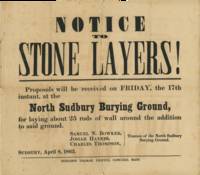
1863ref. Cat320Concord Massachusetts: Benjamin Tolman 1863. Printed broadside 11 ¼ x 10 inches. Some tearing at folds very good. A straightforward but telling piece documenting the expansion of a Massachusetts burying ground during the American Civil War signed in type by three trustees of the North Sudbury Burying Ground. As casualties mounted and remains were returned to hometowns existing cemeteries were frequently enlarged with new land enclosed and improved by contract. The specification of “25 rods” over 400 feet of wall indicates a substantial addition typical of mid-war efforts to increase capacity in established town burial grounds rather than create entirely new sites. Sudbury contributed roughly 150–170 men to Union service of whom approximately eleven died a scale of loss consistent with small Massachusetts towns and sufficient to register locally in burial and memorial practices. We find no other records of ephemera or broadsides relating to Civil War-era cemetery expansion. This notice is not at AAS. Benjamin Tolman unknown books
2004ref. 118758New York: Lower East Side Tenement Museum 2004. Softcover. NF. Duotone wraps with French flaps; 56 pp. with duotone images throughout. A lovely catalogue describing the history of the tenements and what life was like within. The photographs and floor plans show more of the story. Lower East Side Tenement Museum paperback books
ref. 5765N.p. N.d. Good. Small broadside approximately 7.75 x 3.25 inches. Mounted on later paper. Contemporary ink signature at foot. Light tanning and scattered staining. A printed invitation from Serapia Rivas for the funeral of her sister Teresa with a small woodcut vignette of a skull and crossbones at the head. Potential attendees had very short notice -- the invitation notes that the burial will take place "Tomorrow the 5th of this month at four in the afternoon. unknown books
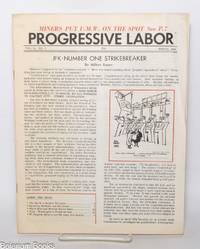
1963ref. 343156Brooklyn: Progress Labor Co 1963. Magazine. 15p. wraps with minor toning some creasing otherwise in good condition 8.5x11 inches. Headline article by Milton Rosen "JFK: number one strikebreaker" includes articles on Robert F. Williams Kentucky miners on strike and more. Progress Labor Co unknown books
ref. 39528Norwalk CT: The Easton Press 2007. Hardcover. Collector's Edition signed by Doctorow and Kunstler on a dedicated flyleaf with a certificate of authenticity laid in. 9" x 6". XIV 363 7 pp. Publisher's genuine leather boards; gilt stamped design to covers and spine; a.e.g.; paste-down illustration to front cover. Fine. . LikeNew. Hardcover . The Easton Press [2007] hardcover books
1963ref. 343037Brooklyn: Progress Labor Co 1963. Magazine. 15p. wraps minor edge wear and creasing else very good condition 8.5x11 inches. Headline article by Milton Rosen "The Black working-class of Birmingham flexed its giant muscles Birmingham jobless discard non-violence" and more. Progress Labor Co unknown books
1905ref. 9447Bullfrog Nye County Nevada 1905. Two broadsheet menus 26 x 13.5 cm. 1 page each. Illustrated. Two holiday menus for Thanksgiving and Christmas of 1905 from the height of the Nevada Gold Rush. The Christmas menu assembled by Robert Brogelman Chef included Blue Point Oysters Mock Turtle Soup Lobster Mayonaise Oyster Fritters English Plum Pudding Malaga Grapes Hennesy 3 Star Brandy and Josyni Key West Cigars. The Thanksgiving menu included Roast Young Turkey a la Malcolm MacDonald Pumpkin Pie and a Manhattan Cocktail. The Montgomery-Shoshone Mine was a Death Valley gold and silver site discovered in 1904 and in operation by 1905 the year of these Thanksgiving and Christmas celebrations. In April of the same year the Salt Lake Mining Review declared "the story of . the Mine's company's property at Bullfrog Nevada is so incredible that the bare facts seem clear out of the range of possibilities" page 8. In June of the same year the LA Times reported there were 1300 head of horses and mules on the Bullfrog-Las Vegas hauling freight. These holiday dinners were offered by the founder of the mine the already ridiculously wealthy Mr. E.A. Montgomery and his major partner Malcolm L. MacDonald. A year later the mine was sold to Charles Schwab the steel magnate not the financier Bullfrog was the definition of a boom town. Within a year of the original discovery 10000 people sought gold and pleasure there. "The town citizens had an active social life including baseball games dances basket socials whist parties tennis a symphony Sunday school picnics basketball games Saturday night variety shows at the opera house and pool tournaments. In 1906 Countess Morajeski opened the Alaska Glacier Ice Cream Parlor to the delight of the local citizenry. That same year an enterprising miner Tom T. Kelly built a Bottle House out of 50000 beer and liquor bottles" nps.gov "Rhyolite Ghost Town". By 1908 mine productivity was dwindling and by March 1911 the mine was shut. The Thanksgiving menu has some small grease stains and tape repairs to the verso at two folds. The Christmas menu has one short tape repair to the edge. Still near very good and a rare survival from the apex moment of a town that lasted little more than six years. unknown books
1938ref. 10837Los Angeles: Adcraft 1938. 7pp. Square octavo 23 cm x 20 cm that folds to digest size 23 cm x10 cm Color wrappers. About very good. Folds as issued some minor color offsetting to first two pages. Illustrated guide for the prospective tourist to Death Valley with a description of the area and the lodgings offered by the Death Valley Hotel Company at the Furnace Creek Inn Furnace Creek Camp and the Amargosa Hotel. Also included are a list of points of interest and a milage chart to Death Valley from points in California and Nevada. Excellent Bird's-eye map at the center by Gerald Eddy. "Death Valley boasts and rightfully so the greatest contrasts to be found in this country. Precipitate mountains and majestic canyons overlooking the extreme in flat barren valleys; contrasts in elevations from 280 feet below sea level at Bad Water to 11045 above at Telescope Peak towering directly above the greatest abrupt rise from base to tip to be found in the United States." - p.1. Adcraft unknown books