[DEATH AND MOURNING] Davis, Rev LD L DBiblio.com

6.279 resultados
1853ref. 19918Syracuse: E.H. Babcock & Co 1853. A typical but uncommon example of nineteenth century sentimental mourning literature. Reverend Davis a Methodist minister reflects on the frailty of mankind and the particular heartbreak of losing a child. He offers comfort to the bereaved through scriptural evidence that a deceased child goes to a better place and will be reunited with loved ones in eternity. First and only edition. 12mo 148 pp in publisher's blind-stamped plum cloth. Wood-engraved vignette of a family scene on title page. Inscribed on the front pastedown "Mrs. Clement Dale the Author L.D. Davis a Cousin of my Mama." Some staining to boards internals clean; very good. Four copies located in OCLC. A typical but uncommon example of nineteenth century sentimental mourning literature. Reverend Davis a Methodist minister reflects on the frailty of mankind and the particular heartbreak of losing a child. He offers comfort to the bereaved through scriptural evidence that a deceased child goes to a better place and will be reunited with loved ones in eternity. E.H. Babcock & Co hardcover
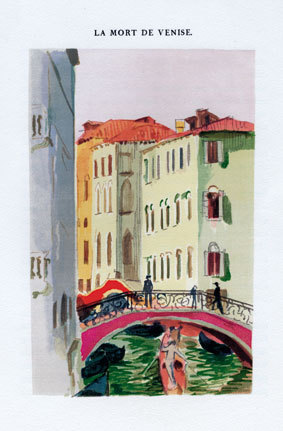
1930ref. 1180Paris, Editions EOS, 1930 ; in-4 en feuillets, couverture rempliée rouge-brique, sous chemise cartonnée à larges rabats et lacets de soie de même couleur et illustrée d’un grand bois gravé bistre, dos en percaline bistre ; (4) feuillets, 88 pages, (4) feuillets ; 20 bois gravés en couleurs dont dix hors-texte, six vignettes et culs-de-lampe et un grand bois illustrant l’étui et la couverture.
1773ref. 5488Troyes: chez Jean-Antoine Garnier ca. 1766 to 1773. Hardcover. Fine. Bound with: Le Grand Calendrier et Compost des bergers composé par le berger de la Grande Montagne Avec le Compôt naturel reformé selon le retranchement des dix jours par le Pape Gregoire III. Ensemble la manière comme se doit gouverner le Berger pour empêcher qu'aucun Sorciers ne fassent mourir leurs troupeaux avec toutes choses nécessaire pour se régler en leur art. Troyes: Chez Jean-A. Garnier Imp. Lib. No date ca. 1776 Quarto: II. 144 pp. A-S4. TWO RARE EDITIONS. Bound in contemporary tanned sheep the boards framed by a triple gold rule the spine ruled in gold and with rampant lions tooled in the compartments. The Privilege at end is granted to Pierre Garnier and dated 21 May 1728. It gives also a list of his other publications. Unusually fine copies printed on delicate paper of these works which are rarely found in such nice condition bound in a strictly contemporary binding. The bottom line of the first t.p. "avec permission" has been shaved off. In the second work leaf N1 has marginal stains; the last few leaves are lightly foxed. The Dance of Death "Les trois vifs et les Trois Morts" and the other accompanying texts are illustrated with 60 woodcuts of the Dance of Death copied from the original designs which appeared in the edition of the Danse Macabre of G. Marchant 1490. That of the Moor on p. 32 may be a very close copy of the same subject in the Compost. Another version of it appears on p. 27 and is a very close copy of that in the Bradwardine No. 64. N. B. - the two blocks of this subject appearing respectively on pp. 24 & 27 of the present Danse Macabre are not identical. Two works bound together both examples of important literary genres dating to the late-Medieval and early-Renaissance periods. The "Danse macabre" is a pictorial cycle and poem first painted at a Paris cemetery about 1425. Woodcuts copied from the Paris fresco along with the accompanying verses were first printed by Guy Marchant at Paris in 1485. "Le Grand Calendrier" an illustrated almanac and calendar was first printed in 1491 by Guy Marchant. The book remarkable for both its text and its illustrations was a kind of encyclopedia of meteorological agricultural hygienic and moral knowledge. I. The Dance of Death One of the earliest examples of the pictorial cycle and poem known as the Danse Macabre was painted between August 1424 and Lent 1425 in the arcades of the Cimetière des Saints-Innocents Cemetery of the Holy Innocents in Paris. These arcades constructed as charniers to house bones from earlier mass burials were demolished in 1669 along with their frescoes. The images of the Danse in this book were directly inspired by the Paris Danse. Woodcuts of the Danse copied from the Paris fresco along with the 67 verses that accompanied the images were first printed by Guy Marchant at Paris in 1485 with woodcuts designed by Pierre le Rouge. While there were no women in the original Danse in 1486 Marchant published an all-female version "La Danse Macabre des Femmes". Later Marchant united these two texts in the two-volume "Miroer Salutaire". While Marchant followed the sequence from the Cimetière des Saints-Innocents he introduced numerous changes adding new pictorial elements and verses including 20 additional dancers and the woodcut of the four skeleton musicians. From the 16th through the 18th centuries editions of the Danse appeared outside of Paris printed -with various changes- by French provincial printers in Lyon Rouen and Troyes. Over the years the woodblocks used to print the illustrations in the various Paris editions worn or damaged from repeated use and in some instances lost were re-cut with the images reproduced with varying degrees of fidelity to the originals. The printing history of the Danse in Troyes began in 1493 when Pierre le Rouge's woodblocks were acquired by his nephew Nicolas le Rouge who printed editions of the text into the 1530s. It is in Troyes that the woodcuts were first copied and further changes were introduced by successive printers. In 1610 the Troyes printer Noël Moreau began printing editions of the Danse using copies of the woodcuts from the Parisian edition published by Marchant 1490. Moreau added several new images at this point including the Black man blowing a horn and carrying a spear. According to Mortimer Moreau also used several original 15th c. blocks in this edition e.g. p. 26 the Punishment of the Sin of Luxury also used in the "Compost et kalendrier des bergiers" of 1497. and one of the Occupations of the Months May from the "Compost" of 1499. In 1641 Nicolas Oudot's son Nicolas Oudot II printed a new edition using Moreau's woodcuts. The last Oudot edition with the text largely re-written was printed by Nicolas II's son and widow in 1729 under the title "La Grande Danse Macabée sic!". It is this edition that would set the template for the next publishers the Garniers. The dating of this edition /- 1773 is based on the dates during which the publisher is known to have been active. A number of early bibliographers following the printed privilege on the last page dated this edition to 1728 and numerous cataloguing records have this date. However the publisher to whom the privilege was granted Pierre Garnier died in 1738. Further Jean-Antoine Garnier who is named as publisher on the title page was active between 1766 and 1773. Alexis Socard "Livres Populaires de Troyes" 1864 p. 126-127 tells us that the Garniers continued to print the book up until 1820 with the same imprint and privilege. See also: Corrard de Breban "Recherches sur l'établissement et l'exercice de l'imprimerie à Troyes" Paris 1873 4th ed. p.73-74. The additional texts: Already in the late 15th c. editions of the Danse had begun to include supplemental texts. Those included in this edition are: "Le débat du corps et de l'ame" "La complainte de l'ame damnée" "L'exhortation de bien vivre et de bien mourir" "La vie du mauvais Antechrist" and "Les quinze signes du jugement." Of these "La Vie du mauvais Antechrist" pp. 70-72 is antisemitic. The Antichrist is born of incest by "Un paillard Juif abominable" who knows his own daughter carnally is nursed by a whore before embarking on his career of destroying Christianity. He comes to Jerusalem where the Jews adore him he himself is circumcised but when he attempts a second Ascension from the Mount of Olives he is cast down into a sepulchre at the bottom of hell and "dix millions . De ces Juifs l'accompagneront". Marquand Library Notes: Fairfax Murray 108; see a reproduction of one of J.A. Marchant's editions in Claudin's Hist. de l'Impr. I. 339 sq. A brief description of those editions with some reproductions is found in Nisard Hist. des Livres populaires 1854 II 303 sq. A few of the images in these editions are new e.g. p. 26 the Punishment of the Sin of Luxury which originated in the Compost of 1497 see No. 103 and reproduction in Claudin I. 375 and one of the Occupations of the Months May from the Compost & Kal. Des Bergères 1499 see note to No. 103 and Claudin I. 379 sq. Langlois Essai Historique Philosophique et Pittoresque sur les Danses des Morts I p.340 31; Douce p.60 26; Reichelt 96 II. The Shepherd's Calendar and Compost Le Grand Calendrier et Compost des bergers A Troyes chés P. Garnier s.d. ca. 1776 Illustrated with 49 woodcuts including 12 full-page cuts one for each month of the calendar. Like the Danse Macabre many popular editions of this calendar were printed into the 18th c. particularly in Troyes and Paris. The Kalendrier des Bergiers an illustrated almanac and calendar was first printed on 2 May 1491 by Guy Marchant. On 18 April 1493 he printed an entirely new edition under the title: "Compost et Kalendrier des Bergiers" and on 18 July Marchant completed yet another edition further expanded in both text and illustrations: "Here is the Compost et Kalendrier des Bergiers. to which many new items have been added as those who look at it will be able to discover." The book remarkable for both its text and its illustrations was a kind of encyclopedia of meteorological agricultural hygienic and moral knowledge. "What we have here" says Monceaux "is the first almanac ever printed in France and one can readily understand the appeal of a work that addressed itself to the rural and popular masses and gave them advice of every kind on the health and hygiene of men and animals on agriculture on how to conduct oneself in this world with a view to arriving safely in the next - while at the same time giving those who could not read some basic knowledge of astronomy and the measurement of time via explanatory images." The beautiful incunabula editions of the Shepherd's Calendar were transformed into popular booklets in the mid-17th century notably by Nicolas Oudot. All the printers of the Bibliothèque bleue Blue Library published an edition of this Compost. "This undoubtedly means that the Compost was to be considered an introduction to popular literature because it contained presented-one might even say in their purest form the essential themes of the popular library." G. Bollème Les almanachs populaires p. 41. The book opens with a brief verse to the reader explaining the Gregorian calendar reform followed by a prologue in which the shepherd-author presents his central argument: that the natural human lifespan is seventy-two years demonstrable through a parallel between the twelve months of the year and twelve successive stages of human life six years to each month. The heart of the book is the compost and the almanac proper. The compost material includes mnemonic verses and tables for calculating the moveable feasts of the church year - Easter Pentecost and the rest - along with the Golden Number a nineteen-year cycle used to predict the date of the new moon the Dominical Letter a device for finding the day of the week on which any given feast falls and Epact tables the Epact being a number expressing the age of the moon on 1 January used to calculate Easter under the Gregorian reform. The almanac proper gives each month its own full-page woodcut a verse in the month's own voice describing its character and principal feasts and a calendar table. Part Two is devoted to the vices and the torments of Hell. It opens with the "Exhortation pour le Salut de l'Ame faite par maniere de double ballade" a poem calling the reader to repentance. The moral center of this section is an extended account of the punishments awaiting sinners in Hell introduced through the figure of Lazarus. It is illustrated with seven woodcuts depicting the punishments of the damned one for each of the deadly sins - the proud hung from spinning wheels fitted with iron cramps; the envious plunged to the waist in a freezing river; the wrathful pierced by swords in a dark and blood-soaked hall; the slothful assailed by serpents; the avaricious submerged in cauldrons of boiling oil and molten metal; the gluttonous forced to eat toads and drink from a foetid river; the lustful tormented in pits of fire and sulphur. Part Three - headed "La Troisième Partie du Compost des Bergers qui est science salutaire ou champ des vertus" - is devoted to religious and moral instruction. One notable section is the Field of Virtues "Jardin ou Champ des Vertus" which contains a poem of the soul adrift at sea guided by God to port two shepherd songs a verse catalogue of the pains of Hell a long poem in the voice of a rotting corpse meditating on the vanity of earthly honor a poem spoken by Death mounted on the pale horse of the Apocalypse and the Tree of Virtues with Humility as root and seven cardinal virtues - Charity Faith Hope Prudence Temperance Justice and Force - as its branches each with named sub-branches. Immediately following and without a new Part heading comes the Anatomical Man - a figure illustrated with a woodcut showing which of the twelve zodiac signs governs which part of the body with the practical implication that one should not apply a surgical instrument to any part of the body while the moon is passing through its governing sign - followed by the four human complexions or temperaments choleric sanguine phlegmatic and melancholic a month-by-month health regimen giving dietary and practical advice for each season and a comprehensive phlebotomy guide treating every vein in the body from forehead to groin. The book closes with the comic poem "Les débats des Gens d'Armes & d'une Femme contre un Limaçon" in which a woman armed with her distaff and two soldiers with their swords attempt to drive away a snail that has been eating her garden while the snail defies them all by threatening them with its horns. chez Jean-Antoine Garnier, ca. 1766 to hardcover books
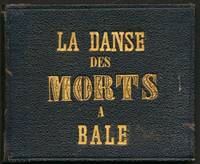
1860ref. 3220383Chromolithograph panorama 8.8 x 296 cm on five conjoined strips; folding down into the original black cloth covers 9.1 x 11.2 cm. Rare and attractive if rather disconcerting tourist souvenir panorama of the Dance of Death. The panorama contains 43 separate scenes and is a reproduction of the 63 metre-long fresco painted on the inner wall of the cemetery of the Augustinan Convent Basel c.1440. that was possibly created under the influence of the plague epidemic of 1439. The sequence emphasises the vanity of social distinctions each character dancing with death. The wall and fresco were demolished in 1805 however a number of fragments survive in the Historisches Museum Basel. Identifications of the subjects is given in the bottom margin in French English and German. The English identifications read from left to right: Preacher Charnel House Pope Emperor Empress King Queen Cardinal Bishop Duke Duchess Earl Abbot Knight Lawyer Alderman Canon Doctor Nobleman Lady Merchant AbbessCripple Hermit Young Man Maiden Minstrel Herald Judge Headsman Jester Pedlar Blind Man Jew Pagan Paganess Cook Peasant Painter Painter's Wife Paradise and The Dance of Death. As a tailpiece a view of Todlenanz as it appeared in 1800. The panorama is derived from a watercolour copy by the still life painter Johann Rudolf Feyerabend 1779-1814 that was completed in 1806 and is also housed in the Historisches Museum Basel. [Basel?]
1919ref. 62005Paris: Chez l’imprimeur Leon Pichon 5 Rue Christine 1919. 12mo. 6.5 x 6.5 3 leaves unnumbered. title w/ woodcut borders & printer’s device 20 numbered woodcut engraved plates. Softcovers minor shelfwear w/ woodcut-decorated jacket folded over the covers minor spotting foxing on back cover very minor bumping to corners still VG copy numbered on colophon & ownership markings on ffep. First edition No. 353 of 400 copies printed of the noted engraver’s first major post-World War I work as a Dance of Death depicting Death’s passage in the blighted and stricken era and a firm protest against modern mechanized warfare. Hermann-Paul 1864-1940 rose to fame during the Belle Epoque with his cutting satiric depiction of the foibles of French Society was a noted defender of Alfred Dreyfus whom after the war departed from his previously leftist ideals of the Parisian art scene and spent much of the between-the-wars period as an outsider. Chez l’imprimeur Leon Pichon, 5, Rue Christine, paperback
1773ref. 5488Troyes: chez Jean-Antoine Garnier ca. 1766 to 1773. Hardcover. Fine. Bound with: Le Grand Calendrier et Compost des bergers composé par le berger de la Grande Montagne Avec le Compôt naturel reformé selon le retranchement des dix jours par le Pape Gregoire III. Ensemble la manière comme se doit gouverner le Berger pour empêcher qu'aucun Sorciers ne fassent mourir leurs troupeaux avec toutes choses nécessaire pour se régler en leur art. Troyes: Chez Jean-A. Garnier Imp. Lib. No date ca. 1776 Quarto: II. 144 pp. A-S4. TWO RARE EDITIONS. Bound in contemporary tanned sheep the boards framed by a triple gold rule the spine ruled in gold and with rampant lions tooled in the compartments. The Privilege at end is granted to Pierre Garnier and dated 21 May 1728. It gives also a list of his other publications. Unusually fine copies printed on delicate paper of these works which are rarely found in such nice condition bound in a strictly contemporary binding. The bottom line of the first t.p. "avec permission" has been shaved off. In the second work leaf N1 has marginal stains; the last few leaves are lightly foxed. The Dance of Death "Les trois vifs et les Trois Morts" and the other accompanying texts are illustrated with 60 woodcuts of the Dance of Death copied from the original designs which appeared in the edition of the Danse Macabre of G. Marchant 1490. That of the Moor on p. 32 may be a very close copy of the same subject in the Compost. Another version of it appears on p. 27 and is a very close copy of that in the Bradwardine No. 64. N. B. - the two blocks of this subject appearing respectively on pp. 24 & 27 of the present Danse Macabre are not identical. Two works bound together both examples of important literary genres dating to the late-Medieval and early-Renaissance periods. The "Danse macabre" is a pictorial cycle and poem first painted at a Paris cemetery about 1425. Woodcuts copied from the Paris fresco along with the accompanying verses were first printed by Guy Marchant at Paris in 1485. "Le Grand Calendrier" an illustrated almanac and calendar was first printed in 1491 by Guy Marchant. The book remarkable for both its text and its illustrations was a kind of encyclopedia of meteorological agricultural hygienic and moral knowledge. I. The Dance of Death One of the earliest examples of the pictorial cycle and poem known as the Danse Macabre was painted between August 1424 and Lent 1425 in the arcades of the Cimetière des Saints-Innocents Cemetery of the Holy Innocents in Paris. These arcades constructed as charniers to house bones from earlier mass burials were demolished in 1669 along with their frescoes. The images of the Danse in this book were directly inspired by the Paris Danse. Woodcuts of the Danse copied from the Paris fresco along with the 67 verses that accompanied the images were first printed by Guy Marchant at Paris in 1485 with woodcuts designed by Pierre le Rouge. While there were no women in the original Danse in 1486 Marchant published an all-female version "La Danse Macabre des Femmes". Later Marchant united these two texts in the two-volume "Miroer Salutaire". While Marchant followed the sequence from the Cimetière des Saints-Innocents he introduced numerous changes adding new pictorial elements and verses including 20 additional dancers and the woodcut of the four skeleton musicians. From the 16th through the 18th centuries editions of the Danse appeared outside of Paris printed -with various changes- by French provincial printers in Lyon Rouen and Troyes. Over the years the woodblocks used to print the illustrations in the various Paris editions worn or damaged from repeated use and in some instances lost were re-cut with the images reproduced with varying degrees of fidelity to the originals. The printing history of the Danse in Troyes began in 1493 when Pierre le Rouge's woodblocks were acquired by his nephew Nicolas le Rouge who printed editions of the text into the 1530s. It is in Troyes that the woodcuts were first copied and further changes were introduced by successive printers. In 1610 the Troyes printer Noël Moreau began printing editions of the Danse using copies of the woodcuts from the Parisian edition published by Marchant 1490. Moreau added several new images at this point including the Black man blowing a horn and carrying a spear. According to Mortimer Moreau also used several original 15th c. blocks in this edition e.g. p. 26 the Punishment of the Sin of Luxury also used in the "Compost et kalendrier des bergiers" of 1497. and one of the Occupations of the Months May from the "Compost" of 1499. In 1641 Nicolas Oudot's son Nicolas Oudot II printed a new edition using Moreau's woodcuts. The last Oudot edition with the text largely re-written was printed by Nicolas II's son and widow in 1729 under the title "La Grande Danse Macabée sic!". It is this edition that would set the template for the next publishers the Garniers. The dating of this edition /- 1773 is based on the dates during which the publisher is known to have been active. A number of early bibliographers following the printed privilege on the last page dated this edition to 1728 and numerous cataloguing records have this date. However the publisher to whom the privilege was granted Pierre Garnier died in 1738. Further Jean-Antoine Garnier who is named as publisher on the title page was active between 1766 and 1773. Alexis Socard "Livres Populaires de Troyes" 1864 p. 126-127 tells us that the Garniers continued to print the book up until 1820 with the same imprint and privilege. See also: Corrard de Breban "Recherches sur l'établissement et l'exercice de l'imprimerie à Troyes" Paris 1873 4th ed. p.73-74. The additional texts: Already in the late 15th c. editions of the Danse had begun to include supplemental texts. Those included in this edition are: "Le débat du corps et de l'ame" "La complainte de l'ame damnée" "L'exhortation de bien vivre et de bien mourir" "La vie du mauvais Antechrist" and "Les quinze signes du jugement." Of these "La Vie du mauvais Antechrist" pp. 70-72 is antisemitic. The Antichrist is born of incest by "Un paillard Juif abominable" who knows his own daughter carnally is nursed by a whore before embarking on his career of destroying Christianity. He comes to Jerusalem where the Jews adore him he himself is circumcised but when he attempts a second Ascension from the Mount of Olives he is cast down into a sepulchre at the bottom of hell and "dix millions . De ces Juifs l'accompagneront". Marquand Library Notes: Fairfax Murray 108; see a reproduction of one of J.A. Marchant's editions in Claudin's Hist. de l'Impr. I. 339 sq. A brief description of those editions with some reproductions is found in Nisard Hist. des Livres populaires 1854 II 303 sq. A few of the images in these editions are new e.g. p. 26 the Punishment of the Sin of Luxury which originated in the Compost of 1497 see No. 103 and reproduction in Claudin I. 375 and one of the Occupations of the Months May from the Compost & Kal. Des Bergères 1499 see note to No. 103 and Claudin I. 379 sq. Langlois Essai Historique Philosophique et Pittoresque sur les Danses des Morts I p.340 31; Douce p.60 26; Reichelt 96 II. The Shepherd's Calendar and Compost Le Grand Calendrier et Compost des bergers A Troyes chés P. Garnier s.d. ca. 1776 Illustrated with 49 woodcuts including 12 full-page cuts one for each month of the calendar. Like the Danse Macabre many popular editions of this calendar were printed into the 18th c. particularly in Troyes and Paris. The Kalendrier des Bergiers an illustrated almanac and calendar was first printed on 2 May 1491 by Guy Marchant. On 18 April 1493 he printed an entirely new edition under the title: "Compost et Kalendrier des Bergiers" and on 18 July Marchant completed yet another edition further expanded in both text and illustrations: "Here is the Compost et Kalendrier des Bergiers. to which many new items have been added as those who look at it will be able to discover." The book remarkable for both its text and its illustrations was a kind of encyclopedia of meteorological agricultural hygienic and moral knowledge. "What we have here" says Monceaux "is the first almanac ever printed in France and one can readily understand the appeal of a work that addressed itself to the rural and popular masses and gave them advice of every kind on the health and hygiene of men and animals on agriculture on how to conduct oneself in this world with a view to arriving safely in the next - while at the same time giving those who could not read some basic knowledge of astronomy and the measurement of time via explanatory images." The beautiful incunabula editions of the Shepherd's Calendar were transformed into popular booklets in the mid-17th century notably by Nicolas Oudot. All the printers of the Bibliothèque bleue Blue Library published an edition of this Compost. "This undoubtedly means that the Compost was to be considered an introduction to popular literature because it contained presented-one might even say in their purest form the essential themes of the popular library." G. Bollème Les almanachs populaires p. 41. The book opens with a brief verse to the reader explaining the Gregorian calendar reform followed by a prologue in which the shepherd-author presents his central argument: that the natural human lifespan is seventy-two years demonstrable through a parallel between the twelve months of the year and twelve successive stages of human life six years to each month. The heart of the book is the compost and the almanac proper. The compost material includes mnemonic verses and tables for calculating the moveable feasts of the church year - Easter Pentecost and the rest - along with the Golden Number a nineteen-year cycle used to predict the date of the new moon the Dominical Letter a device for finding the day of the week on which any given feast falls and Epact tables the Epact being a number expressing the age of the moon on 1 January used to calculate Easter under the Gregorian reform. The almanac proper gives each month its own full-page woodcut a verse in the month's own voice describing its character and principal feasts and a calendar table. Part Two is devoted to the vices and the torments of Hell. It opens with the "Exhortation pour le Salut de l'Ame faite par maniere de double ballade" a poem calling the reader to repentance. The moral center of this section is an extended account of the punishments awaiting sinners in Hell introduced through the figure of Lazarus. It is illustrated with seven woodcuts depicting the punishments of the damned one for each of the deadly sins - the proud hung from spinning wheels fitted with iron cramps; the envious plunged to the waist in a freezing river; the wrathful pierced by swords in a dark and blood-soaked hall; the slothful assailed by serpents; the avaricious submerged in cauldrons of boiling oil and molten metal; the gluttonous forced to eat toads and drink from a foetid river; the lustful tormented in pits of fire and sulphur. Part Three - headed "La Troisième Partie du Compost des Bergers qui est science salutaire ou champ des vertus" - is devoted to religious and moral instruction. One notable section is the Field of Virtues "Jardin ou Champ des Vertus" which contains a poem of the soul adrift at sea guided by God to port two shepherd songs a verse catalogue of the pains of Hell a long poem in the voice of a rotting corpse meditating on the vanity of earthly honor a poem spoken by Death mounted on the pale horse of the Apocalypse and the Tree of Virtues with Humility as root and seven cardinal virtues - Charity Faith Hope Prudence Temperance Justice and Force - as its branches each with named sub-branches. Immediately following and without a new Part heading comes the Anatomical Man - a figure illustrated with a woodcut showing which of the twelve zodiac signs governs which part of the body with the practical implication that one should not apply a surgical instrument to any part of the body while the moon is passing through its governing sign - followed by the four human complexions or temperaments choleric sanguine phlegmatic and melancholic a month-by-month health regimen giving dietary and practical advice for each season and a comprehensive phlebotomy guide treating every vein in the body from forehead to groin. The book closes with the comic poem "Les débats des Gens d'Armes & d'une Femme contre un Limaçon" in which a woman armed with her distaff and two soldiers with their swords attempt to drive away a snail that has been eating her garden while the snail defies them all by threatening them with its horns. chez Jean-Antoine Garnier, ca. 1766 to hardcover
1728ref. 17444Troyes 1728. 4to. Jean-Antoine Garnier 19th-century half cloth. With 60 woodcuts in text including 3 repeats most of them half-page. 76 pp. 18th-century French chapbook edition of one of the most popular picture books in Europe since the Middle Ages. It depicts two Dances of Death: first the Dance of Death of men of all ranks and professions followed by the Dance of Death of women of various ranks and stations in life. These Dances of Death were meant to remind people that everybody was mortal however powerful in life and to warn people to be prepared to die at any moment.Browned throughout some occasional foxing and a small piece torn from the margin of page 19 not affecting text or illustration. Overall a good copy.l Oberlé La Bibl. Bleue 1; Nisard II p. 284: "Le plus beau des livres de la Bibliothèque Bleue". hardcover
1862ref. 9095Paris Baillieu 1862 -in-4 bradel demi-chagrin un volume, reliure bradel demi-chagrin rouge (binding half morocco) grand in-quarto, dos long (spine without raised band) décoré or (gilt decoration)- titre frappé or (gilt title) - papier peigné aux plats (cover with marbled paper) (papier peigné du 1er plat légèrement insolé), tête lisse (top edge smooth), gouttière et tranche de queue non rognées (no smooth fore-edge), long papier (fore-edge - great papier), couverture imprimée et illustrée en noir conservée (cover preserved - library edition) , tiré sur papier vergé, orné de 56 superbes gravures sur bois (engraving-wood) in-texte, les bois (reproduisant les xylographies du XVème siècle) sont ceux qui ont été gravés pour les éditions populaires publiées à Troyes par Oudot et Garnier au XVI ème et au XVIIème siècles, le texte est lui conforme à l'édition de 1486, cette impression du XIXème est bien supérieure en qualité que l'édition du XVème,3 feuillets + 67 pages (en réalité 66, saut de pagination de 64 à 66 - erreur d'imposition [voir GALLICA]), sans date (1862) Paris Baillieu (Lille Imprimerie Horemans) Editeur,
1786ref. 5000990London: Printed for G.G.J. and J. Robinson 1786. Some foxing light marginal toning to endleaves: a very good copy. Quarto 300 x 232 mm. pp. iv 34 without final blank; recently bound in speckled half calf to style smooth spine with triple gilt fillets gilt floral motif at foot red morocco label contemporary marbled paper sides top edge cut others uncut. First edition: one of the rarest and most desirable of all Pacific voyage narratives and among the earliest books devoted to Hawaii. We have traced only five copies at auction in the past fifty years confirming its reputation as one of the most elusive of all eighteenth-century voyage accounts. The catalogue of the Hill Collection aptly describes it as "the highlight of a Cook collection". David Samwell 1751-1798 a Welsh surgeon who sailed on Cook's final voyage joined the Resolution as surgeon's mate before becoming surgeon of the Discovery in 1778. His account of Cook's death at Kealakekua Bay is of exceptional importance providing what Sir Maurice Holmes described as "the fullest most detailed and most objective" narrative of the event. Drawing carefully on eyewitness testimony Samwell's work fills significant gaps left by the official account and remains a cornerstone source for understanding the circumstances surrounding Cook's death. The book was written in part to correct the impression created by the official narrative of the voyage published under the editorship of James King in 1784. As Samwell observed in his preface public opinion had come to attribute Cook's death "in some measure to rashness or too much confidence on his side; whereas nothing can be more ill-founded or unjust" p. iii. Holmes later remarked that the work is particularly valuable because it addresses matters "suppressed in the official account" especially regarding responsibility for Cook's death and because Samwell's assessment of Cook's character coming from "an educated man who knew him well" must be read alongside King's in order to gain a balanced view of the navigator as he appeared to those who served under him. Samwell provides a detailed reconstruction of the fatal encounter at Kealakekua Bay. In several respects his account differs from the official version. Discussing Cook's first wound he notes that although one eyewitness supported the claim made in the official voyage that Cook had been stabbed first the testimony of numerous other witnesses convinced him that Cook was initially struck with a club a conclusion later confirmed to him by the Hawaiian priest Kaireekea pp. 15-16. Samwell also places considerable responsibility on Lieutenant John Williamson whom he accuses of failing to support Cook during the attack. The narrative of Cook's death is followed by a biographical memoir largely reverential in tone and concludes with observations on the spread of venereal disease among the indigenous peoples of the Pacific. As a surgeon Samwell was particularly well placed to discuss the subject although his contention that there was insufficient proof that Europeans first introduced the disease to Hawaii is now generally regarded as doubtful. He records that despite Cook's efforts to prohibit intercourse between his sailors and Polynesians during the first visit in 1778 the disease had become widespread by the expedition's return later that year. Apart from its rarity the work exercised considerable influence. It provided a major source for Andrew Kippis's Life of Captain James Cook 1788 and his contribution to Biographia Britannica 1789. Unlike many contemporary accounts of Cook's third voyage which appeared in numerous European editions and piracies Samwell's narrative was published only in this English edition and a French translation. Not until David Magee's Captain Cook and Hawaii 1957 introduced by Sir Maurice Holmes was the text reprinted. Holmes noted on that occasion that the original printing was "of great rarity and correspondingly expensive". The book holds a prominent place in Hawaiian bibliography. The Hill catalogue observes that among the earliest books relating to Hawaii it ranks alongside Zimmermann's Reise um die Welt 1781 and Shaw's Catalogue of the Different Specimens of Cloth 1787 as one of the most significant publications of the eighteenth century. Combining exceptional rarity with fundamental historical importance Samwell's account remains one of the indispensable primary sources for Cook's final voyage and death. . Printed for G.G.J. and J. Robinson unknown
1784ref. 3603426London: Sold in Spur Street Leicester Square 1784. Small crease in lower corner in good condition. Oval engraving 350 x 265 mm. image size; mounted. Rare variant of the famous engraving of Cook's death showing as the caption notes "Part of the Original Plate after Webber" and presumably quite literally printed from an oval cut from the fuller engraved copper. This is only very rarely seen: the single example noted by Joppien and Smith was in the British Museum. The full-size engraving was first issued early in 1784. Based on the oil painting executed by Webber soon after he returned to London in 1780 the figures were engraved by Francesco Bartolozzi and the landscape by William Byrne. Quickly becoming the most famous of all eighteenth-century depictions of the massacre the view appeared at about the same time as the official third voyage account was published. This was no coincidence: although lavishly illustrated by Webber the official account did not include any depiction of the most famous scene of the entire voyage the death of Captain Cook. As a result the iconic engraving is often seen bound into extra-illustrated editions of the third voyage account. Reflecting the general opinion prevailing in published accounts of the voyage the original image as Joppien and Smith argue appeared to show Cook as 'an innocent victim killed in the act of pleading for peace'. This is here heightened by the changed composition as the oval shape dictates a radically different impact to that of the original engraving omitting the dramatic conflict between the British sailors and the Hawaiians and thus implying a scene in which Cook his arm raised in supplication to his men offstage stands alone and is overwhelmed by a seething crowd. The only copy noted among Australian holdings appears to be the heavily clipped copy in the National Library of Australia part of the Nan Kivell collection. . Sold in Spur Street, Leicester Square unknown
1993Catalogue de l'exposition présentée en 1993 au centre culturel de la Communauté française, Wallonie, Bruxelles, Le Botanique, sur la tradition mexicaine de "la mort en fête": textes de Thierry ZENO, Salvador RUEDA SMITHERS et Ariane FRADCOURT sur l'histoire du culte de la mort mexicain, les rites funéraires et les créations artistiques qui l'illlustrent, en particulier les fameuses "calaveras" (squelettes en action), avec notes et références, photos (scènes et objets), reproductions de gravures; texte de Miriam MOLINA sur l'illustrateur et graveur José Guadalupe Posada (1852-1913) et la société de son temps, avec 66 reproductions de gravures de calaveras de José Guadalupe POSADA, "Mexicain au point de faire rire le peuple, avec ses estampes, de sa misère et de l'injustice, voire de la mort", et de M. MANILLA, V.G. GAONA, L. MENDEZ et A.ZALCE; bibliographie. Français
ref. 7902LES APPELS D'ORPHEE N° 1 À 3. Paris, Association pour la défense des cimetières, 1985-1991. Trois fascicules in-8 carré, plaquettes agrafées, reproductions.
1993ref. 18070Bruxelles, Fondation Europalia, 1993 1 volume 21,2 x 26,1cm Cartonnage éditeur illustré. 158p., 3 feuillets; très nombreuses illustrations in texte, vignettes et pleines pages, en noir et en couleurs. Bon état.
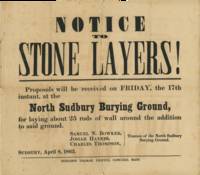
1863ref. Cat320Concord Massachusetts: Benjamin Tolman 1863. Printed broadside 11 ¼ x 10 inches. Some tearing at folds very good. A straightforward but telling piece documenting the expansion of a Massachusetts burying ground during the American Civil War signed in type by three trustees of the North Sudbury Burying Ground. As casualties mounted and remains were returned to hometowns existing cemeteries were frequently enlarged with new land enclosed and improved by contract. The specification of “25 rods” over 400 feet of wall indicates a substantial addition typical of mid-war efforts to increase capacity in established town burial grounds rather than create entirely new sites. Sudbury contributed roughly 150–170 men to Union service of whom approximately eleven died a scale of loss consistent with small Massachusetts towns and sufficient to register locally in burial and memorial practices. We find no other records of ephemera or broadsides relating to Civil War-era cemetery expansion. This notice is not at AAS. Benjamin Tolman unknown books
1863ref. Cat320Concord Massachusetts: Benjamin Tolman 1863. Printed broadside 11 ¼ x 10 inches. Some tearing at folds very good. A straightforward but telling piece documenting the expansion of a Massachusetts burying ground during the American Civil War signed in type by three trustees of the North Sudbury Burying Ground. As casualties mounted and remains were returned to hometowns existing cemeteries were frequently enlarged with new land enclosed and improved by contract. The specification of “25 rods” over 400 feet of wall indicates a substantial addition typical of mid-war efforts to increase capacity in established town burial grounds rather than create entirely new sites. Sudbury contributed roughly 150–170 men to Union service of whom approximately eleven died a scale of loss consistent with small Massachusetts towns and sufficient to register locally in burial and memorial practices. We find no other records of ephemera or broadsides relating to Civil War-era cemetery expansion. This notice is not at AAS. Benjamin Tolman unknown
1999ref. LFA-126745036Revue trimestrielle de formation spirituelle : 128 pages, format 155 x 220 mm, brochée, bon état
ref. 41689P., Fayard, 1960, in 8° broché, 331 pages ; couverture illustrée (très légèrement fanée) ; prière d'insérer.
1943ref. 58524Pomona CA: Frashers Inc. 1943. Oblong 12mo. 3.75 x 2.5 in. 12 miniature Real Photo Postcards w/ text w/in the negative preserved in original mailing portfolio die-cut window on recto canceled stamp & address on verso minor dustsoiling shelfwear to portfolio still NF set of RPPC’s from the library of George Stein 1914-1988 stationed at Camp Haan in World War II and was a longtime driver and heavy equipment operator for the Clark County Highway Dept. son of Gran Duchy of Luxembourg immigrant farmers and later builder in Vancouver WA. This complete miniature set of Real Photo Postcards shot by the iconic California photographer includes such images as “20 Mule Team Borax Wagons”; “Furnace Creek Camp”; “Salt Pool and the Devil’s Golf Course”; “Death Valley Scotty”; “Mushroom Rock”; and others. Frasher 1888-1955 opened a commercial photography studio with his wife Josephine Angel in 1912 with her shooting portraits and Frasher traveling Eastern California by automobile in the 1920’s and 1930’s on photographic expeditions. He would eventually produce over 60000 negatives and his stock-in-trade Real Photo Postcards were very popular. See: Peter Hiller Visions of the West; The Photographic Legacy of Burton Frasher Sr. Postcard History March 30 2020. Frashers, Inc., unknown
ref. 863A Francfort, en Foire, Chez J.F. Bassompierre, libraire à Liège, 1761 ; in-12, 1ff. bl., 361pp., 3ff. n. ch. dont 2 bl. Plein veau moucheté, dos lisse orné, pièce de titre rouge ; petits manques aux coiffes, coins légèrement émoussés, petit travail de vers sur le dos, une charnière fendue sur deux centimètres. Une rousseur sur le titre, sinon intérieur frais.
1953ref. 2094S. l., Société Bibliophile "Hippocrate et ses amis", 1953 ; in-folio, en feuillets sous chemise-étui bordeaux, dos en cuir gris, titre doré, couverture beige imprimée rouge à rabats, 26 lithographies en couleurs par Yves Brayer dont une en frontispice ; (3) ff., 133 pp., (6) ff.
1946ref. LFA-126724454Une revue de 24 pages, format 150 x 230 mm, illustrée, brochée, publiée en 1946, bon état
1959ref. 18361Guy Lévis Mano, 1959. Broché, couverture beige imprimée et illustrée, non coupé. 21,7 x 15,1 cm.
1981ref. 29366New York:: Harcourt Brace Jovanovich 1981. First Printing of the First US Edition. A Very Good plus copy in a Very Good unclipped dust jacket with light edge wear to the estremities. Donald Knox tells the story of the Bataan campaign the Death March and prison camp life under the Japanese in the words of the survivors themselves. Over a period of seven years he interviewed over 200 veterans; the voices of sixty-eight were selected to provide the personal side of the horrors and heroism experienced in these events. The interviewees all American are mostly enlisted men; however a few officers and nurses also tell their story. Harcourt Brace Jovanovich, unknown
1986ref. 9948Canberra: National Gallery of Australia 1986. Four accordion fold leaves 13x13cm folded printed on one side only in blue 6 panels each with UV and XY appearing together to make 24 panels in total. Housed in blue printed box. Fine condition box with some wear. Eirene Mort's 1879-1977 charming Australian Alphabet printed by the National Gallery which purchased the designs from the artist's estate in 1984. The designs were drawn in London in 1902 when Mort was 23 and were intended to be produced as a book though it was never published. OCLC cites just the Australian Alphabet book publication from 1986 with introduction by John McPhee. Perhaps this frieze was published alongside or at a later date by the gallery. In any event we find not mention of it. National Gallery of Australia unknown
1973ref. LFA-126738192Revue culturelle, économique et sociale des activités dauphinoises, savoyardes, provençales et vivaroises : 80 pages, format 210 x 270 mm, illustrée, brochée, bon état