PlatoABAA
6119 risultati
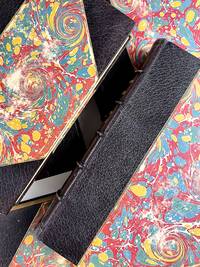
1892rif. 53851Oxford: Clarendon Press 1892. Near fine. Handsome set of Jowett's Plato in beautifully preserved Rivière & Son half morocco bindings. Plato's dialogues form much of the philosophical foundation of Western civilization. In the APOLOGY EUTHYPHRO CRITO PHAEDO and more Socrates leads his interlocutors through a series of questions that concern morality and faith censorship and education political justice and injustice and the immortality of the soul. A stellar copy and a requirement for any library on the history of thought. Five volumes 9'' x 5.75'' each. Contemporary half maroon morocco by Rivière & Son marbled boards raised bands gilt-ornamented spines. Top edges gilt marbled endpapers. Third edition. Text in English. 594; 576; 544; 646; 542 pages. Evidence of bookplate removal to front endpapers a few small dings to vol. IV else exceptionally sharp. Clarendon Press unknown books
1681rif. 29415London. Very Good. 1681. Full-Leather. Very Good full leather edition has a name and date of 1743 on the back of the front endpaper. The leather has wear to the spine ends and corner tips and the hinge areas have some scuffs. Binding is tight and the text is clean. ; 16mo 6" - 7" tall; 271 pages . hardcover
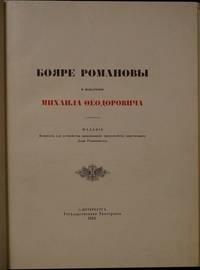
rif. 3801204Short description: In Russian. Vasenko Platon Grigorievich. Boyare Romanovs and the Emperor of Mikhail Fedorovich. St. Petersburg: Edition of the Committee for the Organization of the Celebration of the Three Centenary of the Reign of the House of Romanov 1913: The State Type. The image is provided for reference only. It may reflect condition of one of the available copies or only help in identifying the edition. Please feel free to contact us for a detailed description of the copies available. SKU3801204 unknown
rif. 3801204Short description: In Russian. Vasenko, Platon Grigorievich. Boyare Romanovs and the Emperor of Mikhail Fedorovich. St. Petersburg: Edition of the Committee for the Organization of the Celebration of the Three Centenary of the Reign of the House of Romanov, 1913: The State Type. You are welcome to reach out to us for a detailed description of the copies currently available. Delivery of this book may take longer than usual including extended processing and pre-shipping time, no expedited shipping is available. Please advise us if you have a set date or a deadline to receive your order.SKU3801204
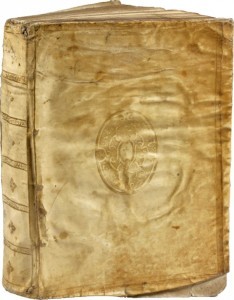
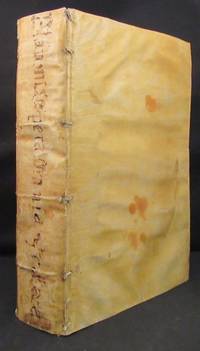
rif. LCS-13867Exemplaire très pur conservé dans sa reliure en vélin souple de l’époque. PLATON. Le Timée de Platon, traittant de la nature du monde, & de l’homme, & de ce qui concerne universellement tant l’ame, que le corps des deux: translaté de Grec en Fraçois, avec l’exposition des lieux plus obscurs & & difficiles. Par Loys le Roy dit Regius. Plutarque de la creation de l’ame, que Platon descrit en son Timee. (Achevé d’imprimer le 23 mars 1581). Paris, Abel l’Angelier, 1581. [Relié avec:] [DU BELLAY, Joachim] / LE ROY, Louis. Le Sympose de Platon, ou de l’amour et de beauté, traduit de Grec en François, avec trois livres de commentaires, extraicts de toute Philosophie & recueillis des meilleurs autheurs tant Grecs que Latins, & autres, par Loys le Roy, dit Regius. Plusieurs passages des meilleurs Poëtes Grecs & Latins, citez aux Commentaires, mis en vers François, par I. du Bellay Angevin. Paris, Abel l’Angelier, 1581. Soit 2 ouvrages reliés en 1 volume in-4 de: I/ ff. 1 à 8, (4) ff. de table, ff. 9 à 159, (1) f. de privilège; II/ (4) ff., 192 ff. avec de nombreuses erreurs de pagination. Quelques figures techniques dans le texte du Timée. Quelques mouillures ou taches dans le premier texte. Relié en plein vélin souple de l’époque, médaillon central frappé or sur les plats, dos lisse orné de roulettes et fleurons dorés, tranches dorées. Reliure de l’époque légèrement fatiguée. 219 x 166 mm.
1675rif. 024817London: T. R. Thomas Radcliffe & N. T. Nathaniel Thompson for James Magnes and Richard Bentley. First Edition in English of the Apology and Phaedo and the First English Translations everprinted of authentic Dialogues of Plato. This edition was preceded only by the pseudo-Platonic Axiochus translated by Spenser printed in 1592 and known in unique copy only and a selection of Plato's dialogues printed for school use in 1673. Engraved frontispiece entitled "Socrates Triumphans" depicting the philosopher being handed the cup of hemlock. Title page printed in red and black. Octavo 176 x 117 mm. Frontispiece and six following leaves with restored chips at top margin all in blank areas except affecting rules on the title page frontispiece rebacked top corner rounded on about the first 25 leaves small hole paper flaw on A6 very faint inking to several words on P1 occasional pencil marginalia. Modern quarter calf. The Apology is one of Plato's greatest dialogues still moving enough to evoke tears. . Good. Hardcover. 1st Edition. 1675. T. R. [Thomas Radcliffe] & N. T. [Nathaniel Thompson] for James Magnes and Richard Bentley hardcover
rif. alb47e5a843890c9b6eVasenko, P.G. Boyare Romanovs and the Emperor of Mikhail Fedorovich. In Russian /Vasenko, P.G. Boyare Romanovy i votsarenie Mikhaila Fedorovicha. St. Petersburg: State Printing House, 1913. 224, XII, 2 p., 22 l., 1913. We have thousands of titles and often several copies of each title may be available. Please feel free to contact us for a detailed description of the copies available. SKUalb47e5a843890c9b6e.
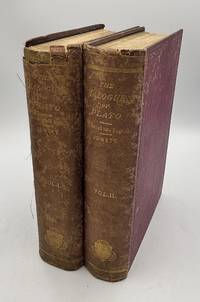
1871rif. 1261Oxford: Clarendon Press 1871. Good. James A. Garfield's copy of the first edition of Benjamin Jowett's landmark English translation of Plato. Volumes I and II only of four from the personal library of James A. Garfield 1831-1881 twentieth President of the United States. Both volumes bear Garfield's distinctive "Inter Folia Fructus / Library of James A. Garfield" bookplate together with manuscript library/shelf notation. An unusually resonant presidential association. Garfield was not merely a statesman who happened to own Plato: he was a formidable classical scholar and educator. Before entering national politics he taught Greek and Latin and became president of the Western Reserve Eclectic Institute later Hiram College. Classical literature remained an important part of his intellectual life. His ownership of Jowett's Plato therefore represents a particularly appropriate conjunction of book and owner. Published by the Clarendon Press in 1871 this was the first edition of Benjamin Jowett's celebrated English translation of Plato's dialogues. Jowett's translation became one of the most influential English presentations of Plato and helped introduce generations of English-speaking readers to the philosopher. These two volumes are preserved in their original publisher's cloth. The bindings show substantial wear consistent with use and age including significant loss at the head of the spine of Volume I with binding structure exposed along with rubbing and other wear. The set is incomplete comprising Volumes I and II of the four originally issued. Despite these faults a compelling association copy uniting one of the foundational texts of Western philosophy the first edition of its most influential Victorian English translation and the personal library of an American president whose own education and intellectual life were deeply rooted in the classics. Provenance: James A. Garfield by his library bookplate and manuscript library markings. . Clarendon Press unknown
rif. 29408Paris: Venundantur ab Ioanne Parvo & Iodoco Badio colophon: impressa sunt solertiore cura Ascensianis Anno domini MDXVIII 1518 Quinto Kalendas Iuanias. Deo Gratiae. Very Rare and Extremely Early Printing. THE FIRST PARISIAN PRINTING AND THE FIRST PRINTING OUTSIDE OF ITALY. It includes certain pseudo-Platonic dialogues never before printed is only the second printing of the 16th century and the fourth of all printings. Truly rare no copy is in the British Museum and it is mentioned only in Adams. Dedicated by Ficino to Lorenzo de’ Medici this printing was reproduced from the Venetian incunable edition of B. de Choris 1491. A COPY WITH FINE PROVENANCE. Four ownership signatures are noted on the title-page suggesting that the book traveled throughout Europe during its first 250 years of existence. One of the signatures most probably signifies ownership of the book by Sir John Cobham who had been raised to the peerage by King Charles I in 1645. Very finely engraved and illustrated title-page with superb Renaissance decorative borders incorporating allegorical figures and a scribe at work; at the center a very beautiful engraving of the printers at work at the press very fine and ornate capital letters throughout in black with ornate xilographic decorations occasional manuscript emendations in the margins in a contemporary Renaissance hand and with contemporary ownership inscription on the title. Folio 330 x 223 in eights full antique calf incorporating double blind fillet borders on the covers enclosing roll tooled inner borders in blind with a large central panel incorporating decorated corner tools and inner rolled borders all in blind the spine with wide raised bands brown morocco lettering label gilt. cc. num. CCCLXXXIX 389 folio leaves A very large handsome crisp and clean copy with expert and insignificant repair to a closed tear on one leaf. A copy with very wide and ample margins. The binding is in quite excellent condition with very little wear of evidence of use. A sympathetic restoration of the spine panel accomplished at some time. VERY RARE. THE FIRST PRINTING OUTSIDE OF ITALY AND THE FIRST PARISIAN PRINTING. A very beautiful and important production of Ficino's great Latin translation of Plato—"still the best translation of that author Italy can boast" Britannica. This printing also includes certain pseudo-Platonic dialogues never before printed. Ficino began his translation in 1466 from a manuscript supplied by his patron Cosimo de'Medici and by Amerigo Benci. During its progress Ficino submitted sections for review to the greatest scholars of the age: Angelo Poliziano Cristofor Landino Demetrios Chalchondylas and others which served to refine the work. Marcilio Ficino is perhaps the most important of all scholarly Renaissance thinkers and his influence on philosophical humanistic and cultural thought remains unsurpassed. Through the beneficence of the Medici family Renaissance Platonism emanated from him and his work and studies caused the vast expansion of the ideas inherent in Platonic thought. Some have argued that Ficino's direct effect on the Renaissance is without equal by any other scholar. His Latin translation of Plato allowed for all of Plato's dialogues to be available to Western readers for the first time. 'This first edition produced by Jean Petit and Jodocus Badius in Paris became the standard Plato-edition of the time with numerous editions following it. It remained for many years perhaps the most influential of all Renaissance readings of Plato and is considered to this day one of the most important and refined of all early printings of the great philospher's writings. Bade and Petit important in their own right were highly important contemporaries of Erasmus. They are responsible for many of the finest and most widely used editions of classical texts printed during the century. Jean Petit printer publisher and bookseller in Paris is known to have printed from 1493 to 1530 about one tenth of all publications in Paris more than ten thousand volumes. He was one of the four major booksellers at the University of Paris and greatly contributed to the spread of early Renaissance Humanism in Paris. He published a large number of original editions. Among his collaborators were Robert Estienne and Josse Bade. Bade Jodocus Badius 1462-1535 an associate of Erasmus is also considered one of the greatest printers of the period. A scholar of considerable repute and a renowned grammarian he studied in Brussels and Ferrara and taught Greek in Lyon from 1492 to 1498. In Lyon he worked as a proofreader and editor for the printer Jean Trechsel. On his arrival in Paris Jean Petit - one of the "grand libraires" and the most important bookseller and publisher of the era - helped Bade establish his own printing house in 1503. The business flourished and turned into one of the most prolific and important presses of the 16th century. It took on the name "Prelum Ascensianum" and specialized in classical texts in Latin often with his own familiare commentum. For the 2nd-century BC Roman playwright Terence Badius printed a Praenotamenta in 1502. This introduced the subject of Roman comedy through a lengthy treatment of general theories of poetry and thorough discussion of its origins development and classifications. He also published the works by contemporary humanist writers who frequented the printing house from where much Renaissance thought was disseminated. With 775 editions Bade's press served as one of the most active publishers during the first three decades of the 16th century. His frequent work with or for Johannes Parvus Jean Petit created an alliance with the era's most important bookseller and publisher. THE KING OF PHILOSOPHERS. ONE OF THE SUPREME TEXTS OF THE RENAISSANCE. Plato’s reintroduction into European thought has had a total and sweeping effect in the realms of philosophy science and religion. This work reprints the whole text in one endeavour of the first edition Florence 1484-85 issued over many months in a series of parts. The first edition in parts of Plato’s OPERA is of the most extreme rarity probably now absolutely unobtainable so this is one of the very earliest printings one could hope to secure in its complete state and an especially interesting issuance of the OPERA from one of the finest European printers. Venundantur ab Ioanne Parvo & Iodoco Badio hardcover
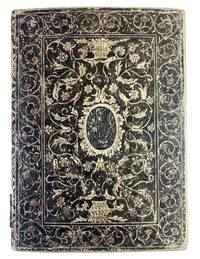
1520rif. 4422Cologne: Quentel heirs 1520. 4to 194 x 140 mm. Collation: A-B4. 15 pages. Woodcut initial on title the latter in two sizes of large gothic types text in small gothic types leaded epigram on title and text heading in roman. Small stain in top of gutter margins small inkstain on A1v f. B3 corner clipped. Bound in early 18th-century South German pasteboards completely overpainted in imitation of a Renaissance binding: both covers painted in watercolor and gouache on a brown ground with outer panel of scrolling tendrils with red flowers and leaves central panel with arabesque foliate decor two vases at top and bottom and central cartouche containing a winged lion holding a book painted in silver on a black ground; flat spine with portion of a different painted decor endleaves of gold on green Bronzefirnispapier bronze varnish paper probably from Augsburg with interlacing tendrils and birds foxes rabbits dogs an angel’s head and a putto emerging from a bud thick paper flyleaves small tear to backstrip edges slightly rubbed small marginal repair to lower flyleaf. Provenance: contemporary inscription on title: Plus que moins que me d’amour or quie en amour et or est qui la scait servir; Maurice Burrus 1882-1959 bookplate and acquisition label dated September 1937 identifying Arthur Lauria as the seller. First separate edition previously unknown of Cicero’s translation of part of Plato’s Timaeus. Cicero's fragmentary translation of sections 27d-47b was highly influential in late antiquity. In either Cicero’s version or Calcidius’s more extensive translation of sections 17a–53c the Timaeus was often the only text of Plato found in medieval monastic scriptoria and libraries. The first separate edition of Calcidius’s translation was also published in 1520 by Josse Bade. This edition was intended as a schoolbook with its moderately leaded lines. The title page includes an epigram by one Ioannis Sartae Leodiensis Jean de Sarthe of Liège. I locate one mention of another copy in a 1902 catalogue of the library of the Gymnasium of Emmerich bound with two other Cicero Quentel imprints from 1518 and 1517 J. Wattendorff Katalog der Lehrerbibliothek Part IV Emmerich 1904 p. 21 shelfmark O 35. That volume was evidently destroyed in 1944 when 90% of the town was bombed. The most remarkable feature of this unusual book is the binding carefully painted on inexpensive pasteboards by an unknown early 18th-century amateur to resemble a 16th-century gold-tooled and paneled binding. The artist indulged in a certain amalgamation of styles viz. the central silver medallion containing a representation of the lion of Venice holding the Gospel of Mark. The lovely “bronze varnish” or gold varnish endpapers with their swirling tendrils among which are hidden animals and birds are typical of papers produced in Augsburg in the first two decades of the 18th century cf. Haemmerle pp. 72-73. These especially resemble examples produced by Georg Christoph Stoy. I have not found an exact match in the printed and online literature. Not in VD16 KVK OCLC ISTC Hoffmann etc. My thanks to Irene Malfatto for her help with the inscription. Quentel heirs unknown
1520rif. 4422Cologne: Quentel heirs 1520. 4to 194 x 140 mm. Collation: A-B4. 15 pages. Woodcut initial on title the latter in two sizes of large gothic types text in small gothic types leaded epigram on title and text heading in roman. Small stain in top of gutter margins small inkstain on A1v f. B3 corner clipped. Bound in early 18th-century South German pasteboards completely overpainted in imitation of a Renaissance binding: both covers painted in watercolor and gouache on a brown ground with outer panel of scrolling tendrils with red flowers and leaves central panel with arabesque foliate decor two vases at top and bottom and central cartouche containing a winged lion holding a book painted in silver on a black ground; flat spine with portion of a different painted decor endleaves of gold on green Bronzefirnispapier bronze varnish paper probably from Augsburg with interlacing tendrils and birds foxes rabbits dogs an angel’s head and a putto emerging from a bud thick paper flyleaves small tear to backstrip edges slightly rubbed small marginal repair to lower flyleaf. Provenance: contemporary inscription on title: Plus que moins que me d’amour or quie en amour et or est qui la scait servir; Maurice Burrus 1882-1959 bookplate and acquisition label dated September 1937 identifying Arthur Lauria as the seller. First separate edition previously unknown of Cicero’s translation of part of Plato’s Timaeus. Cicero's fragmentary translation of sections 27d-47b was highly influential in late antiquity. In either Cicero’s version or Calcidius’s more extensive translation of sections 17a–53c the Timaeus was often the only text of Plato found in medieval monastic scriptoria and libraries. The first separate edition of Calcidius’s translation was also published in 1520 by Josse Bade. This edition was intended as a schoolbook with its moderately leaded lines. The title page includes an epigram by one Ioannis Sartae Leodiensis Jean de Sarthe of Liège. I locate one mention of another copy in a 1902 catalogue of the library of the Gymnasium of Emmerich bound with two other Cicero Quentel imprints from 1518 and 1517 J. Wattendorff Katalog der Lehrerbibliothek Part IV Emmerich 1904 p. 21 shelfmark O 35. That volume was evidently destroyed in 1944 when 90% of the town was bombed. The most remarkable feature of this unusual book is the binding carefully painted on inexpensive pasteboards by an unknown early 18th-century amateur to resemble a 16th-century gold-tooled and paneled binding. The artist indulged in a certain amalgamation of styles viz. the central silver medallion containing a representation of the lion of Venice holding the Gospel of Mark. The lovely “bronze varnish” or gold varnish endpapers with their swirling tendrils among which are hidden animals and birds are typical of papers produced in Augsburg in the first two decades of the 18th century cf. Haemmerle pp. 72-73. These especially resemble examples produced by Georg Christoph Stoy. I have not found an exact match in the printed and online literature. Not in VD16 KVK OCLC ISTC Hoffmann etc. My thanks to Irene Malfatto for her help with the inscription. Quentel heirs unknown books
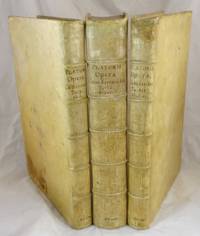
1578rif. 620Geneva: Henr. Stephani 1578. First Edition. vellum. Very good. The STEPHANUS Plato The Book That Established the UNIVERSAL REFERENCE System for Platos Writings PLATO. Platonis opera quae extant omnia. The Complete Works of Plato Title also in Greek Henr. Stephani Geneva 1578. First Greek/Latin Edition. Volume 1: TP 16 unnumbered leaves handwritten replacement preliminaries circa 18th c = Dedication to Queen Elizabeth Studioso Lectori Platone Epigrammata Catalogus Dialogorum half title with first page of text - unnumbered - on the verso 1 469 471 471 542. Volume 2: Half-title blank leaf lettered AA.i. 3 unnumbered leaves printed replacement preliminaries circa 18th c. = Dedication to King James the Sixth of Scotland later James the First of England Two Poems 3-701 672 673 704 992. Volume 3: Half-title 3 unnumbered leaves handwritten replacement preliminaries circa 18th c. = Dedication to the Republic of Bern Poem AAAA.i. = Contents Page 3-374 375 368 377-416 1-139; Folio. Three vols. 10.25 x 15.5 in. text block sheets are 10 x 15 in. Folio. "A great Renaissance author and scholar as well as a member of one of Europe's most illustrious families of printers Henri Estienne II himself edited his grand Plato for which he commissioned a new Latin translation by Jean de Serres. Together with his monumental 1572 Thesaurus graecae linguae the lavish Plato was responsible according to Schreiber for securing both Estienne's scholarly reputation and his financial ruin" Garden Ltd. #40. First Greek/Latin edition printed in parallel text with translation and commentary by Jean de Serres noted French historian and advisor to King Henry IV during the reformation. The famous Stephanus edition which has served as the universal reference system for all other editions of Plato's writing since its publication. In every translation of Plato there are small numbers in the margin which refer to the pagination in this edition affording scholars the opportunity to cross-reference each other's work in any language - they are called the "Stephanus numbers." For example Socrates major speech in the Symposium completes at 212c. Some preliminary pages dedication poems etc. are not original but rather were printed and inserted sometime in the 18th century. Because the preliminary pages included dedications to Queen Elizabeth copies of the Stephanus Plato circulating in countries hostile to the throne at the time of publication 1578 often had these pages removed. Some copies of the Stephanus Plato have appeared at auction lacking preliminaries altogether. In 2008 Sokol Books Ltd. catalogued the missing prelims: their absence is the works most common defect. Others like this copy had the preliminaries replacedsometimes by hand other times by a local printeronce relations with England had improved. This is one of those rare copies with replacements. Thus not only is this an important and rare antiquarian book The Stephanus Plato! but also an important historical artifact given its unique history and provenance. CONDITION: Very Good in uniformly bound contemporary possibly early 17th c. vellum with manuscript lettering to spines. Minor repairs to vellum on head and heel of spine mostly on volume 3. Expert old paper repairs to title page of volume I and half-titles of vols. II & III with bookplates on all three pastedowns: Inter Libros Josephi Mariae Parascandolo Antecessoris Regii A.L.N. of Naples. Woodcut-engraved printers vignette on title woodcut-engraved decorated initials head-pieces & tail-pieces. Large paper 15 x 10. Handwritten and printed preliminaries replaced sometime in the 18th c. A tightly bound historically important copy of one of the most important books in the history of philosophy. Henr. Stephani hardcover
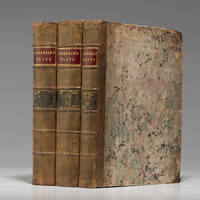
1759rif. 1308111759. First Edition. Signed. SYDENHAM Floyer translator PLATO. Dialogues of Plato. London: W. Sandby and others 1759-1779. Three volumes. Large quarto contemporary half calf raised bands gilt morocco spine labels title labels refurbished. Each volume housed in a custom chemise and together in a clamshell box. $16500.First editions of these dialogues of Plato many marking their first appearances in English signed by the translator on the dedication page of the Synopsis.Floyer Sydenham ""was an excellent Greek scholar and devoted himself to the task of translating the works of Plato. In 1759 he published his proposals in a quarto tract and accomplished his purpose between 1759 and 1780 in four quarto parts"" DNB XIX 245. A contemporary review observed ""His notes which are very copious serve to illustrate many obscure passages in the text and explain many mythological allusionsÉ This learned Translator of Plato's Works pursues his undertaking with unremitted diligence; and acquits himself with his usual judgment and accuracy"" Brueggemann 152 quoting the Monthly Review. Unfortunately Sydenham's labors were not appreciated during his lifetime and he died in debtor's prison before completing the project. Thomas Taylor later made use of Sydenham's work in his own edition of PlatoÑand praised the earlier translator in verse: ""Genius sublime; who from barbaric night/ Led Wisdom forth far beaming heav'nly light;/ Whose skill great Plato's elegance commands/ His graces copies and his fire expands."" Illustrated with two folding plates diagramming Plato's arguments. The parts were published separately in very small runs and complete contemporary sets are now extremely scarce. This set contains 12 of 13 parts published with main title pages for the volumes dated 1767 1773 and 1779. Volume I: A Synopsis or General View of the Works of Plato 1759 Io 1759 The Greater Hippias 1759 The Lesser Hippias 1761 Meno no separate title page but 1759 The Rivals no separate title page but 1761; Volume II: The Banquet 1761 The First Alcibiades 1773 The Second Alcibiades 1776; Volume III: A Dissertation on the Doctrine of Heraclitus 1775 PhilebusÉ the First Part 1779. Only PhilebusÉ the Second Part is absent as often seen. With affixed errata slip on page 83 of Volume III. Schweiger 250 251 257. Rothschild 2384-85. Lowndes 1877. ESTC T132440. Volume I with early inked owner name and note: ""very scarce.""Contents overall very clean with a few instances of faint foxing; bindings moderately rubbed. A handsome wide-margined copy. hardcover
1759rif. 1308111759. First Edition. Signed. SYDENHAM Floyer translator PLATO. Dialogues of Plato. London: W. Sandby and others 1759-1779. Three volumes. Large quarto contemporary half calf raised bands gilt morocco spine labels title labels refurbished. Each volume housed in a custom chemise and together in a clamshell box. $16500.First editions of these dialogues of Plato many marking their first appearances in English signed by the translator on the dedication page of the Synopsis.Floyer Sydenham ""was an excellent Greek scholar and devoted himself to the task of translating the works of Plato. In 1759 he published his proposals in a quarto tract and accomplished his purpose between 1759 and 1780 in four quarto parts"" DNB XIX 245. A contemporary review observed ""His notes which are very copious serve to illustrate many obscure passages in the text and explain many mythological allusionsÉ This learned Translator of Plato's Works pursues his undertaking with unremitted diligence; and acquits himself with his usual judgment and accuracy"" Brueggemann 152 quoting the Monthly Review. Unfortunately Sydenham's labors were not appreciated during his lifetime and he died in debtor's prison before completing the project. Thomas Taylor later made use of Sydenham's work in his own edition of PlatoÑand praised the earlier translator in verse: ""Genius sublime; who from barbaric night/ Led Wisdom forth far beaming heav'nly light;/ Whose skill great Plato's elegance commands/ His graces copies and his fire expands."" Illustrated with two folding plates diagramming Plato's arguments. The parts were published separately in very small runs and complete contemporary sets are now extremely scarce. This set contains 12 of 13 parts published with main title pages for the volumes dated 1767 1773 and 1779. Volume I: A Synopsis or General View of the Works of Plato 1759 Io 1759 The Greater Hippias 1759 The Lesser Hippias 1761 Meno no separate title page but 1759 The Rivals no separate title page but 1761; Volume II: The Banquet 1761 The First Alcibiades 1773 The Second Alcibiades 1776; Volume III: A Dissertation on the Doctrine of Heraclitus 1775 PhilebusÉ the First Part 1779. Only PhilebusÉ the Second Part is absent as often seen. With affixed errata slip on page 83 of Volume III. Schweiger 250 251 257. Rothschild 2384-85. Lowndes 1877. ESTC T132440. Volume I with early inked owner name and note: ""very scarce.""Contents overall very clean with a few instances of faint foxing; bindings moderately rubbed. A handsome wide-margined copy. hardcover books
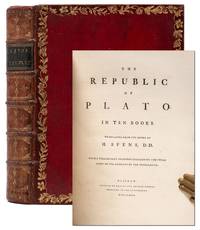
1763rif. 8261Glasgow: Robert & Andrew Foulis 1763. First edition in English. Near Fine. Translated from the Greek by H. Spens and with his introductory essay. An exceptional copy bound by the Foulis Press Bindery and rare thus. Quarto 241 x 179 mm similar leaf size to other copies designated as "large paper" copies. Complete: 4 xl 430 2 ads. An exceptional Near Fine copy overall. Beautifully bound in full cherry-red turkey morocco with decorative gilt floral borders. Spine in compartments with the cross design described by Philip Gaskell as likely identifying the deluxe Foulis bindings see The Library Fifth Series Volume VII No. 2. Boards with the same distinctive floral tooling used on the Foulis Press binding of Robert Simson's Opera Glasgow: Robert and Andrew Foulis 1776 held at Glasgow University. Edges stained dark green. Binding with some minor repairs to the outer joints. Internal contents generally in fine condition. With the library label of Appuldurcombe House "App." to upper pastedown and an ownership inscription dated June 1776 to upper free endpaper. Extremely scarce and desirable in a deluxe binding executed by the Foulis Press Bindery. Housed in a custom slipcase. This copy belonged to the politician and antiquary Sir Richard Worsley 7th Baronet 1751 - 1805 and contains the label of his family's Appuldurcombe House "App.". The anonymous ownership inscription reveals that Worsley then gifted the copy to a friend: "Given to me at Appuldurcombe Isle of Wight June the 7 1776. By my very worthy & amicable Friend Sir Richard Worsley Baronet." It is likely that this copy was specially presented by the Foulis Press to Worsley's father Thomas 1726 - 1768 sometime around 1763 and passed into Worsley's possession upon his father's death in 1768. If Worsley read Plato in his father's library as a child as many aristocratic young men would have done at the time the experience may have inspired his lifelong interest in the classical world. Throughout the 1780s Worsley traveled in Greece Italy Egypt and Turkey collecting sculpture paintings and gems which he brought back to Britain and housed at Appuldurcombe. Worsley had by 1790 assembled the largest collection of classical Greek sculpture in Britain and had been made a fellow of both the Society of Antiquaries of London and the Royal Society. The distinctive style of the Foulis Bindery is evident in the binding of this copy: the spine gilt the floral borders and the color and type of the leather all match other deluxe bindings done by the press. In The Library Philip Gaskell describes a matching spine design and color of leather: "It is.hard to establish the identity of any of the better sort of Foulis bindings since no signed examples have appeared. There is however a design of which the distinctive feature is a series of crosses in the spine panels which occurs on the well-made calf and morocco bindings of a surprisingly wide range of Foulis books and which I have seen nowhere else. This observation was first suggested to me by Mr. John Weird of Glasgow University who showed me several splendid examples in faded cherry-red morocco." Gaskell p. 87. The Glasgow University Special Collections digital exhibit "Robert & Andrew Foulis the Foulis Press and Their Legacy" also notes that Robert Foulis "personally supervised the binding of many of the finer volumes" and "'red turkey gilt'.apparently was Foulis' favorite binding." Additionally the exact floral pattern seen on the boards - a bloom a leaf and a bunch of grapes - can also be found on a copy of Robert Simson's Opera Glasgow: Robert and Andrew Foulis 1776 held in the Glasgow University collections shelfmark BD12-c.22. Taken together this evidence indicates that this copy was indeed bound by the Foulis Press Bindery. First written around 380 BC The Republic is a work in which Plato explores questions of justice goodness and truth and how to order the ideal government and man within it. It is without a doubt one of the most influential works of philosophy and political theory ever written containing immensely consequential ideas like Plato's allegory of the cave and his outline of the five regimes. The ripple of concepts first discussed in The Republic can be followed throughout the course of human political and intellectual development from classical Greece to the Renaissance and the Enlightenment as insightful today as it was nearly 2500 years ago. "Amidst a great diversity both of subject and treatment the dialogues are pervaded by two dominant impulses: a love of truth and a passion for human improvement. While nowhere is a definite system laid down it has been truly said that the germs of all ideas can be found in Plato" PMM 27: Plato's Opera 1484. Gaskell Philip. "The Early Work of the Foulis Press and Wilson Foundry." The Library Fifth Series Volume VII No. 2 June 1952 pp. 77-110. Smith Robert Fairfull. "Robert & Andrew Foulis the Foulis Press and Their Legacy." Glasgow University Special Collections digital exhibit. Near Fine. Robert & Andrew Foulis unknown
1491rif. 68663Venice: Vernardinus de Choris de Cremona and Simon de Luere for Andreas Torresanus 1491. Venice: Bernardinus de Choris and Simon de Luere for Andreas Torresanus August 13 1491. And: FICINO Marsilio. Platonica theologia de immortalitate animorum. Venice: 13 August 1491. Second edition of the works of Plato. Folio 11 7/8 x 8 inches; 301 x 206 mm. 4 444 leaves. Printed in Gothic type in double columns. With beautifully illuminated initials and border to the first text leaf. Numerous illuminated 7 8 9 and 10-line initials heightened in gilt with blue red and green backgrounds. The initial letter will extend beyond the letter with illumination 5-7 lines both up and down. Additional 3 4 5 and 7-line initials in red blue or gold. The first leaf of text a1 with two large illuminated initials and a full illuminated border with red green blue and gilt scrolls floral motifs and a shield surrounded by a wreath. This is the first edition to include Ficino's great work Platonica Theologia which was not included in the 1484 edition as Ficino first published his work in 1482. Marsilio Ficino's Latin translation. Second editions of Ficino's translation of Plato's work first published 1484 as well as his chief philosophical work the Platonica theologia in which he attempts to illustrate the harmony between Platonism and Christian theology first published 1482 and this edition is the first to collect both works together in one. With only one complete copy of the 1484 first edition at auction since the the copy that came up in the 1940s. This copy sold in 2021 for $1026000. This present edition is realistically the first obtainable edition of Plato's works. 18th-century acid treated calf. Spine with orange morocco spine label lettered in gilt. All edges dyed yellow and speckled red. Newer endpapers. A small amount of old ink neat marginalia. A small repaired hole to the title-page not affecting text just the top edge of some illumination on verso. A very clean and beautiful copy with lovely illumination. Overall a very good copy of the second edition and first obtainable edition of Plato's Opera. Plato was the first of the ancient philosophers to appear in print and for nearly thirty years Ficino's translation was the only published version available until the appearance of the Greek 'editio princeps' in 1513. Ficino's translation took twenty years to complete and during this time he was assisted by members of the Platonic Academy founded by his patron Cosimo de Medici whose ambition was to revive the study of Platonic philosophy. "Amidst a great diversity both of subject and treatment the dialogues are pervaded by two dominant impulses: a love of truth and a passion for human improvement. While nowhere is a definite system laid down it has been truly said that the germs of all ideas can be found in Plato." "Printing and the Mind of Man" # 27 for 1484 edition. BMC V 465 IB. 23432; IGI 7861; PolainB 3190; Goff P-772; PMM 27. HBS 68663. $75000. Vernardinus de Choris, de Cremona, and Simon de Luere, for Andreas Torresanus unknown books
1513rif. 32134Venice: Aldus Manutius and Andreas Torresanus September 1513. The Editio Princeps the First Edition of the Works of Plato in Greek. Folio 312 x 194mm beautifully bound in its contemporary limp vellum binding with hand calligraphy to the spine panel yapp edges. 15 unnumbered leaves without leaf 16 blank; 502 pages without the final blank; 439 pages. Aldine anchor device Fletcher f4 to title-page and verso of the last leaf. A superb copy in excellent condition. Very rare thus in its original binding some leaves with very sophisticated very sympathetic expert re-margining at the bottom outside corners where loss occurred at some time. The restoration has been brilliantly accomplished and is nearly imperceptible. VERY RARE AND IMPORTANT. THE FIRST ALDINE EDITION OF PLATO. THE EDITIO PRINCEPS AND A UNIQUE AND IMPORTANT COPY. As Marsilio Ficino dedicated his Latin translation of Plato to Lorenzo de’ Medici so Manutius dedicates his Greek edition to the son of Lorenzo Giovanni who became Pope Leone X in march. Aldus places his hopes for the foundation of his Academy in the new pope as he says in the dedicatory epistle of his edition of Greek Orators published in the same year: “may you watch over us and take care of our mission which deserves the help and favours of the highest statesmen indeed may you Supreme Pontiff found this Academy as perpetual good for mankind in the city of Rome.” The Platonic Dialogues are preceded by the “Life” of Plato by Diogenes Laertius and followed by a Greek hymn by Marco Musuro publisher of the edition together with Manutius. In 1513 Manutius printed the Editio Princeps of Plato which he dedicated to Pope Leo X in a preface eloquently and earnestly comparing the miseries of warfare and the woes of Italy with the sublime and tranquil objects of the student's life.The printings of Plato done through the years 1484-1485 were issued in parts and the printing of 1491 was printed in book form please see mention in next paragraph. These editions were published and printed in the Latin language rather than in the Greek see the next paragraph for information on the printing and translation of Plato out of the original Greek manuscripts. In 1462 by order and gift of Cosimo de Medici and with support of the Academy the manuscript translations of Plato's philosophical writings.his Dialogues.were begun. They were concluded under the beneficence of Lorenzo the Magnificent. The translation which was completed in the 1470's contributed in great measure to the rediscovery of critical thinking and of the disciplines of Greek scholarship. Marcello Ficino had begun his translation under the patronage of Cosimo de Medici in 1463. The work was completed five years later and circulated in manuscript for several years before finally being printed in parts beginning in 1484. It wasn't until 1491 that an edition brought together for the first time the fundamental text of Plato with Ficino's PLATONICA THEOLOGIA the most important Renaissance interpretation of the great philosopher. In this groundbreaking work Ficino sets out to prove that a harmony can be found between Christian theology and Platonism. The conversion of these two modes of thought the classic and the medieval was instrumental in the formation of the modern European identity. The importance Ficino placed on this work even extended to the printing and he was not pleased with the first edition which contained 7 pages of corrigenda. In contrast Ficino was very pleased with the typographical correctness of the later 1491 edition and this printing in large measure comes with the most important of the textual corrections and emendations and changes. So it was not until 1513 when Aldus undertook the project that the "Works"or "Opera" of Plato the Omnia Platonis Opera was published in the original Greek language of its author. This printing by Aldus was the true first printing of the original writings of Plato in their original tongue. The printing of the Editio Princeps was one of the most important projects ever undertaken by Aldus and represents along with his printing of Aristotle's works the consummate offering of the greatest philosophers of all time. The importance of Aldo's success in bringing the original language of Plato to the reader is one of the most significant accomplishments of the Aldine Press. The leading publisher and printer of the Venetian High Renaissance Aldus set up a definite scheme of book design produced the first italic type introduced small and handy pocket editions of the classics and applied several innovations in binding technique and design for use on a broad scheme. The use of the Greek fonts used in the printing of the text by Aldus is appreciated as one of the singular greatest accomplishments in all of printing history. It was Manutius' ambition to secure the literature of Greece from further loss by committing its chief masterpieces to type. The preface to his editions were written in Greek. Greeks from Crete collated manuscripts read proofs and gave models of calligraphy for casts of Greek type. Not counting the craftsmen employed in purely manual labour Manutius entertained as many as thirty of these Greek assistants in his family. "The entire western philosophical tradition has been described as a footnote to Plato but his importance was particularly felt in the Renaissance where his newly-rediscovered ideas percolated across intellectual communities and laid the groundwork for both the empiricism of the Enlightenment as well as a robust esoteric tradition. Only the Phaedo Meno and a paraphrase of the Timaeus were available to the Latin West for much of the Middle Ages until the groundbreaking Latin translation of the complete works by Marsilio Ficino. For this first Greek edition the great Cretan scholar Marcus Musurus edited the text working from high quality manuscripts belonging to Cardinal Bessarion. In the dedication Aldus sets out a vision for classical studies and the foundation of a Greek academy on Plato’s model; his letter is “one of the most comprehensive statements of the humanist position to be found outside Erasmus” Lowry. This edition also includes the Hellenistic paraphrase of the Timaeus and Diogenes Laertius’s life of Plato. Ahmanson-Murphy 114; Clemons and Fletcher 17; Renouard Alde 62:4; see Lowry The World of Aldus Manutius p.205; Wilson From Byzantium to Italy pp.151-2." Christies 12/2018 Firmin-Didot p. 342; Doniscotti-Orlandi n LXXVIII Laurenziana n 116; Marciana n 130; Legrand I 39; Adams P 1436; UCLA 97 - 1 97-2 Aldus Manutius and Andreas Torresanus hardcover
1484rif. ABC_50481Colophon: Florence: Laurentium Venetum i.e. the Sisters of the Convent of San Jacopo di Ripoli for Laurentius Francisci de Alopa 1484. Modern blind-tooled vellum in period style. Folio ca. 27.7 x 20.8 cm. Editio princeps of the first mathematical world model in philosophy. Platos Timaeus here with the Critias De legibus the Epistolae corrigenda and colophon survives in a substantial consecutive portion of the 1484-1485 Florentine Opera: 176 leaves comprising the complete parts III IV and V. What gives this section its singular force is the presence of the Timaeus the dialogue in which the structure of the cosmos is explained through number proportion geometry and ordered construction. This should not be overstated into modern science in the strict sense yet it is fully arguable that the text offers the earliest great model of nature as intelligible through formal relations and that this edition is the first printed witness to that claim.In that limited but important sense the book stands near the beginning of a long intellectual trajectory that still shapes the modern world: the effort to render complex phenomena explicable through abstraction structure and rule-governed relations. In that respect its underlying ambition still feels strikingly modern: to explain the visible world through abstract structures capable of ordering complexity. Plato grants mathematical form a privileged explanatory status in relation to the visible world; modern computational thinking likewise depends on formalisation modelling and the reduction of phenomena to structures that can be analysed and operated upon. The Critias continuing the Atlantis narrative announced in the Timaeus extends cosmology into political and moral history while the Laws Platos final dialogue turns to the architecture of legislation civic education and mixed government. In the present survival these final Platonic books are joined by the Epistolae and the corrigenda making the copy especially valuable as evidence for the closing structure and publication logic of the edition.Printed as part of the first collected edition of Platos dialogues issued in five sections and associated with the press of San Jacopo di Ripoli the first press known to employ women this copy also embodies a major event in Renaissance textual culture. Ficinos Latin translation produced under Medici patronage furnished Europe with the first complete Plato in a language accessible to the republic of letters decisively shaping philosophy natural speculation theology and political thought. This copy preserves telling signs of early reception. At the opening of the De legibus a contemporary humanistic note reads Ad laurentium medicem virum magnanimum. while an early hand has written at the lower margin Mars. Ficino in Tim. Ptol. The first leaf supplied from another copy and slightly shorter bears a 2.5 cm illuminated initial Q in red green and blue on a gold-ochre ground with further small initials and paragraph marks in red and blue differing from the remainder. Many surviving copies of the 1484-1485 Plato are incomplete a fact long connected with the editions sectional production and probable separate distribution. A consecutive and complete survival of parts III-V is therefore not merely a fragment but a materially eloquent witness to the first printed transmission of Platos mathematical cosmology and one of the decisive editorial enterprises of the Renaissance.Binding with minor abrasion and slight fading to the backstrip. Includes a circular owner's stamp reading "Walter Ashburner Florence" on leaves cum4v 2rum6v ll4r pp1r ss10v chi6v. 1. Small wormhole in the lower blank margin of about ten early leaves; a thin pale water stain along the upper margin of some initial leaves; occasional light blooms and marginal halos more noticeable in places. Further marginal worming from oo2 and towards the end; small old repair with a pasted patch peccetta affecting the lower margin on the final leaves. Generally very well preserved and clean. This copy preserves telling signs of early reception. At the opening of the De legibus a contemporary humanistic note reads Ad laurentium medicem virum magnanimum. while an early hand has written at the lower margin Mars. Ficino in Tim. Ptol. The first leaf supplied from another copy and slightly shorter bears a 2.5 cm illuminated initial Q in red green and blue on a gold-ochre ground with further small initials and paragraph marks in red and blue differing from the remainder.l ISTC ip00771000. IGI 7860. HC 13062. BMC VI 666. GW M33912. Kristeller The First Printed Edition of Platos Works and the Date of Its Publication 1484 in Studies in Renaissance Thought and Letters Rome 1993 138ff. Laurentium Venetum [i.e. the Sisters of the Convent of San Jacopo di Ripoli for Laurentius (Francisci) de Alopa], hardcover
rif. PHI803MLe Livre de Poche, 1967. In-16, broché, 187 pages. Ex-libris manuscrit. Très bon exemplaire