5 752 résultats
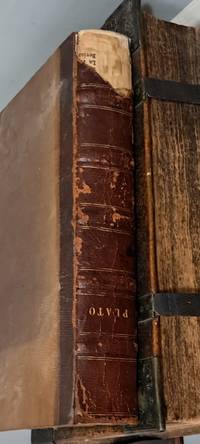
1759réf. 1308111759. First Edition. Signed. SYDENHAM Floyer translator PLATO. Dialogues of Plato. London: W. Sandby and others 1759-1779. Three volumes. Large quarto contemporary half calf raised bands gilt morocco spine labels title labels refurbished. Each volume housed in a custom chemise and together in a clamshell box. $16500.First editions of these dialogues of Plato many marking their first appearances in English signed by the translator on the dedication page of the Synopsis.Floyer Sydenham ""was an excellent Greek scholar and devoted himself to the task of translating the works of Plato. In 1759 he published his proposals in a quarto tract and accomplished his purpose between 1759 and 1780 in four quarto parts"" DNB XIX 245. A contemporary review observed ""His notes which are very copious serve to illustrate many obscure passages in the text and explain many mythological allusions This learned Translator of Plato's Works pursues his undertaking with unremitted diligence; and acquits himself with his usual judgment and accuracy"" Brueggemann 152 quoting the Monthly Review. Unfortunately Sydenham's labors were not appreciated during his lifetime and he died in debtor's prison before completing the project. Thomas Taylor later made use of Sydenham's work in his own edition of Platoand praised the earlier translator in verse: ""Genius sublime; who from barbaric night/ Led Wisdom forth far beaming heav'nly light;/ Whose skill great Plato's elegance commands/ His graces copies and his fire expands."" Illustrated with two folding plates diagramming Plato's arguments. The parts were published separately in very small runs and complete contemporary sets are now extremely scarce. This set contains 12 of 13 parts published with main title pages for the volumes dated 1767 1773 and 1779. Volume I: A Synopsis or General View of the Works of Plato 1759 Io 1759 The Greater Hippias 1759 The Lesser Hippias 1761 Meno no separate title page but 1759 The Rivals no separate title page but 1761; Volume II: The Banquet 1761 The First Alcibiades 1773 The Second Alcibiades 1776; Volume III: A Dissertation on the Doctrine of Heraclitus 1775 Philebus the First Part 1779. Only Philebus the Second Part is absent as often seen. With affixed errata slip on page 83 of Volume III. Schweiger 250 251 257. Rothschild 2384-85. Lowndes 1877. ESTC T132440. Volume I with early inked owner name and note: ""very scarce.""Contents overall very clean with a few instances of faint foxing; bindings moderately rubbed. A handsome wide-margined copy. hardcover
1520réf. 4422Cologne: Quentel heirs 1520. 4to 194 x 140 mm. Collation: A-B4. 15 pages. Woodcut initial on title the latter in two sizes of large gothic types text in small gothic types leaded epigram on title and text heading in roman. Small stain in top of gutter margins small inkstain on A1v f. B3 corner clipped. Bound in early 18th-century South German pasteboards completely overpainted in imitation of a Renaissance binding: both covers painted in watercolor and gouache on a brown ground with outer panel of scrolling tendrils with red flowers and leaves central panel with arabesque foliate decor two vases at top and bottom and central cartouche containing a winged lion holding a book painted in silver on a black ground; flat spine with portion of a different painted decor endleaves of gold on green Bronzefirnispapier bronze varnish paper probably from Augsburg with interlacing tendrils and birds foxes rabbits dogs an angel’s head and a putto emerging from a bud thick paper flyleaves small tear to backstrip edges slightly rubbed small marginal repair to lower flyleaf. Provenance: contemporary inscription on title: Plus que moins que me d’amour or quie en amour et or est qui la scait servir; Maurice Burrus 1882-1959 bookplate and acquisition label dated September 1937 identifying Arthur Lauria as the seller. First separate edition previously unknown of Cicero’s translation of part of Plato’s Timaeus. Cicero's fragmentary translation of sections 27d-47b was highly influential in late antiquity. In either Cicero’s version or Calcidius’s more extensive translation of sections 17a–53c the Timaeus was often the only text of Plato found in medieval monastic scriptoria and libraries. The first separate edition of Calcidius’s translation was also published in 1520 by Josse Bade. This edition was intended as a schoolbook with its moderately leaded lines. The title page includes an epigram by one Ioannis Sartae Leodiensis Jean de Sarthe of Liège. I locate one mention of another copy in a 1902 catalogue of the library of the Gymnasium of Emmerich bound with two other Cicero Quentel imprints from 1518 and 1517 J. Wattendorff Katalog der Lehrerbibliothek Part IV Emmerich 1904 p. 21 shelfmark O 35. That volume was evidently destroyed in 1944 when 90% of the town was bombed. The most remarkable feature of this unusual book is the binding carefully painted on inexpensive pasteboards by an unknown early 18th-century amateur to resemble a 16th-century gold-tooled and paneled binding. The artist indulged in a certain amalgamation of styles viz. the central silver medallion containing a representation of the lion of Venice holding the Gospel of Mark. The lovely “bronze varnish” or gold varnish endpapers with their swirling tendrils among which are hidden animals and birds are typical of papers produced in Augsburg in the first two decades of the 18th century cf. Haemmerle pp. 72-73. These especially resemble examples produced by Georg Christoph Stoy. I have not found an exact match in the printed and online literature. Not in VD16 KVK OCLC ISTC Hoffmann etc. My thanks to Irene Malfatto for her help with the inscription. Quentel heirs unknown
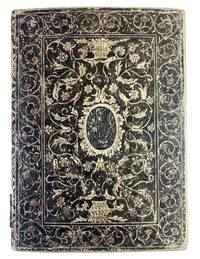
réf. 29408Paris: Venundantur ab Ioanne Parvo & Iodoco Badio colophon: impressa sunt solertiore cura Ascensianis Anno domini MDXVIII 1518 Quinto Kalendas Iuanias. Deo Gratiae. Very Rare and Extremely Early Printing. THE FIRST PARISIAN PRINTING AND THE FIRST PRINTING OUTSIDE OF ITALY. It includes certain pseudo-Platonic dialogues never before printed is only the second printing of the 16th century and the fourth of all printings. Truly rare no copy is in the British Museum and it is mentioned only in Adams. Dedicated by Ficino to Lorenzo de’ Medici this printing was reproduced from the Venetian incunable edition of B. de Choris 1491. A COPY WITH FINE PROVENANCE. Four ownership signatures are noted on the title-page suggesting that the book traveled throughout Europe during its first 250 years of existence. One of the signatures most probably signifies ownership of the book by Sir John Cobham who had been raised to the peerage by King Charles I in 1645. Very finely engraved and illustrated title-page with superb Renaissance decorative borders incorporating allegorical figures and a scribe at work; at the center a very beautiful engraving of the printers at work at the press very fine and ornate capital letters throughout in black with ornate xilographic decorations occasional manuscript emendations in the margins in a contemporary Renaissance hand and with contemporary ownership inscription on the title. Folio 330 x 223 in eights full antique calf incorporating double blind fillet borders on the covers enclosing roll tooled inner borders in blind with a large central panel incorporating decorated corner tools and inner rolled borders all in blind the spine with wide raised bands brown morocco lettering label gilt. cc. num. CCCLXXXIX 389 folio leaves A very large handsome crisp and clean copy with expert and insignificant repair to a closed tear on one leaf. A copy with very wide and ample margins. The binding is in quite excellent condition with very little wear of evidence of use. A sympathetic restoration of the spine panel accomplished at some time. VERY RARE. THE FIRST PRINTING OUTSIDE OF ITALY AND THE FIRST PARISIAN PRINTING. A very beautiful and important production of Ficino's great Latin translation of Plato—"still the best translation of that author Italy can boast" Britannica. This printing also includes certain pseudo-Platonic dialogues never before printed. Ficino began his translation in 1466 from a manuscript supplied by his patron Cosimo de'Medici and by Amerigo Benci. During its progress Ficino submitted sections for review to the greatest scholars of the age: Angelo Poliziano Cristofor Landino Demetrios Chalchondylas and others which served to refine the work. Marcilio Ficino is perhaps the most important of all scholarly Renaissance thinkers and his influence on philosophical humanistic and cultural thought remains unsurpassed. Through the beneficence of the Medici family Renaissance Platonism emanated from him and his work and studies caused the vast expansion of the ideas inherent in Platonic thought. Some have argued that Ficino's direct effect on the Renaissance is without equal by any other scholar. His Latin translation of Plato allowed for all of Plato's dialogues to be available to Western readers for the first time. 'This first edition produced by Jean Petit and Jodocus Badius in Paris became the standard Plato-edition of the time with numerous editions following it. It remained for many years perhaps the most influential of all Renaissance readings of Plato and is considered to this day one of the most important and refined of all early printings of the great philospher's writings. Bade and Petit important in their own right were highly important contemporaries of Erasmus. They are responsible for many of the finest and most widely used editions of classical texts printed during the century. Jean Petit printer publisher and bookseller in Paris is known to have printed from 1493 to 1530 about one tenth of all publications in Paris more than ten thousand volumes. He was one of the four major booksellers at the University of Paris and greatly contributed to the spread of early Renaissance Humanism in Paris. He published a large number of original editions. Among his collaborators were Robert Estienne and Josse Bade. Bade Jodocus Badius 1462-1535 an associate of Erasmus is also considered one of the greatest printers of the period. A scholar of considerable repute and a renowned grammarian he studied in Brussels and Ferrara and taught Greek in Lyon from 1492 to 1498. In Lyon he worked as a proofreader and editor for the printer Jean Trechsel. On his arrival in Paris Jean Petit - one of the "grand libraires" and the most important bookseller and publisher of the era - helped Bade establish his own printing house in 1503. The business flourished and turned into one of the most prolific and important presses of the 16th century. It took on the name "Prelum Ascensianum" and specialized in classical texts in Latin often with his own familiare commentum. For the 2nd-century BC Roman playwright Terence Badius printed a Praenotamenta in 1502. This introduced the subject of Roman comedy through a lengthy treatment of general theories of poetry and thorough discussion of its origins development and classifications. He also published the works by contemporary humanist writers who frequented the printing house from where much Renaissance thought was disseminated. With 775 editions Bade's press served as one of the most active publishers during the first three decades of the 16th century. His frequent work with or for Johannes Parvus Jean Petit created an alliance with the era's most important bookseller and publisher. THE KING OF PHILOSOPHERS. ONE OF THE SUPREME TEXTS OF THE RENAISSANCE. Plato’s reintroduction into European thought has had a total and sweeping effect in the realms of philosophy science and religion. This work reprints the whole text in one endeavour of the first edition Florence 1484-85 issued over many months in a series of parts. The first edition in parts of Plato’s OPERA is of the most extreme rarity probably now absolutely unobtainable so this is one of the very earliest printings one could hope to secure in its complete state and an especially interesting issuance of the OPERA from one of the finest European printers. Venundantur ab Ioanne Parvo & Iodoco Badio hardcover
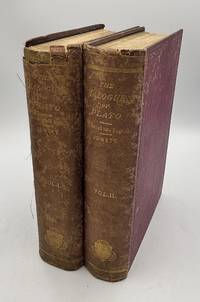
1871réf. 1261Oxford: Clarendon Press 1871. Good. James A. Garfield's copy of the first edition of Benjamin Jowett's landmark English translation of Plato. Volumes I and II only of four from the personal library of James A. Garfield 1831-1881 twentieth President of the United States. Both volumes bear Garfield's distinctive "Inter Folia Fructus / Library of James A. Garfield" bookplate together with manuscript library/shelf notation. An unusually resonant presidential association. Garfield was not merely a statesman who happened to own Plato: he was a formidable classical scholar and educator. Before entering national politics he taught Greek and Latin and became president of the Western Reserve Eclectic Institute later Hiram College. Classical literature remained an important part of his intellectual life. His ownership of Jowett's Plato therefore represents a particularly appropriate conjunction of book and owner. Published by the Clarendon Press in 1871 this was the first edition of Benjamin Jowett's celebrated English translation of Plato's dialogues. Jowett's translation became one of the most influential English presentations of Plato and helped introduce generations of English-speaking readers to the philosopher. These two volumes are preserved in their original publisher's cloth. The bindings show substantial wear consistent with use and age including significant loss at the head of the spine of Volume I with binding structure exposed along with rubbing and other wear. The set is incomplete comprising Volumes I and II of the four originally issued. Despite these faults a compelling association copy uniting one of the foundational texts of Western philosophy the first edition of its most influential Victorian English translation and the personal library of an American president whose own education and intellectual life were deeply rooted in the classics. Provenance: James A. Garfield by his library bookplate and manuscript library markings. . Clarendon Press unknown
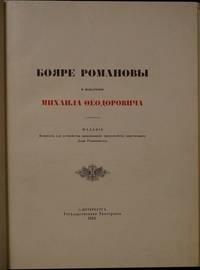
réf. alb47e5a843890c9b6eVasenko, P.G. Boyare Romanovs and the Emperor of Mikhail Fedorovich. In Russian /Vasenko, P.G. Boyare Romanovy i votsarenie Mikhaila Fedorovicha. St. Petersburg: State Printing House, 1913. 224, XII, 2 p., 22 l., 1913. We have thousands of titles and often several copies of each title may be available. Please feel free to contact us for a detailed description of the copies available. SKUalb47e5a843890c9b6e.
1675réf. 024817London: T. R. Thomas Radcliffe & N. T. Nathaniel Thompson for James Magnes and Richard Bentley. First Edition in English of the Apology and Phaedo and the First English Translations everprinted of authentic Dialogues of Plato. This edition was preceded only by the pseudo-Platonic Axiochus translated by Spenser printed in 1592 and known in unique copy only and a selection of Plato's dialogues printed for school use in 1673. Engraved frontispiece entitled "Socrates Triumphans" depicting the philosopher being handed the cup of hemlock. Title page printed in red and black. Octavo 176 x 117 mm. Frontispiece and six following leaves with restored chips at top margin all in blank areas except affecting rules on the title page frontispiece rebacked top corner rounded on about the first 25 leaves small hole paper flaw on A6 very faint inking to several words on P1 occasional pencil marginalia. Modern quarter calf. The Apology is one of Plato's greatest dialogues still moving enough to evoke tears. . Good. Hardcover. 1st Edition. 1675. T. R. [Thomas Radcliffe] & N. T. [Nathaniel Thompson] for James Magnes and Richard Bentley hardcover
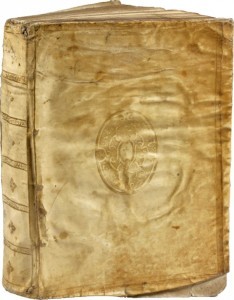
réf. LCS-13867Exemplaire très pur conservé dans sa reliure en vélin souple de l’époque. PLATON. Le Timée de Platon, traittant de la nature du monde, & de l’homme, & de ce qui concerne universellement tant l’ame, que le corps des deux: translaté de Grec en Fraçois, avec l’exposition des lieux plus obscurs & & difficiles. Par Loys le Roy dit Regius. Plutarque de la creation de l’ame, que Platon descrit en son Timee. (Achevé d’imprimer le 23 mars 1581). Paris, Abel l’Angelier, 1581. [Relié avec:] [DU BELLAY, Joachim] / LE ROY, Louis. Le Sympose de Platon, ou de l’amour et de beauté, traduit de Grec en François, avec trois livres de commentaires, extraicts de toute Philosophie & recueillis des meilleurs autheurs tant Grecs que Latins, & autres, par Loys le Roy, dit Regius. Plusieurs passages des meilleurs Poëtes Grecs & Latins, citez aux Commentaires, mis en vers François, par I. du Bellay Angevin. Paris, Abel l’Angelier, 1581. Soit 2 ouvrages reliés en 1 volume in-4 de: I/ ff. 1 à 8, (4) ff. de table, ff. 9 à 159, (1) f. de privilège; II/ (4) ff., 192 ff. avec de nombreuses erreurs de pagination. Quelques figures techniques dans le texte du Timée. Quelques mouillures ou taches dans le premier texte. Relié en plein vélin souple de l’époque, médaillon central frappé or sur les plats, dos lisse orné de roulettes et fleurons dorés, tranches dorées. Reliure de l’époque légèrement fatiguée. 219 x 166 mm.
1804réf. 2306765London: Printed for Thomas Taylor by R. Wilks Chancery-Lane; and Sold by E. Jeffery and R.H. Evans Pall-Mall 1804. First Thus. First Thus. Very Good/No Jacket. First thus. Bookplate of Parisian bookseller Hector Bossange on front endpapers Astor Library stamp on title pages. Boards rubbed with minor restoration to corners portion of corner of rear flyleaf on volume three absent. 1804 Large Hardcover. cxxiii 544; 657; 600; 614; 720 pp. 4to. Red leather spines with gilt titles and decorations marbled boards and endpapers. The first English translation of the complete works of Plato. Earlier translations contained only selected dialogues abridged versions of works etc. and many early translations of Plato were into Latin rather than English Taylor notes this and also mentions the primacy of his translation in his dedication to Charles Howard Duke of Norfolk. Thomas Taylor was also the first to translate Aristotle's complete works into English. This edition includes introductory information a biographical sketch of Plato and Taylor's extensive notes on his translations and on those of Floyer Sydenham. The complete contents are as follows: General Introduction; Explanation of Certain Terms Peculiar to the Platonic Philosophy; Life of Plato by Olympiodorus; The First Alcibiades; The Republic; Additional Notes on the First Alcibiades Extracted from the MS. Commentary of Proclus on That Dialogue; Additional Notes on the Republic; The Laws; The Epinomis or the Philosopher; The Timaeus; The Critias or Atlanticus; Additional Notes on the Timaeus Extracted from the Commentary of Proclus on That Dialogue; The Parmenides; The Sophista; The Phaedrus; The Greater Hippias; The Banquet; Additional Notes on the Parmenides Extracted from the MS. Commentary of Proclus on That Dialogue and from the MS. of Damascius Peri Archon; Additional Notes on the Phaedrus from Proclus on the Theology of Plato; The Theaetetus; The Politicus; The Minos; The Apology of Socrates; The Crito; The Phaedo; The Gorgias; The Philebus; The Second Alcibiades; The Euthyphro; The Meno; The Protagoras; The Theages; The Laches; The Lysis; The Charmides; The Lesser Hippias; The Euthydemus; The Hipparchus; The Rivals; The Menexenus; The Clitopho; The Io; The Cratylus; The Twelve Epistles; Additional Notes on the Cratylus Extracted from the MS. Scholia of Proclus on That Dialogue. Printed for Thomas Taylor, by R. Wilks, Chancery-Lane; and Sold by E. Jeffery, and R.H. Evans, Pall-Mall unknown books
réf. 3801204Short description: In Russian. Vasenko, Platon Grigorievich. Boyare Romanovs and the Emperor of Mikhail Fedorovich. St. Petersburg: Edition of the Committee for the Organization of the Celebration of the Three Centenary of the Reign of the House of Romanov, 1913: The State Type. You are welcome to reach out to us for a detailed description of the copies currently available. Delivery of this book may take longer than usual including extended processing and pre-shipping time, no expedited shipping is available. Please advise us if you have a set date or a deadline to receive your order.SKU3801204
réf. 3801204Short description: In Russian. Vasenko Platon Grigorievich. Boyare Romanovs and the Emperor of Mikhail Fedorovich. St. Petersburg: Edition of the Committee for the Organization of the Celebration of the Three Centenary of the Reign of the House of Romanov 1913: The State Type. The image is provided for reference only. It may reflect condition of one of the available copies or only help in identifying the edition. Please feel free to contact us for a detailed description of the copies available. SKU3801204 unknown
1681réf. 29415London. Very Good. 1681. Full-Leather. Very Good full leather edition has a name and date of 1743 on the back of the front endpaper. The leather has wear to the spine ends and corner tips and the hinge areas have some scuffs. Binding is tight and the text is clean. ; 16mo 6" - 7" tall; 271 pages . hardcover
1675réf. 64473First English Edition PLATO. CHARLETON Walter translator. His Apology of Socrates and Phaedo or Dialogue concerning the Immortality of Mans Soul And Manner of Socrates his Death: Carefully translated from the Greek and Illustrated by Reflections upon both the Athenian Laws and ancient Rites and Traditions concerning the Soul therein mentioned. London: Printed by T.R. & N.T. for James Magnes and Richard Bentley 1675. First English edition. Engraved frontispiece by R. White entitled Socrates Triumphans. Octavo 4 1/2 x 7 1/16 inches. 4 blank 40 300 4 blank. Full modern speckled calf ruled in blind. Red morocco spine label. Spine lettered in gilt. All edges speckled. Repair to inner bottom corner of title-page minimal loss of text. Bottom outer blank corner missing from leaf F and I2. A very good complete copy. "Plato A Greek philosopher and prose writer. Born at Athens of a noble family Plato aspired to political activity. Dismayed at the inequities of the Athenian tyranny and later at the execution of his teacher Socrates under the democracy he turned towards philosophy in search of an alternative to the unstable and unjust public life of the time. He also sought unity behind the changing impressions of the visible universe.All Plato's writing except for The Apology and the Letters is in dialogue form.The Apology records Socrates' defense at his trial. These dialogues are philosophically inconclusive but are considered best to represent the historical Socrates." BenÈt's Reader's Encyclopedia810. "Phaedo a dialogue by Plato. In it Phaedo a disciple of Socrates describes the last hour of his teacher's life. Socrates and his friends discuss the possibility of the immortality of the soul. The doctrine of ideas and the theory of reminiscence are the most important arguments" BenÈt's Reader's Encyclopedia 797. ESTC R12767 HBS 64473. $4500 Printed by T.R. & N.T. for James Magnes and Richard Bentley unknown books
1892réf. 53851Oxford: Clarendon Press 1892. Near fine. Handsome set of Jowett's Plato in beautifully preserved Rivière & Son half morocco bindings. Plato's dialogues form much of the philosophical foundation of Western civilization. In the APOLOGY EUTHYPHRO CRITO PHAEDO and more Socrates leads his interlocutors through a series of questions that concern morality and faith censorship and education political justice and injustice and the immortality of the soul. A stellar copy and a requirement for any library on the history of thought. Five volumes 9'' x 5.75'' each. Contemporary half maroon morocco by Rivière & Son marbled boards raised bands gilt-ornamented spines. Top edges gilt marbled endpapers. Third edition. Text in English. 594; 576; 544; 646; 542 pages. Evidence of bookplate removal to front endpapers a few small dings to vol. IV else exceptionally sharp. Clarendon Press unknown
réf. albf7eb4b19c138bc05Vasenko P. G Boyare Romanovs and the Emperor of Mikhail Fedorovich. In Russian /Vasenko P. G Boyare Romanovy i votsarenie Mikhaila Fedorovicha. Publishing House of the Committee for the organization of the celebration of the 300th anniversary of the reign of the House of Romanov. St. Petersburg State Printing House. 1912. 240 p. We have thousands of titles and often several copies of each title may be available. Please feel free to contact us for a detailed description of the copies available. SKUalbf7eb4b19c138bc05.
1634réf. 32Walderus' printing was the second edtion of the complete Plato in Greek. Printed in Basil 1534 it followed by two decades the Venice edition prinfed by Aldus in 1513. In those decades the Humanists Gyrnaeus and Oporinus had been at work on that text and comparing it with the oldest manuscripts. The Plato 690 pgs was part of job that also included a Commentary by Proclus 445pgs in addition to an index and supplementary materials. Plato and Proclus recieve seperate pagination but additionally and index and supplementary material amounting to about 36 pgs was printed as well. Printed on the stock of this particular copy and calculating the bulk resulting in a one volume quarto volume it seems a bit heavy and necessarily heavily lined Additionally Plato and Proclus are seperately paginated and the Supplementary unpaginated. The first printing of the complete run was bound in in three volumes. As the decades and the centuries passed Plato was often found bound seperately. This is the at least the second binding of that original printing and was done under the care of Residence Jesusits in Galway in the late 1800s judging from materials used.This binding contains no visible trace of any earlier bindings. At this time the text was attached to three stout cords and apparently also trimmed and edge sprinkle at that binding in the late 1800s.These cords are attched to a half goat or hide binding broken at the last panel and starting at corners but strong. It contains the complete 1534 Walderus Plato and the required 36 leaves unpaginated supplementary material and index. Bookworm damage! This damage occurs throughout the book little loss of text generally very light but a concentration in several square inch areas at some leaf edges. The good news is that the volume as it exists is stable and readable. The bad news is that although the pgs 98-118 are remarkably stable now only experienced people should handle this book: the wosrt locations are where damage in the outer margin results in lacy paper see image #7.Imo the lacing on those outer leaves can be stabilized in situ without much bulk with ultra light tissue- I was a restorer- but that is a task for a conservator or skilled binder Walderus hardcover
2016réf. SBBI-L-BJS00463-MIX-20230CreateSpace Independent Publishi 2016. paperback. Acceptable. Please see the condition note after this for details if this is missing please consider Acceptable to mean poor quality that could include major staining water damage writing missing dustjacket etc etc. Our books are dispatched from a Yorkshire former cotton mill. We list via barcode/ISBN so please note that the images are stock images and may not be the exact copy you receive furthermore the details about edition and year might not be accurate as many publishers reuse the same ISBN for multiple editions and as we simply scan a barcode or enter an ISBN we do not check the validity of the edition data when listing. If you're looking for an exact edition please don't order at least not without checking with us first although we don't always have time to check. We aim to dispatch prompty the service used will depend on order value and book size. We can ship to most countries see our shipping policies. Payment is via Abe only. CreateSpace Independent Publishi paperback
1557réf. 3087Venice: Comin da Trino 1557. Graesse V.325 giving 1558 imprint; a second issue; the Italian Union Catalogue Catalogo Unico lists only 5 copies in Italian libraries. Rare first Italian-language edition of this Platonic dialogue somewhat anomalous in the Platonic corpus because of its extended treatment of the nature of physical matter and cosmology and a favorite among Renaissance readers for its myth of Atlantis which influenced other Renaissance utopias. The 1550s or thereabouts saw the first Italian translation of the most popular Platonic dialogues whether directly from Greek as here or via Ficinos Latin translation; the prestige of Ficinos Latin translation and wider readership for the original Greek probably explains why this Italian edition came so relatively late. The edition was translated by the littérateur Sebastiano Erizzo 1525-1585 a prolific writer of poetry fiction and belles lettres who provides some commentary in the way of printed marginal annotations; he would later translate a further selection of dialogues into Italian in which the Timaeus was reprinted 1574. NUC lists UNC and OCLC adds Duke. Comin da Trino
réf. 26961Bâle, Johann Froben et Hieronymus Episcopius, 1551. 1 vol. in-folio, peau de truie estampée à froid sur ais de bois biseautés, dos à nerfs soulignés de filets à froid, titre écrit à la plume en tête, triple encadrement de roulettes à froid sur les plats, la première à décor de rinceaux et fleurettes, la seconde à décor continu de palmettes, la troisième comportant des représentations allégoriques des sept vertus cardinales, plaque estampée à froid au centre du plat sup. avec une représentation allégorique de la Trinité accompagnée d'un verset de l'évangile de saint Jean ("sic Deus dilexit mundum ut Filium suum unigenitum daret") et d'une plaque centrale à froid au plat inférieur représentant une crucifixion, tranches rouges, fermoir en bronze ciselé. Reliure de l'époque, manque un fermoir, usures aux coins et à la coiffe sup., tache d'humidité en tête du plat sup. et quelques rayures. Cachet humide violet de la bibliothèque du lycée de Stralsund (Allemagne). (6) ff., 952 pp., (24)ff. d'index. Signatures : alpha6 [a-z]6 [A-Z]6 [Aa-Zz]6 [AA-II]6 HH8 [LL-OO]6. Un trou de ver traverse le volume.
1781réf. YRG-246In-8, 12 tomes dont Dialogorum Platonis Argumenta Exposita et Illustrata, a Diet Tiedman Grec et Latin. demi-cuir havane, dos à cinq nerfs, pièces de titres, titres dorés, frottements aux plats avec manque de papier, intérieur frais sur vergé, gravure a la cuve par Weis,quelque pages jaunie. Société Typographique de Bâle. Très bel exemplaire, complet et rare. Photos sur demande. En l'état.Hors frais d’envoi.
1557réf. 3087Venice: Comin da Trino 1557. Graesse V.325 giving 1558 imprint; a second issue; the Italian Union Catalogue Catalogo Unico lists only 5 copies in Italian libraries. Rare first Italian-language edition of this Platonic dialogue somewhat anomalous in the Platonic corpus because of its extended treatment of the nature of physical matter and cosmology and a favorite among Renaissance readers for its myth of Atlantis which influenced other Renaissance utopias. The 1550s or thereabouts saw the first Italian translation of the most popular Platonic dialogues whether directly from Greek as here or via Ficinos Latin translation; the prestige of Ficinos Latin translation and wider readership for the original Greek probably explains why this Italian edition came so relatively late. The edition was translated by the littérateur Sebastiano Erizzo 1525-1585 a prolific writer of poetry fiction and belles lettres who provides some commentary in the way of printed marginal annotations; he would later translate a further selection of dialogues into Italian in which the Timaeus was reprinted 1574. NUC lists UNC and OCLC adds Duke. Comin da Trino books
réf. Q-0672601818The Bobbs-Merrill Company 1952-06-01. Paperback. New. In shrink wrap. Looks like an interesting title! The Bobbs-Merrill Company paperback
1997réf. 14765Indianapolis Indiana U.S.A.: Hackett Pub Co Inc. New. 1997. Hardcover. 0872203492 . FREE UPGRADE to Courier/Priority Shipping Upon Request - IN STOCK AND IMMEDIATELY AVAILABLE FOR SHIPMENT - Flawless -- with a bonus offer . Hackett Pub Co Inc hardcover
1759réf. 100405London: Various Publishers 1759-1771. Finely bound 18th century printing of Plato's works. Quartos 2 volumes bound in full contemporary calf with gilt tooling to the spine in five compartments within raised gilt bands red and green morocco spine labels lettered in gilt double gilt ruling to the front and rear panels. Signed by the translator and editor Floyer Sydenham on the dedication page. Containing: The Dialogues of Plato A Synopsis or General View of the Works of Plato Meno A Dialogue Concerning Virtue The Greater Hippias: Concerning the Beautifull The Lesser Hippias: Concerning Voluntary and Involuntary Error The Rivals Concerning Philosophy The Banquet Concerning Love and Proposals for a New Subscription. From the library of British Army officer Leonard Smelt who served as sub-governor to Frederick Duke of York and the future George IV and became a close friend of Samuel Johnson and Oliver Goldsmith later in life with his bookplates to the pastedowns. Subsequently from the library of English churchman and academic Charles Henry Hall who served as the Dean of Christ Church from 1809 to 1812 with his bookplates to the front free endpapers. In very good condition with noted provenance. That Plato should be the first of all the ancient philosophers to be translated and broadcast by the printing press was inevitable. Plato's central conception of a universe of ideas Perfect Types of which material objects are imperfect forms and his ethical code based on action according to human nature developed by education which represents the authority of the State fitted in as well with the philosophical religious and political thought of western Europe in the 15th century striving to free itself from the shackles of scholasticism as it did with those of the Byzantine Greeks by whom Plato was repopularized in the western world The dialogues are pervaded by two dominant impulses: a love of truth and a passion for human improvement" PMM 27. Various Publishers unknown books
réf. 17035PLATO. The Greater Hippias: A Dialogue of Plato Concerning The Beautifull. London: H. Woodfall 1759. First Edition. Quarto 127 pages. Modern calf-backed marbled boards fresh endpapers. In the Greater Hippias Socrates and Hippias set out to find a definition for "beauty" but are destined to fail due to their inability to formulate an answer which encompasses the entire concept. The text has an anatreptic purpose-- that is the result of the dialogue is to defeat commonly held opinions without necessarily offering a resolution. The Platonic concept of something "good in and of itself" makes its first appearance in this early dialogue which can be read as much as a serious philosophical work as a light satirical comedy with two actors. Translated by Floyer Sydenham whose Platonic scholarship was credited with "'just criticism and extensive learning an elegant taste and a genius naturally philosophic' by Thomas Taylor. Leaves rippled somewhat with light foxing. In very good condition. unknown books
réf. 9112955"Short description: In Russian. Kerzhentsev, Platon Mikhailovich. Principles of Organization. Leningrad; Moscow: State Publishing House, 1925. You are welcome to reach out to us for a detailed description of the copies currently available. Delivery of this book may take longer than usual including extended processing and pre-shipping time, no expedited shipping is available. Please advise us if you have a set date or a deadline to receive your order.SKU9112955"