[PLATO]; CICERO (translator)Biblio.com
7 552 résultats
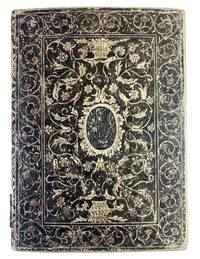
1520réf. 4422Cologne: Quentel heirs 1520. 4to 194 x 140 mm. Collation: A-B4. 15 pages. Woodcut initial on title the latter in two sizes of large gothic types text in small gothic types leaded epigram on title and text heading in roman. Small stain in top of gutter margins small inkstain on A1v f. B3 corner clipped. Bound in early 18th-century South German pasteboards completely overpainted in imitation of a Renaissance binding: both covers painted in watercolor and gouache on a brown ground with outer panel of scrolling tendrils with red flowers and leaves central panel with arabesque foliate decor two vases at top and bottom and central cartouche containing a winged lion holding a book painted in silver on a black ground; flat spine with portion of a different painted decor endleaves of gold on green Bronzefirnispapier bronze varnish paper probably from Augsburg with interlacing tendrils and birds foxes rabbits dogs an angel’s head and a putto emerging from a bud thick paper flyleaves small tear to backstrip edges slightly rubbed small marginal repair to lower flyleaf. Provenance: contemporary inscription on title: Plus que moins que me d’amour or quie en amour et or est qui la scait servir; Maurice Burrus 1882-1959 bookplate and acquisition label dated September 1937 identifying Arthur Lauria as the seller. First separate edition previously unknown of Cicero’s translation of part of Plato’s Timaeus. Cicero's fragmentary translation of sections 27d-47b was highly influential in late antiquity. In either Cicero’s version or Calcidius’s more extensive translation of sections 17a–53c the Timaeus was often the only text of Plato found in medieval monastic scriptoria and libraries. The first separate edition of Calcidius’s translation was also published in 1520 by Josse Bade. This edition was intended as a schoolbook with its moderately leaded lines. The title page includes an epigram by one Ioannis Sartae Leodiensis Jean de Sarthe of Liège. I locate one mention of another copy in a 1902 catalogue of the library of the Gymnasium of Emmerich bound with two other Cicero Quentel imprints from 1518 and 1517 J. Wattendorff Katalog der Lehrerbibliothek Part IV Emmerich 1904 p. 21 shelfmark O 35. That volume was evidently destroyed in 1944 when 90% of the town was bombed. The most remarkable feature of this unusual book is the binding carefully painted on inexpensive pasteboards by an unknown early 18th-century amateur to resemble a 16th-century gold-tooled and paneled binding. The artist indulged in a certain amalgamation of styles viz. the central silver medallion containing a representation of the lion of Venice holding the Gospel of Mark. The lovely “bronze varnish” or gold varnish endpapers with their swirling tendrils among which are hidden animals and birds are typical of papers produced in Augsburg in the first two decades of the 18th century cf. Haemmerle pp. 72-73. These especially resemble examples produced by Georg Christoph Stoy. I have not found an exact match in the printed and online literature. Not in VD16 KVK OCLC ISTC Hoffmann etc. My thanks to Irene Malfatto for her help with the inscription. Quentel heirs unknown
1520réf. 4422Cologne: Quentel heirs 1520. 4to 194 x 140 mm. Collation: A-B4. 15 pages. Woodcut initial on title the latter in two sizes of large gothic types text in small gothic types leaded epigram on title and text heading in roman. Small stain in top of gutter margins small inkstain on A1v f. B3 corner clipped. Bound in early 18th-century South German pasteboards completely overpainted in imitation of a Renaissance binding: both covers painted in watercolor and gouache on a brown ground with outer panel of scrolling tendrils with red flowers and leaves central panel with arabesque foliate decor two vases at top and bottom and central cartouche containing a winged lion holding a book painted in silver on a black ground; flat spine with portion of a different painted decor endleaves of gold on green Bronzefirnispapier bronze varnish paper probably from Augsburg with interlacing tendrils and birds foxes rabbits dogs an angel’s head and a putto emerging from a bud thick paper flyleaves small tear to backstrip edges slightly rubbed small marginal repair to lower flyleaf. Provenance: contemporary inscription on title: Plus que moins que me d’amour or quie en amour et or est qui la scait servir; Maurice Burrus 1882-1959 bookplate and acquisition label dated September 1937 identifying Arthur Lauria as the seller. First separate edition previously unknown of Cicero’s translation of part of Plato’s Timaeus. Cicero's fragmentary translation of sections 27d-47b was highly influential in late antiquity. In either Cicero’s version or Calcidius’s more extensive translation of sections 17a–53c the Timaeus was often the only text of Plato found in medieval monastic scriptoria and libraries. The first separate edition of Calcidius’s translation was also published in 1520 by Josse Bade. This edition was intended as a schoolbook with its moderately leaded lines. The title page includes an epigram by one Ioannis Sartae Leodiensis Jean de Sarthe of Liège. I locate one mention of another copy in a 1902 catalogue of the library of the Gymnasium of Emmerich bound with two other Cicero Quentel imprints from 1518 and 1517 J. Wattendorff Katalog der Lehrerbibliothek Part IV Emmerich 1904 p. 21 shelfmark O 35. That volume was evidently destroyed in 1944 when 90% of the town was bombed. The most remarkable feature of this unusual book is the binding carefully painted on inexpensive pasteboards by an unknown early 18th-century amateur to resemble a 16th-century gold-tooled and paneled binding. The artist indulged in a certain amalgamation of styles viz. the central silver medallion containing a representation of the lion of Venice holding the Gospel of Mark. The lovely “bronze varnish” or gold varnish endpapers with their swirling tendrils among which are hidden animals and birds are typical of papers produced in Augsburg in the first two decades of the 18th century cf. Haemmerle pp. 72-73. These especially resemble examples produced by Georg Christoph Stoy. I have not found an exact match in the printed and online literature. Not in VD16 KVK OCLC ISTC Hoffmann etc. My thanks to Irene Malfatto for her help with the inscription. Quentel heirs unknown books
réf. B9783368402679Hardback. New. hardcover
réf. B9783368402662Paperback / softback. New. paperback
réf. 3368402676.Ghardcover. Good. Access codes and supplements are not guaranteed with used items. May be an ex-library book. hardcover
réf. 3368402668.Gpaperback. Good. Access codes and supplements are not guaranteed with used items. May be an ex-library book. paperback
réf. ria9783368402662_inpPaperback. New. New Book; Fast Shipping from UK; Not signed; Not First Edition; Reproduction of the original. paperback
réf. ria9783368402679_inpHardcover. New. New Book; Fast Shipping from UK; Not signed; Not First Edition; Reproduction of the original. hardcover
réf. RO60014169Eugen Diederichs. non daté. In-12. Relié. Bon état, Couv. convenable, Dos frotté, Intérieur frais. 223 pages. Ouvrage en allemand.. . . . Classification Dewey : 430-Langues germaniques. Allemand
réf. 3787310401.Gperfect. Good. Access codes and supplements are not guaranteed with used items. May be an ex-library book. unknown
réf. 3843031312.Ghardcover. Good. Access codes and supplements are not guaranteed with used items. May be an ex-library book. hardcover
réf. 3847835602.Ghardcover. Good. Access codes and supplements are not guaranteed with used items. May be an ex-library book. hardcover
2013réf. 2-9892605144Imprensa da Universidade de Coimbra 2013. Paperback. New. 3rd edition. 268 pages. Portuguese language. 7.48x4.72x0.61 inches. Imprensa da Universidade de Coimbra paperback
1972réf. 51871Athen, 1972. 1 Tafel (Portrait), 522 SS., 1 Bl. Gr.-8°, Original-Broschur.
1551réf. 5172Michel De Vascosan 17 x 22,5 Paris 1551 In-4, reliure de vélin souple cousue de l'époque, traces des lanières d'attaches, dos muet. "Le Timée de Platon traittant de la nature du monde et de l'homme, et de ce qui concerne universellement tant l'âme que le corps des deux, translaté du grec en françois, avec l'exposition des lieux plus obscurs et difficiles par Loys Le Roy" : [1 f.bl.], titre, dédicace à Monseigneur le révérendissime Cardinal de Lorraine, l'argument du Timée de Platon par Loys le Roy, [8 ff.], le Timée de Platon en quatre parties, 9-115 ff., les chapitres contenus es quatre parties [3 ff.]. Suivi par "Trois oraisons de Desmosthène prince des orateurs, dittes Olynthiaques, pleines de matières d'estat, deduittes avecques singulières prudence & éloquence, translatées pareillement de grec en françois, avec une préface contenant la conjonction de l'éloquence et de la philsophie", titre [1 f.], dédicace à la duchesse de Valentinois [2 ff.], préface de Loys Le Roy et argument [5 ff.], suite de l'argument et oraisons 9-25 ff., privilège et colophon [1 f.], émendations des fautes [1f.]. Couverture de vélin et premier feuillet blanc rongés en queue et sur le bas des plats (4 à 5 cm), page de titre du Timée coupée à la moitié (donc sans la marque de Vascosan ni la date de 1551), mouillures sur les 32 premiers et 20 derniers feuillets, dix premières pages avec déchirures à la marge supérieure, ainsi que les 4 derniers feuillets, page de titre des "Trois oraisons de Démosthène" portant la date de 1552 bien présente, colophon portant la mention "Imprimé à Paris par Michel de Vascosan, le XXII jour de janvier M.D.LII., certains passages biffés sans porter atteinte à la lecture, marque de cire rouge au dos de la couverture de vélin, annotation manuscrite sous le colophon "l'an mille cinq cent quatrevingt X". Rare édition originale, publiée par Vascosan, de la première traduction française de l'oeuvre majeure de Platon à l'influence ininterrompue, par l'humaniste parisien Louis Le Roy (1510-1577), qui fut avec Amyot un des grands traducteurs des auteurs grecs au XVIe siècle.(EvC25)
1551réf. 5172Michel De Vascosan 17 x 22,5 Paris 1551 In-4, reliure de vélin souple cousue de l'époque, traces des lanières d'attaches, dos muet. "Le Timée de Platon traittant de la nature du monde et de l'homme, et de ce qui concerne universellement tant l'âme que le corps des deux, translaté du grec en françois, avec l'exposition des lieux plus obscurs et difficiles par Loys Le Roy" : [1 f.bl.], titre, dédicace à Monseigneur le révérendissime Cardinal de Lorraine, l'argument du Timée de Platon par Loys le Roy, [8 ff.], le Timée de Platon en quatre parties, 9-115 ff., les chapitres contenus es quatre parties [3 ff.]. Suivi par "Trois oraisons de Desmosthène prince des orateurs, dittes Olynthiaques, pleines de matières d'estat, deduittes avecques singulières prudence & éloquence, translatées pareillement de grec en françois, avec une préface contenant la conjonction de l'éloquence et de la philsophie", titre [1 f.], dédicace à la duchesse de Valentinois [2 ff.], préface de Loys Le Roy et argument [5 ff.], suite de l'argument et oraisons 9-25 ff., privilège et colophon [1 f.], émendations des fautes [1f.]. Couverture de vélin et premier feuillet blanc rongés en queue et sur le bas des plats (4 à 5 cm), page de titre du Timée coupée à la moitié (donc sans la marque de Vascosan ni la date de 1551), mouillures sur les 32 premiers et 20 derniers feuillets, dix premières pages avec déchirures à la marge supérieure, ainsi que les 4 derniers feuillets, page de titre des "Trois oraisons de Démosthène" portant la date de 1552 bien présente, colophon portant la mention "Imprimé à Paris par Michel de Vascosan, le XXII jour de janvier M.D.LII., certains passages biffés sans porter atteinte à la lecture, marque de cire rouge au dos de la couverture de vélin, annotation manuscrite sous le colophon "l'an mille cinq cent quatrevingt X". Rare édition originale, publiée par Vascosan, de la première traduction française de l'oeuvre majeure de Platon à l'influence ininterrompue, par l'humaniste parisien Louis Le Roy (1510-1577), qui fut avec Amyot un des grands traducteurs des auteurs grecs au XVIe siècle.(EvC25)
1995réf. R320144789GF-Flammarion. 1995. In-12. Broché. Bon état, Couv. convenable, Dos satisfaisant, Intérieur frais. 438 pages.. . . . Classification Dewey : 880-Littératures helléniques. Littérature grecque
réf. 1396073698.Ghardcover. Good. Access codes and supplements are not guaranteed with used items. May be an ex-library book. hardcover
réf. 1390450546.Gpaperback. Good. Access codes and supplements are not guaranteed with used items. May be an ex-library book. paperback
réf. 1142027333.Gpaperback. Good. Access codes and supplements are not guaranteed with used items. May be an ex-library book. paperback
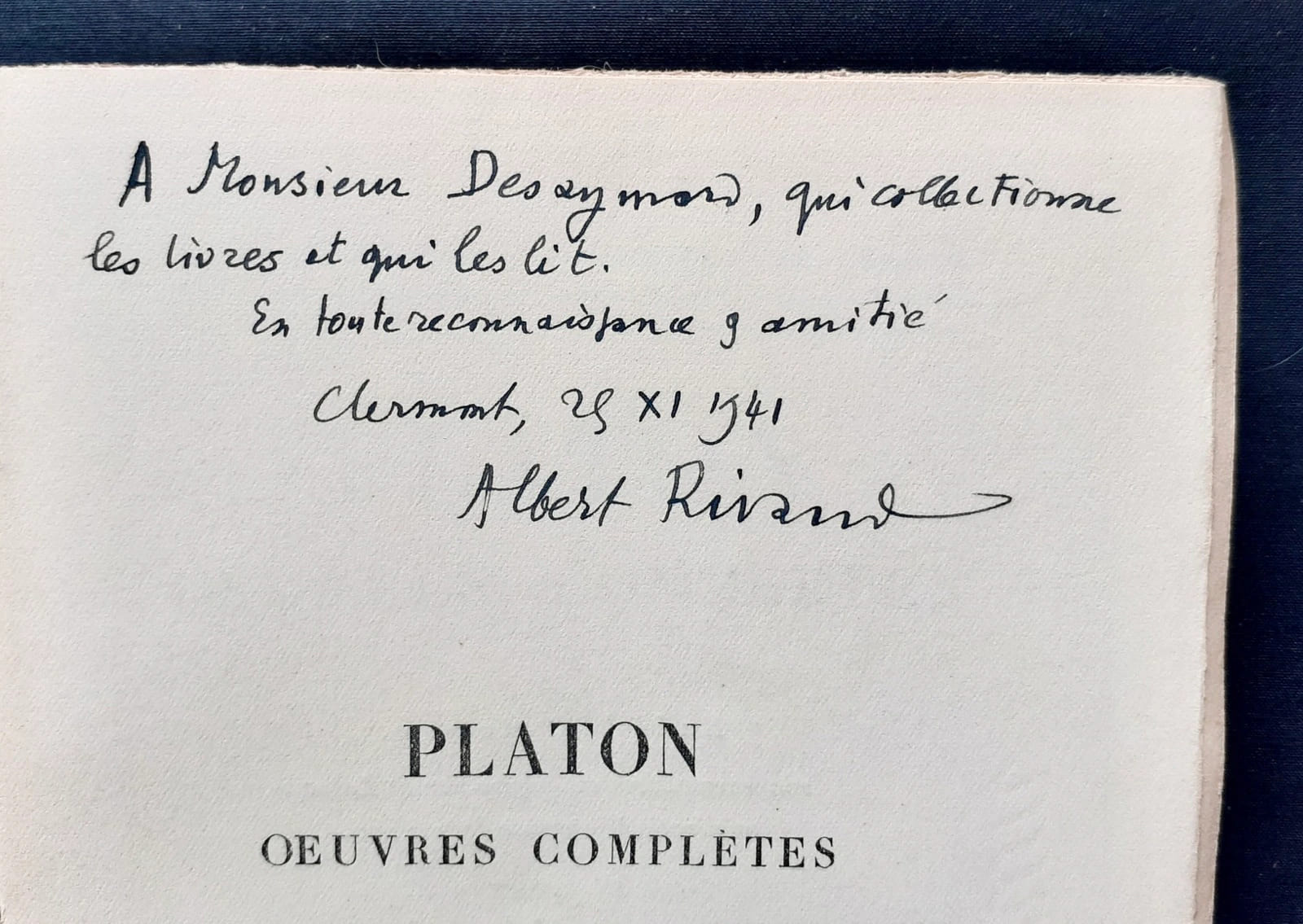
réf. 48860Texte établi et traduit par Albert Rivaud - Paris : Société "Les Belles Lettres" (Collection des Universités de France publiée sous le patronage de l'Association Guillaume Budé), 1925 - Un volume 20,2x13,5cm broché - texte et traduction - Edition originale de la traduction : 1/200 exemplaires sur vélin pur fil Lafuma. Exemplaire en bon état, non coupé, sans annotations à l'intérieur. Avec un envoi autographe signé d'Albert Rivaud adressé à Joseph Desaymard.
réf. 9782080152121G.F.
1926réf. R320039914LES BELLES LETTRES. 1926. In-12. Broché. Etat d'usage, Couv. convenable, Dos fané, Intérieur frais. 233 pages.. . . . Classification Dewey : 890-Littératures des autres langues
1924réf. R320039913LES BELLES LETTRES. 1924. In-12. Broché. Etat d'usage, Couv. convenable, Dos satisfaisant, Intérieur frais. 280 pages.. . . . Classification Dewey : 890-Littératures des autres langues
réf. FR19692Imprimé en 1976.