17 412 résultats
1989réf. 39162KRÜGER WOLFGANG 1989. 3. hardcover. KRÜGER, WOLFGANG hardcover
1874réf. 148987London: James Parker and Co. 1874. Lent to A. J. Ayer Scarce first edition of Bradley's first book with an autograph letter signed on New College Oxford headed paper from the philosopher A. J. Ayer 9 February 1962 thanking a "Dear John" for the loan of the book - "it is strange stuff even more 'literary' than his later work. But as nearly always he is troubled by genuine problems". This literary quality that Ayer identifies explains Bradley's appeal to authors such as T. S. Eliot whose doctoral dissertation was on "Knowledge and Experience in the Philosophy of F. H. Bradley". Octavo. Stab-stitched in original printed wrappers front wrapper lettered in black. Ownership signature of John Willes dated 1978 to inside front wrapper and his acquisition note at the head of the letter. Spine ends chipped short split to rear joint wrappers a little soiled; a very good copy. unknown
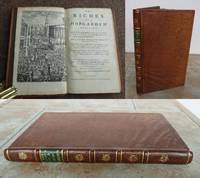
1733réf. 53412London printed for D. Browne at the Black Swan without Temple-Bar no date circa 1733. TITLE CONTINUED: With the Observations and Remarks of the most celebrated Hop-Planters in Britain. Wherein such rules are laid down for the management of the hop as may improve the most barren ground from one shilling to thirty or forty pounds an acre per annum. In which is particularly set forth the whole culture from the first breaking up of the ground the planting &c. to the kilning or drying of the hop. Rendred familiar to every capacity. By R. Bradley professor of botany in the University of Cambridge and F.R.S. SECOND EDITION circa 1733. A reissue of the first edition of 1729 with new title page and half-title issued as a pamphlet. 8vo approximately 200 x 120 mm 8 x 4¾ inches engraved frontispiece plus 2 small woodcuts in the text pages: 4 1 iv-viii 1 -104 half title present with publisher's advert to verso Instructions for Planting Hops by the Dublin Society published in 1733 is listed in the books just published No.4 pages 43 and 44 misnumbered 44 and 43 catchwords correct bound in modern full speckled calf green gilt lettered label to spine gilt decoration and rules between raised bands to spine blind rules to edges of covers new brown endpapers. Pale age-browning throughout tiny stab holes to inner margins tiny burn hole to outer margin of leaf C2 occasional small fox spot a very good copy. See: Blanche Henrey British Botanical and Horticultural Literature before 1800 Volume 3 page 17 No. 506; Catalogue of Botanical Books in the Collection of Rachel McMasters Miller Hunt Volume II page 122 No. 47 listing first edition; Mary S. Aslin Catalogue of the Printed Books on Agriculture 1471-1840 page 22 first edition; G.E. Fussell More Old English Farming Books 1523 to 1730 page 113 listing first edition; Donald McDonald Agricultural Writers 1200-1800 pages 170-176; ESTC T44952. MORE IMAGES ATTACHED TO THIS LISTING ALL ZOOMABLE FURTHER IMAGES ON REQUEST. POSTAGE AT COST AND ALL PARCELS SENT FULLY TRACKED AND FULLY INSURED. London, printed for D. Browne, at the Black Swan, without Temple-Bar, no date [circa 1733]. hardcover
1992réf. 47994FISCHER 08/1992. 291.-340. Tsd. softcover. FISCHER paperback
1998réf. LS-65Berkeley CA.: Marion Zimmer Bradley Literary Works Trust 1998. Classic scarce text published on behalf of Fantasy Worlds Festival for Marion Zimmer Bradley a year before M.Z. Bradley's death contains a compilation of nineteen short science-fiction/fantasy novellas by various renown writers and protegees of MZB including Diana L. Paxton; Cynthia McQuillin; Raul S. Reyes; Lawrence Watt-Evans; Elisabeth Waters; Syne Mitchell; Paul Edwin Zimmer; and others. Some of the stories include: Lost Moon; Toyen; Totem Night; Washerwoman; The High Altar; Change-child; As Three to One; The White Falcon; Earth's Song; Ingredients; Rehabilitation; Raven's Blade; The Accursed Villa and others. 342 pgs. Minor slight crease on second front free blank endpaper. SIGNED by Marion Zimmer Bradley & Rachel Holmen on the title pg; Signed by Rachel Holmen on her last introduction pg. Signed by the copyright designer Margaret Davis on the last credits page. Gilt spine and front cover. Virtually no shelfwear. First Printing Limited to 300 copies. Scarce. Signed by Authors. Limited First Edition. Hard Cover. Fine. 8vo - over 7¾" - 9¾" tall. Privately Printed. Marion Zimmer Bradley Literary Works Trust Hardcover
2011réf. 100418Konig. New. 2011. Paperback. 3863350804 . FREE UPGRADE to Courier/Priority Shipping Upon Request - IN STOCK AND IMMEDIATELY AVAILABLE FOR SHIPMENT - Flawless copy brand new pristine never opened -- 224 pages. Catalogue Raisonne Catalog Raisonné Complete Works Life and Work Raisonnee -- with a bonus offer . Konig paperback
1951réf. 61-330MHolt 1951. 1951. 618p. Photos. Maps. Tan cloth. Heavy. Spine darkened. SIGNED & INSCRIBED. "Dear Alan: I have tried to tell the story to which you contributed so much. I will be eternally grateful for your valuable assistance. Brad" Alan is Admiral Alan Goodrich Kirk who commanded the US naval forces involved Operation Neptune the D-Day landings in Normandy. Near Fine copy. Signed by Author. Hardcover. Near Fine/No Jacket. Holt, 1951. Hardcover
2020réf. SBBI-mon0000083692Canal Walk Press 2020. paperback. Good. Our good condition books are generally good for reading but not for gifting or collecting. They could have imperfections such as creasing fanning inscriptions margin notes yellowing staining on edge or cover or pages bumps scuffs etc etc sometimes multiple of these. It's a wide category that encompasses anything that isn't almost-new down to anything that is slightly better than poor. We would NOT recommend gifting Good books - these should be considered reading copies. Our books are dispatched from a Yorkshire former cotton mill. We list via barcode/ISBN so please note that the images are stock images and may not be the exact copy you receive furthermore the details about edition and year might not be accurate as many publishers reuse the same ISBN for multiple editions and as we simply scan a barcode or enter an ISBN we do not check the validity of the edition data when listing. If you're looking for an exact edition please don't order at least not without checking with us first although we don't always have time to check. We aim to dispatch prompty the service used will depend on order value and book size. We can ship to most countries see our shipping policies. Payment is via Abe only. Canal Walk Press paperback
1897réf. 17944Springfield MAss: The Wayside Press 1897. First edition. Hardcover. Very good. Volume I number 1 through Volume II number 3. Volume I is tall thin 8vo. containing the four numbers of Volume I. Volume II is 4to. containing the three complete numbers of Volume II all published but for a fragmentary No. 4 not present here. Contemporary half morocco marbled paper boards. Top edges gilt. Marbled endpapers with cloth inner hinges. A compilation of stories and poetry richly illustrated throughout with reproductions of the work of Beardsley Morris Burne-Jones Parrish Toulouse-Lautrec and others by a master of the American Arts and Crafts Movement. Unfortunately in 1897 Bradley's health suffered; he had to sell the Wayside Press and was unable to complete the final number of volume II. Spines are sunned and the bindings are rubbed in places. Overall a nice copy of Bradley's book in a very good binding. Scarce. . The Wayside Press hardcover
1897réf. 17944Springfield MAss: The Wayside Press 1897. First edition. Hardcover. Very good. Volume I number 1 through Volume II number 3. Volume I is tall thin 8vo. containing the four numbers of Volume I. Volume II is 4to. containing the three complete numbers of Volume II all published but for a fragmentary No. 4 not present here. Contemporary half morocco marbled paper boards. Top edges gilt. Marbled endpapers with cloth inner hinges. A compilation of stories and poetry richly illustrated throughout with reproductions of the work of Beardsley Morris Burne-Jones Parrish Toulouse-Lautrec and others by a master of the American Arts and Crafts Movement. Unfortunately in 1897 Bradley's health suffered; he had to sell the Wayside Press and was unable to complete the final number of volume II. Spines are sunned and the bindings are rubbed in places. Overall a nice copy of Bradley's book in a very good binding. Scarce. . The Wayside Press hardcover books
1990réf. 48816BASTEI-LÜBBE 02/1990. 3. softcover. BASTEI-LÜBBE paperback
1992réf. 48817BASTEI-LÜBBE 02/1992. 5. softcover. BASTEI-LÜBBE paperback
1894réf. 5046Chicago: The Dial Press 1894. First edition. First edition. Offered here are two original drawings as possible designs for the title page of this book together with the original and inscribed first edition book for which the final Bradley illustrative designs were used. The book in original publisherís polished light brown buckram. Presentation Copy from the Author Harry Smith to H. I. Kimball cofounder of the famed Stone and Kimball Press in Chicago: ìTo H. I. Kimball Jr. with the compliments of Harry B. Smith October 1894. Together with two drawings by Will Bradley who designed the final art for the title page printed in red and black. The putative drawings by Bradley are: 1 a finely executed title page with a wonderful interpretive design of a butterfly with two long appendages extending downward lettering of title in red design work blossoms surrounding press and date at bottom all in black ink on folded 12mo sheet laid paper. The second is a smaller pencil rendering of the design in more cursory representation. Book is near fine with brown stamped cover design most likely by Bradley as well. Extremely scarce and desirable Will Bradley conceptual design for a title page. The Dial Press unknown
1894réf. 5046Chicago: The Dial Press 1894. First edition. First edition. Offered here are two original drawings as possible designs for the title page of this book together with the original and inscribed first edition book for which the final Bradley illustrative designs were used. The book in original publisherís polished light brown buckram. Presentation Copy from the Author Harry Smith to H. I. Kimball cofounder of the famed Stone and Kimball Press in Chicago: ìTo H. I. Kimball Jr. with the compliments of Harry B. Smith October 1894. Together with two drawings by Will Bradley who designed the final art for the title page printed in red and black. The putative drawings by Bradley are: 1 a finely executed title page with a wonderful interpretive design of a butterfly with two long appendages extending downward lettering of title in red design work blossoms surrounding press and date at bottom all in black ink on folded 12mo sheet laid paper. The second is a smaller pencil rendering of the design in more cursory representation. Book is near fine with brown stamped cover design most likely by Bradley as well. Extremely scarce and desirable Will Bradley conceptual design for a title page. The Dial Press unknown books
2010réf. 87040Deitch Projects. New. 2010. Hardcover. 0981577172 . FREE UPGRADE to Courier/Priority Shipping Upon Request - IN STOCK AND IMMEDIATELY AVAILABLE FOR SHIPMENT - Flawless copy brand new pristine never opened -- 64 pages; 60 illustrations. Catalogue Raisonne Catalog Raisonné Complete Works Life and Work Raisonnee Deitch Projects hardcover
1980réf. L3 box622 b2asGunther Voigt: "Deutschlands Heere bis 1918. Ursprung und Entwicklung der einzelnen Formationen In German. Complete 11 Volumes". Heransgege von Dermot Bradley und Hans Bleckwenn. 1980 Biblio Verlag Osnabruck. Printed in W-Germany by Proff & Co. KG Bad Honnef a. Rhein. 11 volumes in German Band 1 - Band 11. Blue cloth hardcover total 6230 pages. Unused books with slight shelf wear in storage. Biblio Verlag, Osnabruck. Printed in W-Germany by Proff & Co. KG, Bad Honnef a. Rhein. hardcover
1980réf. L3 Box622 aGunther Voigt: "Deutschlands Heere bis 1918. Ursprung und Entwicklung der einzelnen Formationen In German. Complete 11 Volumes". Heransgege von Dermot Bradley und Hans Bleckwenn. 1980 Biblio Verlag Osnabruck. Printed in W-Germany by Proff & Co. KG Bad Honnef a. Rhein. 11 volumes in German Band 1 - Band 11. Blue cloth hardcover total 6230 pages. Unused books with slight shelf wear in storage.Band 1. Garde - und Grenadierrgt. 1 - 12. 771 pages. Band 2. Infanterie - bzw. Fusilierrgt. 13 - 60. 660 pages. Band 3. Infanterie - Fusilier - bzw. Grenadierrgt. 61 - 99. 542 pages. band 4. Infanterie - Fusilier - bzw. Grenadierrgt. 100 - 127. 504 pages. 5. Infanterie - Rgt. 128 - 182 Jager - Btl. 1 - 15; See - Btl. I - III. 616 pages. Band 6. Kavallerie: Kurassiere und Dragoner. 779 pages. Band 7. Kavallerie: Husaren Ulanen Jager zu Pferde. 798 pages. Band 8. Feldartillerie und FuBartillerie FuBartillerie bearbeitet von Gunter Wegner. 620 pages. Band 9. Pioniere. 460 pages. Band 10. Bayern: Infanterie und Jager. 669 pages. Band 11. Bayern: Kavallerie Artillerie Technische Truppen. 590 pages. Biblio Verlag, Osnabruck. Printed in Germany by Proff & Co. KG, Bad Honnef a. Rhein. hardcover
2011réf. C100418Konig. As New. Paperback. FREE UPGRADE to Courier/Priority Shipping Upon Request - IN STOCK AND IMMEDIATELY AVAILABLE FOR SHIPMENT - Flawless copy brand new pristine never opened -- 224 pages. Catalogue Raisonne Catalog Raisonné Complete Works Life and Work Raisonnee -- with a bonus offer-- - May be EITHER: out of print OOP and extremely rare in this pristine condition; signed by author or contributor; or a first or special edition; inquire for details . 2011. 3863350804 . Konig paperback
1990réf. 47995FISCHER 09/1990. 1. softcover. FISCHER paperback
1990réf. 47998FISCHER 11/1990. 101.-150. Tsd. softcover. FISCHER paperback
1993réf. 47993FISCHER 08/1993. 341.-390. Tsd. softcover. Ungekürzte Ausgabe! FISCHER paperback
réf. 41892London: Printed for W. Mears 1726. Second edition 4to 284 x 217 mm 24 314 4 indexpp. title page printed in red and black 33 fine copper engraved plates 13 of which double-page marbled endpapers renewed finely bound to style in a full panelled calf red morocco gilt lettered label to second spine compartment others tooled in gilt a very nice copy. A translation from the German of Agricolas most important work which was the first treatise on cuttings and graftings which made him famous. Here Agricola gives a detailed description of his method this consisted in grafting twigs and boughs to pieces of root of the same tree using a plaster containing turpentine and pitch mixed by means of heat which he termed vegetable mummy.Henry. This is the preferred second English translation to which is added an appendix containing a Variety of Experiments lately practised upon the system by R. Bradley Professor of Botany at Cambridge. Provenance: Engraved armorial bookplate of William Adair 1700-1783 and Robert Shafto of Benwell 1732-1797. Henrey II. p.p.445-447 III 412; Hunt 452; Macdonald pp.171-172. London: Printed for W. Mears, 1726 unknown
1991réf. 48819BASTEI-LÜBBE 03/1991. 4. softcover. BASTEI-LÜBBE paperback
1994réf. 47996FISCHER 07/1994. 391.-440. Tsd. softcover. FISCHER paperback
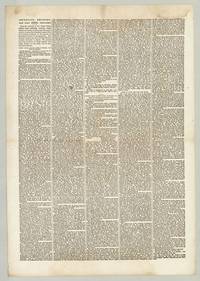
réf. 9066Georgia 1873. Broadside 18" x 12.75" text in five columns. CONDITION: Good old folds light dampstaining one small stain in the second column one tiny puncture at right margin and a small puncture at center causing losses to three letters. A scarce broadside concerning two Federal court decisions that upheld the selection of African American jurors in Georgia per the 14th and 15th Amendments. This broadside was published a day after the decision of Judge Joseph Bradley Associate Justice of the Supreme Court of the U.S. in the U.S. Circuit Court Southern District of Georgia regarding the mixed-race jury in the case of United States Vs. Appleton P. Collins of Macon Georgia "on indictment for violation of Enforcement Act." In 1872 Collins participated in a racially-fueled riot involving voter intimidation against African Americans at a Macon voting station that resulted in fatalities. Responding to "the argued motion to quash the indictment against Mr. A. B. Collins.on the ground of the illegal selection of the grand jury" Judge Bradley upholds an earlier decision delivered in Atlanta by Judge John Erskine of the U.S. Circuit Court in the Northern District of Georgia which calls for juries to be selected "without regard to race color or previous condition." The broadside reprints the decisions of Judges Bradley and Erskine both of which reject motions by white defendants arguing that the mixed-race juries in their respective trials were illegal. Prior to emancipation both enslaved and free African Americans were barred from testifying in court against whites an exclusion that the Black Codes passed by state governments across the South during Reconstruction sought to uphold by making it illegal for African Americans to serve on juries or testify against whites. These codes were countered by the Enforcement Acts 1870-71 which protected those contested rights and allowed Federal intervention in the event of states' failure to uphold them. Judge Bradley's recent decision is presented first. He opens by observing that U.S. courts are independent of state laws and that their processes and procedures are subject to the sole regulation of Congress and its courts. Bradley thus establishes the sovereignty of the Federal government over individual states in spite of the Black Codes. On the subject of selecting and empaneling jurors in the U.S. courts Bradley invokes the Congressional mandate that they be designated by lot "and that they should have the same qualification as required for jurors in the highest courts of the State"-a rule that has its precedent in the July 20 1840 Act of Congress 5 Stat. 394. Bradley states that conformity between Congress and state law concerning jury selection is required on two fronts: "first in reference to the qualifications and exemptions of jurors; secondly in reference to the mode of designating and empanelling jurors as by ballot lot or otherwise." In Georgia he continues the only qualifications of jurors are that "they shall be upright and intelligent jurors between the ages of 21 and 60" and-following an 1869 statute-that they be taxpayers. Officers-state or county officials-are to select from the body of the District 500 persons "without regard to race color or previous condition to serve as jurors" which is "in accord with the spirit of the Fourteenth and Fifteenth Amendments to the Constitution by which all persons born or naturalized in the United States are citizens and entitled to full equality before the laws." The broadside then reprints an earlier decision sustained by Bradley of Judge Erskine in the 1872 case United States vs. William Gardner on "indictment for violation of Revenue laws." Erskine writes: "Before the perusal of the panel comprised of six white persons and six colored the defendant challenged the array on the ground that the jury was illegally constituted and moved that it be quashed." By a rule of the U.S. District Court for this District that was adopted at the March term of 1871 the Marshal was instructed to select the "most upright and intelligent persons" without regard to race or color from the jury list of the county. Concerning the word "most" Erskine writes that the question is raised "by learned counsel on both sides" whether the word was "to apply to each class white or colored." He responds: "At most the word but expressed moral fitness as necessary to the end proposed." Of the nearly 1700 names forwarded to the Marshal 250 names were picked and "strange as it may appear every ballot drawn from the box contained the name of a white person." The ratio in this Judicial District of whites to Blacks is eight to five. Erskine comments: It is obvious to the common mind that that mode of designating or selecting these jurors cast the entire burden of jury service in the Federal Court upon one of the classes only- white citizens; thus released colored citizens who possessed the constitutional and statutory qualifications for jurors from the performance of a duty which they equally with the qualified white citizens owed to their country. Not only the Constitution of this State but the recent amendments to the National Constitution have made the colored man a citizen habilitating him with all the rights privileges and immunities enjoyed by the white citizen: therefore he should perform his part of the public labor. Erskine cites an 1872 amendment ordering that "each ballot shall be so rolled that neither the name nor the county can be seen. The ballots shall then be placed in the box and thoroughly mixed." It is noted that no property qualification is required in Georgia for an individual to serve as a juror. "To be 'white' was another qualification for a juror but this no longer exists-State Constitution supra." The broadside concludes with Erskine's examination of a number of other cases. The defendant in the first case Dr. Appleton P. Collins 1835-1886 was born in Macon Georgia and graduated from the Medical College of New Orleans immediately before the Civil War broke out. He enlisted in the 2nd Battalion Georgia Infantry Co. B in May 1861 and was discharged in September 1862 when he was approved to serve as an assistant surgeon for the Confederate Army. After the war he was appointed city physician for Macon. In 1872 the Georgia Weekly Telegraph Journal and Messenger reported a violent encounter between white and Black voters at a Macon voting station in which several people were killed. The white participants' intimidation tactics violated the Enforcement Act and evidently led to the case United States Vs. Appleton P. Collins. Witnesses quoted in the Telegraph article described the events as follows: The white and blacks had met and there seemed to be a great struggle at the polls as to which should vote. I called the attention of the gentleman to it and proposed to go down and draw away the blacks until arrangements could be made for voting. There were more blacks than whites-a great many more. The colored people were confined to the rear most of the morning but had made a sort of flank movement and were coming from two directions.The struggle between the men seemed to be to see which should get the polls .I was engaged at the time with a white man and a colored man who seemed struggling to see who should get on the terrace.That was Dr. Appleton Collins. He was in a fight with a negro.I saw a pistol between them. No examples recorded in OCLC but we find an example at the University of Georgia. A fascinating broadside offering insight into race relations as they pertained to jury selection for trials in Georgia during the Reconstruction era. REFERENCES: "Appleton P. Collins Macon City Physician" at Rose Hill Cemetery Macon Georgia online; Georgia Weekly Telegraph Journal and Messenger Macon November 5 1872 p. 3. [Georgia,] 1873 unknown