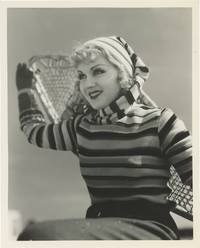
1962Best.-Nr. 5327New York: Photo Researchers Inc 1962. Striking photographic portrait of Ursula Andress in her role as Bond girl Honey Ryder in the 1962 film Dr. No. Taken by American photographer Bradley Smith 1910-1997 on location in Jamaica where shooting took place near Ian Fleming's Goldeneye estate and in the small town of Oracabessa. Original borderless double-weight black & white photograph measuring 24.75cm x 34.5cm 9.75" x 12 5/8"; a few holograph notes photographer's rubber-stamp Photo Researchers sticker and a typed snipe taped on verso reading: "DR. NO" - On location in Jamaica. Portrait of Ursula Andress young Swiss-born actress starring in "Dr. No." Light wear to extremities a few faint creases to corners; Very Good. Photo Researchers, Inc unknown
1905Best.-Nr. 29101New York: A. F. Bradley circa 1905-06 1905. Reside of tap in the outer margins of the sheet; slightly toned; in very good condition. A 22 x 15.5 cm image oval photographic portrait of William Dean Howells on a 31.5 x 21 cm sheet signed below the image by the photographer and Howells whose signature is dated April 8 1907. A fine photographic portrait of one of the great men of American letters William Dean Howells 1837-1920 by one of the prominent portrait photographers of New York society at the turn of the century Alvin F. Bradley. Bradley 1862-1948 and his Bradley Studio on Fifth Avenue capitalized on the popularity of portrait photography among the wealthy and fashionable. Wilson's Photographic Magazine published a profile of Bradley in its February 1906 issue in which this photograph of Howells was noted as an example of his "forceful portraits." Howells for his part loved the camera and being photographed. New York: A. F. Bradley, [circa 1905-06] unknown
1933Best.-Nr. 165905Los Angeles: Paramount Pictures 1933. Vintage publicity photograph of Grace Bradley by photographer Ray Jones circa 1933 with a studio stamp crediting photographer Jones and a mimeo snipe printed on the verso. From the archive of noted Hollywood still photographer Ray Jones. Born in Wisconsin on January 1 1901 Jones worked for Paramount Pictures in the early 1930s and went on to be the head of the still photography department at Universal Pictures in 1935 where he worked well into the 1950s. Grace Bradley was a stage and screen actress who made 35 film appearances from 1932 to 1943 and was one of the most popular musical stars of the 1930s. Among the films in which Bradley is best remembered includes "Too Much Harmony" 1933 "Six of a Kind" 1934 "Anything Goes" 1936 and "The Big Broadcast of 1938" 1938. Bradley married "Hopalong Cassidy" star William Boyd in 1937 and retired from acting in 1953. 8 x 10 inches. Near Fine. Paramount Pictures unknown
1933Best.-Nr. 165905Los Angeles: Paramount Pictures 1933. Vintage publicity photograph of Grace Bradley by photographer Ray Jones circa 1933 with a studio stamp crediting photographer Jones and a mimeo snipe printed on the verso. From the archive of noted Hollywood still photographer Ray Jones. Born in Wisconsin on January 1 1901 Jones worked for Paramount Pictures in the early 1930s and went on to be the head of the still photography department at Universal Pictures in 1935 where he worked well into the 1950s. Grace Bradley was a stage and screen actress who made 35 film appearances from 1932 to 1943 and was one of the most popular musical stars of the 1930s. Among the films in which Bradley is best remembered includes "Too Much Harmony" 1933 "Six of a Kind" 1934 "Anything Goes" 1936 and "The Big Broadcast of 1938" 1938. Bradley married "Hopalong Cassidy" star William Boyd in 1937 and retired from acting in 1953. 8 x 10 inches. Near Fine. Paramount Pictures unknown books
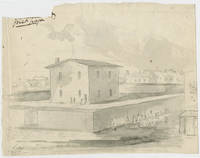
1418Best.-Nr. 53599Hampton Roads VA. October 14 1861. Original Sketch for Civil War HARPER'S WEEKLY A pencil sketch with watercolor shading depicting part of Fort Monroe Virginia drawn for potential publication in Harper's Weekly in October 1861 by Bradley S. Osbon freelance reporter and self-described "sailor of fortune" with his name signed on the lower left and on the verso. Osbon made several written and illustrated contributions to Harper's Weekly including reporting on the construction of the ironclad Monitor also from Fort Monroe. The fort at the southern tip of the Virginia peninsula remained under Union control throughout the war and was used as prison for captured Confederate soldiers and as a refuge for fugitive slaves. Encapsulated. Upper left corner torn away obscuring manuscript ink annotation. Contemporary pencil annotation on verso. Light dust soiling and an occasional fox mark. About very good. unknown
1418Best.-Nr. 53599Hampton Roads VA. October 14 1861. Original Sketch for Civil War HARPER'S WEEKLY A pencil sketch with watercolor shading depicting part of Fort Monroe Virginia drawn for potential publication in Harper's Weekly in October 1861 by Bradley S. Osbon freelance reporter and self-described "sailor of fortune" with his name signed on the lower left and on the verso. Osbon made several written and illustrated contributions to Harper's Weekly including reporting on the construction of the ironclad Monitor also from Fort Monroe. The fort at the southern tip of the Virginia peninsula remained under Union control throughout the war and was used as prison for captured Confederate soldiers and as a refuge for fugitive slaves. Encapsulated. Upper left corner torn away obscuring manuscript ink annotation. Contemporary pencil annotation on verso. Light dust soiling and an occasional fox mark. About very good. unknown books
Best.-Nr. 62647305MacMillan . Hardback. New. pp. 216 MacMillan hardcover
Best.-Nr. 12276130-nnew. unknown
Best.-Nr. 12276130like new. unknown
2011Best.-Nr. x-0230576923Palgrave Macmillan 2011. Hardcover. New. 1st edition. 202 pages. 9.00x5.75x0.75 inches. Palgrave Macmillan hardcover
Best.-Nr. 0230576923.Ghardcover. Good. Access codes and supplements are not guaranteed with used items. May be an ex-library book. hardcover
2011Best.-Nr. DADAX0230576923MACMILLAN 2011-05-27. 2011. hardcover. New. 5.60x0.80x8.50. Buy with confidence. Excellent Customer Service & Return policy. MACMILLAN hardcover
Best.-Nr. 0975558579.Ghardcover. Good. Access codes and supplements are not guaranteed with used items. May be an ex-library book. hardcover
2008Best.-Nr. Q-0765320002Tor Books 2008-08-05. Paperback. New. In shrink wrap. Looks like an interesting title! Tor Books paperback
Best.-Nr. B9783036524504Hardback. New. hardcover
1996Best.-Nr. Q-0963586173Kennesaw Mountain Press 1996-04-01. Paperback. New. In shrink wrap. Looks like an interesting title! Kennesaw Mountain Press paperback
1996Best.-Nr. 82758Kennesaw GA: Kennesaw Mountain Press in association with Medical Staff Press L.L.C. 1996. Presumed First Edition First printing thus. Trade paperback. Good. Format is approximately 8.5 inches by 11 inches. 76 pages. Illustrations. Cover has some wear and a chip at the bottom front edge. The Civil War was a major impetus for the development of the Orthopedic specialty. The work presents a Preface Introduction Background a multi-part section on Anatomical Regions and an End Matter section which includes Glossary End Notes Bibliography Index of Text Index of Cases Index of Tables and information about the authors. A Minnesota native Dr. Kuz specializes in hand surgery including reconstruction after trauma and arthritis children's hand conditions and problems and surgery of the wrist elbow and shoulder. Joint replacement and sports injuries are also areas of special attention for Dr. Kuz. He has authored numerous scientific articles a book chapter and two books on Civil War medicine. He was elected by his peers for inclusion in Best Doctors in America consecutively since 1996 and selected as Grand Rapids "Best Plastic Surgeon" by Grand Rapids Magazine for the past 10 years. Dr. Brad Bengtson is a board-certified plastic surgeon in Michigan dedicated to helping his patients achieve the surgical or non-surgical results they desire. His reputation for excellence state-of-the-art techniques and compassion have created a large following of patients seeking to reduce the effects of aging. He has a passion for making a difference in the lives of patients. With his surgical expertise and over 20 years of plastic surgery experience Dr. Bengtson travels the world educating plastic surgeons on his innovative procedures and techniques. Extracted from a discussion on the web on Civil War wounded Essential Civil War Curriculum by Glenna R. Schroeder-Lein 2018. It is important to examine the nature and effects of wounds since one-third of Civil War deaths resulted directly from these wounds and many more soldiers suffered non-fatal but permanently damaging injuries. The chief sources of battlefield wounds were artillery ammunition and bullets. Those most likely to be killed in battle were men hit directly by artillery projectiles of any sort and those suffering a piercing wound in the head or trunk of the body. Most soldiers shot in the extremities were not immediate fatalities unless their limb was blown off or they were wounded in a major artery. Severe damage to arms and legs made amputation the treatment of choice in such cases. However most wounds were not so severe and did not require amputation. Far more surgeries consisted of cleaning and stitching wounds as well as removing bullets and bone fragments. Out of 174206 known wounds of the extremities treated by Union surgeons nearly 30000 wounded soldiers had amputations with approximately a twenty-seven percent fatality rate. Historians estimate that there were some 25000 Confederate amputations with a similar fatality rate. In some cases surgeons on both sides performed resections or excisions the terms were interchangeable removing several inches of shattered bone or a mangled joint. These surgeons attempted to avoid amputation when only the bone and muscles not the nerves and arteries of the limb were damaged. This shortened the limb but often left some function. Because the surgery weakened the limb it was more often performed on arms than legs. Union surgeons performed at least 4656 resections or excisions but these operations had a higher fatality rate than amputations. When a soldier sustained a battle wound his initial treatment depended on the severity of the wound and his location on the battlefield. If the wound was minor the soldier could walk to the nearest first aid station for bandaging and then return to the battle but the more severely wounded had to be removed from the field. Field hospitals were established as close to the battlefield as possible without being in artillery range or at risk of capture. Here doctors removed bullets cleaned and bandaged wounds and performed amputations as necessary. Nearly all surgeries North and South were performed with anesthesia either chloroform or ether although chloroform was preferred. Kennesaw Mountain Press in association with Medical Staff Press, L.L.C. paperback
Best.-Nr. 148361Used. For more details please contact me unknown
Best.-Nr. 6203326623.Gpaperback. Good. Access codes and supplements are not guaranteed with used items. May be an ex-library book. paperback
Best.-Nr. 26104709-nnew. unknown
Best.-Nr. 26104709like new. unknown
Best.-Nr. B9780128044568Paperback / softback. New. paperback
Best.-Nr. A9780128044568Paperback / softback. New. paperback
Best.-Nr. 0267722354.Ghardcover. Good. Access codes and supplements are not guaranteed with used items. May be an ex-library book. hardcover
Best.-Nr. 1333542232.Gpaperback. Good. Access codes and supplements are not guaranteed with used items. May be an ex-library book. paperback