"KIERKEGAARD, SØREN.Livre Rare Book

1 907 résultats
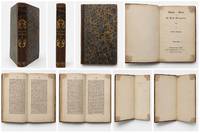
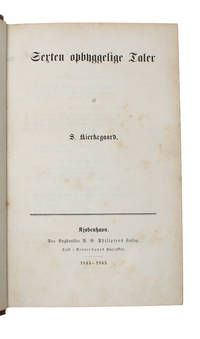
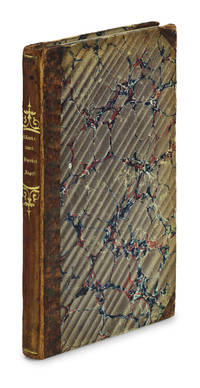
1843réf. 53093Kjøbenhavn [Copenhagen], 1843-1845. 8vo. Near contemporary half calf with richly gilt spine. Binding with very light wear. Front free end-paper with the ownership-inscription of Michael Bentzon and his acquisition date of 1855 (the same year that Kierkegaard died). Some brownspotting here and there and the first couple of leaves of ""To opbyggelige Taler, 1844"" with a damp stain. Neat underlinings in the text as well as several marginalia, mostly in pencil. A very good copy indeed. (IV), 52, 62, 84, 59, 70, 111pp. Complete with all the half-titles and the joint title-page (without the blank leaf after the preface of ""To opbyggelige Taler, 1844"" - which is not called for and hardly ever present).
1843réf. 53093Kjøbenhavn Copenhagen 1843-1845. 8vo. Near contemporary half calf with richly gilt spine. Binding with very light wear. Front free end-paper with the ownership-inscription of Michael Bentzon and his acquisition date of 1855 the same year that Kierkegaard died. Some brownspotting here and there and the first couple of leaves of "To opbyggelige Taler 1844" with a damp stain. Neat underlinings in the text as well as several marginalia mostly in pencil. A very good copy indeed. IV 52 62 84 59 70 111pp. Complete with all the half-titles and the joint title-page without the blank leaf after the preface of "To opbyggelige Taler 1844" - which is not called for and hardly ever present. First edition of Kierkegaard's important Eighteen Upbuilding Discourses which comprise his two three and four upbuilding discourses from the years 1843-45 with the joint title-page of all eighteen. The work constitutes Kierkegaard's religious works which supplement his theological and philosophical ones.The first upbuilding discourses were published the same year as Either-Or and it is interesting to note that in opposition to his major philosophical works the religious upbuilding discourses actually bear the name of the author on the title-page -a fact that was by no means incidental. While the pseudonymous works could make one doubt the religiousness of the author the parallelly written religious discourses stress the fact that we are dealing with an author who was religious from the very beginning -a fact that Kierkegaard also wished to underline himself; in his journals he clearly states that the religious discourses bear as much significance for his work as a whole as do the larger pseudonymous works "I began with "Either-Or" and two upbuilding discourses." he says and explains that he intended the upbuilding the religious to advance and that he wanted to show "that the writer was not an esthetic author who in the course of time grew older and for that reason became religious" Journals IX A 227.The importance of the upbuilding discourses and the close relationship they have with the major works and Kierkegaard's philosophical development is also stressed by the fact that every pseudonymous work was accompanied by a little collection of "upbuilding discourses" until "Concluding Postscript" appeared.Himmelstrup 85. unknown
1843réf. 8Either/Or Danish: Enten – Eller is the first published work of Danish philosopher Søren Kierkegaard. Volume 2 only. First edition. First printing. C.A. Reitzel Kjøbenhavn. 1843. Very good condition for an 1843 edition. Bound in an attractive contemporary half leather binding with marbled paper-covered boards. The binding is solid and structurally sound with moderate rubbing and wear to the spine corners and board edges consistent with age. The text block is complete and firmly attached. Pages are clean and fully legible showing expected age toning with occasional light foxing and minor staining. Blank endpapers display old pencil ownership or catalogue annotations and some dampstaining near the corners. No significant tears or loss of text were observed. Overall a well-preserved and highly presentable copy with an attractive period binding retaining its historical character. C.A. Reitzel, hardcover
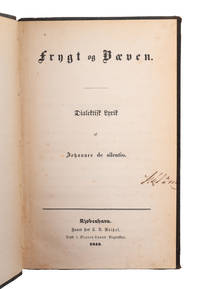
1843réf. 62092Kjøbenhavn, 1843. 8vo. Contemporary dark brown half cloth with gilt lettering to spine. Capitals and a bit of the front hinge worn, but overall very nice and tight. Internally a bit of brownspotting (as always due to the quality of the paper), but less than usual. Old owner's signature to title-page. VIII, 135 pp.
1843réf. 62092Kjøbenhavn 1843. 8vo. Contemporary dark brown half cloth with gilt lettering to spine. Capitals and a bit of the front hinge worn but overall very nice and tight. Internally a bit of brownspotting as always due to the quality of the paper but less than usual. Old owner's signature to title-page. VIII 135 pp. First edition of one of Kierkegaard's most important and sought-after works Fear and Trembling which is rather more difficult to find than most of his other works. Fear and Trembling is one of Kierkegaard’s most important works. And it is also one of his most difficult. It deals – in forceful brevity – with the relationship between reason and faith and provides us with Kierkegaard’s most thorough exposition of the religious stage which he considered the most meaningful form of existence. It is here that Kierkegaard introduces the “tragic hero” and contrasts it to the “Knight of Faith” who both ignore their own wishes for a higher good. These two essential figures epitomize the ethical and the religious and pave the way for the understanding of these stages in Kierkegaard’s philosophy. It is arguably also here that the idea of the essential leap of faith is introduced for the first time. The Knight of Faith sacrifices his son at the command of God and thus sets aside an ethical demand in in order to attain a higher goal that exists beyond the ethical. This teleological suspension of the ethical requires a leap of faith that is only possible through faith in virtue of the absurd. Himmelstrup 48. hardcover
1841(Copenhagen), 1841-1846. Lex 8vo. Bound in three contemporary uniform black full cloth bindings with gilt lettering and numbering to spines. Extremities a bit worn and hinges a bit weak. Some brownspotting. Overall a pretty good set. Richly illustrated throughout, both in the text and with plates.
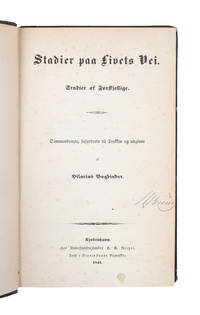
1845réf. 62096Kjøbenhavn [Copenhagen], 1845. Lex8vo. Nice contemporary brown half cloth with gilt title to spine. Capitals worn and wear along upper front hinge. Corners worn. In spite of the wear, an attractive and tight copy. First and last leaves with a bit of brownspotting, otherwise only light occasional spotting. Old owner's signature to title-page. VIII, 383 pp.
1845réf. 62096Kjøbenhavn Copenhagen 1845. Lex8vo. Nice contemporary brown half cloth with gilt title to spine. Capitals worn and wear along upper front hinge. Corners worn. In spite of the wear an attractive and tight copy. First and last leaves with a bit of brownspotting otherwise only light occasional spotting. Old owner's signature to title-page. VIII 383 pp. First edition of one of Kierkegaard's main works "Stages on Life's Way" his pivotal sequal to his main work "Either-Or" in which he had presented the first two stages the aesthetic and the ethical. In "Stages on Life's Way" he continues his work on these stages and moves on to present also the religious stage which takes up ab. two thirds of the work. The religious stage is that in which man attains a personal relationship with God and that in which man only truly begins to exist as the aesthetic and ethical stages are inadequate. It is in this foundational work in the religious stage that Kierkegaard first properly describes what is now known as the "Leap of Faith" in fact a "leap to faith" namely the leap that involves willing and belief in stead of reason and knowledge the leap that you make in order to connect to God and which requires that which he calls "the suspension of the ethical". Stages on Life’s Way is one of Kierkegaard’s most important works. Not only does it sum up and explain some of the most important themes of Kierkegaard’s previous works utilizing the characters and pseudonymous authors of the earlier works to do so; it goes beyond these foundational themes introduces the religious stage and points to the further development of the central themes in Kierkegaard’s philosophy most of which are only fully developed in Concluding Unscientific Postscript. hardcover
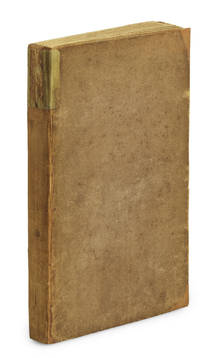
1841réf. 62112Kjøbenhavn, P.G. Philipsens Forlag, 1841. 8vo. (4), 350 pp., 1 f. (blank), 2 pp. (advertisements). Completely uncut and partly unopened in the original brown cardboard binding. Rebacked with paper perfectly matching that of the boards. Corners restored. Title-page evenly browned and a few leaves with a bit of brownspotting, but overall in unusually nice condition, clean, fresh, and bright. Completely unmarked.
1841réf. 62112Kjøbenhavn P.G. Philipsens Forlag 1841. 8vo. 4 350 pp. 1 f. blank 2 pp. advertisements. Completely uncut and partly unopened in the original brown cardboard binding. Rebacked with paper perfectly matching that of the boards. Corners restored. Title-page evenly browned and a few leaves with a bit of brownspotting but overall in unusually nice condition clean fresh and bright. Completely unmarked. A fabulous copy of the first edition of Kierkegaard’s dissertation here in the original binding which is of the utmost scarcity. We have only seen it in this state once before. And of all the copies we have handled of the Irony over the last decades we have only once before come across a copy with the advertisement-leaf in the back. This is virtually never present. This completely uncut copy is approximately 1 cm taller and wider than regular copies. The spines of the original Kierkegaard cardboard bindings are always just thin paper directly glued on the block making them extremely fragile especially on the thicker volumes. If one finds these original bindings the spines are almost always more or less disintegrated. Kierkegaard's dissertation constitutes the culmination of three years’ intensive studies of Socrates and “the true point of departure for Kierkegaard’s authorship” Brandes. The work is of the utmost importance in Kierkegaard’s production not only as his first academic treatise but also because he here introduces several themes that will be addressed in his later works. Among these we find the question of defining the subject of cognition and self-knowledge of the subject. The maxim of “know thyself” will be a constant throughout his oeuvre as is the theory of knowledge acquisition that he deals with here. The dissertation is also noteworthy in referencing many of Hegel’s theses in a not negative context something that Kierkegaard himself would later note with disappointment and characterize as an early uncritical use of Hegel. Another noteworthy feature is the fact that the thesis is written in Danish which was unheard of at the time. Kierkegaard felt that Danish was a more suitable language for the thesis and hadto petition the King to be granted permission to submit it in Danish rather than Latin. This in itself poses as certain irony as the young Kierkegaard was known to express himself poorly and very long-winded in written Danish. One of Kierkegaard’s only true friends his school friend H.P. Holst recounts in 1869 how the two had a special school friendship and working relationship in which Kierkegaard wrote Latin compositions for Holst while Holst wrote Danish compositions for Kierkegaard who “expressed himself in a hopelessly Latin Danish crawling with participial phrases and extraordinarily complicatedsentences” Garff p. 139. When Kierkegaard in 1838 was ready to publish his famous piece on Hans Christian Andersen see nr. 1 & 2 above which was to appear in Heiberg’s journal Perseus Heiberg had agreed to publish the piece although he had some severe critical comments about the way and the form in which it was written – if it were to appear in Perseus Heiberg demanded at the very least the young Kierkegaard would have to submit it in a reasonably readable Danish. “Kierkegaard therefore turned to his old schoolmate H. P. Holst and asked him to do something with the language…” Garff p. 139. From their school days Holst was well aware of the problem with Kierkegaard’s Danish and he recounts that over the summer he actually “translated” Kierkegaard’s article on Andersen into proper Danish. The oral defense was conducted in Latin however. The judges all agreed that the work submitted was both intelligent and noteworthy. But they were concerned about its style which was found to be both tasteless long-winded and idiosyncratic. We already here witness Kierkegaard’s idiosyncratic approach to content and style that is so characteristic for all of his greatest works. Both stylistically and thematically Kierkegaard’s and especially a clear precursor for his magnum opus Either-Or that is to be his next publication. The year 1841 is a momentous one in Kierkegaard’s life. It is the year that he completes his dissertation and commences his sojourn in Berlin but it is also the defining year in his personal life namely the year that he breaks off his engagement with Regine Olsen. And finally it is the year that he begins writing Either-Or. In many ways Either-Or is born directly out of The Concept of Irony and is the work that brings the theory of Irony to life. Part One of the dissertation concentrates on Socrates as interpreted by Xenophon Plato and Aristophanes with a word on Hegel and Hegelian categories. Part Two is a more synoptic discussion of the concept of irony in Kierkegaard’s categories with examples from other philosophers. The work constitutes Kierkegaard’s attempt at understanding the role of irony in disrupting society and with Socrates understood through Kierkegaard we witness a whole new way of interpreting the world before us. Wisdom is not necessarily fixed and we ought to use Socratic ignorance to approach the world without the inherited bias of our cultures. With irony we will be able to embrace the not knowing. We need to question the world knowing we may not find an answer. The moment we stop questioning and just accept the easy answers we succumb to ignorance. We must use irony to laugh at ourselves in order to improve ourselves and to laugh at society in order to improve the world. The work was submitted to the Philosophical Faculty at the University of Copenhagen on June 3rd 1841. Kierkegaard had asked for his dissertation to be ready from the printer’s in ample time for him to defend it before the new semester commenced. This presumably because he had already planned his sojourn to Berlin to hear the master philosopher Schelling. On September 16th the book was issued and on September 29th the defense would take place. The entire defense including a two hour long lunch break took seven hours during which ”an unusually full auditorium” would listen to the official opponents F.C. Sibbern and P.O. Brøndsted as well as the seven “ex auditorio” opponents F.C. Petersen J.L. Heiberg P.C. Kierkegaard Fr. Beck F.P.J. Dahl H .J.Thue og C.F. Christens not to mention Kierkegaard himself. Two weeks later on October 12th Kierkegaard broke off his engagement with Regine Olsen for the implications of this event see the section about Regine in vol. II. The work appeared in two states – one with the four pages of “Theses” for academics of the university whereas the copies without the theses were intended for ordinary sale. These sales copies also do not have “Udgivet for Magistergraden” and “theologisk Candidat” on the title-page. The present copy is one of the sales-copies without theses. Himmelstrup 8 The present copy is no. 11 in Girsel's "Kierkegaard" The Catalogue which can be found here. hardcover
1836Kjøbenhavn [i.e. Copenhagen], 1836. Large 4to. I: Loose, as issued, unbound. With a horizontal and a vertical crease down the middle. 4 pp. II: Loose, as issued, unbound, but inserted into a simple paper folder (small 8vo). With a horizontal and a vertical crease down the middle. 4 pp. + 4 pp. III: Loose, as issued, unbound, but inserted into a simple paper folder (small 8vo). With a horizontal and a vertical crease down the middle. 4 pp.
1843réf. 61020Kjøbenhavn, P.G. Philipsens Forlag, 1843 - 45. 8vo. Nice contemporary half calf with gilding to spine. Slight wear to capitals and corners and spine a little spotted. Overall very nice. Some leaves with brownspotting, but also internally nicer and fresher than usual. Contemporary owner's inscription to front free end-paper, dated 1854. A very nice copy. (4), 6284 59 (including the blank leaf between the title-page and the preface) 70, (2, - i.e. 1 blank f.)" 111 pp.
1843réf. 61020Kjøbenhavn P.G. Philipsens Forlag 1843 - 45. 8vo. Nice contemporary half calf with gilding to spine. Slight wear to capitals and corners and spine a little spotted. Overall very nice. Some leaves with brownspotting but also internally nicer and fresher than usual. Contemporary owner's inscription to front free end-paper dated 1854. A very nice copy. 4 62; 84; 59 including the blank leaf between the title-page and the preface; 70 2 - i.e. 1 blank f.; 111 pp. Very rare first edition of this Kierkegaard-title which is without doubt the most difficult to get hold of. "Sixteen Upbuilding Discourses" consists of the popular Two Three and Four Upbuilding Discourses. The unsold copies of these "Opbyggelige Taler" "Upbuilding Discourses" were initially collected under the title "Atten opbyggelige Taler" Eighteen Upbuilding Discourses and published with a collected title-page; when "To opbyggelige Taler" "Two Upbuilding Discourses" from 1843 was sold out the remaining sixteen upbuilding discourses were published with the title-page "Sexten opbyggelige Taler". The number of copies of this scarce title is said to be well under 100 and is thus by far the rarest of all of Kierkegaard's books. unknown
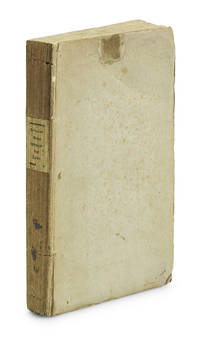
1843réf. 62941Kjøbenhavn, Philipsen, 1843-45. 8vo. (4), 52 + 62 (+ 1 blank leaf) + 84 + 59 (including the blank leaf between the title-page and the preface!) + 70 (+ 1 blank leaf) + 111 pp. Completely uncut in the original brownish grey boards with original printed title-label to spine (fully intact). Boards a bit brownspotted and a larger damp stain to top of front board. A couple of smaller stains (lacquer or wax) to spine. A few horizontal creases to spine with paper almost invisibly glued back on to hold tight. Occasional brownspotting, mostly to the first and last leaves. But overall splendidly preserved.
1849réf. 62135Kjøbenhavn, Reitzel, 1849. 8vo. XIV, (2), 320" (4), 250 pp + final blank. Both volumes in one – the original blue cardboard binding (“hollanderet bind”) with the original printed paper title-label (preserved in its entirety) to the spine. Slight loss to the paper to upper capital and to lower front hinge, but amazingly well preserved, fresh, and crisp. Completely uncut (23,5 x 14,5 cm., making it ab. 1,5 + 1 cm larger than other well margined copies). Some brownspotting (as always), mostly quite light. Old owner’s name to inside of front board. Housed in a beautiful marbled paper box with a richly gilt red Morocco spine. The gilding is in the style of Kierkegaard’s most lavishly decorated full calf bindings and with the title in gilt Gothic lettering. The box is signed “Anker Kysters Efterf. And the gilding by Hagel Olsen. Front board with the gilt super ex libris of the previous owner.
1843réf. 62941Kjøbenhavn Philipsen 1843-45. 8vo. 4 52 62 1 blank leaf 84 59 including the blank leaf between the title-page and the preface! 70 1 blank leaf 111 pp. Completely uncut in the original brownish grey boards with original printed title-label to spine fully intact. Boards a bit brownspotted and a larger damp stain to top of front board. A couple of smaller stains lacquer or wax to spine. A few horizontal creases to spine with paper almost invisibly glued back on to hold tight. Occasional brownspotting mostly to the first and last leaves. But overall splendidly preserved. A truly magnificent copy of the first edition of this very scarce Kierkegaard-title in completely original condition with all of the original printed title-label preserved and fully complete with the joint title-page contents all the half-titles dedications blanks etc. This Kierkegaard-title is rare in itself with much less than 278 copies printed in all but it is utterly amazing to find this exceedingly rare book in original state like here. Only very few copies are left in the original binding which we have only seen once before. The spines of the original Kierkegaard cardboard bindings are always just thin paper directly glued on the block making them extremely fragile. If one finds these original bindings the spines are almost always more or less disintegrated. The present copy is a rare exception that furthermore has the original title-label which is of the utmost scarcity. To our knowledge only one other copy in the original binding has been located. Apart from the other copy we have seen of this work in the original binding the present copy is also the only original Kierkegaard-binding we have seen that is not in the usual blue “hollanderet” cardboard binding but plain brown. No other such copy has been registered for sale and no other such copy to our knowledge is registered in any institution. Furthermore this seems to be the only copy to have surfaced so far which has preserved the original printed title-label in its entirety. As far as we know it has been recorded no-where due to its extreme scarcity. Kierkegaard’s Upbuilding or Edifying Discourses were published over the course of two years in 1843 and 1844. In all 18 Upbuilding Discourses were published divided over six publications namely: Two Upbuilding Discourses from 1843 Three Upbuilding Discourses from 1843 Four Upbuilding Discourses from 1843 Two Upbuilding Discourses from 1844 Three Upbuilding Discourses from 1844 Four Upbuilding Discourses from 1844 Each of these publications accompanied one of the main pseudonymous works beginning with Either-Or in 1843. As opposed to his major philosophical works the religious upbuilding discourses actually bear the name of the author on the title-page. Of course this was by no means incidental. While the pseudonymous works could raise the question of the religiousness of the author the parallelly written religious discourses stress the fact that we are dealing with an author who was religious from the very beginning – an essential fact that Kierkegaard wished to stress for those interested in his authorship. In his journals Kierkegaard clearly states that the religious discourses are as significant in his oeuvre as a whole as are the larger pseudonymous works “I began with “Either-Or” and two upbuilding discourses.” he says and explains that he intended the upbuilding the religious to advance and that he wanted to show “that the writer was not an aesthetic author who in the course of time grew older and for that reason became religious”. Journals IX A 227. He was religious all along also during all of the major philosophical publications that were not written in his name. The fact that every major pseudonymous work – up until Concluding Unscientific Postscript appeared and revealed the identity of the real author – was accompanied by one of these small Upbuilding Discourses bears testament to the pivotal role they play in Kierkegaard’s philosophical development. Furthermore while Kierkegaard could not present anyone with copies of his pseudonymous works as explained above he could indeed give away presentation-copies of his accompanying Upbuilding Discourses which he then did. The Upbuilding Discourses are particularly interesting in several regards one being that it is in the course of the printing of these that Kierkegaard changes his publisher. Ever since Kierkegaard had chosen to publish his first book himself he had had his books on commission with the leading Copenhagen publisher Reitzel the sole exception being his thesis the Irony. That was also the case with Two Upbuilding Discourses from 1843. But for some reason the following five publications of Upbuilding Discourses did not appear with Reitzel but with P.G. Philipsen instead. We do not know the exact reason for this change in publishers as the commission was exactly the same for the two. Whereas Two Upbuilding Discourses from 1843 had sold relatively well the Three and Four Upbuilding Discourses from 1843 did not sell well. A mere 102 and 104 copies respectively out of a commission issue of 300 were sold. In an attempt at making money on these discourses in spite of the poor sales numbers Philipsen offers to buy the unsold copies of Two Upbuilding Discourses from 1843 buys a sales issue of 300 copies of the Two Upbuilding Discourses from 1844 and makes the same agreement with Kierkegaard for the following two Discourse-publications. Sales numbers are still poor however and in the spring of 1845 only ca 100 copies of each of the 1844 Discourse publications have been sold. The printing issue of each was about 500 and Philipsen’s sales issue 300; thus both Philipsen and Kierkegaard had large numbers of each Discourse-publication left and in May 1845 they make a new deal. Philipsen buys the remainder issues of all six Discourse-publications including the 278 copies of Two Upbuilding Discourses from 1843 from Reitzel. Philipsen has a joint title-page printed along with a contents-leaf and now issues the seminal Kierkegaard-publication that is no. 85 in the bibliography Himmelstrup namely Eighteen Upbuilding Discourses – all six publications constituting all eighteen Upbuilding Discourses collected in one book. Seeing that there were 278 copies left of the Two Upbuilding Discourses from 1843 a maximum of 278 copies of Eighteen Upbuilding Discourses can have been made making it one of the scarcest Kierkegaard-books. The actual number is certainly lower than 278 though probably quite a bit lower seeing that Philipsen continued to sell the separate publications all copies of which he then evidently did not include in the Eighteen Upbuilding Discourses. The individual pamphlets of course are even scarcer with a maximum of 232 copies of Two Upbuilding Discourses from 1843 and somewhere between 100 and 150 copies of the others. We know from the Erindringsbog fra Bianco Luno 1844 that Kierkegaard had 506 copies of Four Upbuilding Discourses 1844 printed six of them on fine paper for presentation. Seeing that we have already established the clear thread of identity throughout all six publications we must assume that the other pamphlets were printed in the same numbers. And we have the record of the remainder issues that Philipsen buys in 1845 which lets us conclude of the Upbuilding Discourses that by that time 222 copies of Two 1843 139 copies of Three 1843 130 copies of Four 1843 120 copies of Two 1844 92 copies of Three 1844 96 copies of Four 1844 were sold out of the total number of original issues. In other words these are extremely scarce. Not least in the original wrappers or bindings. The scarcest Kierkegaard-title that exists however will be found in the continuation of the printing history of the Upbuilding Discourses. It is the mythically rare title of Sixteen Upbuilding Discourses which Philipsen issued in 1852 when the Two Upbuilding Discourses had been sold out and it was no longer possible to collect Eighteen Upbuilding Discourses. Thus Philipsen had yet another title-page printed this time with Sixteen Upbuilding Discourses as the title and the year 1843-45 on it along with a new index-leaf; he issued this the scarcest of all Kierkegaard-titles in March 1852. “It is not known how large the issue was but it cannot have been more than 83 seeing that that was what was left of Three Upbuilding Discourses from 1843.” Tekstspejle p. 54 translated from Danish. The idea of the Eighteen Upbuilding Discourses let alone the Sixteen was not Kierkegaard’s. He had agreed to the Eighteen but it was not his intended project with the Upbuilding Discourses. Therefore he wished for the book not to be reviewed and he naturally did not give away any copies of the Eighteen Upbuilding Discourses and of course not the Sixteen either only the individual pamphlets. In all seven presentation-copies of the different Upbuilding Discourses are registered all being for either Heiberg or Nielsen. Curiously neither Eighteen nor Sixteen Upbuilding Discourses were to be found in Kierkegaard’s book collection after his death. All the individual pamphlets were however along with a copy of the first nine Upbuilding Discourses – i.e. the three publications from 1843 – bound together. For more on the conundrum of the actual number of copies of the Upbuilding Discourses see the Preface by Flemming Chr. Nielsen in Girsel’s Kierkegaard-catalogue p. 19. Himmelstrup 85 hardcover
1849réf. 62135Kjøbenhavn Reitzel 1849. 8vo. XIV 2 320; 4 250 pp final blank. Both volumes in one – the original blue cardboard binding “hollanderet bind” with the original printed paper title-label preserved in its entirety to the spine. Slight loss to the paper to upper capital and to lower front hinge but amazingly well preserved fresh and crisp. Completely uncut 235 x 145 cm. making it ab. 15 1 cm larger than other well margined copies. Some brownspotting as always mostly quite light. Old owner’s name to inside of front board. Housed in a beautiful marbled paper box with a richly gilt red Morocco spine. The gilding is in the style of Kierkegaard’s most lavishly decorated full calf bindings and with the title in gilt Gothic lettering. The box is signed “Anker Kysters Efterf. And the gilding by Hagel Olsen. Front board with the gilt super ex libris of the previous owner. A truly magnificent copy of the second issue of Either-Or truly splendidly preserved in completely original condition. The spines of the original Kierkegaard cardboard bindings are always just thin paper directly glued on the block making them extremely fragile especially on the thicker volumes as Enten-Eller and Afsluttende uvidenskabelig Efterskrift. If one finds these original bindings the spines are almost always more or less disintegrated and the original paper-labels are hardly ever preserved. Here we not only have an extremely well-preserved copy with very little of the paper missing of an original binding on the bulkiest Kierkegaard-title there is with the original printed paper title-label preserved in its entirety we have the second issue of Either-Or in its completely original condition bound in one volume as evidently it came from the publishers. This is an extreme rarity! Over the decades we have been able to locate two copies of the first edition of Either-Or in the original bindings but we have never come across a copy of the seminally important second issue in the original binding. This is possibly a unique preservation. Kierkegaard’s magnum opus Either-Or is considered the foundational work of existentialism and doubtlessly the most famous work by the greatest Scandinavian philosopher of all times who "is now generally considered to be however eccentric one of the most important Christian philosophers" PMM 314. Kierkegaard's monumental magnum opus seminally influenced later as well as contemporary philosophy and ranks as one of the most important works of philosophy of modern times. Either-Or is the earliest of Kierkegaard’s major works and the work with which he begins his pseudonymous authorship. Kierkegaard’s pseudonymity is an entire subject unto its own. The various cover names he uses play a significant role in his way of communicating and are essential to the understanding of his philosophical and religious messages. And it all properly begins here with his groundbreaking magnum opus. Conjuring up two distinctive figures with diverging beliefs and modes of life – the aesthetic “A” of Part One and the ethical B note that this is the first “pseudonym” that Kierkegaard uses in his earliest articles – no. I above/Judge Vilhelm of Part Two Kierkegaard presents us with the most basic reflections on the search for a meaningful existence seen from two completely different philosophical views. This masterpiece of duality explores the foundational conflict between the ethical and the aesthetical providing us along the way with the now so famous contemplations on music Mozart drama boredom pleasures virtues and probably most famously seduction and rejection – The Seducer’s Diary. It is primarily Judge Vilhelm from Part Two of Either-Or that has bestowed upon Kierkegaard the reputation as the Father of Existentialism. His emphasis on taking ownership of oneself and the importance of making choices has made him the first personification of Existentialism and the idea that one does not passively develop into the self that he or she should be or ought to become. Kierkegaard went to great lengths to ensure that the public would not know the identity of the author was of Either-Or. He even had the draft of the work done by several hands so that employees at the printer’s would also be deceived. Despite his efforts however it did not take long for the public to guess that Kierkegaard had written this astounding work. But Kierkegaard himself kept up the façade and did not accept authorship until several years later. Nothing Kierkegaard did was left to chance which his carefully chosen pseudonyms also reflect. This also spills over in his presentation-inscriptions which follow as strict a pattern as the pseudonyms themselves – he never signed himself the author if his Christian name was not listed as the author on the title-page. And seeing that he had not accepted authorship of Either-Or and is not mentioned by name anywhere on the title-page also not as the editor nor publisher as with the other pseudonymous works he was not able to give away copies of his magnum opus which is why no presentation-copy of the first edition exists. The appearance of the second edition of this monumental work was naturally carefully planned. Either-Or first appeared in 1843 and due to the great demand for the work which had originally only been printed in ca 525 copies it had quickly been sold out; but Kierkegaard refused to have it reprinted. In 1849 finally he decided to let it appear again in a textually unchanged version. When the second edition appeared recte second issue Kierkegaard had meanwhile owned up to the authorship of Either-Or. He had done so in 1846 in his Concluding Unscientific Postscript to The Philosophical Fragments own translation: “For the sake of manners and etiquette I hereby acknowledge what can hardly in reality be of interest to anybody to know that I am as one says the author of Either-Or Victor Eremita Copenhagen in February 1843.”. Now finally Kierkegaard could give away his magnum opus! In his Papers from 1849 Kierkegaard states own translation: “The poets here at home each received a copy of Either-Or. I thought it my duty; and now I was able to do it; because now one cannot reasonably claim that a conspiracy is made concerning the book. -because the book is now old and its crisis over. Of course they were given the copy from Victor Eremita.” Pap. X1A 402. Naturally because “as little as I in Either-Or is the Seductor or the Assessor as little am I the publisher Victor Eremita exactly as little; he is a poetically-real subjective thinker as he is also found in “in vino veritas.” “ the postscript to the Postscript 1846 But he only sent few copies to very choice people fewer than he did most of his other works and only three copies have been identified to Henrik Hertz Christian Winther and Hans Christian Andersen. Three further copies in gift-bindings corresponding to these have been identified but in these copies the leaf with the presentation-inscription has also been torn out. He must have given away yet another copy – one presumably not being on vellum-paper as according to his own notes he had asked the printers for six copies on vellum paper see Pap. Vol. X part five p. 203. - making the total known albeit not all identified number of copies seven. “Two copies in a binding corresponding to Hertz’s copy have been traced but in both the front free end-paper has been torn out. It leads one to think that the completely unusual presentation inscription signed by Victor Eremita! for the immediate posterity has been of such a curious nature that it has tempted autograph hunters on several occasions.” Tekstspejle p. 97 translated from Danish. “The other book of which the recipients stand out is the second edition of Either-Or which appeared in May 1849. The first edition from 1843 had been sold out for several years but Kierkegaard had refused to have it reprinted. In our context we must remember that in 1843 he was unable to send gift copies of the first edition… When in 1843 he lets Either-Or be reprinted in textually unaltered form he has meanwhile 1846 admitted to authorship of the work. But the wording on the title-pages of the two leaves does not allow him to sign the dedication “from the Author” or “from the publisher” or the like.” Tekstspejle p. 96 translated from Danish. Either-Or is now not only the title of Kierkegaard’s most famous and widely read work it is also a phrase that summarizes much of the thinking for which he is best known and a cornerstone of what we now characterize as Existentialism. The first edition caused a sensation. The second issue termed “edition” although it is textually unaltered is not only the first edition of the work to appear after Kierkegaard had acknowledged authorship of it and thus also confirmed being one and the same with his most famous pseudonym it is also the first of Kierkegaard’s works to appear in a second edition or issue. The second edition of the work is thus also of the utmost importance and is one of the only important second editions of any of Kierkegaard’s works. PMM: 314 Himmelstrup 21 hardcover
1844réf. 62260Kjøbenhavn, Reitzel, 1844. 8vo. (8), 184 pp. Lovely contemporary brown half calf with richly gilt spine. Light wear to hinges, capitals, and corners, but overall very nice. First leaves with a bit of brownspotting, but also internally unusually nice.
1844réf. 62260Kjøbenhavn Reitzel 1844. 8vo. 8 184 pp. Lovely contemporary brown half calf with richly gilt spine. Light wear to hinges capitals and corners but overall very nice. First leaves with a bit of brownspotting but also internally unusually nice. An absolutely lovely copy in contemporary binding of this notoriously rare first edition. It is this classic of Existentialism that introduced the notion of “Angst” anxiety in philosophy. If Kierkegaard had written nothing else The Concept of Anxiety alone would have cemented him as one of the most important thinkers since antiquity. Nowhere else can one find an account of the concept of anxiety that comes close in importance to the one Kierkegaard gives in the present work. Using the Fall in the Garden of Eden as the foundation of the analysis he succeeds in describing what no-one has been able to before or since. “Long before modern psychology had entered puberty Kierkegaard unfurled advanced psychological concepts that in many senses were Freudian before Freud was around. In his primary psychological work The Concept of Anxiety he presents his detailed analyses of the relationship of anxiety to phenomena such as freedom sexuality original sin and history.” The Søren Kierkegaard Research Centre. Being one of his most important and influential philosophical works The Concept of Anxiety is essential to all later existentialist writers. It was arguably this work that more than any other influenced Existentialism. The work bears a printed dedication to his beloved Poul Martin Møller one of the most beautiful and moving dedications in a philosophical work. Poul Martin Møller was his philosophy professor but more than that he was a moral mentor and one of a few people that Kierkegaard truly admired and cared for. Poul Martin Møller died in 1838 leaving almost no published works behind; he is the only person outside of Kierkegaard’s immediate family here including Regine who had been honoured with a printed dedication in any of his books. Apart from the title Sixteen Upbuilding Discourses the amputated Eighteen Upbuilding Discourses – without the two that were quickly sold out The Concept of Anxiety is by far the scarcest of Kierkegaard’s works – “The Concept of Anxiety was only printed in 250 copies!” Textspejle p. 58 translated from Danish which is ca half of most of the other works. It is interestingly the only one of the pseudonymous writings from the period that was reprinted despite the poor sales numbers of the first issue. In the summer of 1847 when Reitzel buys the remainders of the first issue a mere 165 copies of what is arguably now considered Kierkegaard’s most important work had been sold. The Concept of Anxiety is not only notorious for its pivotal importance in the history of philosophy and for essentially being the theoretical foundation of Existentialism; among Kierkegaard collectors and bibliophiles in general it is also notorious for its scarcity having been printed in a mere ca 250 copies. Furthermore like Fear and Trembling not a single presentation-copy of the work is known to exist. Himmelstrup 62. unknown
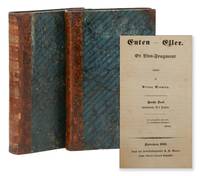
1843réf. 1006Kierkegaard's Famous "Either-Or" Challenge to Life – PMM 314 KIERKEGAARD Sören. Enten-Eller. Et Livs-Fragment. udgivet af Victor Eremita Either-Or A Fragment of Life C.A. Reitzel Kjøbenhavn 1843. Volume 1: Half-title TP V-XX = Forord XXI = Indhold half-title 3-470 2 blank leaves; Volume 2: Half-title TP 1 leaf = Inhold half-title 1-368 1 blank leaf Octavo First Edition Himmelstrup 20. Printing and the Mind of Man 314 With the often missing half-titles present. This is one of only 525 copies printed of this work. "Kierkegaard's third published book and the first of many pseudonymous 'aesthetic' works. Generally regarded as the first major statement of his own unsystematic philosophy this 'fragment' is a literary and philosophical tour de force incorporating a stunning array of subject matter literary effects and moods including melancholy aphorisms and personal meditation elaborate musical dramatic and literary criticism lyrical effusions odd essays on unhappiness and boredom a strange 'Seducer's Diary' and in the second volume an extended treatise on marriagethe human personality and the ethical life in the form of a letter from a Judge to a younger man capped by a sermon sounding a note of radical doubt about both the aesthetic and ethical justifications for existence." Wronoski p. 11 "Enten-Eller was written before he was twenty-nine. It is a curious bundle of papers essays semi-dialogues and notes seemingly ill-assorted but in fact dialectically arranged. Adopting what he called an 'aesthetic attitude' he held that this consisted in balancing possibilities and that in matters religious and ethical it was up to the individual to make his choice. Choice as the title of his work suggests was at the root of Kierkegaard's theory. There can be no system of existence only a system of ideas. From this he develops his thesis of 'Existence" since taken up by the modern Existentialist in which human beings considered as subjects not objects are the only real existence: their reflective as opposed to active nature being focused on the 'acts' of making perpetual decisions" PMM pp. 190-91 CONDITION: Very good in original contemporary quarter cloth with marbled boards. Minimal edgewear. Handwritten spine labels light spotting to pages. Housed in protective cloth clamshell box. C.A. Reitzel hardcover
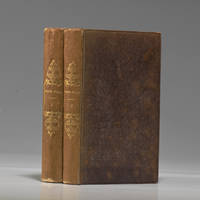
1843réf. 1311161843. First Edition. KIERKEGAARD S¿ren. Enten-Eller. Et Livs-Fragment. Kjobenjavn Copenhagen: C.A. Reitzel 1843. Two volumes. Octavo contemporary violet ribbon-embossed cloth elaborately gilt-decorated spines. $9500.First edition of Kierkegaard's first significant work one of only 525 copies printed and published by the philosopher under the pseudonym ""Victor Eremita.""Kierkegaard's earliest major work Enten-Eller Either/Or contrasts two ways of life: the aesthetic and the ethical. The book comprises ""a curious bundle of papers essays semi-dialogues and notes seemingly ill-assorted but in fact dialectically arrangedÉ the chief advantage of this method seems to have been to give Kierkegaard the opportunity of letting different sides of his mind converse as individuals with each other in a semi-Socratic fashionÉ Choice as the title of his work suggests was at the root of Kierkegaard's theory. There can be no system of existence only a system of ideas. From this he develops his thesis of 'Existence' since taken up by the modern ExistentialistsÉ As a thinker Kierkegaard had to wait for the twentieth century to find his audience; he is now generally considered to be however eccentric one of the most important Christian philosophers"" PMM 314. With the scarce half titles. Kierkegaard's name inked in an early hand under the author line on the half title of volume I; partially removed oval stamp on title page of volume II.Contents with occasional light foxing small area of offsetting from inked author name; spines evenly toned to brown boards with spots of toning cloth slightly rubbed at corners and spine ends. A very good copy. hardcover
1843réf. 1311161843. First Edition. KIERKEGAARD S¿ren. Enten-Eller. Et Livs-Fragment. Kjobenjavn Copenhagen: C.A. Reitzel 1843. Two volumes. Octavo contemporary violet ribbon-embossed cloth elaborately gilt-decorated spines. $9500.First edition of Kierkegaard's first significant work one of only 525 copies printed and published by the philosopher under the pseudonym ""Victor Eremita.""Kierkegaard's earliest major work Enten-Eller Either/Or contrasts two ways of life: the aesthetic and the ethical. The book comprises ""a curious bundle of papers essays semi-dialogues and notes seemingly ill-assorted but in fact dialectically arrangedÉ the chief advantage of this method seems to have been to give Kierkegaard the opportunity of letting different sides of his mind converse as individuals with each other in a semi-Socratic fashionÉ Choice as the title of his work suggests was at the root of Kierkegaard's theory. There can be no system of existence only a system of ideas. From this he develops his thesis of 'Existence' since taken up by the modern ExistentialistsÉ As a thinker Kierkegaard had to wait for the twentieth century to find his audience; he is now generally considered to be however eccentric one of the most important Christian philosophers"" PMM 314. With the scarce half titles. Kierkegaard's name inked in an early hand under the author line on the half title of volume I; partially removed oval stamp on title page of volume II.Contents with occasional light foxing small area of offsetting from inked author name; spines evenly toned to brown boards with spots of toning cloth slightly rubbed at corners and spine ends. A very good copy. hardcover books
1843réf. 140946922Copenhagen: C. A. Reitzel 1843. First Edition. Very Good. First edition of Soren Kierkegaard's best-known work Either/Or. Octavo. Two volumes bound in contemporary half-calf over marbled boards; bound without the half-titles. Text in Danish. Very Good rubbing and wear to bindings neatly rebacked with old spines preserved. Former owner names to preliminary blacks and owner's rubber stamp to title pages. Contents tanned sporadically foxed and occasionally lightly stained. A lovely set. Either/Or Danish philosopher Søren Aabye Kierkegaard's groundbreaking first published work. Only 525 copies of this edition were published in 1843 under an editorial pseudonym "Victor Emerita" at the author's own expense. It was mostly written during his stay in Berlin where he took notes on Schelling's Philosophy of Revelation. It includes essays of literary and music criticism and a set of romantic-like-aphorisms as part of his larger theme of examining the reflective and philosophical structure of faith. He is widely considered to be the first existentialist philosopher. "As a thinker Kierkegaard had to wait for the twentieth century to find his audience; he is now generally considered to be however eccentric one of the most important Christian philosophers" write Carter and Muir in Printing and the Mind of Man. C. A. Reitzel unknown
1843réf. 140946922Copenhagen: C. A. Reitzel 1843. First Edition. Very Good. First edition of Soren Kierkegaard's best-known work Either/Or. Octavo. Two volumes bound in contemporary half-calf over marbled boards; bound without the half-titles. Text in Danish. Very Good rubbing and wear to bindings neatly rebacked with old spines preserved. Former owner names to preliminary blacks and owner's rubber stamp to title pages. Contents tanned sporadically foxed and occasionally lightly stained. A lovely set. Either/Or Danish philosopher Søren Aabye Kierkegaard's groundbreaking first published work. Only 525 copies of this edition were published in 1843 under an editorial pseudonym "Victor Emerita" at the author's own expense. It was mostly written during his stay in Berlin where he took notes on Schelling's Philosophy of Revelation. It includes essays of literary and music criticism and a set of romantic-like-aphorisms as part of his larger theme of examining the reflective and philosophical structure of faith. He is widely considered to be the first existentialist philosopher. "As a thinker Kierkegaard had to wait for the twentieth century to find his audience; he is now generally considered to be however eccentric one of the most important Christian philosophers" write Carter and Muir in Printing and the Mind of Man. C. A. Reitzel unknown books
1843réf. 62137Kjøbenhavn, Reitzel, 1843. 8vo. VIII, 135 pp. Completely uncut in the original blue cardboard binding. Spine and front hinge neatly restored, preserving part of the original printed title-label. Brownspotting as usual. Overall a very nice copy indeed. Old owners’ names to inside of front board (N. Pedersen 18/8 1879 and C. Wegener).