1.921 Ergebnisse
Best.-Nr. 10833Collection complète, du n° 1 (été 1924) au n° 29 (printemps 1932). Nous joignons l'Index des années 1924-1928, paru sous forme de tiré-à-part joint au n° 22 (Hiver 1929). TOUS LES NUMEROS FONT PARTIE DU TIRAGE SUR VELIN PUR FIL LAFUMA (2e papier dont le nombre d'exemplaires est compris entre 150 et 300) et sont tous en bon ou très bon état. // Le n° 1 porte la mention manuscrite " Exemplaire sur Lafuma ", apposée par Auguste Morel qui a également signé cet exemplaire de ses initiales ; ce détail fait de cet exemplaire une belle pièce joycienne puisque dans ce premier numéro de " Commerce " paraît la première traduction en français d'un extrait d'ULYSSE de Joyce - traduction justement due au même Auguste Morel et à Valery Larbaud. // Rare et belle collection sur grand papier.
1841Best.-Nr. 46401675Kjobenhavn, Philipsen, 1841 ; in-8, demi-basane brune, coins, dos orné, tranches bleues. (Reliure danoise de l’époque) 4 ff. n. ch., 350 pp.ÉDITION ORIGINALE. PREMIER TIRAGE de TOUTE RARETÉ non mis dans le commerce.Le Concept d’ironie constamment rapporté à Socrate est la thèse de doctorat du jeune Kierkegaard. Il l’avait déposée le 16 juillet 1841 et brillamment soutenue le 29 septembre devant la Faculté de Copenhague. Il obtint le grade de Magister artium. C’est le second livre de l’auteur. La première partie est consacrée à l’ironie grecque, la seconde concerne l’ironie des romantiques allemands, les théories de Fichte, Hegel, Schlegel...EXEMPLAIRE DU TOUT PREMIER TIRAGE. Le titre porte la mention : Soutenu pour le grade de Magister. Au verso il porte une citation latine de Sibbern. Il est suivi d’un second titre en latin : Theses dissertationi danicae de notione ironiae annexae quas ad jura magistri artium in Universitate Hafniensi rite obtinenda die XXIX (cette date est manuscrite) Septemb. Publico colloquio defendere conabitur Severinus Aabye Kierkegaard theol. cand. MDCCCLXI (pour MDCCCXLI). -Suit 1 f. avec une liste de 15 thèses en latin. Himmelstrup n°8.Exemplaire dans sa première reliure. Dos un peu épidermé, la dorure du décor est passée.
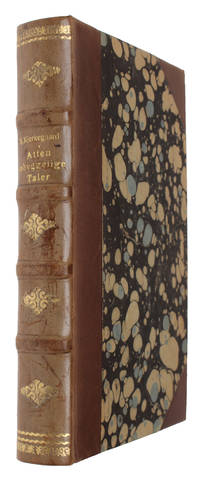
Best.-Nr. 13902K. 1843-1845. Lidt senere sort hldrbd. Nedre kapitæl lidt stødt. Gennemgående vandskjold. IV5262845970111pp. Originaludgave. Himmelstrup 85. unknown
1843Best.-Nr. 13902K., 1843-1845. Lidt senere sort hldrbd. Nedre kapitæl lidt stødt. Gennemgående vandskjold. (IV)+52+62+84+59+70+111pp.
1843K., 1843-1845. Lidt senere sort hldrbd. Nedre kapitæl lidt stødt. Gennemgående vandskjold. (IV)+52+62+84+59+70+111pp.
1841Best.-Nr. PERBKIER19Copenhagen: P.G.Philipsens. 1841. 1841. 8vo. pp. 4 p.l. 350. lacking final blank. contemporary half roan rubbed some foxing & browning. First Edition First Issue of Kierkegaard's doctoral thesis on the concept of irony for which he obtained permission to write in Danish rather than the usually required Latin. The work is divided into two parts the first dealing with Socrates as an 'ironist' and the second with the concept of irony per se. ".Irony set the pattern for subsequent writings by its masterful and at times lyrical style its humour and satire. Because of its subtlety the dissertation has often been misunderstood. In particular it has commonly been viewed as a youthful Hegelian writing whereas actually it is an ironic attack on both Hegelianism and romanticism each being made to overwhelm the other. From the literary standpoint the book is rich in allusions to philosophic and general sources.". Arbaugh Kierkegaard's Authorship 1968 p. 47 Himmelstrup 8. Rand I p. 320. F. Copenhagen: P.G.Philipsens. 1841. unknown
1843Best.-Nr. 57279Kjøbenhavn [Copenhagen], P. G. Philipsens Forlag, 1843-1845. 8vo. Bound uncut in a recent pastiche cardboardbinding, imitating the original brown cardboard binding, in which it was issued. Printed pastice paper label to spine. Some brownspotting as always, due to the paper quality. (4), 52, 62, 84, 59 (recte 57 pp., i.e. without the blank leaf between the title-page and the preface), 70, 111 pp. Complete with all the titles and the joint title-page (without the blank leaf after the preface of ""To opbyggelige Taler, 1844"" - which is not called for and hardly ever present).
1843Best.-Nr. 57279Kjøbenhavn Copenhagen P. G. Philipsens Forlag 1843-1845. 8vo. Bound uncut in a recent pastiche cardboardbinding imitating the original brown cardboard binding in which it was issued. Printed pastice paper label to spine. Some brownspotting as always due to the paper quality. 4 52 62 84 59 recte 57 pp. i.e. without the blank leaf between the title-page and the preface 70 111 pp. Complete with all the titles and the joint title-page without the blank leaf after the preface of "To opbyggelige Taler 1844" - which is not called for and hardly ever present. First edition of Kierkegaard's important eighteen upbuilding discourses which comprise his two three and four upbuilding discourses from the years 1843-45 with the joint title-page of all eighteen. The work constitutes Kierkegaard's religious works which supplement his theological and philosophical ones.The first upbuilding discourses were published the same year as Either-Or and it is interesting to note that in opposition to his major philosophical works the religious upbuilding discourses actually bear the name of the author on the title-page a fact that was by no means incidental. While the pseudonymous works could make one doubt the religiousness of the author the parallelly written religious discourses stress the fact that we are dealing with an author who was religious from the very beginning a fact that Kierkegaard also wished to establish himself; in his journals he clearly states that the religious discourses bear as much significance for his work as a whole as do the larger pseudonymous works "I began with "Either-Or" and two upbuilding discourses." he says and explains that he intended the upbuilding the religious to advance and that he wanted to show "that the writer was not an esthetic author who in the course of time grew older and for that reason became religious" Journals IX A 227.The importance of the upbuilding discourses and the close relationship they have with the major works and Kierkegaard's philosophical development also becomes evident with the fact that every pseudonymous work was accompanied by a little collection of "upbuilding discourses" until "Concluding Postscript" appeared.Himmelstrup 85. unknown
1843Kjøbenhavn [Copenhagen], P. G. Philipsens Forlag, 1843-1845. 8vo. Bound uncut in a recent pastiche cardboardbinding, imitating the original brown cardboard binding, in which it was issued. Printed pastice paper label to spine. Some brownspotting as always, due to the paper quality. (4), 52, 62, 84, 59 (recte 57 pp., i.e. without the blank leaf between the title-page and the preface), 70, 111 pp. Complete with all the titles and the joint title-page (without the blank leaf after the preface of ""To opbyggelige Taler, 1844"" - which is not called for and hardly ever present).
1840Best.-Nr. 915Kjøbenhavn: Corsaren 1840. First Edition. Hardcover. Very good. KIERKEGAARD Soren & GOLDSCHMIDT Meir Aaron ed. Corsaren. DANISH SATIRE - CARICATURING KIERKEGAARD complete Corsaren Affair Kjøbenhavn Vol I: 1840 - 41 Vol II: 1843 Vol III: 1846. Octavo. First Edition. $ 2500 The complete Corsaren Affair all issues related to Soren Kierkegaards conflict with Aaron Goldschmidt editor of the famous Danish satirical journal Corsaren with the iconic caricatures of Kierkegaard that now stand as the most famous "portraits" of the founder of existentialism. This satirical weekly typically was issued with 8 pages with numbered columns 2-per page. Filled with short polemics and dozens of caricatures of various public figures in Denmark. A wonderful snapshot of literary and political life in mid-19th century Denmark often the target of political and police censure due to its scathing depictions of powerful figures. Mention and review of Kierkegaards Concept of Irony in issues 49 & 51; Review of Either-Or in issue 129 Polemics against Kierkegaard began in issues 276 & 277 Continued polemical ridicule and caricatures in issues 278 279 & 280 Review of Concluding Unscientific Postscript in issue 284 Famous depiction of Kierkegaard as center of the world in issue 285 Further devastating polemicizing in issues 297 299 300 & 304 CONDITION: Good 3 matching volumes in contemporary quarter leather with marbled boards. Leather along front hinge slightly starting. Staining and moderate wear to leather with light to moderate foxing to pages. Corsaren hardcover
1841Best.-Nr. 269Kjøbenhavn: P.G. Philipsens Forlag 1841. First printing. Hardcover. Very Good . The Rare First Edition First Issue of Kierkegaards Second Book KIERKEGAARD Soren. Om Begrebet Ironi med stadigt Hensyn til Socrates On the Concept of Irony with Constant References to Socrates P.G. Philipsens Forlag Kjøbenhavn 1841. TP with note regarding Kierkegaard's candidacy for Master of the Arts and the date above Sibbern's name on the verso of TP second TP in Latin with hand written date in Roman numerals i-ii = Theses in Latin iii = Indhold half-title 3-350 small Octavo. First Edition First Issue Himmelstrup 8. The rare early issue with the second title page in Latin. "Kierkegaard's second book his dissertation in theology presented at the University of Copenhagen. In this work Kierkegaard invidiously contrasts the irony of Socrates with the comparatively palliated and world-weary irony of the romantics. Irony constitutes the first in that series of multivalent existential categories the exception the Extraordinary the incommensurate Angst the leap faith the absurd the 'offense' the moment deployed against the Hegelian System. Indeed irony and the figure of the ironist are central to Kierkegaard's entire 'aesthetic' corpus. Socrates was a figure to whom Kierkegaard would regularly return as an antidote to the 'speculative disease' in philosophy." Wronoski p. 9 CONDITION: Very good in contemporary boards rebacked though not recently most likely early 20th c. Pages browned as usual. CONDITION: Very good in contemporary boards rebacked though not recently most likely early 20th c. Pages browned as usual. PHOTOS AVAILABLE UPON REQUEST P.G. Philipsens Forlag hardcover
1843Best.-Nr. 13904K., 1843-1845. 8vo. Smukt lidt senere hldrbd.m. rig rygforgyldn., ophøjet ""bind"", dannet af heftesnoren. 2. blad (indhold) repareret. Pp 1-50 m. svagt skjold for neden, ellers pæn. (Iv)+52+62+84+59+70+111pp.
Best.-Nr. 13904K. 1843-1845. 8vo. Smukt lidt senere hldrbd.m. rig rygforgyldn. ophøjet "bind" dannet af heftesnoren. 2. blad indhold repareret. Pp 1-50 m. svagt skjold for neden ellers pæn. Iv5262845970111pp. Originaludgave. Himmelstrup 85.First edition of Kierkegaard's important eighteen upbuilding discourses which comprise his two three and four upbuilding discourses from the years 1843-45 with the joint title-page of all eighteen. The work constitutes Kierkegaard's religious works which supplement his theological and philosophical ones.The first upbuilding discourses were published the same year as Either-Or and it is interesting to note that in opposition to his major philosophical works the religious upbuilding discourses actually bear the name of the author on the title-page -a fact that was by no means incidental. While the pseudonymous works could make one doubt the religiousness of the author the parallelly written religious discourses stress the fact that we are dealing with an author who was religious from the very beginning -a fact that Kierkegaard also wished to establish himself; in his journals he clearly states that the religious discourses bear as much significance for his work as a whole as do the larger pseudonymous works "I began with "Either-Or" and two upbuilding discourses." he says and explains that he intended the upbuilding the religious to advance and that he wanted to show "that the writer was not an aesthetic author who in the course of time grew older and for that reason became religious" Journals IX A 227.The importance of the upbuilding discourses and the close relationship they have with the major works and Kierkegaard's philosophical development also becomes evident with the fact that every pseudonymous work was accompanied by a little collection of "upbuilding discourses" until "Concluding Postscript" appeared. unknown
1843K., 1843-1845. 8vo. Smukt lidt senere hldrbd.m. rig rygforgyldn., ophøjet ""bind"", dannet af heftesnoren. 2. blad (indhold) repareret. Pp 1-50 m. svagt skjold for neden, ellers pæn. (Iv)+52+62+84+59+70+111pp.
1843Best.-Nr. 53093Kjøbenhavn [Copenhagen], 1843-1845. 8vo. Near contemporary half calf with richly gilt spine. Binding with very light wear. Front free end-paper with the ownership-inscription of Michael Bentzon and his acquisition date of 1855 (the same year that Kierkegaard died). Some brownspotting here and there and the first couple of leaves of ""To opbyggelige Taler, 1844"" with a damp stain. Neat underlinings in the text as well as several marginalia, mostly in pencil. A very good copy indeed. (IV), 52, 62, 84, 59, 70, 111pp. Complete with all the half-titles and the joint title-page (without the blank leaf after the preface of ""To opbyggelige Taler, 1844"" - which is not called for and hardly ever present).
1843Best.-Nr. 53093Kjøbenhavn Copenhagen 1843-1845. 8vo. Near contemporary half calf with richly gilt spine. Binding with very light wear. Front free end-paper with the ownership-inscription of Michael Bentzon and his acquisition date of 1855 the same year that Kierkegaard died. Some brownspotting here and there and the first couple of leaves of "To opbyggelige Taler 1844" with a damp stain. Neat underlinings in the text as well as several marginalia mostly in pencil. A very good copy indeed. IV 52 62 84 59 70 111pp. Complete with all the half-titles and the joint title-page without the blank leaf after the preface of "To opbyggelige Taler 1844" - which is not called for and hardly ever present. First edition of Kierkegaard's important Eighteen Upbuilding Discourses which comprise his two three and four upbuilding discourses from the years 1843-45 with the joint title-page of all eighteen. The work constitutes Kierkegaard's religious works which supplement his theological and philosophical ones.The first upbuilding discourses were published the same year as Either-Or and it is interesting to note that in opposition to his major philosophical works the religious upbuilding discourses actually bear the name of the author on the title-page -a fact that was by no means incidental. While the pseudonymous works could make one doubt the religiousness of the author the parallelly written religious discourses stress the fact that we are dealing with an author who was religious from the very beginning -a fact that Kierkegaard also wished to underline himself; in his journals he clearly states that the religious discourses bear as much significance for his work as a whole as do the larger pseudonymous works "I began with "Either-Or" and two upbuilding discourses." he says and explains that he intended the upbuilding the religious to advance and that he wanted to show "that the writer was not an esthetic author who in the course of time grew older and for that reason became religious" Journals IX A 227.The importance of the upbuilding discourses and the close relationship they have with the major works and Kierkegaard's philosophical development is also stressed by the fact that every pseudonymous work was accompanied by a little collection of "upbuilding discourses" until "Concluding Postscript" appeared.Himmelstrup 85. unknown
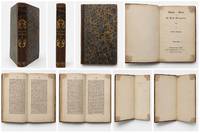
1843Best.-Nr. 8Either/Or Danish: Enten – Eller is the first published work of Danish philosopher Søren Kierkegaard. Volume 2 only. First edition. First printing. C.A. Reitzel Kjøbenhavn. 1843. Very good condition for an 1843 edition. Bound in an attractive contemporary half leather binding with marbled paper-covered boards. The binding is solid and structurally sound with moderate rubbing and wear to the spine corners and board edges consistent with age. The text block is complete and firmly attached. Pages are clean and fully legible showing expected age toning with occasional light foxing and minor staining. Blank endpapers display old pencil ownership or catalogue annotations and some dampstaining near the corners. No significant tears or loss of text were observed. Overall a well-preserved and highly presentable copy with an attractive period binding retaining its historical character. C.A. Reitzel, hardcover
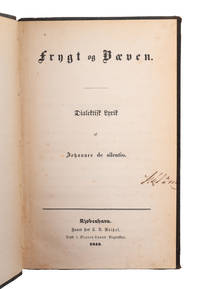
1843Best.-Nr. 62092Kjøbenhavn 1843. 8vo. Contemporary dark brown half cloth with gilt lettering to spine. Capitals and a bit of the front hinge worn but overall very nice and tight. Internally a bit of brownspotting as always due to the quality of the paper but less than usual. Old owner's signature to title-page. VIII 135 pp. First edition of one of Kierkegaard's most important and sought-after works Fear and Trembling which is rather more difficult to find than most of his other works. Fear and Trembling is one of Kierkegaard’s most important works. And it is also one of his most difficult. It deals – in forceful brevity – with the relationship between reason and faith and provides us with Kierkegaard’s most thorough exposition of the religious stage which he considered the most meaningful form of existence. It is here that Kierkegaard introduces the “tragic hero” and contrasts it to the “Knight of Faith” who both ignore their own wishes for a higher good. These two essential figures epitomize the ethical and the religious and pave the way for the understanding of these stages in Kierkegaard’s philosophy. It is arguably also here that the idea of the essential leap of faith is introduced for the first time. The Knight of Faith sacrifices his son at the command of God and thus sets aside an ethical demand in in order to attain a higher goal that exists beyond the ethical. This teleological suspension of the ethical requires a leap of faith that is only possible through faith in virtue of the absurd. Himmelstrup 48. hardcover
1843Best.-Nr. 62092Kjøbenhavn, 1843. 8vo. Contemporary dark brown half cloth with gilt lettering to spine. Capitals and a bit of the front hinge worn, but overall very nice and tight. Internally a bit of brownspotting (as always due to the quality of the paper), but less than usual. Old owner's signature to title-page. VIII, 135 pp.
1841(Copenhagen), 1841-1846. Lex 8vo. Bound in three contemporary uniform black full cloth bindings with gilt lettering and numbering to spines. Extremities a bit worn and hinges a bit weak. Some brownspotting. Overall a pretty good set. Richly illustrated throughout, both in the text and with plates.
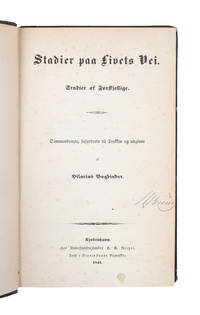
1845Best.-Nr. 62096Kjøbenhavn [Copenhagen], 1845. Lex8vo. Nice contemporary brown half cloth with gilt title to spine. Capitals worn and wear along upper front hinge. Corners worn. In spite of the wear, an attractive and tight copy. First and last leaves with a bit of brownspotting, otherwise only light occasional spotting. Old owner's signature to title-page. VIII, 383 pp.
1845Best.-Nr. 62096Kjøbenhavn Copenhagen 1845. Lex8vo. Nice contemporary brown half cloth with gilt title to spine. Capitals worn and wear along upper front hinge. Corners worn. In spite of the wear an attractive and tight copy. First and last leaves with a bit of brownspotting otherwise only light occasional spotting. Old owner's signature to title-page. VIII 383 pp. First edition of one of Kierkegaard's main works "Stages on Life's Way" his pivotal sequal to his main work "Either-Or" in which he had presented the first two stages the aesthetic and the ethical. In "Stages on Life's Way" he continues his work on these stages and moves on to present also the religious stage which takes up ab. two thirds of the work. The religious stage is that in which man attains a personal relationship with God and that in which man only truly begins to exist as the aesthetic and ethical stages are inadequate. It is in this foundational work in the religious stage that Kierkegaard first properly describes what is now known as the "Leap of Faith" in fact a "leap to faith" namely the leap that involves willing and belief in stead of reason and knowledge the leap that you make in order to connect to God and which requires that which he calls "the suspension of the ethical". Stages on Life’s Way is one of Kierkegaard’s most important works. Not only does it sum up and explain some of the most important themes of Kierkegaard’s previous works utilizing the characters and pseudonymous authors of the earlier works to do so; it goes beyond these foundational themes introduces the religious stage and points to the further development of the central themes in Kierkegaard’s philosophy most of which are only fully developed in Concluding Unscientific Postscript. hardcover
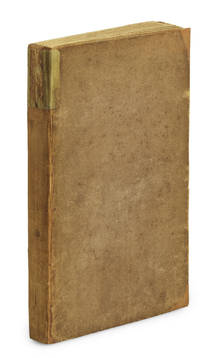
1841Best.-Nr. 62112Kjøbenhavn, P.G. Philipsens Forlag, 1841. 8vo. (4), 350 pp., 1 f. (blank), 2 pp. (advertisements). Completely uncut and partly unopened in the original brown cardboard binding. Rebacked with paper perfectly matching that of the boards. Corners restored. Title-page evenly browned and a few leaves with a bit of brownspotting, but overall in unusually nice condition, clean, fresh, and bright. Completely unmarked.
1841Best.-Nr. 62112Kjøbenhavn P.G. Philipsens Forlag 1841. 8vo. 4 350 pp. 1 f. blank 2 pp. advertisements. Completely uncut and partly unopened in the original brown cardboard binding. Rebacked with paper perfectly matching that of the boards. Corners restored. Title-page evenly browned and a few leaves with a bit of brownspotting but overall in unusually nice condition clean fresh and bright. Completely unmarked. A fabulous copy of the first edition of Kierkegaard’s dissertation here in the original binding which is of the utmost scarcity. We have only seen it in this state once before. And of all the copies we have handled of the Irony over the last decades we have only once before come across a copy with the advertisement-leaf in the back. This is virtually never present. This completely uncut copy is approximately 1 cm taller and wider than regular copies. The spines of the original Kierkegaard cardboard bindings are always just thin paper directly glued on the block making them extremely fragile especially on the thicker volumes. If one finds these original bindings the spines are almost always more or less disintegrated. Kierkegaard's dissertation constitutes the culmination of three years’ intensive studies of Socrates and “the true point of departure for Kierkegaard’s authorship” Brandes. The work is of the utmost importance in Kierkegaard’s production not only as his first academic treatise but also because he here introduces several themes that will be addressed in his later works. Among these we find the question of defining the subject of cognition and self-knowledge of the subject. The maxim of “know thyself” will be a constant throughout his oeuvre as is the theory of knowledge acquisition that he deals with here. The dissertation is also noteworthy in referencing many of Hegel’s theses in a not negative context something that Kierkegaard himself would later note with disappointment and characterize as an early uncritical use of Hegel. Another noteworthy feature is the fact that the thesis is written in Danish which was unheard of at the time. Kierkegaard felt that Danish was a more suitable language for the thesis and hadto petition the King to be granted permission to submit it in Danish rather than Latin. This in itself poses as certain irony as the young Kierkegaard was known to express himself poorly and very long-winded in written Danish. One of Kierkegaard’s only true friends his school friend H.P. Holst recounts in 1869 how the two had a special school friendship and working relationship in which Kierkegaard wrote Latin compositions for Holst while Holst wrote Danish compositions for Kierkegaard who “expressed himself in a hopelessly Latin Danish crawling with participial phrases and extraordinarily complicatedsentences” Garff p. 139. When Kierkegaard in 1838 was ready to publish his famous piece on Hans Christian Andersen see nr. 1 & 2 above which was to appear in Heiberg’s journal Perseus Heiberg had agreed to publish the piece although he had some severe critical comments about the way and the form in which it was written – if it were to appear in Perseus Heiberg demanded at the very least the young Kierkegaard would have to submit it in a reasonably readable Danish. “Kierkegaard therefore turned to his old schoolmate H. P. Holst and asked him to do something with the language…” Garff p. 139. From their school days Holst was well aware of the problem with Kierkegaard’s Danish and he recounts that over the summer he actually “translated” Kierkegaard’s article on Andersen into proper Danish. The oral defense was conducted in Latin however. The judges all agreed that the work submitted was both intelligent and noteworthy. But they were concerned about its style which was found to be both tasteless long-winded and idiosyncratic. We already here witness Kierkegaard’s idiosyncratic approach to content and style that is so characteristic for all of his greatest works. Both stylistically and thematically Kierkegaard’s and especially a clear precursor for his magnum opus Either-Or that is to be his next publication. The year 1841 is a momentous one in Kierkegaard’s life. It is the year that he completes his dissertation and commences his sojourn in Berlin but it is also the defining year in his personal life namely the year that he breaks off his engagement with Regine Olsen. And finally it is the year that he begins writing Either-Or. In many ways Either-Or is born directly out of The Concept of Irony and is the work that brings the theory of Irony to life. Part One of the dissertation concentrates on Socrates as interpreted by Xenophon Plato and Aristophanes with a word on Hegel and Hegelian categories. Part Two is a more synoptic discussion of the concept of irony in Kierkegaard’s categories with examples from other philosophers. The work constitutes Kierkegaard’s attempt at understanding the role of irony in disrupting society and with Socrates understood through Kierkegaard we witness a whole new way of interpreting the world before us. Wisdom is not necessarily fixed and we ought to use Socratic ignorance to approach the world without the inherited bias of our cultures. With irony we will be able to embrace the not knowing. We need to question the world knowing we may not find an answer. The moment we stop questioning and just accept the easy answers we succumb to ignorance. We must use irony to laugh at ourselves in order to improve ourselves and to laugh at society in order to improve the world. The work was submitted to the Philosophical Faculty at the University of Copenhagen on June 3rd 1841. Kierkegaard had asked for his dissertation to be ready from the printer’s in ample time for him to defend it before the new semester commenced. This presumably because he had already planned his sojourn to Berlin to hear the master philosopher Schelling. On September 16th the book was issued and on September 29th the defense would take place. The entire defense including a two hour long lunch break took seven hours during which ”an unusually full auditorium” would listen to the official opponents F.C. Sibbern and P.O. Brøndsted as well as the seven “ex auditorio” opponents F.C. Petersen J.L. Heiberg P.C. Kierkegaard Fr. Beck F.P.J. Dahl H .J.Thue og C.F. Christens not to mention Kierkegaard himself. Two weeks later on October 12th Kierkegaard broke off his engagement with Regine Olsen for the implications of this event see the section about Regine in vol. II. The work appeared in two states – one with the four pages of “Theses” for academics of the university whereas the copies without the theses were intended for ordinary sale. These sales copies also do not have “Udgivet for Magistergraden” and “theologisk Candidat” on the title-page. The present copy is one of the sales-copies without theses. Himmelstrup 8 The present copy is no. 11 in Girsel's "Kierkegaard" The Catalogue which can be found here. hardcover
1836Kjøbenhavn [i.e. Copenhagen], 1836. Large 4to. I: Loose, as issued, unbound. With a horizontal and a vertical crease down the middle. 4 pp. II: Loose, as issued, unbound, but inserted into a simple paper folder (small 8vo). With a horizontal and a vertical crease down the middle. 4 pp. + 4 pp. III: Loose, as issued, unbound, but inserted into a simple paper folder (small 8vo). With a horizontal and a vertical crease down the middle. 4 pp.