2.332 resultados
1843ref. 63627Kjøbenhavn 1843. 8vo. Contemporary half calf with marbled boards and gilt title to spine. Spine worn with loss of leather. Damp stain to upper part of leaves until p. 31. and again at the end. Last leaf with a marginal repair far from affecting text. Brownspotting. Stamp to title-page p. 1 and last page Theoloigical Library the one on title-page overwritten with ownership signature. VIII 135 pp. Scarce first edition of one of Kierkegaard's most splendid and most sought-after works in thich the “Leap of Faith” is introduced. Although Fear and Trembling is evidently printed in the same number of copies as almost all the other works by Kierkegaard i.e. ca 525 this is one of the most difficult of his works to find in the first edition. Perhaps later research will show whether unsold copies were destroyed which seems unlikely however. We know that in July or August 1847 321 copies of Fear and Trembling had been sold. What we also know is that it is highly sought-after by collectors and much less frequently on the market than most of Kierkegaard’s other works. Fear and Trembling is one of Kierkegaard’s most important works. And it is also one of his most difficult. It deals – in forceful brevity – with the relationship between reason and faith and provides us with Kierkegaard’s most thorough exposition of the religious stage which he considered the most meaningful form of existence. Setting the scene in his Preface with the punchy opening lines: “Not merely in the realm of commerce but in the world of ideas as well our age is organizing a regular clearance sale. Everything is to be had at such a bargain that it is questionable whether in the end there is anybody who will want to bid.”Preface Walter Lowrie’s translation 1941 Kierkegaard begins the work with a rendering of the biblical tale of Abraham and Isak from the Old Testament using it to illustrate how religious reasons can triumph over ethical. It is here that Kierkegaard introduces the “tragic hero” and contrasts it to the “Knight of Faith” who both ignore their own wishes for a higher good. These two essential figures epitomize the ethical and the religious and pave the way for the understanding of these stages in Kierkegaard’s philosophy. It is arguably also here that the idea of the essential leap of faith is introduced for the first time. The Knight of Faith sacrifices his son at the command of God and thus sets aside an ethical demand in in order to attain a higher goal that exists beyond the ethical. This teleological suspension of the ethical requires a leap of faith that is only possible through faith in virtue of the absurd. In many ways Fear and Trembling is the most forceful of Kierkegaard’s works as is also indicated by the title. Kierkegaard himself also considered it one of his most significant productions and wrote in his posthumously published Notebooks: “Oh once I am dead Fear and Trembling alone will be enough for an imperishable name as an author. Then it will be read translated into foreign languages as well. The reader will almost shrink from the frightful pathos in the book.” NB 12:147 1849. This splendidly dense work which so magnificently weaves together existential concerns with biblical interpretation is responsible for the introduction of many of the concepts that are most fundamental to Kierkegaard’s philosophy and is essential to the understanding of his thought. Himmelstrup 48 hardcover
1844ref. 62257Kjøbenhavn Reitzel 1844. Small 8vo. 164 pp. Completely uncut in the original printed light green wrappers with the text of the title-page repeated inside a frame to front board printed author and title to spine and the printing year within the same repeated frame to the back board. An almost untouched copy with just a tiny crease to the front wrapper and a tiny little nick to lower capital at back hinge. A bit of brownspotting due to the quality of the paper. Housed in an elegant green half morocco box with gilt lines and Gothic gilt lettering to spine. Green marbled paper boards and gilt super ex libris to front board Anker Kysters Eftf. And gilt by Hagel Olsen. A truly remarkable copy of the first edition in completely original condition in the fragile original wrappers virtually untouched. We have seen copies in the original wrappers before but never in this state. This is a truly amazing survival. In uncut state the work is a lot larger than regular copies – more than a cm taller and also significantly wider. By many Philosophical Fragments is considered Kierkegaard’s actual religious-philosophical main work. It is the first book written under the important pseudonym Johannes Climacus and it is here that Kierkegaard unfolds the tension between philosophy and religion in an attempt to find a historical onset for eternal consciousness opposing the ideological thought inherited by Plato Aristotle and Hegel. Through Climacus Kierkegaard contrasts the paradoxes of Christianity with Greek and modern philosophical thinking. He begins with Greek Platonic philosophy exploring the implications of venturing beyond the Socratic understanding of truth acquired through recollection to the Christian experience of acquiring truth through grace. It is in Philosophical Fragments that Kierkegaard’s polemic against the philosophy of Hegel becomes most obvious portraying clearly for the first time how the salvation of man can only be found through the paradoxical inversion of the rational values of speculative philosophy and through the “leap of faith” in the crucified Christ. It is here that we have the very root of Existentialism. In his preface Kierkegaard hints at a possible “sequel to Philosophical Fragments in 17 pieces”; this sequel was published in 1846 namely as the 600 pages long Concluding Unscientific Postscript to the Philosophical Fragments which is 83 pages long…. Only one single presentation-copy of Philosophical Fragments is known to exist. Himmelstrup: 62. The present copy is no. 23 in Girsel's "Kierkegaard" The Catalogue which can be found here. hardcover
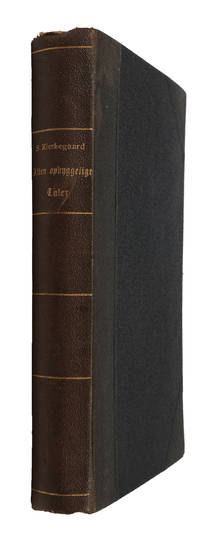
1843ref. 26192Kbh., 1843-45. Et nydeligt samtidigt hshirtbd. m. stregforgyldn. på ryg. Brunplettet. M. alle deltitelblade samt det fælles titelbl. (4), 52, 62, 84, 59, 70, 111 pp.Nice contemporary half cloth with single gilt lines to spine. Fully complete with all half titles and the joint title-page.
1843ref. 26192Kbh. 1843-45. Et nydeligt samtidigt hshirtbd. m. stregforgyldn. på ryg. Brunplettet. M. alle deltitelblade samt det fælles titelbl. 4 52 62 84 59 70 111 pp.Nice contemporary half cloth with single gilt lines to spine. Fully complete with all half titles and the joint title-page. Originaludgave. Himmelstrup 85.First edition of Kierkegaard's important eighteen upbuilding discourses which comprise his two three and four upbuilding discourses from the years 1843-45 with the joint title-page of all eighteen. The work constitutes Kierkegaard's religious works which supplement his theological and philosophical ones.The first upbuilding discourses were published the same year as Either-Or and it is interesting to note that in opposition to his major philosophical works the religious upbuilding discourses actually bear the name of the author on the title-page - a fact that was by no means incidental. While the pseudonymous works could make one doubt the religiousness of the author the parallelly written religious discourses stress the fact that we are dealing with an author who was religious from the very beginning -a fact that Kierkegaard also wished to establish himself; in his journals he clearly states that the religious discourses bear as much significance for his work as a whole as do the larger pseudonymous works "I began with "Either-Or" and two upbuilding discourses." he says and explains that he intended the upbuilding the religious to advance and that he wanted to show "that the writer was not an esthetic author who in the course of time grew older and for that reason became religious" Journals IX A 227.The importance of the upbuilding discourses and the close relationship they have with the major works and Kierkegaard's philosophical development also becomes evident with the fact that every pseudonymous work was accompanied by a little collection of "upbuilding discourses" until "Concluding Postscript" appeared.Himmelstrup 85. hardcover
1843Kbh., 1843-45. Et nydeligt samtidigt hshirtbd. m. stregforgyldn. på ryg. Brunplettet. M. alle deltitelblade samt det fælles titelbl. (4), 52, 62, 84, 59, 70, 111 pp.Nice contemporary half cloth with single gilt lines to spine. Fully complete with all half titles and the joint title-page.
1992ref. BRG-27_4_809Penguin Classics 1992-12-01. paperback. Very Good. 7x5x1. Very Good condition.Crisp pages. Clean cover and pages. Book shows minimal shelf wear. No highlighting/marking. Not Satisfied Contact us to get a refund. Penguin Classics paperback
ref. 10833Collection complète, du n° 1 (été 1924) au n° 29 (printemps 1932). Nous joignons l'Index des années 1924-1928, paru sous forme de tiré-à-part joint au n° 22 (Hiver 1929). TOUS LES NUMEROS FONT PARTIE DU TIRAGE SUR VELIN PUR FIL LAFUMA (2e papier dont le nombre d'exemplaires est compris entre 150 et 300) et sont tous en bon ou très bon état. // Le n° 1 porte la mention manuscrite " Exemplaire sur Lafuma ", apposée par Auguste Morel qui a également signé cet exemplaire de ses initiales ; ce détail fait de cet exemplaire une belle pièce joycienne puisque dans ce premier numéro de " Commerce " paraît la première traduction en français d'un extrait d'ULYSSE de Joyce - traduction justement due au même Auguste Morel et à Valery Larbaud. // Rare et belle collection sur grand papier.
1841ref. 46401675Kjobenhavn, Philipsen, 1841 ; in-8, demi-basane brune, coins, dos orné, tranches bleues. (Reliure danoise de l’époque) 4 ff. n. ch., 350 pp.ÉDITION ORIGINALE. PREMIER TIRAGE de TOUTE RARETÉ non mis dans le commerce.Le Concept d’ironie constamment rapporté à Socrate est la thèse de doctorat du jeune Kierkegaard. Il l’avait déposée le 16 juillet 1841 et brillamment soutenue le 29 septembre devant la Faculté de Copenhague. Il obtint le grade de Magister artium. C’est le second livre de l’auteur. La première partie est consacrée à l’ironie grecque, la seconde concerne l’ironie des romantiques allemands, les théories de Fichte, Hegel, Schlegel...EXEMPLAIRE DU TOUT PREMIER TIRAGE. Le titre porte la mention : Soutenu pour le grade de Magister. Au verso il porte une citation latine de Sibbern. Il est suivi d’un second titre en latin : Theses dissertationi danicae de notione ironiae annexae quas ad jura magistri artium in Universitate Hafniensi rite obtinenda die XXIX (cette date est manuscrite) Septemb. Publico colloquio defendere conabitur Severinus Aabye Kierkegaard theol. cand. MDCCCLXI (pour MDCCCXLI). -Suit 1 f. avec une liste de 15 thèses en latin. Himmelstrup n°8.Exemplaire dans sa première reliure. Dos un peu épidermé, la dorure du décor est passée.
1843ref. 13902K., 1843-1845. Lidt senere sort hldrbd. Nedre kapitæl lidt stødt. Gennemgående vandskjold. (IV)+52+62+84+59+70+111pp.
ref. 13902K. 1843-1845. Lidt senere sort hldrbd. Nedre kapitæl lidt stødt. Gennemgående vandskjold. IV5262845970111pp. Originaludgave. Himmelstrup 85. unknown
1843K., 1843-1845. Lidt senere sort hldrbd. Nedre kapitæl lidt stødt. Gennemgående vandskjold. (IV)+52+62+84+59+70+111pp.
1841ref. PERBKIER19Copenhagen: P.G.Philipsens. 1841. 1841. 8vo. pp. 4 p.l. 350. lacking final blank. contemporary half roan rubbed some foxing & browning. First Edition First Issue of Kierkegaard's doctoral thesis on the concept of irony for which he obtained permission to write in Danish rather than the usually required Latin. The work is divided into two parts the first dealing with Socrates as an 'ironist' and the second with the concept of irony per se. ".Irony set the pattern for subsequent writings by its masterful and at times lyrical style its humour and satire. Because of its subtlety the dissertation has often been misunderstood. In particular it has commonly been viewed as a youthful Hegelian writing whereas actually it is an ironic attack on both Hegelianism and romanticism each being made to overwhelm the other. From the literary standpoint the book is rich in allusions to philosophic and general sources.". Arbaugh Kierkegaard's Authorship 1968 p. 47 Himmelstrup 8. Rand I p. 320. F. Copenhagen: P.G.Philipsens. 1841. unknown
1843ref. 57279Kjøbenhavn [Copenhagen], P. G. Philipsens Forlag, 1843-1845. 8vo. Bound uncut in a recent pastiche cardboardbinding, imitating the original brown cardboard binding, in which it was issued. Printed pastice paper label to spine. Some brownspotting as always, due to the paper quality. (4), 52, 62, 84, 59 (recte 57 pp., i.e. without the blank leaf between the title-page and the preface), 70, 111 pp. Complete with all the titles and the joint title-page (without the blank leaf after the preface of ""To opbyggelige Taler, 1844"" - which is not called for and hardly ever present).
1843ref. 57279Kjøbenhavn Copenhagen P. G. Philipsens Forlag 1843-1845. 8vo. Bound uncut in a recent pastiche cardboardbinding imitating the original brown cardboard binding in which it was issued. Printed pastice paper label to spine. Some brownspotting as always due to the paper quality. 4 52 62 84 59 recte 57 pp. i.e. without the blank leaf between the title-page and the preface 70 111 pp. Complete with all the titles and the joint title-page without the blank leaf after the preface of "To opbyggelige Taler 1844" - which is not called for and hardly ever present. First edition of Kierkegaard's important eighteen upbuilding discourses which comprise his two three and four upbuilding discourses from the years 1843-45 with the joint title-page of all eighteen. The work constitutes Kierkegaard's religious works which supplement his theological and philosophical ones.The first upbuilding discourses were published the same year as Either-Or and it is interesting to note that in opposition to his major philosophical works the religious upbuilding discourses actually bear the name of the author on the title-page a fact that was by no means incidental. While the pseudonymous works could make one doubt the religiousness of the author the parallelly written religious discourses stress the fact that we are dealing with an author who was religious from the very beginning a fact that Kierkegaard also wished to establish himself; in his journals he clearly states that the religious discourses bear as much significance for his work as a whole as do the larger pseudonymous works "I began with "Either-Or" and two upbuilding discourses." he says and explains that he intended the upbuilding the religious to advance and that he wanted to show "that the writer was not an esthetic author who in the course of time grew older and for that reason became religious" Journals IX A 227.The importance of the upbuilding discourses and the close relationship they have with the major works and Kierkegaard's philosophical development also becomes evident with the fact that every pseudonymous work was accompanied by a little collection of "upbuilding discourses" until "Concluding Postscript" appeared.Himmelstrup 85. unknown
1843Kjøbenhavn [Copenhagen], P. G. Philipsens Forlag, 1843-1845. 8vo. Bound uncut in a recent pastiche cardboardbinding, imitating the original brown cardboard binding, in which it was issued. Printed pastice paper label to spine. Some brownspotting as always, due to the paper quality. (4), 52, 62, 84, 59 (recte 57 pp., i.e. without the blank leaf between the title-page and the preface), 70, 111 pp. Complete with all the titles and the joint title-page (without the blank leaf after the preface of ""To opbyggelige Taler, 1844"" - which is not called for and hardly ever present).
1845ref. 63626Kjøbenhavn [Copenhagen], 1845. Lex8vo. Later brown half calf with gilt title to spine (ca. 1940'ies). Corners with ligh wear. First leaves re-hinged. Title-page dusty and professsionally restored from verso with thin Chinese paper, neatly closing a tear (no loss). Some leaves evenly browned and last few leaves brownspotted, otherwise only lighter occasional spotting. VIII, 383 pp.
1845ref. 63626Kjøbenhavn Copenhagen 1845. Lex8vo. Later brown half calf with gilt title to spine ca. 1940'ies. Corners with ligh wear. First leaves re-hinged. Title-page dusty and professsionally restored from verso with thin Chinese paper neatly closing a tear no loss. Some leaves evenly browned and last few leaves brownspotted otherwise only lighter occasional spotting. VIII 383 pp. First edition of one of Kierkegaard's main works "Stages on Life's Way" his pivotal sequal to his main work "Either-Or" in which he had presented the first two stages the aesthetic and the ethical. In Stages on Life’s Way he continues his work on these stages and moves on to present also the religious stage which occupies approximately two thirds of the work. The religious stage is that in which man attains a personal relationship with God and that in which man only truly begins to exist the aesthetic and ethical stages being inadequate. It is in this foundational work in the religious stage that Kierkegaard first properly describes what is now known as the “Leap of Faith” in fact a “leap to faith” namely the leap that involves willing and belief instead of reason and knowledge the leap that you take in order to connect to God and which requires that which Kierkegaard calls “the suspension of the ethical”. Undoubtedly among Kierkegaard’s most brilliant literary achievements “Stages on Life’s Way” is written in the form of different viewpoints of Kierkegaard’s many pseudonymous characters. We have both Hilarius Bookbinder who by chance has come into possession of the documents presented in the work and has prepared them for printing. We have the famous banquet scene which mirrors Plato’s Symposium described by William Afham and in which the three aesthetics participate: Johannes the Seducer Victor Eremita and Constatin Constantius. We have Judge William’s discourse in praise of marriage and we have the diary discovered by Frater Taciturnus of a young man who was deeply in love but felt compelled to break off his engagement. This story in form of a diary is the closest one comes to a description of Kierkegaard’s own love story his relationship to Regine. The diary describes an engagement that has lasted for six months; it alternates between the morning notes that recall the engagement and the midnight notes that put it all in perspective. The work closes with a letter to the reader from Taciturnus on the three “existence-spheres” represented by the three parts of the book. “Stages on Life’s Way” is one of Kierkegaard’s most important works. Not only does it sum up and explain some of the most important themes of Kierkegaard’s previous works utilizing the characters and pseudonymous authors of the earlier works to do so; it goes beyond these foundational themes introduces the religious stage and points to the further development of the central themes in Kierkegaard’s philosophy most of which are only fully developed in “Concluding Unscientific Postscript”. Written under a pseudonym and without Kierkegaard’s name appearing as publisher or indeed anything else he was unable to give away presentation-copies of the work. Thus not a single presentation-copy of the work exists. Himmelstrup 78. unknown
1840ref. 915Kjøbenhavn: Corsaren 1840. First Edition. Hardcover. Very good. KIERKEGAARD Soren & GOLDSCHMIDT Meir Aaron ed. Corsaren. DANISH SATIRE - CARICATURING KIERKEGAARD complete Corsaren Affair Kjøbenhavn Vol I: 1840 - 41 Vol II: 1843 Vol III: 1846. Octavo. First Edition. $ 2500 The complete Corsaren Affair all issues related to Soren Kierkegaards conflict with Aaron Goldschmidt editor of the famous Danish satirical journal Corsaren with the iconic caricatures of Kierkegaard that now stand as the most famous "portraits" of the founder of existentialism. This satirical weekly typically was issued with 8 pages with numbered columns 2-per page. Filled with short polemics and dozens of caricatures of various public figures in Denmark. A wonderful snapshot of literary and political life in mid-19th century Denmark often the target of political and police censure due to its scathing depictions of powerful figures. Mention and review of Kierkegaards Concept of Irony in issues 49 & 51; Review of Either-Or in issue 129 Polemics against Kierkegaard began in issues 276 & 277 Continued polemical ridicule and caricatures in issues 278 279 & 280 Review of Concluding Unscientific Postscript in issue 284 Famous depiction of Kierkegaard as center of the world in issue 285 Further devastating polemicizing in issues 297 299 300 & 304 CONDITION: Good 3 matching volumes in contemporary quarter leather with marbled boards. Leather along front hinge slightly starting. Staining and moderate wear to leather with light to moderate foxing to pages. Corsaren hardcover
1841ref. 269Kjøbenhavn: P.G. Philipsens Forlag 1841. First printing. Hardcover. Very Good . The Rare First Edition First Issue of Kierkegaards Second Book KIERKEGAARD Soren. Om Begrebet Ironi med stadigt Hensyn til Socrates On the Concept of Irony with Constant References to Socrates P.G. Philipsens Forlag Kjøbenhavn 1841. TP with note regarding Kierkegaard's candidacy for Master of the Arts and the date above Sibbern's name on the verso of TP second TP in Latin with hand written date in Roman numerals i-ii = Theses in Latin iii = Indhold half-title 3-350 small Octavo. First Edition First Issue Himmelstrup 8. The rare early issue with the second title page in Latin. "Kierkegaard's second book his dissertation in theology presented at the University of Copenhagen. In this work Kierkegaard invidiously contrasts the irony of Socrates with the comparatively palliated and world-weary irony of the romantics. Irony constitutes the first in that series of multivalent existential categories the exception the Extraordinary the incommensurate Angst the leap faith the absurd the 'offense' the moment deployed against the Hegelian System. Indeed irony and the figure of the ironist are central to Kierkegaard's entire 'aesthetic' corpus. Socrates was a figure to whom Kierkegaard would regularly return as an antidote to the 'speculative disease' in philosophy." Wronoski p. 9 CONDITION: Very good in contemporary boards rebacked though not recently most likely early 20th c. Pages browned as usual. CONDITION: Very good in contemporary boards rebacked though not recently most likely early 20th c. Pages browned as usual. PHOTOS AVAILABLE UPON REQUEST P.G. Philipsens Forlag hardcover
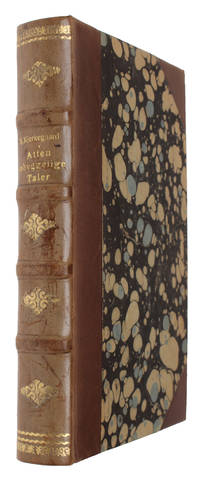
1843ref. 13904K., 1843-1845. 8vo. Smukt lidt senere hldrbd.m. rig rygforgyldn., ophøjet ""bind"", dannet af heftesnoren. 2. blad (indhold) repareret. Pp 1-50 m. svagt skjold for neden, ellers pæn. (Iv)+52+62+84+59+70+111pp.
ref. 13904K. 1843-1845. 8vo. Smukt lidt senere hldrbd.m. rig rygforgyldn. ophøjet "bind" dannet af heftesnoren. 2. blad indhold repareret. Pp 1-50 m. svagt skjold for neden ellers pæn. Iv5262845970111pp. Originaludgave. Himmelstrup 85.First edition of Kierkegaard's important eighteen upbuilding discourses which comprise his two three and four upbuilding discourses from the years 1843-45 with the joint title-page of all eighteen. The work constitutes Kierkegaard's religious works which supplement his theological and philosophical ones.The first upbuilding discourses were published the same year as Either-Or and it is interesting to note that in opposition to his major philosophical works the religious upbuilding discourses actually bear the name of the author on the title-page -a fact that was by no means incidental. While the pseudonymous works could make one doubt the religiousness of the author the parallelly written religious discourses stress the fact that we are dealing with an author who was religious from the very beginning -a fact that Kierkegaard also wished to establish himself; in his journals he clearly states that the religious discourses bear as much significance for his work as a whole as do the larger pseudonymous works "I began with "Either-Or" and two upbuilding discourses." he says and explains that he intended the upbuilding the religious to advance and that he wanted to show "that the writer was not an aesthetic author who in the course of time grew older and for that reason became religious" Journals IX A 227.The importance of the upbuilding discourses and the close relationship they have with the major works and Kierkegaard's philosophical development also becomes evident with the fact that every pseudonymous work was accompanied by a little collection of "upbuilding discourses" until "Concluding Postscript" appeared. unknown
1843K., 1843-1845. 8vo. Smukt lidt senere hldrbd.m. rig rygforgyldn., ophøjet ""bind"", dannet af heftesnoren. 2. blad (indhold) repareret. Pp 1-50 m. svagt skjold for neden, ellers pæn. (Iv)+52+62+84+59+70+111pp.
1849ref. 63618Kjøbenhavn, Reitzel, 1849. 8vo. 42 pp. Uncut in the original printed wrappers. The front wrapper with the text of the title-page (all except the year) repeated inside a double-line border, inside which a line-border with ornamental cornerpieces. Back-wrapper with the year inside the same frame. The printed spine, preserved in its entirety and also completely unrestored, with Gothic lettering and small printed ornamentations. A vertical strip of ca 1 cm towards the spine on both front and back wrapper faded, but only here. The spine is also not faded. A brown discolouration to lower blank margin throughout. Otherwise just light occasional brownspotting. “a. m.” in contemporary hand to front wrapper. Housed in beautiful marbled paper box with a grey morocco spine with gilt Gothic lettering and small gilt ornamentations. Gilt super ex libris to front. Signed in Gilt lettering to inside of spine: Anker Kysters Eftf. and gilt by Hagel Olsen.
1849ref. 63618Kjøbenhavn Reitzel 1849. 8vo. 42 pp. Uncut in the original printed wrappers. The front wrapper with the text of the title-page all except the year repeated inside a double-line border inside which a line-border with ornamental cornerpieces. Back-wrapper with the year inside the same frame. The printed spine preserved in its entirety and also completely unrestored with Gothic lettering and small printed ornamentations. A vertical strip of ca 1 cm towards the spine on both front and back wrapper faded but only here. The spine is also not faded. A brown discolouration to lower blank margin throughout. Otherwise just light occasional brownspotting. "a. m." in contemporary hand to front wrapper. Housed in beautiful marbled paper box with a grey morocco spine with gilt Gothic lettering and small gilt ornamentations. Gilt super ex libris to front. Signed in Gilt lettering to inside of spine: Anker Kysters Eftf. and gilt by Hagel Olsen. A truly magnificent copy of the first edition in the extremely rare original wrappers completely unrestored and with the original printed spine also preserved in its entirety which we have never seen before. This important publication is an essential part of Kierkegaard's upbuilding production written and published under his own name. It consists of three discourses at the communion on Fridays and is the upbuilding religious companion to Sickness Unto Death that was published pseudonymously earlier in the year thus continuing the practice that Kierkegaard began with Either-Or and otherwise ended with Concluding Unscientific Postscript that each pseudonymous work would be accompanied by an upbuilding publication. As Kierkegaard states in his journal from October 1849 after having written that his "three discourses" i.e. "The High Priest" "The Publican" and "The sinner" "are now delivered to the printer 1 I must find a point of rest but I cannot rest on a pseudonym; and these discourses correspond to Anti-Climacus; and the position of Discourses for the Communion on Fridays is once and for all designated as the point of the rest for my works. 2 Since at present people are focusing on my pseudonym Climacus it is important that there be emphasis in the direction of edification. Once again how loving it is of Governance that what I need and am to use always lies ready. 3 "The Preface" calls to mind the Two Edif. Discourses of 1843; it is important to me to emphasize that I began as a religious author right at the outset; it is important for the repetition." NB 13: 79. In fact the reference back to Kierkegaard's debut as an upbuilding author in Two Upbuilding Discourses from 1843 plays a dominant role in the present work. The preface here not merely alludes to the preface of the first upbuilding publication it even largely quotes from it. Kierkegaard clearly perceived the present publication as beginning the second cycle of Upbuilding Discourses see NB 12:133. It is also worth noting that the present collection of discourses plays an important role in Kierkegaard's continued thoughts about Regine and the relationship that he broke off. Even the dating of the preface haunted him in this regard. We know from his notebooks that first he dated it "d. 10 Sept. 49" but then he altered it to the 8th then "start of" and finally "Beginning of September 1849". These dates all recall defining biographical incidences. It is on September 8 1841 that Kierkegaard sought out Regine on the street walked home with her and rushed to the Finance department to ask her father for her hand in marriage. And it was on September 10 also 1841 that he got acceptance from both Regine and her father so that the engagement was finalized. As we know the engagement ended when the tormented Kierkegaard broke it off a year later October 12 1842. The following years up until the publication of "The High Priest"… Kierkegaard considered reconciliation on numerous occasions. Thus in November 1849 he writes in his journal: "Had it been possible the reconciliation with "her" would have happened simultaneously with the three discourses i.e. "The High Priest" "The Publican" – "The Woman who was a Sinner" which in the preface – for the sake of repetition of the entire authorship – contains the repetition of the preface to the two upbuilding discourses 1843 the work I know for certain that she read back then." NB 14:44. As we know this reconciliation never took place accounting for the two dates of engagement being erased. Kierkegaard's upbuilding discourses were of immense importance to him though to his great disappointment they were partly neglected by his contemporaries in favour of his more known philosophical works. Whereas his philosophical works were meant to insinuate themselves into the minds of men his upbuilding discourses which accompanied the pseudonymous works formed a contrast to them by being direct and religious. They were meant to offer comfort to the reader to be exactly that which they were entitled – upbuilding. The three Communion-speeches in the present collection are theologically centered around the meaning of substitution the dialectic of self-delusion and the transformation of the subject by conversion. Reminding us that any kind of suffering that we can face was already faced by Christ Kierkegaard in the first of the discourses uses a passage from the Epistle to the Hebrews 4.15 to explain how Christ too was tempted how he relates to human suffering and how he as the sufferer of all sufferers is qualified to console us. The second discourse The Publican is based on the Scripture passage in Luke 18.13 where Jesus compares two kinds of attitude a person can have toward one's own sin. In analyzing the relationship of the publican and the Pharisee to God Kierkegaard uses the passage to address the reader and directly remind us of a theme that runs like a red thread through his religious writings: the necessity of being alone before God. In The Woman who was a Sinner taken from Luke 7.47 which Kierkegaard would later use for An Upbuilding Discourse 1850 the third discourse in the publication Kierkegaard discusses how to find solace and forgiveness once again hovering about the theme of the self before God. It is in many ways one of Kierkegaard's most moving pieces. Himmelstrup 120. The present copy is no. 76 in Girsel's "Kierkegaard" The Catalogue which can be found here.
1843ref. 53093Kjøbenhavn [Copenhagen], 1843-1845. 8vo. Near contemporary half calf with richly gilt spine. Binding with very light wear. Front free end-paper with the ownership-inscription of Michael Bentzon and his acquisition date of 1855 (the same year that Kierkegaard died). Some brownspotting here and there and the first couple of leaves of ""To opbyggelige Taler, 1844"" with a damp stain. Neat underlinings in the text as well as several marginalia, mostly in pencil. A very good copy indeed. (IV), 52, 62, 84, 59, 70, 111pp. Complete with all the half-titles and the joint title-page (without the blank leaf after the preface of ""To opbyggelige Taler, 1844"" - which is not called for and hardly ever present).