KIERKEGAARD, SORENBiblio.com

2,332 results
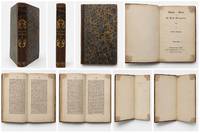
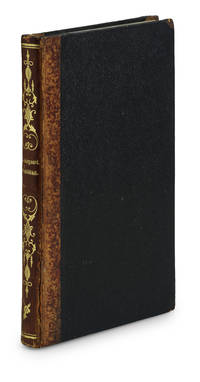
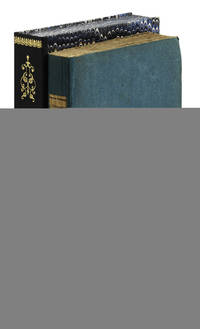
1843ref. 53093Kjøbenhavn Copenhagen 1843-1845. 8vo. Near contemporary half calf with richly gilt spine. Binding with very light wear. Front free end-paper with the ownership-inscription of Michael Bentzon and his acquisition date of 1855 the same year that Kierkegaard died. Some brownspotting here and there and the first couple of leaves of "To opbyggelige Taler 1844" with a damp stain. Neat underlinings in the text as well as several marginalia mostly in pencil. A very good copy indeed. IV 52 62 84 59 70 111pp. Complete with all the half-titles and the joint title-page without the blank leaf after the preface of "To opbyggelige Taler 1844" - which is not called for and hardly ever present. First edition of Kierkegaard's important Eighteen Upbuilding Discourses which comprise his two three and four upbuilding discourses from the years 1843-45 with the joint title-page of all eighteen. The work constitutes Kierkegaard's religious works which supplement his theological and philosophical ones.The first upbuilding discourses were published the same year as Either-Or and it is interesting to note that in opposition to his major philosophical works the religious upbuilding discourses actually bear the name of the author on the title-page -a fact that was by no means incidental. While the pseudonymous works could make one doubt the religiousness of the author the parallelly written religious discourses stress the fact that we are dealing with an author who was religious from the very beginning -a fact that Kierkegaard also wished to underline himself; in his journals he clearly states that the religious discourses bear as much significance for his work as a whole as do the larger pseudonymous works "I began with "Either-Or" and two upbuilding discourses." he says and explains that he intended the upbuilding the religious to advance and that he wanted to show "that the writer was not an esthetic author who in the course of time grew older and for that reason became religious" Journals IX A 227.The importance of the upbuilding discourses and the close relationship they have with the major works and Kierkegaard's philosophical development is also stressed by the fact that every pseudonymous work was accompanied by a little collection of "upbuilding discourses" until "Concluding Postscript" appeared.Himmelstrup 85. unknown
1843ref. 8Either/Or Danish: Enten – Eller is the first published work of Danish philosopher Søren Kierkegaard. Volume 2 only. First edition. First printing. C.A. Reitzel Kjøbenhavn. 1843. Very good condition for an 1843 edition. Bound in an attractive contemporary half leather binding with marbled paper-covered boards. The binding is solid and structurally sound with moderate rubbing and wear to the spine corners and board edges consistent with age. The text block is complete and firmly attached. Pages are clean and fully legible showing expected age toning with occasional light foxing and minor staining. Blank endpapers display old pencil ownership or catalogue annotations and some dampstaining near the corners. No significant tears or loss of text were observed. Overall a well-preserved and highly presentable copy with an attractive period binding retaining its historical character. C.A. Reitzel, hardcover
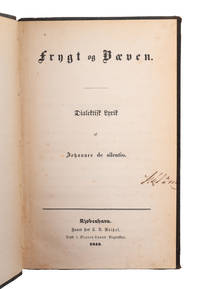
1843ref. 62092Kjøbenhavn, 1843. 8vo. Contemporary dark brown half cloth with gilt lettering to spine. Capitals and a bit of the front hinge worn, but overall very nice and tight. Internally a bit of brownspotting (as always due to the quality of the paper), but less than usual. Old owner's signature to title-page. VIII, 135 pp.
1843ref. 62092Kjøbenhavn 1843. 8vo. Contemporary dark brown half cloth with gilt lettering to spine. Capitals and a bit of the front hinge worn but overall very nice and tight. Internally a bit of brownspotting as always due to the quality of the paper but less than usual. Old owner's signature to title-page. VIII 135 pp. First edition of one of Kierkegaard's most important and sought-after works Fear and Trembling which is rather more difficult to find than most of his other works. Fear and Trembling is one of Kierkegaard’s most important works. And it is also one of his most difficult. It deals – in forceful brevity – with the relationship between reason and faith and provides us with Kierkegaard’s most thorough exposition of the religious stage which he considered the most meaningful form of existence. It is here that Kierkegaard introduces the “tragic hero” and contrasts it to the “Knight of Faith” who both ignore their own wishes for a higher good. These two essential figures epitomize the ethical and the religious and pave the way for the understanding of these stages in Kierkegaard’s philosophy. It is arguably also here that the idea of the essential leap of faith is introduced for the first time. The Knight of Faith sacrifices his son at the command of God and thus sets aside an ethical demand in in order to attain a higher goal that exists beyond the ethical. This teleological suspension of the ethical requires a leap of faith that is only possible through faith in virtue of the absurd. Himmelstrup 48. hardcover
1841(Copenhagen), 1841-1846. Lex 8vo. Bound in three contemporary uniform black full cloth bindings with gilt lettering and numbering to spines. Extremities a bit worn and hinges a bit weak. Some brownspotting. Overall a pretty good set. Richly illustrated throughout, both in the text and with plates.
1855ref. 63624Kjøbenhavn Reitzel 1855. 8vo. 20 31 16 23 32 26 47 30 22 pp. Bound in a very nice contemporary brown half calf binding with richly gilt spine. Lovely patterned end-papers. Light bumping to corners and inner hinge a bit weak. Internally a bit brownspotted. Inserted between the front free end-paper and the title-page are two leaves constituting a neatly written index of all 64 articles contained in the nine issues in fine contemporary hand signed H.W. Petersen. The text is continually paginated throughout in the same hand. With faded ownership signature to title-page Emily Karen Holst. A lovely copy of the first edition of all nine numbers of Kierkegaard’s fierce periodical with all nine issues in the first issue which is uncommon and beautifully bound contemporarily. No presentation-copies nor gift-bindings of the present work are known to exist neither are copies in original bindings nor wrappers as the issues were presumably never issued such but just as they appear here. Having commenced his attack on the Church in “The Fatherland” to pave the way for the final blow that is to come in the course of 1855 Kierkegaard establishes a periodical with the sole purpose of attacking the Church the priests and the official Danish Christianity as such. Kierkegaard is the publisher the editor and the only contributor. This is a focused sharp and destructive periodical intended to shock and to tear down the established Church. It is also witty and acute. Nine issues containing several articles each appeared between May 25 and September 24. The issues were published at one-to-four-week intervals up until Kierkegaard’s death. He collapsed in the street after having published the ninth issue of “The Moment”. A tenth was later found in his home finished but not dated for publication. This was published posthumously. The Moment-articles were extremely popular sold out quickly and were published in several issues. They shocked and outraged most of the Christian population but they also amused and inspired. Some of the articles were so outrageous that many thought the greatest mind of the country had lost his mind. Some speculated that Kierkegaard had been excluded from publishing in The Fatherland which is why he had to found his own organ of proclamation. This was not the case however. In an unpublished draft for an article for no. 9 of The Moment he explains that he had come to realize that The Fatherland was not effective enough. He had told Giødwad that “it will come to nothing as long as I use The Fatherland I need my own instrument” and explains that it is necessary for his contemporaries to deal with him alone. He goes on to talk about the immense effect The Moment has had how all talk about keeping him quiet evaporated and how he has probably reached as wide an audience as he could in The Fatherland but now knowing that ALL of his subscribers were interested in his cause and not just subscribers to The Fatherland. See SKS Introduction to Øieblikket 235. The initial title for “The Moment” had been “In the Moment – For Posterity” but Kierkegaard ended up just calling it “The Moment” as it was more powerful and the longer title would become tedious when continually repeated. Altogether Kierkegaard published a whole 64 articles in” The Moment” distributed thus: May 24 1855: 4 articles June 4 1855: 10 articles June 27 1855: 6 articles July 7 1855: 7 articles July 27 1855: 9 articles August 23 1855: 6 articles August 30 1855: 9 articles September 11 1855: 7 articles September 24 1855: 6 articles In his earlier works For Self Examination and Practice in Christianity from 1850 and 1851 respectively Kierkegaard had already addressed the topic of true Christianity as opposed to the official and institutionalized Christendom. Back then he had done so not subtly but also not as a full-blown attack. After a publishing hiatus of more than three years this was going to change. At the end of his life Kierkegaard embarked on a controversial and fierce attack upon the Danish Church that would have immense consequences for the development and comprehension of the official Church the priesthood and Christianity itself. The Danish State Church epitomized all that he found wrong with Christendom as a whole and he did not embark on his quest lightly. Throughout his writings Kierkegaard had maintained that the belief in Christ required a leap of faith and all of one’s person. The Danish Lutheran church on the other hand claimed that all Danes were born Lutheran and were thus Christians unless they actively chose not to be. The Danish Church had moved increasingly towards transforming Christianity into a profane state religion. It is still the case in Denmark today that when you are born a Dane you are also born a member of the Church. This equivalence between Church and State was extremely far from what Kierkegaard believed Christianity to be. Kierkegaard felt that the Church had betrayed the Christianity of the New Testament and he was willing to fight till his death to defend what he understood true Christianity to be. We were well beyond thoughts of reformation. It needed to be torn down and completely rebuilt. The war was waged in newspaper articles in the paper The Fatherland and in the “periodical” Kierkegaard himself founded with the sole purpose of attacking the Church “Øieblikket” i.e. The Moment in nine installments from May 26 to September 24 1855 with a tenth appearing posthumously. “These writings are markedly different from the rest of his work. Obviously intended for a broad audience they employed searing wit and satire making no attempt to be subtle or nuanced. Amid this public battle Kierkegaard collapsed on the street paralyzed and was taken to hospital. He died there a few weeks later on 11 November 1855. A tentative diagnosis of the cause was tuberculosis of the spine marrow. Towards the end Kierkegaard affirmed to Emil Boesen—a lifelong friend and a priest in the church that Kierkegaard had attacked—that he was still a believer in Christ.” D. Anthony Storm. Kierkegaard’s assault on official Christendom and the Danish Church was based upon his notion that Christendom had departed too far from the Christianity of The New Testament. For the outraged Kierkegaard Bishop Mynster typified the complacent and established “official” Christianity but the relationship with Mynster was complicated. He and Kierkegaard had always been closely intertwined. Few people played as important a role in Kierkegaard’s life as Mynster who Kierkegaard would constantly relate and refer to. Kierkegaard’s “mild” attack on the Church and the established Christianity in Denmark in Training in Christianity 1851 hit Mynster harder than anyone else and the two theological giants never reconciled after the publication of that work. But Kierkegaard had saved something much worse for later. For his own enormous respect for Mynster it also meant a great deal that Mynster was the last person to talk to Kierkegaard’s father before he died and that his father had always held him in extremely high regard. In his Journal from 1853 he writes “.I have something upon my conscience as a writer. Let me indicate precisely how I feel about it. There is something quite definite I have to say and I have so much upon my conscience that as I feel I dare not die without having uttered it. For the instant I die and so leave this world so I understand it I shall in the very same second so frightfully fast it goes! in the very same second I shall be infinitely far away in a different place where still within the same second frightful speed! the question will be put to me: “Hast thou uttered the definite message quite definitely” And if I have not done so what then. There is something quite definite I have to say. But verily I am not eager to say it. On the contrary I would so infinitely prefer that another should say it— which however would not help me since as I understand it it was and remains my task. For it is not a cheerful message this definitive thing and I cannot but think that there are several persons dear to me to whom it would be unwelcome to hear it said. Above all there is a right reverend old man a consideration which has constantly held me back laid a restraint upon my tongue and upon my pen a consideration for the highest dignitary of the Church a man to whom by the memory of a deceased father I felt myself drawn with an almost melancholic affection—and I must think that to him especially it will be very unwelcome that this is said.” Pap. X 6 B: 371. This excellently sums up one the one hand the necessity Kierkegaard felt in saying what needed to be said about the state of Christianity in Denmark and on the other hand why he was reluctant to say it. He knew it would offend but most of all hurt especially Mynster for whom he still had great affection. At the same time it was also Bishop Mynster who was responsible for the approach Kierkegaard considered so dangerous to true Christianity the person who personified the weak and complacent established “official” Christianity that disregarded the true Christianity of The New Testament – the kind of tame Christianity in which the priests tell the congregation what they want to hear. What was he to do Kierkegaard’s journals and papers are full of entries that reflect the conundrum. The defining moment occurred when Mynster had died which happened on January 30th 1854. The Sunday before the funeral Professor of Theology H.L. Martensen Court Preacher at Christiansborg Slotskirke gave a commemorative sermon for Mynster in which he included him in a series of holy men going back to the apostles and called him a “witness to the truth” and a “martyr” in Danish “Blodvidne”. Kierkegaard could not take it. He finally broke his silence and protested with an article in The Fatherland where he called Mynster a “frail pleasure-seeker who was great only as an orator” and presented his own version of a “witness to the truth” namely “A witness to the truth a real witness to the truth is a man who is skinned alive abused dragged from one prison to the next and in the end … crucified beheaded burned at the stake or fried on a grill his soulless body left unburied and sprawling … in some remote place—that’s how a witness to the truth is buried!” Var Biskop Myster et ”Sandhedsvidne”… December 18 1854. And thus the crusade against the established Danish Church had begun. Kierkegaard continued his fight against Martensen against the priests against the official Christianity of Denmark and against the Church in articles in The Fatherland. And most importantly he started his own periodical “The Moment” which was to become extremely influential and today towers as a monument over the greatest crisis the Danish Church has ever found itself in. In “The Moment” Kierkegaard polemicized against the church and its worldly priesthood with both sharpness and wit. He insisted that the authorities of the church admit that true Christianity was disappearing. Kierkegaard would intensify his attacks over the course of “The Moment”. He accused the priests of failing to convert their tear-filled sermons on Sundays into existential practice on Mondays. He called them “bourgeois theologians of convenience” and accused them of being primarily interested in idyllic parsonages feel good Christianity and lucrative advancements calling the priests lumped together an “epitome of nonsense shrouded in long gowns!” He rallied against the church claiming it ought to be closed or torn down and threw mud on the rituals of baptism confirmation and marriage. In “The Moment” this was done so humorously that Kierkegaard managed to win over part of the population. But his fierce attack upon the official Christianity of Denmark caused much more indignation scandal and contradiction than approval. Although Kierkegaard’s illness and soon to follow death on November 11 ended Kierkegaard’s writing and continued attacks it did not end the storm on the Church that the epigons continued. Kierkegaard’s authorship before 1851 had made him famous in both Denmark and abroad as one of the greatest living philosophers and theologians. His attack on official Christianity however had a more direct effect upon his own kingdom but also upon the neighbouring countries Norway Sweden and Germany. Kierkegaard’s Church Feud continued for years after his death and kept affecting the Church severely. One must remember that this fierce attack came from one of the most respected thinkers of the period – of all periods – and it came from within not from an atheist. It came from a believer a more profound believer than most. Kierkegaard only had part of “The Moment” in his possession when he died namely 3 4 and 7 together Auction Catalogue no. 2187-89. We have never seen a copy in a gift-binding and as far as we are aware no such copy is known to exist. Himmelstrup 180 The present copy is no. 92 in Girsel's "Kierkegaard" The Catalogue which can be found here. unknown
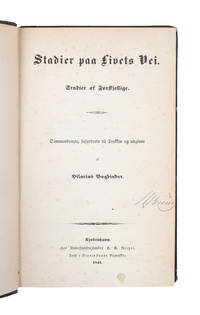
1845ref. 62096Kjøbenhavn [Copenhagen], 1845. Lex8vo. Nice contemporary brown half cloth with gilt title to spine. Capitals worn and wear along upper front hinge. Corners worn. In spite of the wear, an attractive and tight copy. First and last leaves with a bit of brownspotting, otherwise only light occasional spotting. Old owner's signature to title-page. VIII, 383 pp.
1845ref. 62096Kjøbenhavn Copenhagen 1845. Lex8vo. Nice contemporary brown half cloth with gilt title to spine. Capitals worn and wear along upper front hinge. Corners worn. In spite of the wear an attractive and tight copy. First and last leaves with a bit of brownspotting otherwise only light occasional spotting. Old owner's signature to title-page. VIII 383 pp. First edition of one of Kierkegaard's main works "Stages on Life's Way" his pivotal sequal to his main work "Either-Or" in which he had presented the first two stages the aesthetic and the ethical. In "Stages on Life's Way" he continues his work on these stages and moves on to present also the religious stage which takes up ab. two thirds of the work. The religious stage is that in which man attains a personal relationship with God and that in which man only truly begins to exist as the aesthetic and ethical stages are inadequate. It is in this foundational work in the religious stage that Kierkegaard first properly describes what is now known as the "Leap of Faith" in fact a "leap to faith" namely the leap that involves willing and belief in stead of reason and knowledge the leap that you make in order to connect to God and which requires that which he calls "the suspension of the ethical". Stages on Life’s Way is one of Kierkegaard’s most important works. Not only does it sum up and explain some of the most important themes of Kierkegaard’s previous works utilizing the characters and pseudonymous authors of the earlier works to do so; it goes beyond these foundational themes introduces the religious stage and points to the further development of the central themes in Kierkegaard’s philosophy most of which are only fully developed in Concluding Unscientific Postscript. hardcover
1841ref. 62112Kjøbenhavn, P.G. Philipsens Forlag, 1841. 8vo. (4), 350 pp., 1 f. (blank), 2 pp. (advertisements). Completely uncut and partly unopened in the original brown cardboard binding. Rebacked with paper perfectly matching that of the boards. Corners restored. Title-page evenly browned and a few leaves with a bit of brownspotting, but overall in unusually nice condition, clean, fresh, and bright. Completely unmarked.
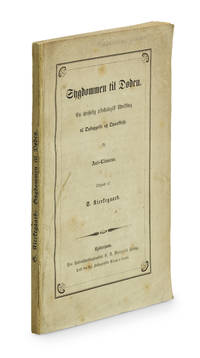
1849ref. 63617Kjøbenhavn, Reitzel, 1849. 8vo. (8), 136 pp. Uncut in the original printed wrappers. The front wrapper with the text of the title-page (all except the year) repeated inside a double-line border, inside which a line-border with ornamental corner-pieces. Back-wrapper with the year inside the same frame. Excellently rebacked and with a closed tear to the front wrapper. Wrappers with light brownspotting. Some brownspotting, mostly to first and last leaves. With the ownership signature of Henning Kehler to front free end-paper.
1841ref. 62112Kjøbenhavn P.G. Philipsens Forlag 1841. 8vo. 4 350 pp. 1 f. blank 2 pp. advertisements. Completely uncut and partly unopened in the original brown cardboard binding. Rebacked with paper perfectly matching that of the boards. Corners restored. Title-page evenly browned and a few leaves with a bit of brownspotting but overall in unusually nice condition clean fresh and bright. Completely unmarked. A fabulous copy of the first edition of Kierkegaard’s dissertation here in the original binding which is of the utmost scarcity. We have only seen it in this state once before. And of all the copies we have handled of the Irony over the last decades we have only once before come across a copy with the advertisement-leaf in the back. This is virtually never present. This completely uncut copy is approximately 1 cm taller and wider than regular copies. The spines of the original Kierkegaard cardboard bindings are always just thin paper directly glued on the block making them extremely fragile especially on the thicker volumes. If one finds these original bindings the spines are almost always more or less disintegrated. Kierkegaard's dissertation constitutes the culmination of three years’ intensive studies of Socrates and “the true point of departure for Kierkegaard’s authorship” Brandes. The work is of the utmost importance in Kierkegaard’s production not only as his first academic treatise but also because he here introduces several themes that will be addressed in his later works. Among these we find the question of defining the subject of cognition and self-knowledge of the subject. The maxim of “know thyself” will be a constant throughout his oeuvre as is the theory of knowledge acquisition that he deals with here. The dissertation is also noteworthy in referencing many of Hegel’s theses in a not negative context something that Kierkegaard himself would later note with disappointment and characterize as an early uncritical use of Hegel. Another noteworthy feature is the fact that the thesis is written in Danish which was unheard of at the time. Kierkegaard felt that Danish was a more suitable language for the thesis and hadto petition the King to be granted permission to submit it in Danish rather than Latin. This in itself poses as certain irony as the young Kierkegaard was known to express himself poorly and very long-winded in written Danish. One of Kierkegaard’s only true friends his school friend H.P. Holst recounts in 1869 how the two had a special school friendship and working relationship in which Kierkegaard wrote Latin compositions for Holst while Holst wrote Danish compositions for Kierkegaard who “expressed himself in a hopelessly Latin Danish crawling with participial phrases and extraordinarily complicatedsentences” Garff p. 139. When Kierkegaard in 1838 was ready to publish his famous piece on Hans Christian Andersen see nr. 1 & 2 above which was to appear in Heiberg’s journal Perseus Heiberg had agreed to publish the piece although he had some severe critical comments about the way and the form in which it was written – if it were to appear in Perseus Heiberg demanded at the very least the young Kierkegaard would have to submit it in a reasonably readable Danish. “Kierkegaard therefore turned to his old schoolmate H. P. Holst and asked him to do something with the language…” Garff p. 139. From their school days Holst was well aware of the problem with Kierkegaard’s Danish and he recounts that over the summer he actually “translated” Kierkegaard’s article on Andersen into proper Danish. The oral defense was conducted in Latin however. The judges all agreed that the work submitted was both intelligent and noteworthy. But they were concerned about its style which was found to be both tasteless long-winded and idiosyncratic. We already here witness Kierkegaard’s idiosyncratic approach to content and style that is so characteristic for all of his greatest works. Both stylistically and thematically Kierkegaard’s and especially a clear precursor for his magnum opus Either-Or that is to be his next publication. The year 1841 is a momentous one in Kierkegaard’s life. It is the year that he completes his dissertation and commences his sojourn in Berlin but it is also the defining year in his personal life namely the year that he breaks off his engagement with Regine Olsen. And finally it is the year that he begins writing Either-Or. In many ways Either-Or is born directly out of The Concept of Irony and is the work that brings the theory of Irony to life. Part One of the dissertation concentrates on Socrates as interpreted by Xenophon Plato and Aristophanes with a word on Hegel and Hegelian categories. Part Two is a more synoptic discussion of the concept of irony in Kierkegaard’s categories with examples from other philosophers. The work constitutes Kierkegaard’s attempt at understanding the role of irony in disrupting society and with Socrates understood through Kierkegaard we witness a whole new way of interpreting the world before us. Wisdom is not necessarily fixed and we ought to use Socratic ignorance to approach the world without the inherited bias of our cultures. With irony we will be able to embrace the not knowing. We need to question the world knowing we may not find an answer. The moment we stop questioning and just accept the easy answers we succumb to ignorance. We must use irony to laugh at ourselves in order to improve ourselves and to laugh at society in order to improve the world. The work was submitted to the Philosophical Faculty at the University of Copenhagen on June 3rd 1841. Kierkegaard had asked for his dissertation to be ready from the printer’s in ample time for him to defend it before the new semester commenced. This presumably because he had already planned his sojourn to Berlin to hear the master philosopher Schelling. On September 16th the book was issued and on September 29th the defense would take place. The entire defense including a two hour long lunch break took seven hours during which ”an unusually full auditorium” would listen to the official opponents F.C. Sibbern and P.O. Brøndsted as well as the seven “ex auditorio” opponents F.C. Petersen J.L. Heiberg P.C. Kierkegaard Fr. Beck F.P.J. Dahl H .J.Thue og C.F. Christens not to mention Kierkegaard himself. Two weeks later on October 12th Kierkegaard broke off his engagement with Regine Olsen for the implications of this event see the section about Regine in vol. II. The work appeared in two states – one with the four pages of “Theses” for academics of the university whereas the copies without the theses were intended for ordinary sale. These sales copies also do not have “Udgivet for Magistergraden” and “theologisk Candidat” on the title-page. The present copy is one of the sales-copies without theses. Himmelstrup 8 The present copy is no. 11 in Girsel's "Kierkegaard" The Catalogue which can be found here. hardcover
1849ref. 63617Kjøbenhavn Reitzel 1849. 8vo. 8 136 pp. Uncut in the original printed wrappers. The front wrapper with the text of the title-page all except the year repeated inside a double-line border inside which a line-border with ornamental corner-pieces. Back-wrapper with the year inside the same frame. Excellently rebacked and with a closed tear to the front wrapper. Wrappers with light brownspotting. Some brownspotting mostly to first and last leaves. With the ownership signature of Henning Kehler to front free end-paper. A magnificent copy of the first edition in the extremely rare original wrappers with a very interesting provenance. Sickness unto Death is one of the main works of Christian existentialism. It is this monumental work which introduces the new pseudonym of Anti-Climacus that we find Kierkegaard’s concept of despair and it is here that he develops his theory of “the sin of despair”. Together with Training in Christianity Kierkegaard considered Sickness Unto Death ”the most valuable I have produced” and indeed many consider this work the most perfect of all of his works. Here Christianity is expressed in its most idealized form. Kierkegaard suffered daily from worries that publishing the work would convey that he was himself an ideal Christian and he long left it unpublished. Finally after more than a year of worries and considerations he decided that as with his major philosophical works this too would have a pseudonymous author and himself merely as the publisher. The pseudonym here however had another purpose than the earlier ones. Instead of deceiving or qualifying the work esthetically the pseudonym is chosen for Kierkegaard not to present himself as the perfect Christian. He chose a new pseudonym that perfectly contrasted the author of Philosophical Fragments and Concluding Unscientific Postscript Johannes Climacus who did not see himself as a Christian namely Johannes Anti-Climacus and finally after more than a year of hesitation Kierkegaard could publish his religious masterpiece with peace of mind. “Anti-Climacus is also the author of Practice in Christianity. He might be considered the author of Kierkegaard’s greatest religious works just as Johannes Climacus is the author of the great pseudonymous esthetic works. H. Hong remarks “The prefix Anti- does not mean ‘against.’ An old form of ‘ante’ before as in ‘anticipate’ the prefix denotes a relation of rank as in ‘before me’ in the First Commandment”. In his journals Kierkegaard said “Climacus is lower denies he is a Christian. Anti-Climacus is higher a Christian on an extraordinarily high level”. Kierkegaard considered this work and Practice in Christianity to be among his most important. The Sickness Unto Death is a companion piece to the Concept of Anxiety which is also a “psychological” work and moves beyond the earlier preliminary psychological considerations of anxiety in the face of freedom or anxiety derived from and leading to sin. Like its companion this work is short but very dense. Here Kierkegaard considers the spiritual aspects of despair. As anxiety is related to the ethical despair is related to the religious that is to the eternal.” D. Anthony Storm Commentary on Kierkegaard. Kehler Henning 1891-1979 was a critic journalist and book collector. He was an important literary critic and especially influential in the years between to two world wars where he excelled in sharp conservative criticism of contemporary affairs. He wished to revitalize Danish culture and was worried about the contemporary materialism and lack of God. Kehler’s collection broadly focused on Danish literature included a significant collection of Kierkegaard. The present copy is no. 71 in Girsel's "Kierkegaard" The Catalogue which can be found here. unknown
1836Kjøbenhavn [i.e. Copenhagen], 1836. Large 4to. I: Loose, as issued, unbound. With a horizontal and a vertical crease down the middle. 4 pp. II: Loose, as issued, unbound, but inserted into a simple paper folder (small 8vo). With a horizontal and a vertical crease down the middle. 4 pp. + 4 pp. III: Loose, as issued, unbound, but inserted into a simple paper folder (small 8vo). With a horizontal and a vertical crease down the middle. 4 pp.
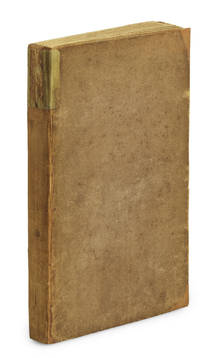
1850ref. 63619Kjøbenhavn, Reitzel, 1850. 8vo. (4), 277 pp. Completely uncut in the original blue cardboard binding. Magnificently preserved with the spine almost completely intact, including the original printed paper title-label. Tiny loss of paper to the capitals and a little loss to the lower front hinge. A small crack to lower back hinge, but binding remarkably firm and tight. Very neat re-enforcements to inner hinges, otherwise unrestored. Light occasional brownspotting. Pencil-annotation to inside of front board. A four-line annotation (about Dean Gude and a sermon he gave in April 1885) to foot of p. 98. With the ownership signature of H.P. Kierkegaard, also dated in his hand “d. 26de September 1850”. Housed in a beautiful black glitted box with elaborate gilding and Gothic gilt lettering to spine (Harry Larsen). A bit of wear to extremities. Himmelstrup 121.
1848ref. 63614Kjøbenhavn, Reitzel, 1848. 8vo. 103 pp. + 74 pp. + 96 pp. + 77 pp. In the four original blue cardboard-bindings, exactly as the work appeared. With the joint title-page in the first volume, and with all the separate half-titles and separate title-pages. The volumes have a bit of edgewear and a little loss of paper here and there. Two volumes have been rebacked with paper matching the original. The fourth part has a bit of light scattered brownspotting, but internally, all volumes are remarkably clean and fresh. A splendid set. Housed in a beautiful custom-made box with red morroco spine with gilt Gothic lettering and double gilt lines. Sides covered in red marbled paper. Box made by Hanne Jensen.
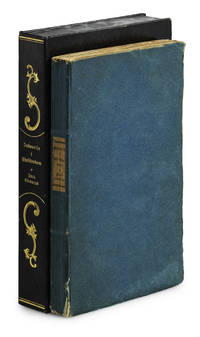
1847ref. 63613Kjøbenhavn, Reitzel, 1847. 8vo. (2), 224" 203 pp. Completely uncut in the original blue cardboard binding. Professionally rebacked with paper matching that of the boards and excellently preserving the original printed paper title-label almost in its entirety, missing only a tiny part of the blank outer edge. Slight wear to extremities, a small hole to the outer layer of the front board and back board with a crease, from the verso. Brownspotting as usual. Overall a truly excellent copy. Housed in a beautiful custom-made box with a dark grey morocco spine with rich gilding in pastichestyle and with gilt Gothic lettering. Sides covered in marbled paper in grey and blue tones. Gilt super ex libris to front and signed in gilt lettering to the inside: Anker Kysters Eftf. and gilt by Hagel Olsen.
1843ref. 61020Kjøbenhavn, P.G. Philipsens Forlag, 1843 - 45. 8vo. Nice contemporary half calf with gilding to spine. Slight wear to capitals and corners and spine a little spotted. Overall very nice. Some leaves with brownspotting, but also internally nicer and fresher than usual. Contemporary owner's inscription to front free end-paper, dated 1854. A very nice copy. (4), 6284 59 (including the blank leaf between the title-page and the preface) 70, (2, - i.e. 1 blank f.)" 111 pp.
1848ref. 63614Kjøbenhavn Reitzel 1848. 8vo. 103 pp. 74 pp. 96 pp. 77 pp. In the four original blue cardboard-bindings exactly as the work appeared. With the joint title-page in the first volume and with all the separate half-titles and separate title-pages. The volumes have a bit of edgewear and a little loss of paper here and there. Two volumes have been rebacked with paper matching the original. The fourth part has a bit of light scattered brownspotting but internally all volumes are remarkably clean and fresh. A splendid set. Housed in a beautiful custom-made box with red morroco spine with gilt Gothic lettering and double gilt lines. Sides covered in red marbled paper. Box made by Hanne Jensen. A truly remarkable set of the first edition in completely original condition with all four parts in the original bindings which is a true rarity. We have never seen a copy in this state before. Published in the midst of the politically tumultuous and revolutionary year 1848 Kierkegaard's Christian Discourses occupies a unique and inspirational position in European literature. With its simplicity and reflective inwardness the four sections of discourses both invoke Kierkegaard's collision with the established order of Christendom but at the same time serve as reassuring affirmations of the blessedness of Christian life – in the midst of a world that seemed to be governed by suffering uproar and fundamental change. Marx had published his Communist Manifesto on February 29 1848 Denmark had just gotten its first Prime Minister on March 22 and would get its first Constitution a year later. Kierkegaard's Christian Discourses was published on April 25 1848. This was amid the most widespread revolutionary wave in European history also known as The Springtime of Nations and a mere month after the fall of the absolute monarchy in Denmark March 21st. But Kierkegaard recognized only one danger: the religious danger. On March 27 1848 he wrote in his journal: "So here I sit. Outside everything is in movement nationalism surges high in all everyone talks of sacrificing life and blood is perhaps ready to do it but supported by the omnipotence of public opinion. And here I sit in a quiet room I will doubtlessly soon be in ill repute for indifference to the national cause; I recognize only one danger: the religious danger." NB 4:118. The Christian Discourses consists of twenty-eight discourses that are divided into four equal sections of seven discourses each on Biblical texts. The work is arranged in contrasting styles. Whereas Parts One The Cares of the Pagans and Three Thoughts That Wound from Behind--for Upbuilding are polemical and can be read as invoking Kierkegaard's collision with the established order of Christendom Parts Two Joyful Notes in the Strife of Suffering and Four Discourses at the Communion on Fridays are reassuring for the single individual affirming the joy and blessedness of a Christian life. The work is written in a simple style accessible for everyone and it presents key Christian themes and concepts in a clear and simple way thus serving as one of the best introductions to the Christendom of Kierkegaard. It is furthermore here that he introduces his Discourses at the Communion on Fridays a completely novel genre that came to play a significant role in Kierkegaard's later writings. The work was published in four parts with separate title-pages and with half-titles stating First to Fourth section. The work is almost always found in one volume as it also appeared but the four parts also appeared separately. The present copy is no. 60 in Girsel's "Kierkegaard" The Catalogue which can be found here.
1850ref. 63619Kjøbenhavn Reitzel 1850. 8vo. 4 277 pp. Completely uncut in the original blue cardboard binding. Magnificently preserved with the spine almost completely intact including the original printed paper title-label. Tiny loss of paper to the capitals and a little loss to the lower front hinge. A small crack to lower back hinge but binding remarkably firm and tight. Very neat re-enforcements to inner hinges otherwise unrestored. Light occasional brownspotting. Pencil-annotation to inside of front board. A four-line annotation about Dean Gude and a sermon he gave in April 1885 to foot of p. 98. With the ownership signature of H.P. Kierkegaard also dated in his hand “d. 26de September 1850”. Housed in a beautiful black glitted box with elaborate gilding and Gothic gilt lettering to spine Harry Larsen. A bit of wear to extremities. Himmelstrup 121. A splendid copy of the first edition in original condition – in the original binding with the exceedingly rare original printed title-label preserved – which has belonged to Kierkegaard’s disabled cousin who was a great source of inspiration to him. Kierkegaard’s confidante and close friend his cousin H.P. Kierkegaard received this copy the day after it was published Sept. 25th. We have never seen a copy in this state before with the original title-label preserved. By Kierkegaard himself described as his “most perfect and truest” work and by Mynster considered “a profane game with the holy” Training in Christianity is one of the most important and most controversial of all of Kierkegaard’s works. As Kirmsse says “it marks the beginning of a relentless and single-minded campaign against “Christendom” “ heralding his feud with the established Church and the Danish priesthood. In many ways Training in Christianity is considered one of the most quintessential Kierkegaardian works having at the centre of attention the question of how to become a Christian in Christendom leading ultimately to a fierce attack on the Danish church. It is in this work that Kierkegaard fully exposes his conception of the religious individual and fully describes the personal suffering that comes with being a Christian. Christ is considered the rolemodel and true Christendom consists in following him. Thus the Christian will also suffer for his faith though no man shall become a martyr for the truth. Kierkegaard thus also distinguishes sharply between the established triumphant church and the true struggling one which comes to constitute the essence of his attack on the established Danish Church. The work is published under the same pseudonym as Sickness Unto Death Anti-Climacus and also here the pseudonym is not meant to deceive or to qualify the work aesthetically. On the contrary this work evokes an idealized Christianity and Kierkegaard did not wish to convey that he was himself such an ideal Christian. “Anti-Climacus is also the author of The Sickness Unto Death. He might be considered the author of Kierkegaard’s greatest religious works just as Johannes Climacus is the author of the great pseudonymous esthetic works. H. Hong remarks “The prefix Anti- does not mean ‘against.’ An old form of ‘ante’ before as in anticipate the prefix denotes a relation of rank as in ‘before me’ in the First Commandment”. In his journals Kierkegaard said “Climacus is lower denies he is a Christian. Anti-Climacus is higher a Christian on an extra ordinarily high level”. Kierkegaard used Anti Climacus to write from the vantage point of a perfect Christian because he himself could not claim to be one. It should also be added that Kierkegaard decided to remove this pseudonym at the last moment by hurrying to the printer but was too late.” Dr. Anthony Storm Commentary on Kierkegaard. Along with being his “most perfect and truest” work Kierkegaard also thought it to be together with The Sickness Unto Death his most important. Concluding that Christendom had departed so far from the Christianity of The New Testament Kierkegaard with Training in Christianity seeks to reintroduce Christianity into Christendom. The work’s perfection lies in its combination of preaching and polemics. and truest thing.» In his reflections on such topics as Christ's invitation to the burdened the imitatio Christi the possibility of offense and the exalted Bishop Mynster who was then the face of the Danish Church was outraged when he read the book and called it «a profane game with the holy». Mynster and Kierkegaard had always been closely intertwined. In many ways Kierkegaard considered him almost family but for the outraged Kierkegaard Mynster also typified the complacent and established «official” Christianity. Few people were as important to Kierkegaard as Mynster and no-one else suffered as severely from his attack on the established Christianity in Denmark. The two theological giants never reconciled. For Kierkegaard the radical commandments of Christianity and what it demands from the individual are absolutely essential and with Training in Christianity he begins his crusade against the kind of tame Christianity in which the priests tell the congregation what they want to hear. ”Of the many works he wrote during 1848 his “richest and most fruitful year” Kierkegaard specified Practice in Christianity as «the most perfect Christ he takes as his theme the requirement of Christian ideality in the context of divine grace. Addressing clergy and laity alike Kierkegaard asserts the need for institutional and personal admission of the accommodation of Christianity to the culture and to the individual misuse of grace. As a corrective defense the book is an attempt to find ideally a basis for the established order which would involve the order’s ability to acknowledge the Christian requirement confess its own distance from it and resort to grace for support in its continued existence. At the same time the book can be read as the beginning of Kierkegaard’s attack on Christendom. Because of the high ideality of the contents and in order to prevent the misunderstanding that he himself represented that ideality Kierkegaard writes under a new pseudonym Anti-Climacus.” Hong edition. The present copy is no. 78 in Girsel's "Kierkegaard" The Catalogue which can be found here. unknown
1847ref. 63613Kjøbenhavn Reitzel 1847. 8vo. 2 224; 203 pp. Completely uncut in the original blue cardboard binding. Professionally rebacked with paper matching that of the boards and excellently preserving the original printed paper title-label almost in its entirety missing only a tiny part of the blank outer edge. Slight wear to extremities a small hole to the outer layer of the front board and back board with a crease from the verso. Brownspotting as usual. Overall a truly excellent copy. Housed in a beautiful custom-made box with a dark grey morocco spine with rich gilding in pastichestyle and with gilt Gothic lettering. Sides covered in marbled paper in grey and blue tones. Gilt super ex libris to front and signed in gilt lettering to the inside: Anker Kysters Eftf. and gilt by Hagel Olsen. A splendidly preserved copy of the first edition of Works of Love in the original binding which is very rare. The spines of the original Kierkegaard cardboard bindings are always just thin paper directly glued on the block making them extremely fragile and the original paper-labels are hardly every preserved. Due to its penetrating illuminating analysis of the forms and sources of love Works of Love constitutes the monumental highpoint for Kierkegaard's concept of love. It is the central work for understanding both the various kinds of love and the conditions of love that Kierkegaard identifies and uses as a basis for his thoughts on Christianity. Although the concept of love is a theme throughout many of his writings from Either-Or 1843 through to On the Changelessness of God's Love 1855 it is in the present work that it receives its full form. The work is made up of 18 speeches that each explore the many aspects of love. The dominating theme is the commandment to love God and one's neighbor as one loves oneself. It is through this choice to love that one ideally expresses one's relationship to God. All the obstacles that stand between this choice of love are also explored in full. But it is cemented that love is that which upbuilds and develops the individual and provides the courage to live a life true to oneself. Only if one loves oneself can one love another. These thoughts are fundamental to Kierkegaard's philosophy and to his Christianity. As such Works of Love constitutes one of his most important and fundamental works. "This work is marked by Kierkegaard's Socratic awareness of the reader both as the center of awakened understanding and as the initiator of action. Written to be read aloud the book conveys a keenness of thought and an insightful poetic imagination that make such an attentive approach richly rewarding. Works of Love not only serves as an excellent place to begin exploring the writings of Kierkegaard but also rewards many rereadings." from the Hong-edition. The present copy is no. 57 in Girsel's "Kierkegaard" The Catalogue which can be found here. hardcover
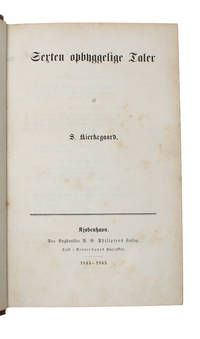
1843ref. 61020Kjøbenhavn P.G. Philipsens Forlag 1843 - 45. 8vo. Nice contemporary half calf with gilding to spine. Slight wear to capitals and corners and spine a little spotted. Overall very nice. Some leaves with brownspotting but also internally nicer and fresher than usual. Contemporary owner's inscription to front free end-paper dated 1854. A very nice copy. 4 62; 84; 59 including the blank leaf between the title-page and the preface; 70 2 - i.e. 1 blank f.; 111 pp. Very rare first edition of this Kierkegaard-title which is without doubt the most difficult to get hold of. "Sixteen Upbuilding Discourses" consists of the popular Two Three and Four Upbuilding Discourses. The unsold copies of these "Opbyggelige Taler" "Upbuilding Discourses" were initially collected under the title "Atten opbyggelige Taler" Eighteen Upbuilding Discourses and published with a collected title-page; when "To opbyggelige Taler" "Two Upbuilding Discourses" from 1843 was sold out the remaining sixteen upbuilding discourses were published with the title-page "Sexten opbyggelige Taler". The number of copies of this scarce title is said to be well under 100 and is thus by far the rarest of all of Kierkegaard's books. unknown
1849ref. 63615Kjøbenhavn, Reitzel, 1849. 8vo. 51 pp. Original gift-binding of the black glitted paper with single gilt lines, all edges gilt, and printed on fine paper. Back hinge cracked and both hinges with loss of paper. Capitals and corners also worn with a bit of loss of paper, and lighter wear along edges of boards. Internally very nice and fresh. A gift-copy, with all likelihood a presentation-copy, from which the presentation has been torn out. Kierkegaard-inscriptions have been the object of many autograph-hunter’s desire, and we have several examples of front free end-papers that have definitely born a presentation-inscription from him, having been torn out.
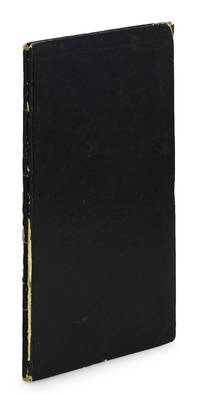
1849ref. 63615Kjøbenhavn Reitzel 1849. 8vo. 51 pp. Original gift-binding of the black glitted paper with single gilt lines all edges gilt and printed on fine paper. Back hinge cracked and both hinges with loss of paper. Capitals and corners also worn with a bit of loss of paper and lighter wear along edges of boards. Internally very nice and fresh. A gift-copy with all likelihood a presentation-copy from which the presentation has been torn out. Kierkegaard-inscriptions have been the object of many autograph-hunter’s desire and we have several examples of front free end-papers that have definitely born a presentation-inscription from him having been torn out. An fabulous copy of the first edition of one of Kierkegaard's treasured works. This is without doubt a gift-binding and thus either one of the copies that Kierkegaard had in his possession when he died and never gave away or it is a presentation-copy from which the presentationinscription is lacking. In the present copy the front free end-paper on which Kierkegaard wrote his presentation-inscriptions in this work has been torn out there are tiny remains from it making the latter scenario by far the most likely. Considered one of Kierkegaard’s most engaging works “The Lily of the Field and the Bird of the Air” consists in three of his most important speeches which represent the highlight of upbuilding existentialist thought. The three main themes of the work are silence obedience and joy and the thread that binds it all together is passion. “Experiencing the greatness of the universe the beauty and the wonder of it can lead to existential silence and induce a wonder that is the beginning of all philosophy. In the chosen book Kierkegaard describes how inexpressibly much one can find joy in that which is near.” Cappelørn. Like Nietzsche Kierkegaard saw the period in which he was born as one characterized by a crisis of faith. But whereas Nietzsche sought to destroy the remnants of a Christianity that was falling apart Kierkegaard wished to create a Christianity that would be able to live and flourish. This is particularly explicit in the present work where he uses his three discourses to analyze the famous biblical Sermon on the Mount. These three Godly discourses vary from his other Discourses – Upbuilding and Various – in answering the by now so familiar question “what it is to be a human being” from a godly standpoint teaching us about silence obedience and joy. Kierkegaard himself described the discourses as “indescribably uplifting” Pap. X 1 A 353 and described the structure meant to make us act and adapt to the “new” Christendom as first esthetic second ethical third religious Pap. VIII 1 A 1. In 2018 a new translation of this seminal work appeared at Princeton University Press the review of which very appropriately stated: “A masterful new translation of one of Kierkegaard’s most engaging works. In the Sermon on the Mount Jesus tells his followers to let go of earthly concerns by considering the lilies of the field and the birds of the air. Soren Kierkegaard’s short masterpiece on this famous gospel passage draws out its vital lessons for readers in a rapidly modernizing and secularizing world. Trenchant brilliant and written in stunningly lucid prose The Lily of the Field and the Bird of the Air 1849 is one of Kierkegaard’s most important books. Presented here in a fresh new translation with an informative introduction this profound yet accessible work serves as an ideal entree to an essential modern thinker. The Lily of the Field and the Bird of the Air reveals a less familiar but deeply appealing side of the father of existentialism – unshorn of his complexity and subtlety yet supremely approachable. As Kierkegaard later wrote of the book “Without fighting with anybody and without speaking about myself I said much of what needs to be said but movingly mildly upliftingly.” This masterful edition introduces one of Kierkegaard’s most engaging and inspiring works to a new generation of readers.” Princeton University Press 2018. It is no wonder that it was precisely this work that was chosen to accompany Danish astronaut Andreas Mogensen into space on September 2nd 2015. With its beautiful descriptions of nature with its strong focus on the value of enjoying the moment and that which is present and with its teaching us to be humble the book seems the perfect choice for man in space. Kierkegaard had three copies of the work in his possession when he died auction catalogue 2156-58. This is one of the scarcest Kierkegaard-titles to find in the trade. When we make our sets of first editions of Kierkegaard’s works this is the one we always have to wait the longest to find. When we finally get a copy it is rarely found on its own and is usually bound with something else. We have only handled few copies of it separately bound. The present copy is no. 64 in Girsel's "Kierkegaard" The Catalogue which can be found here. hardcover
1855ref. 63625Kjøbenhavn, Reitzel, 1855. 8vo. 22 pp., (1 blank f.). Original gift-binding of the black glitted paper with single gilt lines to spine. Spine worn, slightly restored, and with a bit of loss of paper. Boards with a little rubbing and wear along edges. A bit of brownspotting internally. With the exlibris of both Georg Nygaard and J.H. Groth-Andersen to inside of front board and with Georg Nygaard’s neat hand-written pencil-inscription to front fly leaf stating, in Danish, that “This book is one of / Søren Kierkegaard’s / complimentary copies. / Given to me by / editor Frejlif Olsen / October 1910 / Georg Nygaard”. Also a neat pencil-annotation from a later owner to inside of back board stating that this is Kierkegaard’s personal copy and the only known copy in a gift-binding, referencing the auction catalogue, no. 2186. There is also a laid-in note in the same hand explaining that at the auction, there was merely one copy of this title and that no presentation-copies of the present work are known to exist.
1843ref. 62941Kjøbenhavn, Philipsen, 1843-45. 8vo. (4), 52 + 62 (+ 1 blank leaf) + 84 + 59 (including the blank leaf between the title-page and the preface!) + 70 (+ 1 blank leaf) + 111 pp. Completely uncut in the original brownish grey boards with original printed title-label to spine (fully intact). Boards a bit brownspotted and a larger damp stain to top of front board. A couple of smaller stains (lacquer or wax) to spine. A few horizontal creases to spine with paper almost invisibly glued back on to hold tight. Occasional brownspotting, mostly to the first and last leaves. But overall splendidly preserved.