KIERKEGAARD, SORENBiblio.com
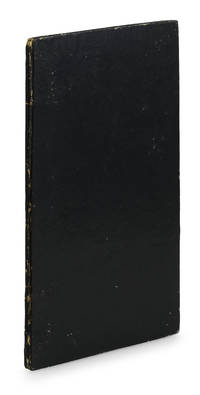
1855réf. 63625Kjøbenhavn Reitzel 1855. 8vo. 22 pp. 1 blank f. Original gift-binding of the black glitted paper with single gilt lines to spine. Spine worn slightly restored and with a bit of loss of paper. Boards with a little rubbing and wear along edges. A bit of brownspotting internally. With the exlibris of both Georg Nygaard and J.H. Groth-Andersen to inside of front board and with Georg Nygaard’s neat hand-written pencil-inscription to front fly leaf stating in Danish that “This book is one of / Søren Kierkegaard’s / complimentary copies. / Given to me by / editor Frejlif Olsen / October 1910 / Georg Nygaard”. Also a neat pencil-annotation from a later owner to inside of back board stating that this is Kierkegaard’s personal copy and the only known copy in a gift-binding referencing the auction catalogue no. 2186. There is also a laid-in note in the same hand explaining that at the auction there was merely one copy of this title and that no presentation-copies of the present work are known to exist. One of the extremely rare gift-copies either a presentation-copy given by Kierkegaard to one of his dedicatees or the copy he had in his possession when he died. It seems likely as explained by the previous owner that this will have been Kierkegaard’s own copy i.e. no. 2186 of the auction catalogue. If not it is the only presentation-copy of this work known to exist. No matter what this is arguably the best copy of the present title that one can find. “The Changelesness of God” constitutes Kierkegaard’s final separate publication and the final work of the separately published pamphlets of the Church Feud-triad. It was published on Sept. 1st 1855 between the 7th and 8th installments of “The Moment”. “The Changelessness of God” is a discourse that Kierkegaard gave as a sermon on May 18 1851 in the Citadel Church in Copenhagen but it had not previously been published. It has the Epistle text of James 1 17-21 as its basis a text that Kierkegaard had also used in his Upbuilding Discourses of 1843. It contains one of his favourite passages from the Bible: “Every good thing bestowed and every perfect gift is from above coming down from the Father of lights with whom there is no variation or shifting shadow”. In his journal from May 1851 after having given the sermon he refers to the text basis as “my first dear Jacob” and says about his sermon that he felt he preached “passably” but so weakly that he could barely be heard” NB 24:74. As most of Kierkegaard’s religious writings this too is called a discourse and for this his final separate publication Kierkegaard uses again the printed dedication that he first used in his upbuilding discourses from 1843 that for his father: “To the late Michael Pedersen Kierkegaard formerly a clothing merchant here in the city my father these discourses are dedicated.” Those who had been in doubt as to his mental health due to the publications in “The Moment” had now finally been disproven or persuaded that there was absolutely nothing wrong with his sanity. This piece constitutes a lucid and calm sermon a continuation of his upbuilding discourses which had been of pivotal importance to him since 1843. “It also served the purpose as H. Johnson notes of demonstrating that Kierkegaard’s attack was from within the church as a believer—a fact that many have failed to notice especially since his anti-ecclesiastical tracts were translated later in places where readers had not been exposed to the rest of his writings. Kierkegaard in fact always considered his upbuilding discourses to be even more important than his philosophical writings.” D. Anthony Storm. The year 1855 marks the definitive turn in Kierkegaard’s life and in his career. It is the year that he publishes his final four publications and the year that he dies. In his earlier works For Self Examination and Practice in Christianity from 1850 and 1851 respectively Kierkegaard had already addressed the topic of true Christianity as opposed to the official and institutionalized Christendom. Back then he had done so not subtly but also not as a full-blown attack. After a publishing hiatus of more than three years this was going to change. At the end of his life Kierkegaard embarked on a controversial and fierce attack upon the Danish Church that would have immense consequences for the development and comprehension of the official Church the priesthood and Christianity itself. The Danish State Church epitomized all that he found wrong with Christendom as a whole and he did not embark on his quest lightly. Throughout his writings Kierkegaard had maintained that the belief in Christ required a leap of faith and all of one’s person. The Danish Lutheran church on the other hand claimed that all Danes were born Lutheran and were thus Christians unless they actively chose not to be. The Danish Church had moved increasingly towards transforming Christianity into a profane state religion. It is still the case in Denmark today that when you are born a Dane you are also born a member of the Church. This equivalence between Church and State was extremely far from what Kierkegaard believed Christianity to be. Kierkegaard felt that the Church had betrayed the Christianity of the New Testament and he was willing to fight till his death to defend what he understood true Christianity to be. We were well beyond thoughts of reformation. It needed to be torn down and completely rebuilt. The war was waged in newspaper articles in the paper The Fatherland and in the “periodical” Kierkegaard himself founded with the sole purpose of attacking the Church “Øieblikket” i.e. The Moment. Kierkegaard’s assault on official Christendom and the Danish Church was based upon his notion that Christendom had departed too far from the Christianity of The New Testament. For the outraged Kierkegaard Bishop Mynster typified the complacent and established “official” Christianity but the relationship with Mynster was complicated. He and Kierkegaard had always been closely intertwined. Few people played as important a role in Kierkegaard’s life as Mynster who Kierkegaard would constantly relate and refer to. Kierkegaard’s “mild” attack on the Church and the established Christianity in Denmark in Training in Christianity 1851 hit Mynster harder than anyone else and the two theological giants never reconciled after the publication of that work. But Kierkegaard had saved something much worse for later. For his own enormous respect for Mynster it also meant a great deal that Mynster was the last person to talk to Kierkegaard’s father before he died and that his father had always held him in extremely high regard. In his Journal from 1853 he writes “.I have something upon my conscience as a writer. Let me indicate precisely how I feel about it. There is something quite definite I have to say and I have so much upon my conscience that as I feel I dare not die without having uttered it. For the instant I die and so leave this world so I understand it I shall in the very same second so frightfully fast it goes! in the very same second I shall be infinitely far away in a different place where still within the same second frightful speed! the question will be put to me: “Hast thou uttered the definite message quite definitely” And if I have not done so what then. There is something quite definite I have to say. But verily I am not eager to say it. On the contrary I would so infinitely prefer that another should say it— which however would not help me since as I understand it it was and remains my task. For it is not a cheerful message this definitive thing and I cannot but think that there are several persons dear to me to whom it would be unwelcome to hear it said. Above all there is a right reverend old man a consideration which has constantly held me back laid a restraint upon my tongue and upon my pen a consideration for the highest dignitary of the Church a man to whom by the memory of a deceased father I felt myself drawn with an almost melancholic affection—and I must think that to him especially it will be very unwelcome that this is said.” Pap. X 6 B: 371. This excellently sums up one the one hand the necessity Kierkegaard felt in saying what needed to be said about the state of Christianity in Denmark and on the other hand why he was reluctant to say it. He knew it would offend but most of all hurt especially Mynster for whom he still had great affection. At the same time it was also Bishop Mynster who was responsible for the approach Kierkegaard considered so dangerous to true Christianity the person who personified the weak and complacent established “official” Christianity that disregarded the true Christianity of The New Testament – the kind of tame Christianity in which the priests tell the congregation what they want to hear. What was he to do Kierkegaard’s journals and papers are full of entries that reflect the conundrum. The defining moment occurred when Mynster had died which happened on January 30th 1854. The Sunday before the funeral Professor of Theology H.L. Martensen Court Preacher at Christiansborg Slotskirke gave a commemorative sermon for Mynster in which he included him in a series of holy men going back to the apostles and called him a “witness to the truth” and a “martyr” in Danish “Blodvidne”. Kierkegaard could not take it. He finally broke his silence and protested with an article in The Fatherland where he called Mynster a “frail pleasure-seeker who was great only as an orator” and presented his own version of a “witness to the truth” namely “A witness to the truth a real witness to the truth is a man who is skinned alive abused dragged from one prison to the next and in the end … crucified beheaded burned at the stake or fried on a grill his soulless body left unburied and sprawling … in some remote place—that’s how a witness to the truth is buried!” Var Biskop Myster et ”Sandhedsvidne”… December 18 1854. And thus the crusade against the established Danish Church had begun. Kierkegaard continued his fight against Martensen against the priests against the official Christianity of Denmark and against the Church in articles in The Fatherland in “The Moment” and in his final separate publications. Although Kierkegaard’s illness and soon to follow death on November 11 ended Kierkegaard’s writing and continued attacks it did not end the storm on the Church that the epigons continued. Kierkegaard’s authorship before 1851 had made him famous in both Denmark and abroad as one of the greatest living philosophers and theologians. His attack on official Christianity however had a more direct effect upon his own kingdom but also upon the neighbouring countries Norway Sweden and Germany. Kierkegaard’s Church Feud continued for years after his death and kept affecting the Church severely. One must remember that this fierce attack came from one of the most respected thinkers of the period – of all periods – and it came from within not from an atheist. It came from a believer a more profound believer than most. Kierkegaard had a single copy of The Changelessness of God in his possession when he died Auction Catalogue # 2186 where there is no description of appearance. Himmelstrup 200 The present copy is no. 94 in Girsel's "Kierkegaard" The Catalogue which can be found here. hardcover
réf. 8166Paris Aubier Montaigne 1970. . Broche couverture d' editeur 14x225cm 268pp. 4 discours edifiants fire opbyggelige taler 1843. Introduction traduction notes par Nelly Viallaneix. Paris, Aubier Montaigne, 1970. unknown
réf. 77927St. Gallen: Verlag Leobuchhandlung. First Edition; First Printing. Hardcover. Very Good in a Very Good glassine dust jacket. No date. Text is in German.; 16mo 6" - 7" tall. Verlag Leobuchhandlung hardcover
1976réf. 3674946MAdrid.: Guadarrama. 1976. Paperback. Good. 18 cm. 286 p. Encuadernación en tapa blanda de editorial ilustrada. Colección 'Ediciones de bolsillo ; ' numero coleccion428. Kierkegaard Søren 1813-1855. La repetición . ISBN: 8425074282 Literatura en otras lenguas germánicas 839.8-96"18" Guadarrama. paperback
réf. 101021053X.Gpaperback. Good. Access codes and supplements are not guaranteed with used items. May be an ex-library book. paperback
réf. 1010210548.Ghardcover. Good. Access codes and supplements are not guaranteed with used items. May be an ex-library book. hardcover
réf. 1273036093.Gpaperback. Good. Access codes and supplements are not guaranteed with used items. May be an ex-library book. paperback
réf. 1024638413.Ghardcover. Good. Access codes and supplements are not guaranteed with used items. May be an ex-library book. hardcover
réf. 1022656643.Gpaperback. Good. Access codes and supplements are not guaranteed with used items. May be an ex-library book. paperback
réf. 1020556439.Ghardcover. Good. Access codes and supplements are not guaranteed with used items. May be an ex-library book. hardcover
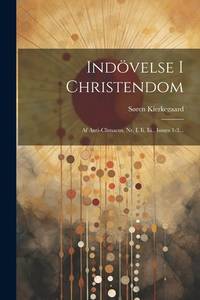
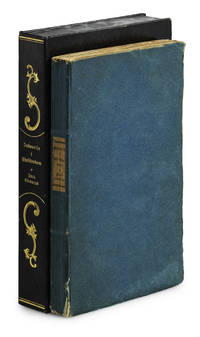
1850réf. 63619Kjøbenhavn Reitzel 1850. 8vo. 4 277 pp. Completely uncut in the original blue cardboard binding. Magnificently preserved with the spine almost completely intact including the original printed paper title-label. Tiny loss of paper to the capitals and a little loss to the lower front hinge. A small crack to lower back hinge but binding remarkably firm and tight. Very neat re-enforcements to inner hinges otherwise unrestored. Light occasional brownspotting. Pencil-annotation to inside of front board. A four-line annotation about Dean Gude and a sermon he gave in April 1885 to foot of p. 98. With the ownership signature of H.P. Kierkegaard also dated in his hand “d. 26de September 1850”. Housed in a beautiful black glitted box with elaborate gilding and Gothic gilt lettering to spine Harry Larsen. A bit of wear to extremities. Himmelstrup 121. A splendid copy of the first edition in original condition – in the original binding with the exceedingly rare original printed title-label preserved – which has belonged to Kierkegaard’s disabled cousin who was a great source of inspiration to him. Kierkegaard’s confidante and close friend his cousin H.P. Kierkegaard received this copy the day after it was published Sept. 25th. We have never seen a copy in this state before with the original title-label preserved. By Kierkegaard himself described as his “most perfect and truest” work and by Mynster considered “a profane game with the holy” Training in Christianity is one of the most important and most controversial of all of Kierkegaard’s works. As Kirmsse says “it marks the beginning of a relentless and single-minded campaign against “Christendom” “ heralding his feud with the established Church and the Danish priesthood. In many ways Training in Christianity is considered one of the most quintessential Kierkegaardian works having at the centre of attention the question of how to become a Christian in Christendom leading ultimately to a fierce attack on the Danish church. It is in this work that Kierkegaard fully exposes his conception of the religious individual and fully describes the personal suffering that comes with being a Christian. Christ is considered the rolemodel and true Christendom consists in following him. Thus the Christian will also suffer for his faith though no man shall become a martyr for the truth. Kierkegaard thus also distinguishes sharply between the established triumphant church and the true struggling one which comes to constitute the essence of his attack on the established Danish Church. The work is published under the same pseudonym as Sickness Unto Death Anti-Climacus and also here the pseudonym is not meant to deceive or to qualify the work aesthetically. On the contrary this work evokes an idealized Christianity and Kierkegaard did not wish to convey that he was himself such an ideal Christian. “Anti-Climacus is also the author of The Sickness Unto Death. He might be considered the author of Kierkegaard’s greatest religious works just as Johannes Climacus is the author of the great pseudonymous esthetic works. H. Hong remarks “The prefix Anti- does not mean ‘against.’ An old form of ‘ante’ before as in anticipate the prefix denotes a relation of rank as in ‘before me’ in the First Commandment”. In his journals Kierkegaard said “Climacus is lower denies he is a Christian. Anti-Climacus is higher a Christian on an extra ordinarily high level”. Kierkegaard used Anti Climacus to write from the vantage point of a perfect Christian because he himself could not claim to be one. It should also be added that Kierkegaard decided to remove this pseudonym at the last moment by hurrying to the printer but was too late.” Dr. Anthony Storm Commentary on Kierkegaard. Along with being his “most perfect and truest” work Kierkegaard also thought it to be together with The Sickness Unto Death his most important. Concluding that Christendom had departed so far from the Christianity of The New Testament Kierkegaard with Training in Christianity seeks to reintroduce Christianity into Christendom. The work’s perfection lies in its combination of preaching and polemics. and truest thing.» In his reflections on such topics as Christ's invitation to the burdened the imitatio Christi the possibility of offense and the exalted Bishop Mynster who was then the face of the Danish Church was outraged when he read the book and called it «a profane game with the holy». Mynster and Kierkegaard had always been closely intertwined. In many ways Kierkegaard considered him almost family but for the outraged Kierkegaard Mynster also typified the complacent and established «official” Christianity. Few people were as important to Kierkegaard as Mynster and no-one else suffered as severely from his attack on the established Christianity in Denmark. The two theological giants never reconciled. For Kierkegaard the radical commandments of Christianity and what it demands from the individual are absolutely essential and with Training in Christianity he begins his crusade against the kind of tame Christianity in which the priests tell the congregation what they want to hear. ”Of the many works he wrote during 1848 his “richest and most fruitful year” Kierkegaard specified Practice in Christianity as «the most perfect Christ he takes as his theme the requirement of Christian ideality in the context of divine grace. Addressing clergy and laity alike Kierkegaard asserts the need for institutional and personal admission of the accommodation of Christianity to the culture and to the individual misuse of grace. As a corrective defense the book is an attempt to find ideally a basis for the established order which would involve the order’s ability to acknowledge the Christian requirement confess its own distance from it and resort to grace for support in its continued existence. At the same time the book can be read as the beginning of Kierkegaard’s attack on Christendom. Because of the high ideality of the contents and in order to prevent the misunderstanding that he himself represented that ideality Kierkegaard writes under a new pseudonym Anti-Climacus.” Hong edition. The present copy is no. 78 in Girsel's "Kierkegaard" The Catalogue which can be found here. unknown
1863réf. 60269Kjøbenhavn. 1863. 8vo. Samtidig skinnryggbind med ryggforgylling og marmorerte dekler. 276 s. MEDBUNDET : Dr. Søren Kierkegaards Indøvelse i Christendom fremstillet og belyst af J. Paludan-Müller Sognepræst i Thisted. Kjøbenhavn. 1856. 87 s. C. A. Reitzels Forlag Dansk. Lite stempel på tittelbladet. unknown
1850réf. 152264Copenhagen: C. A. Reitzel 1850. First edition of Kierkegaard's Practice in Christianity of which he stated: "without a doubt it is the most perfect and truest thing I have written" cited in the Historical Introduction to Princeton's 1991 edition. Kierkegaard fiercely attacks the contemporary Danish church and asserts the need to imitate Christ rather than the ritualistic complacency of modern Christendom. Octavo 200 x 124 mm. Recent black half sheep spine lettered in gilt mottled sides. Binding fine contents somewhat browned and foxed. A very good copy. Himmelstrup 121; McGill p. 52. unknown
1850réf. 13919K. 1850. Nyere blåt blankt omsl. Lidt brunplettet. 4277pp. Originaludgave. Himmelstrup 121. unknown
1967réf. 0009859Indiana University 1967-1978. Hardcover. Very Good. 5 vols. - vol. 1 2 3 5 & 7 Indiana University hardcover
1967réf. 59095Bloomington: Indiana UP 1967. First Edition. . Hardcover. Very Good/Very Good. 8vo - over 7¾ - 9¾" tall. Library markings; dust wrapper in protective cover; 539p. NB: This is a heavier than average volume which may incur a non-standard postage charge. Size: 8vo - over 7¾" - 9¾" tall Indiana UP hardcover
2007réf. 2-2213631387Fayard 2007. Hardcover. New. 452 pages. French language. 9.76x7.01x1.26 inches. Fayard hardcover
2010réf. 743089Ashgate 2010. Hardcover no dust jacket. Slight wear on front facing of cover. Otherwise pristine Ashgate hardcover
2011réf. 340604Princeton: Princeton University Press. Near Fine in Near Fine dust jacket. Cloth. A nice bright copy.; Kierkegaard's Journals and Notebooks; 9.9 X 7.6 X 1.9 inches; 674 pages . 2011. 0691149038 . Princeton University Press hardcover
2014réf. LF-EFZP-DNVX2014. Hardcover. 2014 Princeton University Press hardcover edition. Light reading wear some rubbing to dustjacket else very good condition. hardcover
réf. alb07eec48e33c211f5Series: World Literature Moscow. Exmo 2019 416 p. You are welcome to reach out to us for a detailed description of the copies currently available. Delivery of this book may take longer than usual including extended processing and pre-shipping time no expedited shipping is available. Please advise us if you have a set date or a deadline to receive your order. SKUalb07eec48e33c211f5 unknown
réf. alb08bda91bd7cd1365Series: M Exmo 2019 World Literature 416 p. You are welcome to reach out to us for a detailed description of the copies currently available. Delivery of this book may take longer than usual including extended processing and pre-shipping time no expedited shipping is available. Please advise us if you have a set date or a deadline to receive your order. SKUalb08bda91bd7cd1365 unknown
réf. alb118bd5799f030bcfLibrary of Ethical Thought. Translations from Danish. M Republic 1993. You are welcome to reach out to us for a detailed description of the copies currently available. Delivery of this book may take longer than usual including extended processingand pre-shipping time no expedited shipping is available. Please advise us if you have a set date or a deadline to receive your order. SKUalb118bd5799f030bcf. unknown
réf. alb17ba953e3e44f605Series: Anthology of Wisdom. Translated from Danish Gansen. The design uses works by W. Bradley G. Kalhammer G. Dore. Post-speech by L. Shestov. Moscow Exmo- Press 1999. You are welcome to reach out to us for a detailed description of the copies currently available. Delivery of this book may take longer than usual including extended processing and pre-shipping time no expedited shipping is available. Please advise us if you have a set date or a deadline to receive your order. SKUalb17ba953e3e44f605 unknown
1922réf. NN3384Jena: Diederichs 1922. hardcover. gebraucht gut Gebundene Ausgabe GUTE EXEMPLARE. 21x15 cm. mit Anstreichungen Für Ihre Zufriedenheit versenden wir mit DHL und ausschließlich mit Trackingcode für eine sichere Sendungsverfolgung! Weitere Angebote unter antiquariat-kastanienhof Diederichs hardcover