2 323 résultats
1846K., 1846. Lidt senere beskedent hshirtbd. m. marmorerede permer. Nogle blade jævnt brunede, ellers kun en smule brunplettet. X, 480, (4) pp.
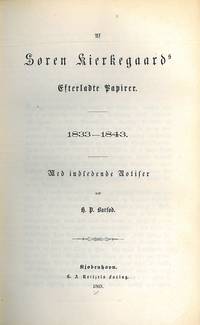
1869réf. 56681Kbh. 1869. 8vo. Samtidig skinnryggbind. LV 506 s. Med en foldet faksimile av Kierkegaards håndskrift. C. A. Reitzels Forlag Dansk. unknown
1846réf. 34479Kjøbenhavn 1846. Samt. hldrbd. m. rig tidstypisk rygforgyldn. False slidte og indre false lidt svage. Hjørner slidte. Brunet og med understregninger primært i blyant. Originaludgave. Himmelstrup 90. unknown
réf. 82091Kjøbenhavn Reitzel 1843. 157 s. 1800-talls skinnbd. Strekdekor i gull på ryggen. Liten slitasje ved øvre kapitél. Klipp i tittelbl. ved nedre marg ikke teksttap. . unknown
1872réf. 61642Kjøbenhavn. 1872. 8vo. Samtidig skinnryggbind med svakt opphøyde ryggbånd og enkel ryggforgylling. 105 1 s. MEDBUNDET : Atten opbyggelge Taler. Af Søren Kierkegaard. Anden Udgave. Kbh. 1862. 378 s. MEDBUNDET : Tre Taler ved tænkte Leiligheder. Af S. Kierkegaard. Andet Oplag. Kbh. 1873. 98 s. C. A. Reitzels Forlag Dansk. Navn på tittelbladene. Materien noe brunet unknown
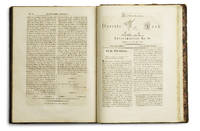
1836réf. 62102Kjøbenhavn 1834-1836. Large 4to. Interimsblade i.e. Interim Papers 1-100 with the joint title-page and the contents leaf bound in a very nice contemporary brown half calf with gilt spine and marbled paper over boards. Spine with wear and hinges and corners bumped. Edges of boards with wear. Occasional brownspotting throughout but all in all a fine and well preserved copy. Each “Interimsblad” takes up 4 pp. Kierkegaard’s contributions: I: ab. 1 p.; II: 2 3/4 pp.; III: 4 pp.; IV: 4 pp. Very rare first printings of Kierkegaard’s first four publications including the very first publication in Kierkegaard’s own name which constitutes a true milestone in the history of Kierkegaard’s opus as does of course his very first publication. KIERKEGAARD’S VERY EARLIEST publications are the papers that he publishes in Kjøbenhavns Flyvende Post before he publishes his famous first book which is a polemic attack on Hans Christian Andersen. The first and fourth of these earliest periodical publications are arguably the most important being the very first thing Kierkegaard publishes and the very first publication in Kierkegaard’s own name respectively; but all these four earliest papers Himmelstrup 123 and 4 are significant 23 and 4 dealing with contemporary press issues primarily freedom of press. Danish politics in the 1830’es was dominated by the slow implementation of rules for election for and assembly of the Estates of the Realm. But as they were only advisory the papers and periodicals were not allowed to publish their opinions. In response to this a liberal opposition arose around the two polemic papers Kjøbenhavnsposten The Copenhagen Post and Fædrelandet The Fatherland. The first point on the agenda for the Liberals was the fight for freedom of the press and the abolishment of censorship. This fight for freedom of the press was something that found resonance with Copenhagen academics and it stirred up a lively activity in Copenhagen. In 1835 active Liberals had encouraged King Frederik VI to support freedom of press but had received an answer stating that he alone was able to evaluate what was truly the best for the people and the state. After this answer from the king the “Society for the Correct Use of the Freedom of press” was founded by moderate liberals and young liberals and at the end of the year almost 2.300 members had joined. It was in the midst of all this that the 21-year old Søren Kierkegaard then a student of theology had his debut with political-literary articles in Kjøbenhavns flyvende Post in Interimsbladende which were published separately. But as opposed to the predominantly liberal views of almost all other contributors Kierkegaard’s articles expressed distinctly conservative views. His first publication Også et Forsvar for Qvindens høie Anlæg Also a Defense of the High Abilities of the Woman constitutes an unpolished ironic apology for the liberation of women. This article is published in December 1834 and is signed “A.”. As opposed to the following next three articles this does not deal with freedom of press. Kierkegaard’s three following publications however all concern the question of freedom of press and constitute satirical polemics against the two liberal papers Kjøbenhavnsposten and Fædrelandet against Orla Lehmann the upcoming star of the liberal youth and against all liberals in general. These three articles were published in February and April 1836. The two first are signed “B.” and the third signed “S. Kierkegaard” constitutes the very first publication in his own name. As is well known the names under which Kierkegaard later publishes come to play a significant role in his authorship and represent an extremely thorough and well-thought-out construction. The foundation of this play with the reader is thus laid in the present publications in which he begins to develop the style for which he later gained worldwide renown. The “names” A and B under which he here publishes will most famously be used again in Either- Or Part one of which consists in “A.’s Papers” and Part Two in “B.’s Papers Letters to A.” Common for all four of his first publications is the attempt at polemic and satirical power at literary elegance and at a masterful and ceremonious critique of the prose of the opponent – all dominant traits in his later writings. Kjøbenhavns flyvende Post The Flying Post of Copenhagen was one of the most important and most widely read cultural and literary periodicals of the period. It was edited and run by Johan Ludvig Heiberg 1791-1860 arguably the most famous cultural person during the Danish Golden Age. He played a more significant role than any other author or thinker during this period and was the leading character of literature and philosophy in the 19th century. He introduced many German thinkers to Denmark most importantly Hegel – who Kierkegaard would later oppose – and he was part of almost all intellectual discussions of the Danish Golden Age. He was also a patron for many leading figures of the era. Interestingly several people thought that the first of the articles on the freedom of the press was written by Heiberg. This was of dubious merit to Kierkegaard himself as he was opposed to the circles around Heiberg and the Hegelian environment but it was still this article – and this miscomprehension – that gave him a claim to fame. Another paper claimed that this “priceless” article had been written by Heiberg himself who “had written many witty things but never anything as witty as this.” Also Kierkegaard’s professor of philosophy Poul Martin Møller to whom Kierkegaard was very devoted and to whom he dedicated Begrebet Angest the only person outside of his family that Kierkegaard ever wrote a printed dedication for loved the article and assumed that Heiberg had written it. “He Kierkegaard had a lifelong antipathy toward the press though he himself published reviews in various papers. His mistrust of the press as a legitimate organ of communication was based on several observations one of which was that the press was the voice of the masses rather than that of the individual. He viewed that voice with great skepticism and sarcasm in later years averring that the crowd. even if technically correct. is wrong by the very fact of being the crowd. The truth can only be stated and practiced as individuals especially as individuals before God. Admittedly Kierkegaard’s view of the masses was not well developed at this juncture.” D. Antony Storm. Himmelstrup: 1 2 3 & 4. The present copy is no. 1 in Girsel's "Kierkegaard" The Catalogue which can be found here. hardcover
1838réf. 77909Kjøbenhavn 1838. 8vo. Nyere kartonasjebind med titteletikett i papir på ryggen. X 2 79 1 blank s.8vo. Recent stiff boards with title i paper pasted on spine. X 2 79 1 blank pp. Hos C. A. Reitzel. Dansk. Himmelstrup 6. Navn i samtidig hånd på tittelbladet. Ex libris. Kierkegaards debut. I dette skriftet kommer han med sterk kritikk av H. C. Andersen. Sannsynligvis trykt i omrking 525 eksemplarer.Himmelstrup 6. Name in contemporarty writing on title page. Ex libris. Kierkegaard’s debut. In this paper he makes a strong critique of H. C. Andersen. Probably printed in approxamately 525 copies. hardcover
1845réf. 59538Kjøbenhavn. 1845. 8vo. Samtidig skinnryggbind med marmorerte dekler. VIII 383 s. Hos Universitetsboghandler C. A. Reitzel Dansk. Ryggen noe slitt. Materien gulnet og pleytet. Ex libris. unknown
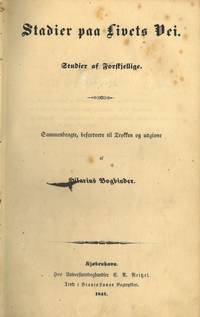
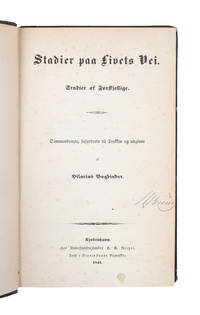
1845réf. 63626Kjøbenhavn Copenhagen 1845. Lex8vo. Later brown half calf with gilt title to spine ca. 1940'ies. Corners with ligh wear. First leaves re-hinged. Title-page dusty and professsionally restored from verso with thin Chinese paper neatly closing a tear no loss. Some leaves evenly browned and last few leaves brownspotted otherwise only lighter occasional spotting. VIII 383 pp. First edition of one of Kierkegaard's main works "Stages on Life's Way" his pivotal sequal to his main work "Either-Or" in which he had presented the first two stages the aesthetic and the ethical. In Stages on Life’s Way he continues his work on these stages and moves on to present also the religious stage which occupies approximately two thirds of the work. The religious stage is that in which man attains a personal relationship with God and that in which man only truly begins to exist the aesthetic and ethical stages being inadequate. It is in this foundational work in the religious stage that Kierkegaard first properly describes what is now known as the “Leap of Faith” in fact a “leap to faith” namely the leap that involves willing and belief instead of reason and knowledge the leap that you take in order to connect to God and which requires that which Kierkegaard calls “the suspension of the ethical”. Undoubtedly among Kierkegaard’s most brilliant literary achievements “Stages on Life’s Way” is written in the form of different viewpoints of Kierkegaard’s many pseudonymous characters. We have both Hilarius Bookbinder who by chance has come into possession of the documents presented in the work and has prepared them for printing. We have the famous banquet scene which mirrors Plato’s Symposium described by William Afham and in which the three aesthetics participate: Johannes the Seducer Victor Eremita and Constatin Constantius. We have Judge William’s discourse in praise of marriage and we have the diary discovered by Frater Taciturnus of a young man who was deeply in love but felt compelled to break off his engagement. This story in form of a diary is the closest one comes to a description of Kierkegaard’s own love story his relationship to Regine. The diary describes an engagement that has lasted for six months; it alternates between the morning notes that recall the engagement and the midnight notes that put it all in perspective. The work closes with a letter to the reader from Taciturnus on the three “existence-spheres” represented by the three parts of the book. “Stages on Life’s Way” is one of Kierkegaard’s most important works. Not only does it sum up and explain some of the most important themes of Kierkegaard’s previous works utilizing the characters and pseudonymous authors of the earlier works to do so; it goes beyond these foundational themes introduces the religious stage and points to the further development of the central themes in Kierkegaard’s philosophy most of which are only fully developed in “Concluding Unscientific Postscript”. Written under a pseudonym and without Kierkegaard’s name appearing as publisher or indeed anything else he was unable to give away presentation-copies of the work. Thus not a single presentation-copy of the work exists. Himmelstrup 78. unknown
1858réf. 56682Kbh. 1858. 8vo. Nyere skinnrygbind med opphøyde ryggbånd. 463 s. Forlagt af C. A. Reitzels Bo og Arvinger Dansk. Meget rent og fint eksemplar. unknown
1845réf. 62096Kjøbenhavn Copenhagen 1845. Lex8vo. Nice contemporary brown half cloth with gilt title to spine. Capitals worn and wear along upper front hinge. Corners worn. In spite of the wear an attractive and tight copy. First and last leaves with a bit of brownspotting otherwise only light occasional spotting. Old owner's signature to title-page. VIII 383 pp. First edition of one of Kierkegaard's main works "Stages on Life's Way" his pivotal sequal to his main work "Either-Or" in which he had presented the first two stages the aesthetic and the ethical. In "Stages on Life's Way" he continues his work on these stages and moves on to present also the religious stage which takes up ab. two thirds of the work. The religious stage is that in which man attains a personal relationship with God and that in which man only truly begins to exist as the aesthetic and ethical stages are inadequate. It is in this foundational work in the religious stage that Kierkegaard first properly describes what is now known as the "Leap of Faith" in fact a "leap to faith" namely the leap that involves willing and belief in stead of reason and knowledge the leap that you make in order to connect to God and which requires that which he calls "the suspension of the ethical". Stages on Life’s Way is one of Kierkegaard’s most important works. Not only does it sum up and explain some of the most important themes of Kierkegaard’s previous works utilizing the characters and pseudonymous authors of the earlier works to do so; it goes beyond these foundational themes introduces the religious stage and points to the further development of the central themes in Kierkegaard’s philosophy most of which are only fully developed in Concluding Unscientific Postscript. hardcover
réf. 138287København 1964. Orig. shirtingbd. Billedplansjer. . Boken befinner seg på et fjernlager og ekstra leveringstid må beregnes! unknown
réf. 142030København 1927 - 28. I 2 priv. skinnbd. Navn på smusstittelbl. . Boken befinner seg på et fjernlager og ekstra leveringstid må beregnes! unknown
réf. 150409København 1927 - 28. I 2 priv. skinnbd. . Boken befinner seg på et fjernlager og ekstra leveringstid må beregnes! unknown
1851Kjøbenhavn, Reitzel, 1851. Ubeskåret i orig. bogtrykt omslag. 42 pp.
1851réf. 41011Kjøbenhavn, Reitzel, 1851. Ubeskåret i orig. bogtrykt omslag. 42 pp.
1860Kjøbenhavn, Gyldendal, 1860. Orig. bogtrykt kartonnage med shirtryg.
1860Kjøbenhavn, Gyldendal, 1860. Nydeligt samtidigt hldrbd. Rygforgyldning. (2),105 pp.
1860réf. 41012Kjøbenhavn, Gyldendal, 1860. Orig. bogtrykt kartonnage med shirtryg.
1838Kjøbenhavn, 1838-49. Alle indbundet i ét lidt senere halvlæderbind m. rig rygforgyldn. False nænsomt restaureret. ""Af en endnu Levendes Papirer"" er kun en smule plettet" " ""Gjentagelsen"" også ganske pæn, de første par blade dog lidt brunplettede, og de sidste sider m. skjold" " ""Smaa = Afhandlinger"" er en del brunplettet.
1838Kjøbenhavn [Copenhagen], 1838. Ubeskåret i nydeligt senere hldrbd. af vinrød oaseged m. rygforgyldn. og skindtitelfelt på forperm. (Oscar Jacobsen). Lettere brunplettet. X + 79pp. Uncut in a very nice later halfleatherbdg. of dark red morocco w. green marbled paper and dark red gilt leather-title-label on front board. Gilt lines to back. (Oscar Jacobsen). Some brownspotting. X + 79pp.
1838Kjøbenhavn, 1838. Ubeskåret, i et senere blankt omslag. Gennemgående skjold i øverste venstre hjørne, overvejende ganske svagt. Første og sidste blade mest påvirkede. X, 79pp.
1838réf. 13867Kjøbenhavn, 1838-49. Alle indbundet i ét lidt senere halvlæderbind m. rig rygforgyldn. False nænsomt restaureret. ""Af en endnu Levendes Papirer"" er kun en smule plettet"" ""Gjentagelsen"" også ganske pæn, de første par blade dog lidt brunplettede, og de sidste sider m. skjold"" ""Smaa = Afhandlinger"" er en del brunplettet.
1838réf. 13886Kjøbenhavn, 1838. Ubeskåret, i et senere blankt omslag. Gennemgående skjold i øverste venstre hjørne, overvejende ganske svagt. Første og sidste blade mest påvirkede. X, 79pp.
1838réf. 52570Kjøbenhavn [Copenhagen], 1838. Lille 8vo. Pænt samtidigt halvlæderbind med enkelte, diskrete stregforgyldninger på ryg. False slidte, ellers ren og frisk. X + 79pp. Small 8vo. Nice contemporary half calf with discreet gilt lines to spine. Hinges with wear, but fine and tight. A large and unusually clean copy. X + 79pp.