KIERKEGAARD, SORENBiblio.com
2215 risultati
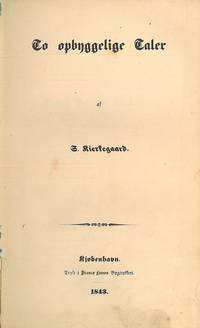
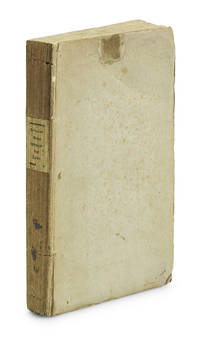
1843rif. 62941Kjøbenhavn Philipsen 1843-45. 8vo. 4 52 62 1 blank leaf 84 59 including the blank leaf between the title-page and the preface! 70 1 blank leaf 111 pp. Completely uncut in the original brownish grey boards with original printed title-label to spine fully intact. Boards a bit brownspotted and a larger damp stain to top of front board. A couple of smaller stains lacquer or wax to spine. A few horizontal creases to spine with paper almost invisibly glued back on to hold tight. Occasional brownspotting mostly to the first and last leaves. But overall splendidly preserved. A truly magnificent copy of the first edition of this very scarce Kierkegaard-title in completely original condition with all of the original printed title-label preserved and fully complete with the joint title-page contents all the half-titles dedications blanks etc. This Kierkegaard-title is rare in itself with much less than 278 copies printed in all but it is utterly amazing to find this exceedingly rare book in original state like here. Only very few copies are left in the original binding which we have only seen once before. The spines of the original Kierkegaard cardboard bindings are always just thin paper directly glued on the block making them extremely fragile. If one finds these original bindings the spines are almost always more or less disintegrated. The present copy is a rare exception that furthermore has the original title-label which is of the utmost scarcity. To our knowledge only one other copy in the original binding has been located. Apart from the other copy we have seen of this work in the original binding the present copy is also the only original Kierkegaard-binding we have seen that is not in the usual blue “hollanderet” cardboard binding but plain brown. No other such copy has been registered for sale and no other such copy to our knowledge is registered in any institution. Furthermore this seems to be the only copy to have surfaced so far which has preserved the original printed title-label in its entirety. As far as we know it has been recorded no-where due to its extreme scarcity. Kierkegaard’s Upbuilding or Edifying Discourses were published over the course of two years in 1843 and 1844. In all 18 Upbuilding Discourses were published divided over six publications namely: Two Upbuilding Discourses from 1843 Three Upbuilding Discourses from 1843 Four Upbuilding Discourses from 1843 Two Upbuilding Discourses from 1844 Three Upbuilding Discourses from 1844 Four Upbuilding Discourses from 1844 Each of these publications accompanied one of the main pseudonymous works beginning with Either-Or in 1843. As opposed to his major philosophical works the religious upbuilding discourses actually bear the name of the author on the title-page. Of course this was by no means incidental. While the pseudonymous works could raise the question of the religiousness of the author the parallelly written religious discourses stress the fact that we are dealing with an author who was religious from the very beginning – an essential fact that Kierkegaard wished to stress for those interested in his authorship. In his journals Kierkegaard clearly states that the religious discourses are as significant in his oeuvre as a whole as are the larger pseudonymous works “I began with “Either-Or” and two upbuilding discourses.” he says and explains that he intended the upbuilding the religious to advance and that he wanted to show “that the writer was not an aesthetic author who in the course of time grew older and for that reason became religious”. Journals IX A 227. He was religious all along also during all of the major philosophical publications that were not written in his name. The fact that every major pseudonymous work – up until Concluding Unscientific Postscript appeared and revealed the identity of the real author – was accompanied by one of these small Upbuilding Discourses bears testament to the pivotal role they play in Kierkegaard’s philosophical development. Furthermore while Kierkegaard could not present anyone with copies of his pseudonymous works as explained above he could indeed give away presentation-copies of his accompanying Upbuilding Discourses which he then did. The Upbuilding Discourses are particularly interesting in several regards one being that it is in the course of the printing of these that Kierkegaard changes his publisher. Ever since Kierkegaard had chosen to publish his first book himself he had had his books on commission with the leading Copenhagen publisher Reitzel the sole exception being his thesis the Irony. That was also the case with Two Upbuilding Discourses from 1843. But for some reason the following five publications of Upbuilding Discourses did not appear with Reitzel but with P.G. Philipsen instead. We do not know the exact reason for this change in publishers as the commission was exactly the same for the two. Whereas Two Upbuilding Discourses from 1843 had sold relatively well the Three and Four Upbuilding Discourses from 1843 did not sell well. A mere 102 and 104 copies respectively out of a commission issue of 300 were sold. In an attempt at making money on these discourses in spite of the poor sales numbers Philipsen offers to buy the unsold copies of Two Upbuilding Discourses from 1843 buys a sales issue of 300 copies of the Two Upbuilding Discourses from 1844 and makes the same agreement with Kierkegaard for the following two Discourse-publications. Sales numbers are still poor however and in the spring of 1845 only ca 100 copies of each of the 1844 Discourse publications have been sold. The printing issue of each was about 500 and Philipsen’s sales issue 300; thus both Philipsen and Kierkegaard had large numbers of each Discourse-publication left and in May 1845 they make a new deal. Philipsen buys the remainder issues of all six Discourse-publications including the 278 copies of Two Upbuilding Discourses from 1843 from Reitzel. Philipsen has a joint title-page printed along with a contents-leaf and now issues the seminal Kierkegaard-publication that is no. 85 in the bibliography Himmelstrup namely Eighteen Upbuilding Discourses – all six publications constituting all eighteen Upbuilding Discourses collected in one book. Seeing that there were 278 copies left of the Two Upbuilding Discourses from 1843 a maximum of 278 copies of Eighteen Upbuilding Discourses can have been made making it one of the scarcest Kierkegaard-books. The actual number is certainly lower than 278 though probably quite a bit lower seeing that Philipsen continued to sell the separate publications all copies of which he then evidently did not include in the Eighteen Upbuilding Discourses. The individual pamphlets of course are even scarcer with a maximum of 232 copies of Two Upbuilding Discourses from 1843 and somewhere between 100 and 150 copies of the others. We know from the Erindringsbog fra Bianco Luno 1844 that Kierkegaard had 506 copies of Four Upbuilding Discourses 1844 printed six of them on fine paper for presentation. Seeing that we have already established the clear thread of identity throughout all six publications we must assume that the other pamphlets were printed in the same numbers. And we have the record of the remainder issues that Philipsen buys in 1845 which lets us conclude of the Upbuilding Discourses that by that time 222 copies of Two 1843 139 copies of Three 1843 130 copies of Four 1843 120 copies of Two 1844 92 copies of Three 1844 96 copies of Four 1844 were sold out of the total number of original issues. In other words these are extremely scarce. Not least in the original wrappers or bindings. The scarcest Kierkegaard-title that exists however will be found in the continuation of the printing history of the Upbuilding Discourses. It is the mythically rare title of Sixteen Upbuilding Discourses which Philipsen issued in 1852 when the Two Upbuilding Discourses had been sold out and it was no longer possible to collect Eighteen Upbuilding Discourses. Thus Philipsen had yet another title-page printed this time with Sixteen Upbuilding Discourses as the title and the year 1843-45 on it along with a new index-leaf; he issued this the scarcest of all Kierkegaard-titles in March 1852. “It is not known how large the issue was but it cannot have been more than 83 seeing that that was what was left of Three Upbuilding Discourses from 1843.” Tekstspejle p. 54 translated from Danish. The idea of the Eighteen Upbuilding Discourses let alone the Sixteen was not Kierkegaard’s. He had agreed to the Eighteen but it was not his intended project with the Upbuilding Discourses. Therefore he wished for the book not to be reviewed and he naturally did not give away any copies of the Eighteen Upbuilding Discourses and of course not the Sixteen either only the individual pamphlets. In all seven presentation-copies of the different Upbuilding Discourses are registered all being for either Heiberg or Nielsen. Curiously neither Eighteen nor Sixteen Upbuilding Discourses were to be found in Kierkegaard’s book collection after his death. All the individual pamphlets were however along with a copy of the first nine Upbuilding Discourses – i.e. the three publications from 1843 – bound together. For more on the conundrum of the actual number of copies of the Upbuilding Discourses see the Preface by Flemming Chr. Nielsen in Girsel’s Kierkegaard-catalogue p. 19. Himmelstrup 85 hardcover
1843rif. 58133Kjøbenhavn 1843-45. 8vo. Samtidig helshirtingbind med ryggforgylling i tidens stil. 52 62 84 59 70 111 s. . Himmelstrup 85.Mangler fellestittelbladet. Bindet slitt ved kapitélene og hjørnene støtt. unknown
1843rif. 152258Copenhagen: P. G. Philipsen 1843-1845. Building the reader's faith First editions collective issue comprising the unsold sheets of six publications of Kierkegaard's Edifying Discourses originally published in 1843 and 1844 here issued together with a collective title page as Eighteen Edifying Discourses. Between 1843 and 1850 Kierkegaard published numerous works under the title of "Edifying Discourses" inviting 'that single individual my reader' to dwell with a biblical passage for the sake of building up faith. 6 parts in 1 vol. as issued octavo 199 x 125 mm. Recent black half sheep spine lettered in gilt mottled paper sides. Binding fine; contents lightly toned and occasionally spotted 2.5 cm closed tear to fifth part pp. 55/6. A very good copy. Himmelstrup 85; original parts 45 57 58 60 61 and 73 respectively. unknown
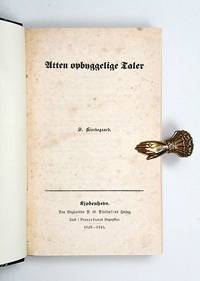
1843rif. 57279Kjøbenhavn Copenhagen P. G. Philipsens Forlag 1843-1845. 8vo. Bound uncut in a recent pastiche cardboardbinding imitating the original brown cardboard binding in which it was issued. Printed pastice paper label to spine. Some brownspotting as always due to the paper quality. 4 52 62 84 59 recte 57 pp. i.e. without the blank leaf between the title-page and the preface 70 111 pp. Complete with all the titles and the joint title-page without the blank leaf after the preface of "To opbyggelige Taler 1844" - which is not called for and hardly ever present. First edition of Kierkegaard's important eighteen upbuilding discourses which comprise his two three and four upbuilding discourses from the years 1843-45 with the joint title-page of all eighteen. The work constitutes Kierkegaard's religious works which supplement his theological and philosophical ones.The first upbuilding discourses were published the same year as Either-Or and it is interesting to note that in opposition to his major philosophical works the religious upbuilding discourses actually bear the name of the author on the title-page a fact that was by no means incidental. While the pseudonymous works could make one doubt the religiousness of the author the parallelly written religious discourses stress the fact that we are dealing with an author who was religious from the very beginning a fact that Kierkegaard also wished to establish himself; in his journals he clearly states that the religious discourses bear as much significance for his work as a whole as do the larger pseudonymous works "I began with "Either-Or" and two upbuilding discourses." he says and explains that he intended the upbuilding the religious to advance and that he wanted to show "that the writer was not an esthetic author who in the course of time grew older and for that reason became religious" Journals IX A 227.The importance of the upbuilding discourses and the close relationship they have with the major works and Kierkegaard's philosophical development also becomes evident with the fact that every pseudonymous work was accompanied by a little collection of "upbuilding discourses" until "Concluding Postscript" appeared.Himmelstrup 85. unknown
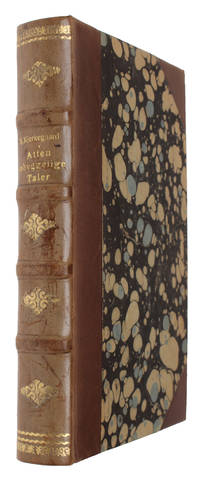
rif. 13904K. 1843-1845. 8vo. Smukt lidt senere hldrbd.m. rig rygforgyldn. ophøjet "bind" dannet af heftesnoren. 2. blad indhold repareret. Pp 1-50 m. svagt skjold for neden ellers pæn. Iv5262845970111pp. Originaludgave. Himmelstrup 85.First edition of Kierkegaard's important eighteen upbuilding discourses which comprise his two three and four upbuilding discourses from the years 1843-45 with the joint title-page of all eighteen. The work constitutes Kierkegaard's religious works which supplement his theological and philosophical ones.The first upbuilding discourses were published the same year as Either-Or and it is interesting to note that in opposition to his major philosophical works the religious upbuilding discourses actually bear the name of the author on the title-page -a fact that was by no means incidental. While the pseudonymous works could make one doubt the religiousness of the author the parallelly written religious discourses stress the fact that we are dealing with an author who was religious from the very beginning -a fact that Kierkegaard also wished to establish himself; in his journals he clearly states that the religious discourses bear as much significance for his work as a whole as do the larger pseudonymous works "I began with "Either-Or" and two upbuilding discourses." he says and explains that he intended the upbuilding the religious to advance and that he wanted to show "that the writer was not an aesthetic author who in the course of time grew older and for that reason became religious" Journals IX A 227.The importance of the upbuilding discourses and the close relationship they have with the major works and Kierkegaard's philosophical development also becomes evident with the fact that every pseudonymous work was accompanied by a little collection of "upbuilding discourses" until "Concluding Postscript" appeared. unknown
1843rif. 53093Kjøbenhavn Copenhagen 1843-1845. 8vo. Near contemporary half calf with richly gilt spine. Binding with very light wear. Front free end-paper with the ownership-inscription of Michael Bentzon and his acquisition date of 1855 the same year that Kierkegaard died. Some brownspotting here and there and the first couple of leaves of "To opbyggelige Taler 1844" with a damp stain. Neat underlinings in the text as well as several marginalia mostly in pencil. A very good copy indeed. IV 52 62 84 59 70 111pp. Complete with all the half-titles and the joint title-page without the blank leaf after the preface of "To opbyggelige Taler 1844" - which is not called for and hardly ever present. First edition of Kierkegaard's important Eighteen Upbuilding Discourses which comprise his two three and four upbuilding discourses from the years 1843-45 with the joint title-page of all eighteen. The work constitutes Kierkegaard's religious works which supplement his theological and philosophical ones.The first upbuilding discourses were published the same year as Either-Or and it is interesting to note that in opposition to his major philosophical works the religious upbuilding discourses actually bear the name of the author on the title-page -a fact that was by no means incidental. While the pseudonymous works could make one doubt the religiousness of the author the parallelly written religious discourses stress the fact that we are dealing with an author who was religious from the very beginning -a fact that Kierkegaard also wished to underline himself; in his journals he clearly states that the religious discourses bear as much significance for his work as a whole as do the larger pseudonymous works "I began with "Either-Or" and two upbuilding discourses." he says and explains that he intended the upbuilding the religious to advance and that he wanted to show "that the writer was not an esthetic author who in the course of time grew older and for that reason became religious" Journals IX A 227.The importance of the upbuilding discourses and the close relationship they have with the major works and Kierkegaard's philosophical development is also stressed by the fact that every pseudonymous work was accompanied by a little collection of "upbuilding discourses" until "Concluding Postscript" appeared.Himmelstrup 85. unknown
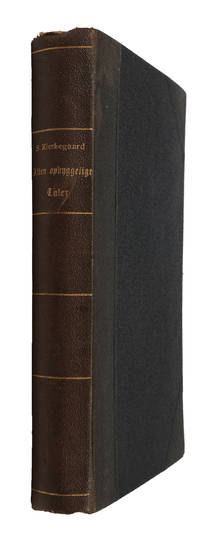
1843rif. 26192Kbh. 1843-45. Et nydeligt samtidigt hshirtbd. m. stregforgyldn. på ryg. Brunplettet. M. alle deltitelblade samt det fælles titelbl. 4 52 62 84 59 70 111 pp.Nice contemporary half cloth with single gilt lines to spine. Fully complete with all half titles and the joint title-page. Originaludgave. Himmelstrup 85.First edition of Kierkegaard's important eighteen upbuilding discourses which comprise his two three and four upbuilding discourses from the years 1843-45 with the joint title-page of all eighteen. The work constitutes Kierkegaard's religious works which supplement his theological and philosophical ones.The first upbuilding discourses were published the same year as Either-Or and it is interesting to note that in opposition to his major philosophical works the religious upbuilding discourses actually bear the name of the author on the title-page - a fact that was by no means incidental. While the pseudonymous works could make one doubt the religiousness of the author the parallelly written religious discourses stress the fact that we are dealing with an author who was religious from the very beginning -a fact that Kierkegaard also wished to establish himself; in his journals he clearly states that the religious discourses bear as much significance for his work as a whole as do the larger pseudonymous works "I began with "Either-Or" and two upbuilding discourses." he says and explains that he intended the upbuilding the religious to advance and that he wanted to show "that the writer was not an esthetic author who in the course of time grew older and for that reason became religious" Journals IX A 227.The importance of the upbuilding discourses and the close relationship they have with the major works and Kierkegaard's philosophical development also becomes evident with the fact that every pseudonymous work was accompanied by a little collection of "upbuilding discourses" until "Concluding Postscript" appeared.Himmelstrup 85. hardcover
rif. 13902K. 1843-1845. Lidt senere sort hldrbd. Nedre kapitæl lidt stødt. Gennemgående vandskjold. IV5262845970111pp. Originaludgave. Himmelstrup 85. unknown
1843rif. 62941Kjøbenhavn, Philipsen, 1843-45. 8vo. (4), 52 + 62 (+ 1 blank leaf) + 84 + 59 (including the blank leaf between the title-page and the preface!) + 70 (+ 1 blank leaf) + 111 pp. Completely uncut in the original brownish grey boards with original printed title-label to spine (fully intact). Boards a bit brownspotted and a larger damp stain to top of front board. A couple of smaller stains (lacquer or wax) to spine. A few horizontal creases to spine with paper almost invisibly glued back on to hold tight. Occasional brownspotting, mostly to the first and last leaves. But overall splendidly preserved.
1843K., 1843-1845. 8vo. Smukt lidt senere hldrbd.m. rig rygforgyldn., ophøjet ""bind"", dannet af heftesnoren. 2. blad (indhold) repareret. Pp 1-50 m. svagt skjold for neden, ellers pæn. (Iv)+52+62+84+59+70+111pp.
1843Kjøbenhavn [Copenhagen], P. G. Philipsens Forlag, 1843-1845. 8vo. Bound uncut in a recent pastiche cardboardbinding, imitating the original brown cardboard binding, in which it was issued. Printed pastice paper label to spine. Some brownspotting as always, due to the paper quality. (4), 52, 62, 84, 59 (recte 57 pp., i.e. without the blank leaf between the title-page and the preface), 70, 111 pp. Complete with all the titles and the joint title-page (without the blank leaf after the preface of ""To opbyggelige Taler, 1844"" - which is not called for and hardly ever present).
1843rif. 13904K., 1843-1845. 8vo. Smukt lidt senere hldrbd.m. rig rygforgyldn., ophøjet ""bind"", dannet af heftesnoren. 2. blad (indhold) repareret. Pp 1-50 m. svagt skjold for neden, ellers pæn. (Iv)+52+62+84+59+70+111pp.
1843rif. 57279Kjøbenhavn [Copenhagen], P. G. Philipsens Forlag, 1843-1845. 8vo. Bound uncut in a recent pastiche cardboardbinding, imitating the original brown cardboard binding, in which it was issued. Printed pastice paper label to spine. Some brownspotting as always, due to the paper quality. (4), 52, 62, 84, 59 (recte 57 pp., i.e. without the blank leaf between the title-page and the preface), 70, 111 pp. Complete with all the titles and the joint title-page (without the blank leaf after the preface of ""To opbyggelige Taler, 1844"" - which is not called for and hardly ever present).
1843Kbh., 1843-45. Et nydeligt samtidigt hshirtbd. m. stregforgyldn. på ryg. Brunplettet. M. alle deltitelblade samt det fælles titelbl. (4), 52, 62, 84, 59, 70, 111 pp.Nice contemporary half cloth with single gilt lines to spine. Fully complete with all half titles and the joint title-page.
1843rif. 26192Kbh., 1843-45. Et nydeligt samtidigt hshirtbd. m. stregforgyldn. på ryg. Brunplettet. M. alle deltitelblade samt det fælles titelbl. (4), 52, 62, 84, 59, 70, 111 pp.Nice contemporary half cloth with single gilt lines to spine. Fully complete with all half titles and the joint title-page.
1843K., 1843-1845. Lidt senere sort hldrbd. Nedre kapitæl lidt stødt. Gennemgående vandskjold. (IV)+52+62+84+59+70+111pp.
1843rif. 13902K., 1843-1845. Lidt senere sort hldrbd. Nedre kapitæl lidt stødt. Gennemgående vandskjold. (IV)+52+62+84+59+70+111pp.
1843rif. 53093Kjøbenhavn [Copenhagen], 1843-1845. 8vo. Near contemporary half calf with richly gilt spine. Binding with very light wear. Front free end-paper with the ownership-inscription of Michael Bentzon and his acquisition date of 1855 (the same year that Kierkegaard died). Some brownspotting here and there and the first couple of leaves of ""To opbyggelige Taler, 1844"" with a damp stain. Neat underlinings in the text as well as several marginalia, mostly in pencil. A very good copy indeed. (IV), 52, 62, 84, 59, 70, 111pp. Complete with all the half-titles and the joint title-page (without the blank leaf after the preface of ""To opbyggelige Taler, 1844"" - which is not called for and hardly ever present).
1978traduzione di Giampiero Posani LIGUORI 1978 144 PP. FONDO DI MGAZZINO: LIEVI SEGNI DEL TEMPO, VOLUME INTONSO, MAI SFOGLIATO.
2013rif. 1088609Frankfurt, M. : PL Acad. Research, 2013. 216 S. ; 21 cm kart.
1927rif. RO60081410GEORG MÜLLER. 1927. In-12. Cartonné. Etat d'usage, Couv. convenable, Mors fendus, Intérieur frais. 222 pages. Texte en allemand (caractères gothiques).. . . . Classification Dewey : 830-Littératures des langues germaniques
rif. 101871250X.Ghardcover. Good. Access codes and supplements are not guaranteed with used items. May be an ex-library book. hardcover
rif. Z1-C-005-01077Nabu Press. Used - Like New. Used - Like New. Ships from UK in 48 hours or less usually same day.Your purchase helps support Sri Lankan Children's Charity 'The Rainbow Centre'. 100% money back guarantee. We are a world class secondhand bookstore based in Hertfordshire United Kingdom and specialize in high quality textbooks across an enormous variety of subjects. We aim to provide a vast range of textbooks rare and collectible books at a great price. Our donations to The Rainbow Centre have helped provide an education and a safe haven to hundreds of children who live in appalling conditions. We provide a 100% money back guarantee and are dedicated to providing our customers with the highest standards of service in the bookselling industry. Nabu Press unknown
2004GUIDA 2004 242 PP. FONDO DI MAGAZZINO: PERFETTO E INTONSO. Parole e frasi comuni alcun assoluto Auschwitz banalità del male Baum Carl Schmitt compito comunità concezione coscienza costituisce costruire Cracovia crisi Cristo dell'Olocausto dell'uomo dice diritto domanda ebraica ebraismo ebrei Eckardt Eichmann Elie Wiesel esiste esso etica f1glio fascismo fede filosofia funzione Germania Gerusalemme Gesù ghetto Giobbe guerra Gumplovicz Hannah Arendt headship Hegel Heidegger Hitler Ibid ideologica Ihid interpretazioni interrogativi Israele Judenrat Judenriite Kafka l'ebreo L'Olocausto l'uomo lager Lévinas liberalismo Lissa lotta male naturale mente Metz mistico mondo morte Movimenti giovanili nazista nemico notte nulla nuovo parlare parola passato Paul Celan pensare poema poesia politica anti - ebraica possibile potere problema processo proprio questione radicale Raul Hilberg razze realtà Reich religiosa responsabilità resurrezione Ruether ruolo sembra senso Shoah signif1cato silenzio situazione sociale sofferenza Sombart storia storico sviluppi tedesco Tel Aviv teodicea teologia cristiana termini Terzo Reich totalitario totalmente tradizione tratta trova umano vuol dire XX secolo
rif. 19278923like new. unknown