Soren KierkegaardBiblio.com
2 396 résultats
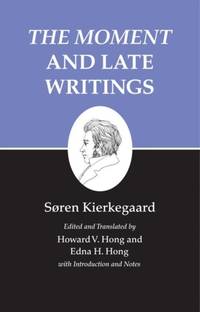
réf. ria9780691032269_inpHardback. New. New Book; Fast Shipping from UK; Not signed; Not First Edition; Kierkegaard a poet of ideals and practitioner of the indirect method also had a direct and polemical side. This title includes the articles from "Fadrelandet" all numbers of "The Moment" and several other late pieces of Kierkegaard' hardcover
réf. 8799821184.Gpaperback. Good. Access codes and supplements are not guaranteed with used items. May be an ex-library book. paperback
réf. 33976433like new. unknown
2015br. Obiettivo del lavoro è quello di richiamare l'attenzione sugli elementi di radicale problematicità dell'esperienza formativa, laddove essa si confronta con percorsi complessi di costruzione della scelta, che non trovano supporti e contributi significativi nelle elaborazioni già compiute a livello di cultura e di civiltà. Nel suo essere chiamata ad assumersi responsabilità così pregnanti in merito ai processi di formazione dei propri interlocutori (quando non al loro stesso "destino"), l'educazione diviene uno dei principali ambiti di messa alla prova del problema etico e fa dell'angoscia che ne deriva uno dei più potenti strumenti di elaborazione della scelta medesima e di progettazione dell'intervento educativo. A partire dalla filosofia di Kierkegaard e dalle considerazioni da essa dedicate al mito di Abramo, la riflessione giunge a confrontarsi con esiti più recenti del pensiero contemporaneo.
Choiseul, revue "Nordiques" n° 10, Printemps - Eté 2006, 174 pp., broché, bon état général.
2011br. Nel 1846, un Kierkegaard poco più che trentenne iniziò ad annotare le proprie riflessioni in quaderni sul cui frontespizio tracciava un grande "NB" (ovvero: NotaBene). Con questa sigla soleva indicare ciò che si proponeva di tener presente, ciò su cui voleva richiamare l'attenzione, ciò che richiedeva un commento, ironico, serio o ammonitore. Nello scegliere NotaBene come titolo dei Quaderni di studi kierkegaardiani, si è voluto, quindi, utilizzare la stessa sigla adottata dal filosofo danese per i suoi appunti, ad indicare una "ripresa" del suo esercizio di pensiero. Il logo dei Quaderni, che riproduce il disegno di un uomo con il cannocchiale - sorta di "autoritratto" di mano dello stesso Kierkegaard -, vuole poi sottolineare un duplice aspetto della sua fisionomia intellettuale: quello dell'osservatore accurato e quello dell'ironista acuto e mordace, capace però anche di autoironia. Sono questi, infatti, i tratti che hanno reso il filosofo danese uno dei pensatori più lucidi e incisivi del pensiero moderno, capaci di esercitare una profonda influenza in ogni ambito dell'attività intellettuale e artistica del Novecento.
2002réf. BN706838Centrum pro studium demokracie a kultury CDK 2002. 2002. Hardcover. Nácvik krestanství: Sudte sami! Nácvik krestanství: Sudte sami! Soren Kierkegaard Centrum pro studium demokracie a kultury (CDK) hardcover
réf. ria9788532645098_inpPaperback. New. New Book; Fast Shipping from UK; Not signed; Not First Edition; N/A paperback
réf. 8481648078.Gpaperback. Good. Access codes and supplements are not guaranteed with used items. May be an ex-library book. paperback
réf. 9S-AOG2-UYDLVozes. New. Vozes unknown
réf. uocl08iaab-22717Vozes. New. Vozes unknown
2018réf. 2-2070114279Editions Gallimard 2018. Leather Bound. New. 1472 pages. French language. 7.17x4.65x1.50 inches. Editions Gallimard hardcover
2018réf. 2-2070114260Editions Gallimard 2018. Leather Bound. New. 1312 pages. French language. 7.09x4.65x1.42 inches. Editions Gallimard hardcover
réf. SLIVCN-9782703110385L'ORANTE EDTIONS
réf. SLIVCN-9782703110408L'ORANTE EDTIONS
réf. SLIVCN-9782703110279L'ORANTE EDTIONS
réf. SLIVCN-9782703110286L'ORANTE EDTIONS
réf. SLIVCN-9782703110330L'ORANTE EDTIONS
réf. 85975Editions de l’Orante 1966, relié toile éditeur avec sa jaquette, 336pp; traduction de Paul-Henri Tisseau et Else-Marie Jacquet-Tisseau - très bon état
réf. 117234Paris, Editions de l’Orante 1970, 220x140mm, XXXII - 414pages, reliure d'éditeur sous doule jaquettes : papier illustré et rhoidoïde. Très bel exemplaire.
2000réf. 70359-A-67764Amsterdam: Boom 2000. Hardcover. Met stofomslag. 793 p. -Wat sporen aan het stofomslag maar het boek zelf is als nieuw. Likt ongelezen. ISBN 9789024415854. Boom hardcover
2017br. «'Nodo dialettico' è espressione utilizzata di frequente da Soren Kierkegaard nel corso della sua frenetica attività di scrittore. La sentenza qoheletica d'apertura - in danese: «Alt har sin Tid» - funge da trait d'union tra i concetti qui proposti quali i due fili costituenti questo enigmatico nodo: l'edificante e la ripresa come cifra della miniera filosofica kierkegaardiana, che nel biennio 1843/1844 deposita l'atto di nascita di ambedue le dialettiche. Ogni cosa ha il suo tempo ed un suo senso, e leggendo questa monografia si fa luce tutto intorno: come se il lascito del Qohelet sia stato per Kierkegaard quello di aver nominato - proprio nel terzo capitoletto sull'alternarsi dei tempi - il posto dell'avere luogo, l'inaggirabile che non si piega all'incalcolabile quantità di vanità del tutto: la morte stessa come antidoto, l'effettività ineludibile di cui ne va il pensiero, l'esserci immessa nel cuore dell'uomo - in qualità di 'eternità'." (dalla presentazione di Eugenio Mazzarella). Con scritti inediti di Soren Kierkegaard.
1996EDITORIALE SCIENTIFICA 1996 180 PP. LIEVISSIMI SEGNI DEL TEMPO, VOLUME PERFETTO E INTONSO
1841réf. 62111Kjøbenhavn P.G. Philipsens Forlag 1841. 8vo. 8 350 pp. Gift binding of elaborately blindpatterned full cloth with single gilt line-border to boards and single gilt lines to spine. All edges gilt and printed on fine paper. The slightest touch of wear to corners and capitals but apart from that a complete fresh clean bright and tight copy. It looks like it has hardly been opened and seems like it just came from the binder. No markings of any kind. A truly splendid copy of the first edition of Kierkegaard's dissertation being a completely fresh copy in the daintiest of the gift-bindings presumably one of the two daintily bound copies that Kierkegaard had in his own collection nr. 2110-11 in the auction catalogue. The copy is with the Thesis and both the day and the time has been filled in by hand. Kierkegaard's dissertationconstitutes the culmination of three years’ intensive studies of Socrates and “the true point of departure for Kierkegaard’s authorship” Brandes. The work is of the utmost importance in Kierkegaard’s production not only as his first academic treatise but also because he here introduces several themes that will be addressed in his later works. Among these we find the question of defining the subject of cognition and self-knowledge of the subject. The maxim of “know thyself” will be a constant throughout his oeuvre as is the theory of knowledge acquisition that he deals with here. The dissertation is also noteworthy in referencing many of Hegel’s theses in a not negative context something that Kierkegaard himself would later note with disappointment and characterize as an early uncritical use of Hegel. Another noteworthy feature is the fact that the thesis is written in Danish which was unheard of at the time. Kierkegaard felt that Danish was a more suitable language for the thesis and hadto petition the King to be granted permission to submit it in Danish rather than Latin. This in itself poses as certain irony as the young Kierkegaard was known to express himself poorly and very long-winded in written Danish. One of Kierkegaard’s only true friends his school friend H.P. Holst recounts in 1869 how the two had a special school friendship and working relationship in which Kierkegaard wrote Latin compositions for Holst while Holst wrote Danish compositions for Kierkegaard who “expressed himself in a hopelessly Latin Danish crawling with participial phrases and extraordinarily complicatedsentences” Garff p. 139. When Kierkegaard in 1838 was ready to publish his famous piece on Hans Christian Andersen see nr. 1 & 2 above which was to appear in Heiberg’s journal Perseus Heiberg had agreed to publish the piece although he had some severe critical comments about the way and the form in which it was written – if it were to appear in Perseus Heiberg demanded at the very least the young Kierkegaard would have to submit it in a reasonably readable Danish. “Kierkegaard therefore turned to his old schoolmate H. P. Holst and asked him to do something with the language…” Garff p. 139. From their school days Holst was well aware of the problem with Kierkegaard’s Danish and he recounts that over the summer he actually “translated” Kierkegaard’s article on Andersen into proper Danish. The oral defense was conducted in Latin however. The judges all agreed that the work submitted was both intelligent and noteworthy. But they were concerned about its style which was found to be both tasteless long-winded and idiosyncratic. We already here witness Kierkegaard’s idiosyncratic approach to content and style that is so characteristic for all of his greatest works. Both stylistically and thematically Kierkegaard’s and especially a clear precursor for his magnum opus Either-Or that is to be his next publication. In many ways Either-Or is born directly out of The Concept of Irony and is the work that brings the theory of Irony to life. Part One of the dissertation concentrates on Socrates as interpreted by Xenophon Plato and Aristophanes with a word on Hegel and Hegelian categories. Part Two is a more synoptic discussion of the concept of irony in Kierkegaard’s categories with examples from other philosophers. The work constitutes Kierkegaard’s attempt at understanding the role of irony in disrupting society and with Socrates understood through Kierkegaard we witness a whole new way of interpreting the world before us. Wisdom is not necessarily fixed and we ought to use Socratic ignorance to approach the world without the inherited bias of our cultures. With irony we will be able to embrace the not knowing. We need to question the world knowing we may not find an answer. The moment we stop questioning and just accept the easy answers we succumb to ignorance. We must use irony to laugh at ourselves in order to improve ourselves and to laugh at society in order to improve the world. The work was submitted to the Philosophical Faculty at the University of Copenhagen on June 3rd 1841. Kierkegaard had asked for his dissertation to be ready from the printer’s in ample time for him to defend it before the new semester commenced. This presumably because he had already planned his sojourn to Berlin to hear the master philosopher Schelling. On September 16th the book was issued and on September 29th the defense would take place. The entire defense including a two hour long lunch break took seven hours during which ”an unusually full auditorium” would listen to the official opponents F.C. Sibbern and P.O. Brøndsted as well as the seven “ex auditorio” opponents F.C. Petersen J.L. Heiberg P.C. Kierkegaard Fr. Beck F.P.J. Dahl H .J.Thue og C.F. Christens not to mention Kierkegaard himself. The work appeared in two states – one with the four pages of “Theses” for academics of the university whereas the copies without the theses were intended for ordinary sale. These sales copies also do not have “Udgivet for Magistergraden” and “theologisk Candidat” on the title-page. The first page of the theses always contains the day “XXIX” of September written in hand and sometimes the time “hora X” is also written in hand but not always. In all 11 presentation-copies of the dissertation are known and of these only one is signed that for Holst all the others merely state the title and name of the recipient. As is evident from the auction catalogue of his collection Kierkegaard had a number of copies of his dissertation in his possession when he died. Five of them were bound and two of them were “nit. M. Guldsnit” i.e. daintily bound and with gilt edges. These two copies were obviously meant as presentation-copies that he then never gave away. The gift copies of the dissertation were given two types of bindings both brownish cloth one type patterned the other one plain and some of them have gilt edges but most of the plain ones do not. There exist two copies on thick vellum paper – one being Kierkegaard’s own copy the other being the copy for H.C. Ørsted discoverer of electromagnetism and then principle of the University of Copenhagen. “As already implied two works of the authorship stand out in the sense that Kierkegaard sent his presentation-copies to a special circle of people: The dissertation from 1841.” Posselt Textspejle p. 91 translated from Danish. Most of the copies were given to former teachers and especially to people who due to leading positions personified the university. “For this circle of initiated we can now due to registered copies confirm that Kierkegaard gave copies with handwritten dedications to the headmaster of the University H.C. Ørsted printed on thick paper Kolderup-Rosenvinge and to J.L. Heiberg. It is granted that Sibbern Madvig and F.C. Petersen were also given the dissertation as a gift. but these copies are not known yet.” Posselt Textspejle pp. 93-94 translated fromDanish. N.b. We have since handled the copy given to Petersen and can thus confirm that it exists. Only a few months after Kierkegaard died 11th of November 1855 at the beginning of April 1856 his books were put up for sale. The sale was an event which created stir among scholars all over Denmark and the event drew large crowds. Everyone wanted a piece of the recently deceased legend and bidding was lively. The average price for the single items was nearly a rix-dollar a very high price for that time. As the old Herman Lynge wrote in a letter on the 22nd of May The Royal Library Recent Letters D. to the famous collector F.S. Bang “At the sale of Dr. Søren Kierkegaard’s books everything went at very high prices especially his own works which brought 2 or 3 times the published prices”.” Rohde Auction Catalogue p. LVIJ. Many authors philosophers and scholars were present in the auction room which was completely full as was the Royal Library who bought ca 80 lots. “Many of the books not only his own were paid for with much higher prices than in the book shops” In Morgenposten no. 99 30. April 1856 written by “P.” translated from Danish. "Some books were bought by libraries where they still are today others were bought by private people who sometimes wrote their names in the front of the books and thus indirectly stated that they came from Kierkegaard’s book collection… The edition of the auction catalogue 1967 registers all books from Kierkegaard’s book collection that it has hitherto been possible to identify – either in public or in private ownership… All in all nearly a couple of hundred volumes – i.e. ca. 10 % – of the Kierkegaardian book collection is said to be rediscovered…" Rohde. Thus today books from Kierkegaard’s library are of the utmost scarcity. Only very few are still possible to acquire and they hardly ever appear on the market. Himmelstrup 8 hardcover