2.257 Ergebnisse
1851Best.-Nr. 57275Kjøbenhavn, C. A. Reitzel, 1851. Indbundet i et pænt nyere halvmaroquin med forgyldt rygtitel. Håndsyede kapitælbånd og fladstrøgne kapitæler. (Sign. Axel Jensen). Nogle spredte brunpletter især på de første og sidste blade. (6),92 pp.
1851Best.-Nr. 62810Kjøbenhavn, C. A. Reitzel, 1851. 8vo. Contemporary brown half calf with marbled paper boards. Spine and corners worn. Title-page brownspotted and brownspotting throughout. Occasional light pencil notes. Ownership signature of Henning Kehler to front free end-paper. (4), 92 pp.
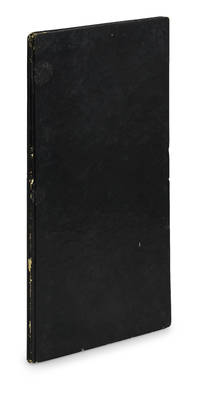
1851Best.-Nr. 63623Kjøbenhavn, Reitzel, 1851. 8vo. (6), 20 pp. Original gift-binding of the black glitted paper, all edges gilt, and printed on fine paper. Excellently rebacked, barely noticeable in almost perfect pastiche (but erroneously “recreating” double gilt lines). A wonderful copy with very light overall wear and a bit of bumping to capitals. Internally a bit of brownspotting.
Best.-Nr. 64989Milano, Edizioni di Comunita, 1948. 14 x 23, 149 pp., broché (brossura/paperback), très bon état (in ottimo stato).
1851Best.-Nr. 63621Kjøbenhavn Reitzel 1851. 8vo. 32 pp. Original gift-binding of the black glitted paper all edges gilt and printed on fine paper. Capitals chipped front hinge with a bit of wear and a few smaller spits on front board towards hinge restored with black colour. Light overall wear. Light brownspotting. First edition - one of the extremely rare gift-copies either a presentation-copy given by Kierkegaard to one of his dedicatees or one of the copies he had in his possession when he died. This small pamphlet constitutes a turning point in Kierkegaard’s life and work. Twice in his career Kierkegaard considered his authorship over. The first time was with the publication of “Concluding Unscientific Postscript” from 1846. The second termination of his authorship came with “Two Discourses at the Communion on Fridays” which appeared on August 6 1851 marking the end of that which we consider his second authorship. As we know from 1848 Kierkegaard stops altogether making lavish presentation-bindings and begins standardizing his presentation practice. From then on he only gives away copies of his books in the black glitted paper-bindings. “Two Discourses at the Communion on Fridays” not only marks an authorial turn in Kierkegaard’s career it also marks a bibliophilic and more personal one namely the discontinuation of writing presentation-inscriptions in his works. “One Upbuilding Discourse” from the previous year is the last work in which Kierkegaard wrote a handwritten presentation inscription. Thus no presentation-inscription of the present work exists. We also do not have a letter accompanying a copy of this work so even though Kierkegaard did give away copies of his works from 1851 and onwards as is evidenced from the presentation-bindings that he had made it is extremely rare to find copies of the works after 1850 in a presentation-binding the dedicatee of which can be traced. One can ask why Kierkegaard stopped writing inscriptions in his books but we will probably not find a precise answer. We find it most likely that the changed practice signals the fact that with the present publication he considered his career over and that it would thus be inappropriate to continue the practice of written presentation inscriptions. Some consider it an aesthetic choice. Whatever the exact reason it was undoubtedly a very well-thought-out decision that can be compared to his decision of how to word the preface to the work. As Cappelørn notes in his “Forligelsen” p. 477 “That it caused Kierkegaard great troubles to give the preface exactly the wording that he wished is understandable. This was the preface for the writing that was to end his authorship. In a journal entry presumably from May 1849 he writes what he had also previously hinted at: that his understanding of the entire authorship “points definitively to Discourses at the Communion on Fridays”. That apprehension was finally fulfilled in August 1851 with the publication of Two Discourses at the Communion on Fridays.” translated from Danish. That Kierkegaard himself saw the present work as the conclusion of his authorship is also evident from his preface: “An authorship that began with Either/Or and advanced step by step seeks here its consummating place of rest at the foot of again underlining the fact that this constitutes the conclusion of his authorship and again embracing all the pseudonymous works in this religious conclusion. The altar where the author personally most aware of his own imperfection and guilt certainly does not call himself a witness to the truth but only a singular kind of poet and thinker who «without authority» has had nothing new to bring but «has wanted to read through once again if possible in a more inward way the original text of individual human existence-relationships the old familiar text handed down from the fathers.” cf. my post script to Concluding Postscript”.” SKS 12 p. 281. Kierkegaard’s reference to the postscript of Concluding Unscientific Postscript is interesting in determining his own view of these two works as being on par with each other in their concluding manner – and in their underlining the equivalence between Kierkegaard himself and his pseudonyms. It is highly interesting that Kierkegaard now in his “final work” refers to his pseudonymity in the preface although this is a religious discourse. What is also interesting about this concluding work is the printed dedication which reads “To One Unnamed whose name shall one day be named is dedicated along with this little work the whole of the authorship from the very beginning” The “unnamed” is Regine with whom Kierkegaard considered reconciliation on numerous occasions. In his journals he wrote much about her and his thoughts about reconciling with her during the period when writing Two Discourses at the Communion on Fridays. As we know the reconciliation never took place but that did not prevent Kierkegaard from dedicating his entire authorship to her with the present publication. Although Kierkegaard had begun working on the publication already in 1849 “Two Discourses at the Communion on Fridays” appeared simultaneously with “On My Work as an Author” on August 6 1851. Kierkegaard had five copies of the work in his collection when he died see Auction Catalogue no. 2173-77 all in black glitted paper bindings. Himmelstrup 130. The present copy is no. 83 in Girsel's "Kierkegaard" The Catalogue which can be found here. unknown
1851Kjøbenhavn, C. A. Reitzel, 1851. Indbundet i et smukt nyere papbind med forgyldt titeletiket på forpermen. (Sign. Erik Olsen). Enkelte spredte brunpletter. 32pp.
1851Best.-Nr. 63621Kjøbenhavn, Reitzel, 1851. 8vo. 32 pp. Original gift-binding of the black glitted paper, all edges gilt, and printed on fine paper. Capitals chipped, front hinge with a bit of wear and a few smaller spits on front board towards hinge restored with black colour. Light overall wear. Light brownspotting.
1972Best.-Nr. 44498AB1972. Montreal/ London McGill-Queen's University Press 1972. 21cm. X167 pages. Original hardcover with illustrated hardcover in Protective Mylar. Excellent condition with only very minor signs of external wear. Søren Aabye Kierkegaard 5 May 1813 11 November 1855 was a Danish philosopher theologian poet social critic and religious author who is widely considered to be the first existentialist philosopher.He wrote critical texts on organized religion Christendom morality ethics psychology and the philosophy of religion displaying a fondness for metaphor irony and parables. Much of his philosophical work deals with the issues of how one lives as a "single individual" giving priority to concrete human reality over abstract thinking and highlighting the importance of personal choice and commitment.He was against literary critics who defined idealist intellectuals and philosophers of his time and thought that Swedenborg Hegel Goethe Fichte Schelling Schlegel and Hans Christian Andersen were all "understood" far too quickly by "scholars".Kierkegaard's theological work focuses on Christian ethics the institution of the Church the differences between purely objective proofs of Christianity the infinite qualitative distinction between man and God and the individual's subjective relationship to the God-Man Jesus the Christ which came through faith. Wikipedia hardcover
1961Mm 150x215 Collana Saggi. Brossura editoriale di 522 pagine, buono stato. Spedizione entro 24 ore dalla conferma dell'ordine.
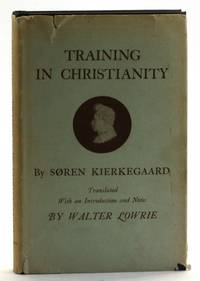
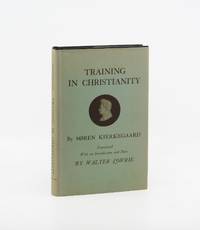
1947Best.-Nr. 513423Princeton University Press 1947. Hardcover with Dust Jacket. VERY GOOD/Good. Later printing. xxvii 275pp. 12mo black cloth gilt spine lettering. Clean sound copy with no markings; DJ tips worn and torn spine toned with splotchy dampstain. Princeton University Press hardcover
Best.-Nr. DADAX0691649669Princeton University Press 2016-04-19. hardcover. New. 5.50x0.69x8.50. Buy with confidence. Excellent Customer Service & Return policy. Princeton University Press hardcover
Best.-Nr. DADAX0691622957Princeton University Press 2015-12-08. Reprint. paperback. New. 5.25x0.64x8.00. Buy with confidence. Excellent Customer Service & Return policy. Princeton University Press paperback
Best.-Nr. 24739907like new. unknown
1941Best.-Nr. 057580Oxford: Oxford University Press 1941. First Edition . Hardcover. Near Fine/Near Fine. Large Octavo. FIRST EDITION. OXFORD : 1941. A lovely clean bright copy. Hardback. Translated from the Danish; with Introduction and Notes by Walter Lowrie. Black cloth; gilt lettered spine. In grey printed dust-jacket; not price-clipped 12s.6d. Bright tight and clean. No owner name or internal markings. NEAR FINE in like jacket; now in a clear protective sleeve. xxvii 275 pages. Index. CONTENTS: Introduction -- Training in Christianity -- An edifying discourse about the woman who was a sinner. Lg.8vo. Will be well-packed for posting/shipping. Rosley Books for Antiquarian books Cumberland Everyman Keswick Inklings Literature MacDonald Rarities Theology and History. . Oxford University Press. SCARCE. Oxford University Press hardcover
2016Best.-Nr. x-0691649669Princeton University Press 2016. Hardcover. New. 304 pages. 8.50x5.50x8.50 inches. Princeton University Press hardcover
Best.-Nr. 0691649669.Ghardcover. Good. Access codes and supplements are not guaranteed with used items. May be an ex-library book. hardcover
Best.-Nr. 0691622957.Gpaperback. Good. Access codes and supplements are not guaranteed with used items. May be an ex-library book. paperback
Best.-Nr. 0691071403.Ghardcover. Good. Access codes and supplements are not guaranteed with used items. May be an ex-library book. hardcover
2015Best.-Nr. x-0691622957Princeton University Press 2015. Paperback. New. reprint edition. 304 pages. 8.00x5.25x0.55 inches. Princeton University Press paperback
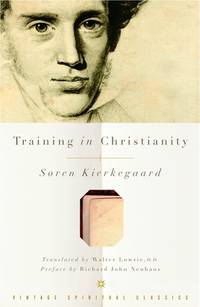
2004Best.-Nr. DADAX0375725644Vintage 2004-12-07. Reprint. paperback. New. 5.19x0.73x8.00. Buy with confidence. Excellent Customer Service & Return policy. Vintage paperback
1971Best.-Nr. 1225880Princeton University Press January 1971. Trade Paperback. Good - Cash. General reader wear to the corners edges and cover. The covers/corners have some creasing. The pages show some general reader wear as well. The book is in good condition with some normal reader wear. Previous owner's names inside. The text has underlining and/or notations. Stock photos may not look exactly like the book. Princeton University Press paperback
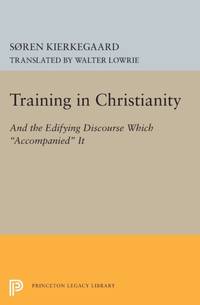
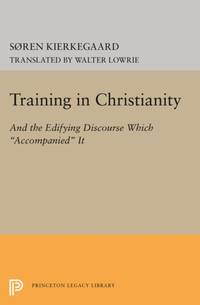
Best.-Nr. ria9780691622958_inpPaperback. New. New Book; Fast Shipping from UK; Not signed; Not First Edition; Kierkegaard in his late and confirmedly Christian period discusses the sharp separation of "Christianity" from "Christendom" as seen in the official church. Originally published in 1944. The Princeton Legacy Library uses the latest p paperback
Best.-Nr. ria9780691649665_inpHardcover. New. New Book; Fast Shipping from UK; Not signed; Not First Edition; Kierkegaard in his late and confirmedly Christian period discusses the sharp separation of "Christianity" from "Christendom" as seen in the official church. Originally published in 1944. The Princeton Legacy Library uses the latest p hardcover
1967Best.-Nr. 1481Princeton University Press 1967. Fine/Near Fine. 8vo black cloth gilt titles xxvii 275pp. 7th printing. Price clipped dust jacket moderately faded to outer edges and flaps sunning to spine. Contents clean binding sharp and square. Originally published in 1850 under the pen name Anti-Climacus Kierkegaard considered Training in Christianity to be his 'most true and perfect work.' Printed together with 'An Edifying Discourse.' 1850. Translation notes and introduction by Walter Lowrie. A fine copy in mylar. Princeton University Press unknown
1957Best.-Nr. 51324Princeton University Press 1957. Later Printing. Hardcover with Dust Jacket. VG in a VG- dust jacket . Princeton University Press, hardcover