KIERKEGAARD, SØREN.MareMagnum
KIERKEGAARD, SORENBiblio.com
To Taler ved Altergangen om Fredagen. Af S. Kierkegaard. - EXTREMELY RARE GIFT-COPY
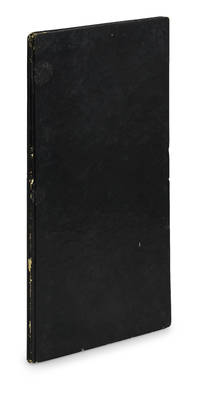
1851rif. 63621Kjøbenhavn Reitzel 1851. 8vo. 32 pp. Original gift-binding of the black glitted paper all edges gilt and printed on fine paper. Capitals chipped front hinge with a bit of wear and a few smaller spits on front board towards hinge restored with black colour. Light overall wear. Light brownspotting. First edition - one of the extremely rare gift-copies either a presentation-copy given by Kierkegaard to one of his dedicatees or one of the copies he had in his possession when he died. This small pamphlet constitutes a turning point in Kierkegaard’s life and work. Twice in his career Kierkegaard considered his authorship over. The first time was with the publication of “Concluding Unscientific Postscript” from 1846. The second termination of his authorship came with “Two Discourses at the Communion on Fridays” which appeared on August 6 1851 marking the end of that which we consider his second authorship. As we know from 1848 Kierkegaard stops altogether making lavish presentation-bindings and begins standardizing his presentation practice. From then on he only gives away copies of his books in the black glitted paper-bindings. “Two Discourses at the Communion on Fridays” not only marks an authorial turn in Kierkegaard’s career it also marks a bibliophilic and more personal one namely the discontinuation of writing presentation-inscriptions in his works. “One Upbuilding Discourse” from the previous year is the last work in which Kierkegaard wrote a handwritten presentation inscription. Thus no presentation-inscription of the present work exists. We also do not have a letter accompanying a copy of this work so even though Kierkegaard did give away copies of his works from 1851 and onwards as is evidenced from the presentation-bindings that he had made it is extremely rare to find copies of the works after 1850 in a presentation-binding the dedicatee of which can be traced. One can ask why Kierkegaard stopped writing inscriptions in his books but we will probably not find a precise answer. We find it most likely that the changed practice signals the fact that with the present publication he considered his career over and that it would thus be inappropriate to continue the practice of written presentation inscriptions. Some consider it an aesthetic choice. Whatever the exact reason it was undoubtedly a very well-thought-out decision that can be compared to his decision of how to word the preface to the work. As Cappelørn notes in his “Forligelsen” p. 477 “That it caused Kierkegaard great troubles to give the preface exactly the wording that he wished is understandable. This was the preface for the writing that was to end his authorship. In a journal entry presumably from May 1849 he writes what he had also previously hinted at: that his understanding of the entire authorship “points definitively to Discourses at the Communion on Fridays”. That apprehension was finally fulfilled in August 1851 with the publication of Two Discourses at the Communion on Fridays.” translated from Danish. That Kierkegaard himself saw the present work as the conclusion of his authorship is also evident from his preface: “An authorship that began with Either/Or and advanced step by step seeks here its consummating place of rest at the foot of again underlining the fact that this constitutes the conclusion of his authorship and again embracing all the pseudonymous works in this religious conclusion. The altar where the author personally most aware of his own imperfection and guilt certainly does not call himself a witness to the truth but only a singular kind of poet and thinker who «without authority» has had nothing new to bring but «has wanted to read through once again if possible in a more inward way the original text of individual human existence-relationships the old familiar text handed down from the fathers.” cf. my post script to Concluding Postscript”.” SKS 12 p. 281. Kierkegaard’s reference to the postscript of Concluding Unscientific Postscript is interesting in determining his own view of these two works as being on par with each other in their concluding manner – and in their underlining the equivalence between Kierkegaard himself and his pseudonyms. It is highly interesting that Kierkegaard now in his “final work” refers to his pseudonymity in the preface although this is a religious discourse. What is also interesting about this concluding work is the printed dedication which reads “To One Unnamed whose name shall one day be named is dedicated along with this little work the whole of the authorship from the very beginning” The “unnamed” is Regine with whom Kierkegaard considered reconciliation on numerous occasions. In his journals he wrote much about her and his thoughts about reconciling with her during the period when writing Two Discourses at the Communion on Fridays. As we know the reconciliation never took place but that did not prevent Kierkegaard from dedicating his entire authorship to her with the present publication. Although Kierkegaard had begun working on the publication already in 1849 “Two Discourses at the Communion on Fridays” appeared simultaneously with “On My Work as an Author” on August 6 1851. Kierkegaard had five copies of the work in his collection when he died see Auction Catalogue no. 2173-77 all in black glitted paper bindings. Himmelstrup 130. The present copy is no. 83 in Girsel's "Kierkegaard" The Catalogue which can be found here. unknown