Soren KierkegaardBiblio.com

2.323 resultados
ref. 1390104060.Gpaperback. Good. Access codes and supplements are not guaranteed with used items. May be an ex-library book. paperback
ref. 1019985674.Ghardcover. Good. Access codes and supplements are not guaranteed with used items. May be an ex-library book. hardcover
ref. 47014315like new. unknown
2003ref. BN213429Grevenberg 2003. 2003. Softcover. Zur Selbstprüfung der Gegenwart anbefohlen. Erbauliche Reden 1850/51. Urteilt selbst. Zur Selbstprüfung der Gegenwart anbefohlen. Erbauliche Reden 1850/51. Urteilt selbst. Sören Kierkegaard Grevenberg paperback
ref. 0243587163.Gpaperback. Good. Access codes and supplements are not guaranteed with used items. May be an ex-library book. paperback
ref. 0364135700.Ghardcover. Good. Access codes and supplements are not guaranteed with used items. May be an ex-library book. hardcover
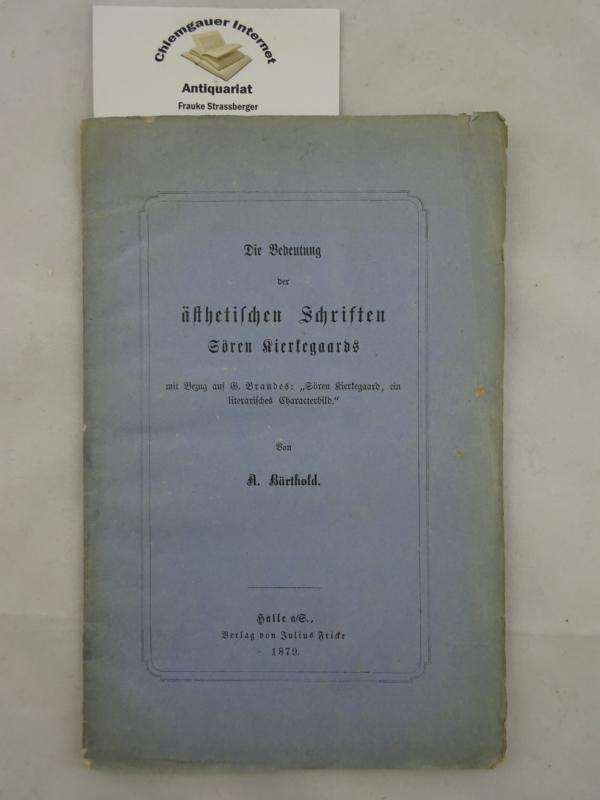
1879ref. 176980Halle, Fricke, 1879. 80 Seiten. 22 cm. Originalbroschur.
ref. 41543560-nnew. unknown
ref. 41543560like new. unknown
ref. ria9783111306421_inpHardcover. New. New Book; Fast Shipping from UK; Not signed; Not First Edition; N/A hardcover
1947ref. V9950Bremen (Johs.Storms) 1947 (= Erste Ausgabe). 8°, Originalkarton (geb.), 224 S.,
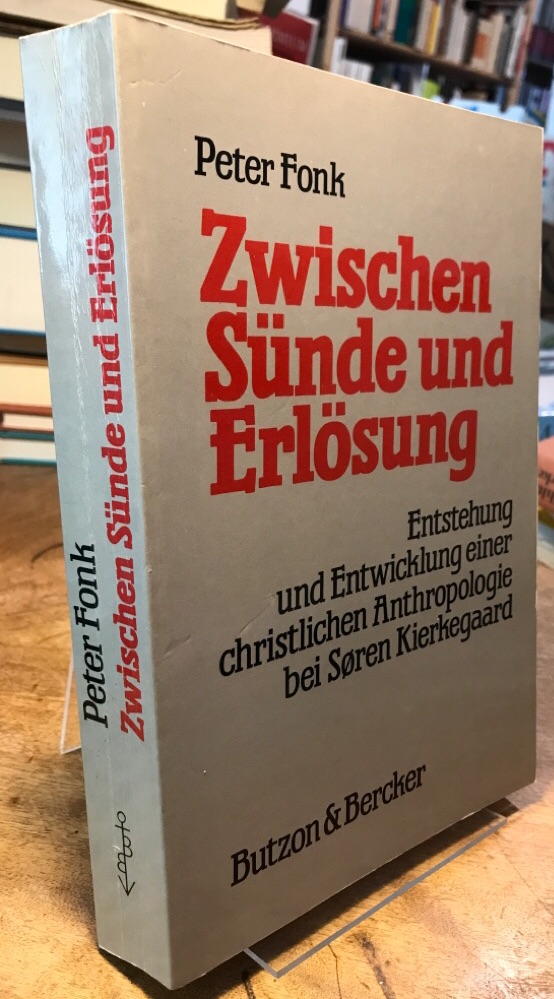
1990ref. 91031Kevelaer, Butzon und Bercker 1990. 462 Seiten. Softcover/Paperback
ref. 3563928312.Ghardcover. Good. Access codes and supplements are not guaranteed with used items. May be an ex-library book. hardcover
ref. 1024939294.Ghardcover. Good. Access codes and supplements are not guaranteed with used items. May be an ex-library book. hardcover
ref. 3744612937.Gpaperback. Good. Access codes and supplements are not guaranteed with used items. May be an ex-library book. paperback
ref. ria9783563928318_inpHardcover. New. New Book; Fast Shipping from UK; Not signed; Not First Edition; Unveränderter Nachdruck der Originalausgabe von 1886. Der Verlag Antigonos spezialisiert sich auf die Herausgabe von Nachdrucken historischer Bücher. Wir achten darauf dass diese Werke der Öffentlichkeit in einem guten Zustand zugängli hardcover
2018ref. BN108882GALLIMARD 2018. 2018. uvres I II uvres I II GALLIMARD unknown
1849ref. 63618Kjøbenhavn Reitzel 1849. 8vo. 42 pp. Uncut in the original printed wrappers. The front wrapper with the text of the title-page all except the year repeated inside a double-line border inside which a line-border with ornamental cornerpieces. Back-wrapper with the year inside the same frame. The printed spine preserved in its entirety and also completely unrestored with Gothic lettering and small printed ornamentations. A vertical strip of ca 1 cm towards the spine on both front and back wrapper faded but only here. The spine is also not faded. A brown discolouration to lower blank margin throughout. Otherwise just light occasional brownspotting. "a. m." in contemporary hand to front wrapper. Housed in beautiful marbled paper box with a grey morocco spine with gilt Gothic lettering and small gilt ornamentations. Gilt super ex libris to front. Signed in Gilt lettering to inside of spine: Anker Kysters Eftf. and gilt by Hagel Olsen. A truly magnificent copy of the first edition in the extremely rare original wrappers completely unrestored and with the original printed spine also preserved in its entirety which we have never seen before. This important publication is an essential part of Kierkegaard's upbuilding production written and published under his own name. It consists of three discourses at the communion on Fridays and is the upbuilding religious companion to Sickness Unto Death that was published pseudonymously earlier in the year thus continuing the practice that Kierkegaard began with Either-Or and otherwise ended with Concluding Unscientific Postscript that each pseudonymous work would be accompanied by an upbuilding publication. As Kierkegaard states in his journal from October 1849 after having written that his "three discourses" i.e. "The High Priest" "The Publican" and "The sinner" "are now delivered to the printer 1 I must find a point of rest but I cannot rest on a pseudonym; and these discourses correspond to Anti-Climacus; and the position of Discourses for the Communion on Fridays is once and for all designated as the point of the rest for my works. 2 Since at present people are focusing on my pseudonym Climacus it is important that there be emphasis in the direction of edification. Once again how loving it is of Governance that what I need and am to use always lies ready. 3 "The Preface" calls to mind the Two Edif. Discourses of 1843; it is important to me to emphasize that I began as a religious author right at the outset; it is important for the repetition." NB 13: 79. In fact the reference back to Kierkegaard's debut as an upbuilding author in Two Upbuilding Discourses from 1843 plays a dominant role in the present work. The preface here not merely alludes to the preface of the first upbuilding publication it even largely quotes from it. Kierkegaard clearly perceived the present publication as beginning the second cycle of Upbuilding Discourses see NB 12:133. It is also worth noting that the present collection of discourses plays an important role in Kierkegaard's continued thoughts about Regine and the relationship that he broke off. Even the dating of the preface haunted him in this regard. We know from his notebooks that first he dated it "d. 10 Sept. 49" but then he altered it to the 8th then "start of" and finally "Beginning of September 1849". These dates all recall defining biographical incidences. It is on September 8 1841 that Kierkegaard sought out Regine on the street walked home with her and rushed to the Finance department to ask her father for her hand in marriage. And it was on September 10 also 1841 that he got acceptance from both Regine and her father so that the engagement was finalized. As we know the engagement ended when the tormented Kierkegaard broke it off a year later October 12 1842. The following years up until the publication of "The High Priest"… Kierkegaard considered reconciliation on numerous occasions. Thus in November 1849 he writes in his journal: "Had it been possible the reconciliation with "her" would have happened simultaneously with the three discourses i.e. "The High Priest" "The Publican" – "The Woman who was a Sinner" which in the preface – for the sake of repetition of the entire authorship – contains the repetition of the preface to the two upbuilding discourses 1843 the work I know for certain that she read back then." NB 14:44. As we know this reconciliation never took place accounting for the two dates of engagement being erased. Kierkegaard's upbuilding discourses were of immense importance to him though to his great disappointment they were partly neglected by his contemporaries in favour of his more known philosophical works. Whereas his philosophical works were meant to insinuate themselves into the minds of men his upbuilding discourses which accompanied the pseudonymous works formed a contrast to them by being direct and religious. They were meant to offer comfort to the reader to be exactly that which they were entitled – upbuilding. The three Communion-speeches in the present collection are theologically centered around the meaning of substitution the dialectic of self-delusion and the transformation of the subject by conversion. Reminding us that any kind of suffering that we can face was already faced by Christ Kierkegaard in the first of the discourses uses a passage from the Epistle to the Hebrews 4.15 to explain how Christ too was tempted how he relates to human suffering and how he as the sufferer of all sufferers is qualified to console us. The second discourse The Publican is based on the Scripture passage in Luke 18.13 where Jesus compares two kinds of attitude a person can have toward one's own sin. In analyzing the relationship of the publican and the Pharisee to God Kierkegaard uses the passage to address the reader and directly remind us of a theme that runs like a red thread through his religious writings: the necessity of being alone before God. In The Woman who was a Sinner taken from Luke 7.47 which Kierkegaard would later use for An Upbuilding Discourse 1850 the third discourse in the publication Kierkegaard discusses how to find solace and forgiveness once again hovering about the theme of the self before God. It is in many ways one of Kierkegaard's most moving pieces. Himmelstrup 120. The present copy is no. 76 in Girsel's "Kierkegaard" The Catalogue which can be found here.
ref. 1023769832.Ghardcover. Good. Access codes and supplements are not guaranteed with used items. May be an ex-library book. hardcover
2000ref. 163166Berlin & New York: de Gruyter 2000. XII, 516 Seiten. Gr. 8° (22,5-25 cm). Orig.-Leinenband mit goldgeprägtem Titel auf Deckel und Rücken. [Hardcover / fest gebunden].
ref. 2070286886.Gmass_market. Good. Access codes and supplements are not guaranteed with used items. May be an ex-library book. unknown
1938ref. 33151Paris Fernand Aubier, Éditions Montaigne 1938 Fort In-8
1855ref. 63624Kjøbenhavn Reitzel 1855. 8vo. 20 31 16 23 32 26 47 30 22 pp. Bound in a very nice contemporary brown half calf binding with richly gilt spine. Lovely patterned end-papers. Light bumping to corners and inner hinge a bit weak. Internally a bit brownspotted. Inserted between the front free end-paper and the title-page are two leaves constituting a neatly written index of all 64 articles contained in the nine issues in fine contemporary hand signed H.W. Petersen. The text is continually paginated throughout in the same hand. With faded ownership signature to title-page Emily Karen Holst. A lovely copy of the first edition of all nine numbers of Kierkegaard’s fierce periodical with all nine issues in the first issue which is uncommon and beautifully bound contemporarily. No presentation-copies nor gift-bindings of the present work are known to exist neither are copies in original bindings nor wrappers as the issues were presumably never issued such but just as they appear here. Having commenced his attack on the Church in “The Fatherland” to pave the way for the final blow that is to come in the course of 1855 Kierkegaard establishes a periodical with the sole purpose of attacking the Church the priests and the official Danish Christianity as such. Kierkegaard is the publisher the editor and the only contributor. This is a focused sharp and destructive periodical intended to shock and to tear down the established Church. It is also witty and acute. Nine issues containing several articles each appeared between May 25 and September 24. The issues were published at one-to-four-week intervals up until Kierkegaard’s death. He collapsed in the street after having published the ninth issue of “The Moment”. A tenth was later found in his home finished but not dated for publication. This was published posthumously. The Moment-articles were extremely popular sold out quickly and were published in several issues. They shocked and outraged most of the Christian population but they also amused and inspired. Some of the articles were so outrageous that many thought the greatest mind of the country had lost his mind. Some speculated that Kierkegaard had been excluded from publishing in The Fatherland which is why he had to found his own organ of proclamation. This was not the case however. In an unpublished draft for an article for no. 9 of The Moment he explains that he had come to realize that The Fatherland was not effective enough. He had told Giødwad that “it will come to nothing as long as I use The Fatherland I need my own instrument” and explains that it is necessary for his contemporaries to deal with him alone. He goes on to talk about the immense effect The Moment has had how all talk about keeping him quiet evaporated and how he has probably reached as wide an audience as he could in The Fatherland but now knowing that ALL of his subscribers were interested in his cause and not just subscribers to The Fatherland. See SKS Introduction to Øieblikket 235. The initial title for “The Moment” had been “In the Moment – For Posterity” but Kierkegaard ended up just calling it “The Moment” as it was more powerful and the longer title would become tedious when continually repeated. Altogether Kierkegaard published a whole 64 articles in” The Moment” distributed thus: May 24 1855: 4 articles June 4 1855: 10 articles June 27 1855: 6 articles July 7 1855: 7 articles July 27 1855: 9 articles August 23 1855: 6 articles August 30 1855: 9 articles September 11 1855: 7 articles September 24 1855: 6 articles In his earlier works For Self Examination and Practice in Christianity from 1850 and 1851 respectively Kierkegaard had already addressed the topic of true Christianity as opposed to the official and institutionalized Christendom. Back then he had done so not subtly but also not as a full-blown attack. After a publishing hiatus of more than three years this was going to change. At the end of his life Kierkegaard embarked on a controversial and fierce attack upon the Danish Church that would have immense consequences for the development and comprehension of the official Church the priesthood and Christianity itself. The Danish State Church epitomized all that he found wrong with Christendom as a whole and he did not embark on his quest lightly. Throughout his writings Kierkegaard had maintained that the belief in Christ required a leap of faith and all of one’s person. The Danish Lutheran church on the other hand claimed that all Danes were born Lutheran and were thus Christians unless they actively chose not to be. The Danish Church had moved increasingly towards transforming Christianity into a profane state religion. It is still the case in Denmark today that when you are born a Dane you are also born a member of the Church. This equivalence between Church and State was extremely far from what Kierkegaard believed Christianity to be. Kierkegaard felt that the Church had betrayed the Christianity of the New Testament and he was willing to fight till his death to defend what he understood true Christianity to be. We were well beyond thoughts of reformation. It needed to be torn down and completely rebuilt. The war was waged in newspaper articles in the paper The Fatherland and in the “periodical” Kierkegaard himself founded with the sole purpose of attacking the Church “Øieblikket” i.e. The Moment in nine installments from May 26 to September 24 1855 with a tenth appearing posthumously. “These writings are markedly different from the rest of his work. Obviously intended for a broad audience they employed searing wit and satire making no attempt to be subtle or nuanced. Amid this public battle Kierkegaard collapsed on the street paralyzed and was taken to hospital. He died there a few weeks later on 11 November 1855. A tentative diagnosis of the cause was tuberculosis of the spine marrow. Towards the end Kierkegaard affirmed to Emil Boesen—a lifelong friend and a priest in the church that Kierkegaard had attacked—that he was still a believer in Christ.” D. Anthony Storm. Kierkegaard’s assault on official Christendom and the Danish Church was based upon his notion that Christendom had departed too far from the Christianity of The New Testament. For the outraged Kierkegaard Bishop Mynster typified the complacent and established “official” Christianity but the relationship with Mynster was complicated. He and Kierkegaard had always been closely intertwined. Few people played as important a role in Kierkegaard’s life as Mynster who Kierkegaard would constantly relate and refer to. Kierkegaard’s “mild” attack on the Church and the established Christianity in Denmark in Training in Christianity 1851 hit Mynster harder than anyone else and the two theological giants never reconciled after the publication of that work. But Kierkegaard had saved something much worse for later. For his own enormous respect for Mynster it also meant a great deal that Mynster was the last person to talk to Kierkegaard’s father before he died and that his father had always held him in extremely high regard. In his Journal from 1853 he writes “.I have something upon my conscience as a writer. Let me indicate precisely how I feel about it. There is something quite definite I have to say and I have so much upon my conscience that as I feel I dare not die without having uttered it. For the instant I die and so leave this world so I understand it I shall in the very same second so frightfully fast it goes! in the very same second I shall be infinitely far away in a different place where still within the same second frightful speed! the question will be put to me: “Hast thou uttered the definite message quite definitely” And if I have not done so what then. There is something quite definite I have to say. But verily I am not eager to say it. On the contrary I would so infinitely prefer that another should say it— which however would not help me since as I understand it it was and remains my task. For it is not a cheerful message this definitive thing and I cannot but think that there are several persons dear to me to whom it would be unwelcome to hear it said. Above all there is a right reverend old man a consideration which has constantly held me back laid a restraint upon my tongue and upon my pen a consideration for the highest dignitary of the Church a man to whom by the memory of a deceased father I felt myself drawn with an almost melancholic affection—and I must think that to him especially it will be very unwelcome that this is said.” Pap. X 6 B: 371. This excellently sums up one the one hand the necessity Kierkegaard felt in saying what needed to be said about the state of Christianity in Denmark and on the other hand why he was reluctant to say it. He knew it would offend but most of all hurt especially Mynster for whom he still had great affection. At the same time it was also Bishop Mynster who was responsible for the approach Kierkegaard considered so dangerous to true Christianity the person who personified the weak and complacent established “official” Christianity that disregarded the true Christianity of The New Testament – the kind of tame Christianity in which the priests tell the congregation what they want to hear. What was he to do Kierkegaard’s journals and papers are full of entries that reflect the conundrum. The defining moment occurred when Mynster had died which happened on January 30th 1854. The Sunday before the funeral Professor of Theology H.L. Martensen Court Preacher at Christiansborg Slotskirke gave a commemorative sermon for Mynster in which he included him in a series of holy men going back to the apostles and called him a “witness to the truth” and a “martyr” in Danish “Blodvidne”. Kierkegaard could not take it. He finally broke his silence and protested with an article in The Fatherland where he called Mynster a “frail pleasure-seeker who was great only as an orator” and presented his own version of a “witness to the truth” namely “A witness to the truth a real witness to the truth is a man who is skinned alive abused dragged from one prison to the next and in the end … crucified beheaded burned at the stake or fried on a grill his soulless body left unburied and sprawling … in some remote place—that’s how a witness to the truth is buried!” Var Biskop Myster et ”Sandhedsvidne”… December 18 1854. And thus the crusade against the established Danish Church had begun. Kierkegaard continued his fight against Martensen against the priests against the official Christianity of Denmark and against the Church in articles in The Fatherland. And most importantly he started his own periodical “The Moment” which was to become extremely influential and today towers as a monument over the greatest crisis the Danish Church has ever found itself in. In “The Moment” Kierkegaard polemicized against the church and its worldly priesthood with both sharpness and wit. He insisted that the authorities of the church admit that true Christianity was disappearing. Kierkegaard would intensify his attacks over the course of “The Moment”. He accused the priests of failing to convert their tear-filled sermons on Sundays into existential practice on Mondays. He called them “bourgeois theologians of convenience” and accused them of being primarily interested in idyllic parsonages feel good Christianity and lucrative advancements calling the priests lumped together an “epitome of nonsense shrouded in long gowns!” He rallied against the church claiming it ought to be closed or torn down and threw mud on the rituals of baptism confirmation and marriage. In “The Moment” this was done so humorously that Kierkegaard managed to win over part of the population. But his fierce attack upon the official Christianity of Denmark caused much more indignation scandal and contradiction than approval. Although Kierkegaard’s illness and soon to follow death on November 11 ended Kierkegaard’s writing and continued attacks it did not end the storm on the Church that the epigons continued. Kierkegaard’s authorship before 1851 had made him famous in both Denmark and abroad as one of the greatest living philosophers and theologians. His attack on official Christianity however had a more direct effect upon his own kingdom but also upon the neighbouring countries Norway Sweden and Germany. Kierkegaard’s Church Feud continued for years after his death and kept affecting the Church severely. One must remember that this fierce attack came from one of the most respected thinkers of the period – of all periods – and it came from within not from an atheist. It came from a believer a more profound believer than most. Kierkegaard only had part of “The Moment” in his possession when he died namely 3 4 and 7 together Auction Catalogue no. 2187-89. We have never seen a copy in a gift-binding and as far as we are aware no such copy is known to exist. Himmelstrup 180 The present copy is no. 92 in Girsel's "Kierkegaard" The Catalogue which can be found here. unknown
1855ref. 62984Kjøbenhavn C.A. Reitzel 1855. 8vo. Bound in contemporary half calf with gilt lettering to spine. A bit of wear to extremities. Internally with a bit of marginal browning. Øieblikket: 20 31 16 23 32 26 77 30 22 pp.; Dette skal siges. 12 pp. First edition of both works. Øieblikket with all nine numbers in first issue is very rare. Himmelstrup 180 177. unknown
ref. 95770Kjøbenhavn 1855. 20; 31 1; 16; 23 1; 32; 26; 47 1; 30; 22 2 s. / Hvad Christus dømmer om officiel Christendom. Af S. Kierkegaard. Bianco Lunos Bogtrykkeri. Forlagt af C.A. Reitzels Bo og Arvinger Kjøbenhavn 1855. 14 s. / Dette skal siges; saa være det da sagt. Af S. Kierkegaard. Andet Oplag. Bianco Lunos Bogtrykkeri. Forlagt af C.A. Reitzels Bog og Arvinger Kjøbenhavn 1855. 12 s. Bundet i et samtidig slitt helsjirtingb. Sprukket i ytre falser og fordekkelen løs. Hjørnene med sår. Gjennomgående sterkt brunplettet. Noen bretter. Øieblikkets No. 1-2 i Andet Oplag. . unknown