KIERKEGAARD, SORENBiblio.com
2.332 resultados
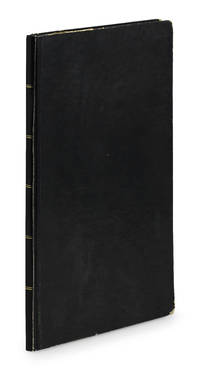
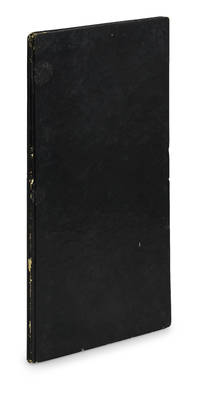
1851ref. 63621Kjøbenhavn Reitzel 1851. 8vo. 32 pp. Original gift-binding of the black glitted paper all edges gilt and printed on fine paper. Capitals chipped front hinge with a bit of wear and a few smaller spits on front board towards hinge restored with black colour. Light overall wear. Light brownspotting. First edition - one of the extremely rare gift-copies either a presentation-copy given by Kierkegaard to one of his dedicatees or one of the copies he had in his possession when he died. This small pamphlet constitutes a turning point in Kierkegaard’s life and work. Twice in his career Kierkegaard considered his authorship over. The first time was with the publication of “Concluding Unscientific Postscript” from 1846. The second termination of his authorship came with “Two Discourses at the Communion on Fridays” which appeared on August 6 1851 marking the end of that which we consider his second authorship. As we know from 1848 Kierkegaard stops altogether making lavish presentation-bindings and begins standardizing his presentation practice. From then on he only gives away copies of his books in the black glitted paper-bindings. “Two Discourses at the Communion on Fridays” not only marks an authorial turn in Kierkegaard’s career it also marks a bibliophilic and more personal one namely the discontinuation of writing presentation-inscriptions in his works. “One Upbuilding Discourse” from the previous year is the last work in which Kierkegaard wrote a handwritten presentation inscription. Thus no presentation-inscription of the present work exists. We also do not have a letter accompanying a copy of this work so even though Kierkegaard did give away copies of his works from 1851 and onwards as is evidenced from the presentation-bindings that he had made it is extremely rare to find copies of the works after 1850 in a presentation-binding the dedicatee of which can be traced. One can ask why Kierkegaard stopped writing inscriptions in his books but we will probably not find a precise answer. We find it most likely that the changed practice signals the fact that with the present publication he considered his career over and that it would thus be inappropriate to continue the practice of written presentation inscriptions. Some consider it an aesthetic choice. Whatever the exact reason it was undoubtedly a very well-thought-out decision that can be compared to his decision of how to word the preface to the work. As Cappelørn notes in his “Forligelsen” p. 477 “That it caused Kierkegaard great troubles to give the preface exactly the wording that he wished is understandable. This was the preface for the writing that was to end his authorship. In a journal entry presumably from May 1849 he writes what he had also previously hinted at: that his understanding of the entire authorship “points definitively to Discourses at the Communion on Fridays”. That apprehension was finally fulfilled in August 1851 with the publication of Two Discourses at the Communion on Fridays.” translated from Danish. That Kierkegaard himself saw the present work as the conclusion of his authorship is also evident from his preface: “An authorship that began with Either/Or and advanced step by step seeks here its consummating place of rest at the foot of again underlining the fact that this constitutes the conclusion of his authorship and again embracing all the pseudonymous works in this religious conclusion. The altar where the author personally most aware of his own imperfection and guilt certainly does not call himself a witness to the truth but only a singular kind of poet and thinker who «without authority» has had nothing new to bring but «has wanted to read through once again if possible in a more inward way the original text of individual human existence-relationships the old familiar text handed down from the fathers.” cf. my post script to Concluding Postscript”.” SKS 12 p. 281. Kierkegaard’s reference to the postscript of Concluding Unscientific Postscript is interesting in determining his own view of these two works as being on par with each other in their concluding manner – and in their underlining the equivalence between Kierkegaard himself and his pseudonyms. It is highly interesting that Kierkegaard now in his “final work” refers to his pseudonymity in the preface although this is a religious discourse. What is also interesting about this concluding work is the printed dedication which reads “To One Unnamed whose name shall one day be named is dedicated along with this little work the whole of the authorship from the very beginning” The “unnamed” is Regine with whom Kierkegaard considered reconciliation on numerous occasions. In his journals he wrote much about her and his thoughts about reconciling with her during the period when writing Two Discourses at the Communion on Fridays. As we know the reconciliation never took place but that did not prevent Kierkegaard from dedicating his entire authorship to her with the present publication. Although Kierkegaard had begun working on the publication already in 1849 “Two Discourses at the Communion on Fridays” appeared simultaneously with “On My Work as an Author” on August 6 1851. Kierkegaard had five copies of the work in his collection when he died see Auction Catalogue no. 2173-77 all in black glitted paper bindings. Himmelstrup 130. The present copy is no. 83 in Girsel's "Kierkegaard" The Catalogue which can be found here. unknown
1851ref. 63621Kjøbenhavn, Reitzel, 1851. 8vo. 32 pp. Original gift-binding of the black glitted paper, all edges gilt, and printed on fine paper. Capitals chipped, front hinge with a bit of wear and a few smaller spits on front board towards hinge restored with black colour. Light overall wear. Light brownspotting.
ref. 64989Milano, Edizioni di Comunita, 1948. 14 x 23, 149 pp., broché (brossura/paperback), très bon état (in ottimo stato).
1851Kjøbenhavn, C. A. Reitzel, 1851. Indbundet i et pænt nyere halvmaroquin med forgyldt rygtitel. Håndsyede kapitælbånd og fladstrøgne kapitæler. (Sign. Axel Jensen). Nogle spredte brunpletter især på de første og sidste blade. (6),92 pp.
1851K., 1851. Slidt samtt. hldrbd. Sidste halvdel skjoldet, noget plettet. (IV)+92pp.
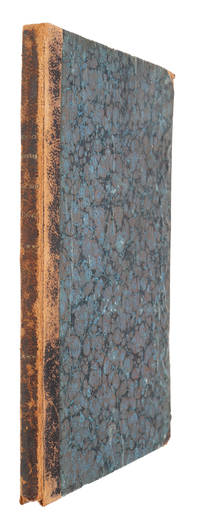
1851ref. 62810Kjøbenhavn C. A. Reitzel 1851. 8vo. Contemporary brown half calf with marbled paper boards. Spine and corners worn. Title-page brownspotted and brownspotting throughout. Occasional light pencil notes. Ownership signature of Henning Kehler to front free end-paper. 4 92 pp. First edition with an excellent provenance. Described by Hong & Hong as written with “the metaphorical imagination of a poet the thoughtfulness of a philosopher and theologian the whimsy of the humourist and the ardour of the lover and believer” The Essential Kierkegaard p. 393 “For Self-Examination” is widely considered one of Kierkegaard’s most accessible works and his most readily comprehended book. Thus although written at the end of his career it serves as an excellent introduction to his thought. “For Self-examination” is particularly famous for its well-known passages on Socrates and its critique of the established order of Christendom that was first hinted at in “Training in Christianity”. The work appeared on September 12 1851 about a month after “Two Discourses at the Communion on Fridays” and “On My Work as an Author” but as opposed to those two works the genesis of which was protracted over almost two years the present work was an act of idea to reality in a single summer that of 1851. In this direct and approachable work published under Kierkegaard’s own name he returns to the inward and the personal to the individual before God. The work is divided into three sections that comprise a sort of trinity; the first is entitled What is Required in Order to Look at Oneself with True Blessing in the Mirror of the Word and the two following sections are on Christ and the Holy Spirit respectively. The book sold well as is evidenced by a second edition appearing already in February 1852. Kehler Henning 1891-1979: Critic journalist and book collector. Kehler was an important literary critic and especially influential in the years between to two world wars where he excelled in sharp conservative criticism of contemporary affairs. He wished to revitalize Danish culture and was worried about the contemporary materialism and lack of God. Kehler’s collection broadly focused on Danish literature included a significant collection of Kierkegaard. Himmelstrup 136. hardcover
1851ref. 63623Kjøbenhavn Reitzel 1851. 8vo. 6 20 pp. Original gift-binding of the black glitted paper all edges gilt and printed on fine paper. Excellently rebacked barely noticeable in almost perfect pastiche but erroneously “recreating” double gilt lines. A wonderful copy with very light overall wear and a bit of bumping to capitals. Internally a bit of brownspotting. First edition one of the extremely rare gift-copies either a presentation-copy given by Kierkegaard to one of his dedicatees or one of the copies he had in his possession when he died. Described by Hong & Hong as written with “the metaphorical imagination of a poet the thoughtfulness of a philosopher and theologian the whimsy of the humourist and the ardour of the lover and believer” The Essential Kierkegaard p. 393 “For Self-Examination” is widely considered one of Kierkegaard’s most accessible works and his most readily comprehended book. Thus although written at the end of his career it serves as an excellent introduction to his thought. “For Self-examination” is particularly famous for its well-known passages on Socrates and its critique of the established order of Christendom that was first hinted at in “Training in Christianity”. The work appeared on September 12 1851 about a month after “Two Discourses at the Communion on Fridays” and “On My Work as an Author” but as opposed to those two works the genesis of which was protracted over almost two years the present work was an act of idea to reality in a single summer that of 1851. In this direct and approachable work published under Kierkegaard’s own name he returns to the inward and the personal to the individual before God. The work is divided into three sections that comprise a sort of trinity; the first is entitled What is Required in Order to Look at Oneself with True Blessing in the Mirror of the Word and the two following sections are on Christ and the Holy Spirit respectively. The book sold well as is evidenced by a second edition appearing already in February 1852. There are no copies with presentation-inscriptions but Kierkegaard still had copies printed on special paper and bound in gift-bindings. He had five of these in his collection when he died. The others he gave away as presentation-copies with no inscription but presumably accompanied by a letter none of which is known to exist. Himmelstrup 136. The present copy is no. 89 in Girsel's "Kierkegaard" The Catalogue which can be found here. unknown
1851ref. 57275Kjøbenhavn C. A. Reitzel 1851. Indbundet i et pænt nyere halvmaroquin med forgyldt rygtitel. Håndsyede kapitælbånd og fladstrøgne kapitæler. Sign. Axel Jensen. Nogle spredte brunpletter især på de første og sidste blade. 692 pp. Originaludgaven. Himmelstrup 136.Exlibris Paul Hauge. unknown
1851ref. 57275Kjøbenhavn, C. A. Reitzel, 1851. Indbundet i et pænt nyere halvmaroquin med forgyldt rygtitel. Håndsyede kapitælbånd og fladstrøgne kapitæler. (Sign. Axel Jensen). Nogle spredte brunpletter især på de første og sidste blade. (6),92 pp.
1851ref. 62810Kjøbenhavn, C. A. Reitzel, 1851. 8vo. Contemporary brown half calf with marbled paper boards. Spine and corners worn. Title-page brownspotted and brownspotting throughout. Occasional light pencil notes. Ownership signature of Henning Kehler to front free end-paper. (4), 92 pp.
1851ref. 63623Kjøbenhavn, Reitzel, 1851. 8vo. (6), 20 pp. Original gift-binding of the black glitted paper, all edges gilt, and printed on fine paper. Excellently rebacked, barely noticeable in almost perfect pastiche (but erroneously “recreating” double gilt lines). A wonderful copy with very light overall wear and a bit of bumping to capitals. Internally a bit of brownspotting.
ref. 069114074X.Gpaperback. Good. Access codes and supplements are not guaranteed with used items. May be an ex-library book. paperback
1993ref. 17671Ewing New Jersey U.S.A.: Princeton Univ Pr. New. Hardcover. FREE UPGRADE to Courier/Priority Shipping Upon Request - IN STOCK AND IMMEDIATELY AVAILABLE FOR SHIPMENT - Flawless -- with a bonus offer--; 017671; CHRISTIAN LIFE LUTHERAN AUTHORS GOD . 1993. 0691033005 . Princeton Univ Pr hardcover
ref. ria9780691033006_inpHardcover. New. New Book; Fast Shipping from UK; Not signed; Not First Edition; Contains the last of seven works signed by the author. This book covers three of his discourses - 'On the Occasion of a Confession' 'On the Occasion of a Wedding' and 'At a Graveside'. 'On the Occasion of a Confession' centers on still hardcover
ref. ria9780691140742_inpPaperback. New. New Book; Fast Shipping from UK; Not signed; Not First Edition; Includes the last of seven works signed by the author. This title both complements and stands in contrast to the author's pseudonymously published "Stages on Life's Way". paperback
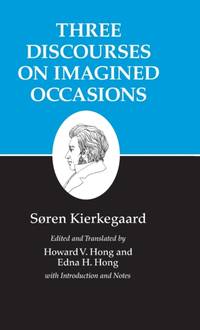
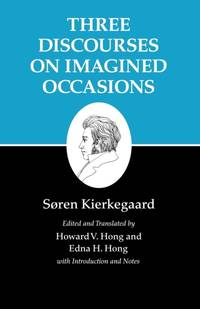
1993ref. L3 box735 a4Three Discourses on Imagined Occasions Kierkegaard's Writings Volume 10. By Søren Kierkegaard. Edited and Translated with Introduction and Notes by Howard V. Hong Edna H. Hong. 1993 by Princeton University Press. Hardcover 204 pages. Princeton University Press hardcover
ref. 0691033005.Ghardcover. Good. Access codes and supplements are not guaranteed with used items. May be an ex-library book. hardcover
1993ref. Q-0691033005Princeton University Press 1993-07-12. Hardcover. New. New. In shrink wrap. Looks like an interesting title! Princeton University Press hardcover
1993ref. DADAX0691033005Princeton University Press 1993-07-12. First Edition. hardcover. New. 6.00x0.50x9.00. Buy with confidence. Excellent Customer Service & Return policy. Princeton University Press hardcover
1941ref. B000NWOQ00Augsburg 1941. Hardcover. Good. Good Hardcover in Good Dust Jacket. Jacket and book have some edgewear. Name inside cover. Text is clean bright and unmarked. Augsburg hardcover
1958ref. 2081502111703147Shinkyo shubbansha 1958. Soft Cover. Fine. Number of pages: 119p Size: 18cm Shinkyo shubbansha paperback
1961Book is in excellent condition. Binding is solid and square, covers have sharp corners, exterior shows no blemishes, text/interior is clean and free of marking of any kind. 199 pages; an Image book,
ref. V-20260902-AB7-S50049Unknown. paperback. Very Good. 6x0x9. The Wisdom of Kierkegaard Vol. I Unknown paperback
2008ref. 230829008A & D Books 2008-12-17. paperback. Used: Very Good. 6x0x9. Clean and unmarked. Some minor cosmetic shelf wear. From a private collection. Very good condition. Comes from non smoking home. A & D Books paperback
ref. 1604593148.Gpaperback. Good. Access codes and supplements are not guaranteed with used items. May be an ex-library book. paperback