2 332 résultats
1938réf. 33151Paris Fernand Aubier, Éditions Montaigne 1938 Fort In-8
réf. 2070286886.Gmass_market. Good. Access codes and supplements are not guaranteed with used items. May be an ex-library book. unknown
2000réf. 163166Berlin & New York: de Gruyter 2000. XII, 516 Seiten. Gr. 8° (22,5-25 cm). Orig.-Leinenband mit goldgeprägtem Titel auf Deckel und Rücken. [Hardcover / fest gebunden].
réf. 1023769832.Ghardcover. Good. Access codes and supplements are not guaranteed with used items. May be an ex-library book. hardcover
1849réf. 63618Kjøbenhavn Reitzel 1849. 8vo. 42 pp. Uncut in the original printed wrappers. The front wrapper with the text of the title-page all except the year repeated inside a double-line border inside which a line-border with ornamental cornerpieces. Back-wrapper with the year inside the same frame. The printed spine preserved in its entirety and also completely unrestored with Gothic lettering and small printed ornamentations. A vertical strip of ca 1 cm towards the spine on both front and back wrapper faded but only here. The spine is also not faded. A brown discolouration to lower blank margin throughout. Otherwise just light occasional brownspotting. "a. m." in contemporary hand to front wrapper. Housed in beautiful marbled paper box with a grey morocco spine with gilt Gothic lettering and small gilt ornamentations. Gilt super ex libris to front. Signed in Gilt lettering to inside of spine: Anker Kysters Eftf. and gilt by Hagel Olsen. A truly magnificent copy of the first edition in the extremely rare original wrappers completely unrestored and with the original printed spine also preserved in its entirety which we have never seen before. This important publication is an essential part of Kierkegaard's upbuilding production written and published under his own name. It consists of three discourses at the communion on Fridays and is the upbuilding religious companion to Sickness Unto Death that was published pseudonymously earlier in the year thus continuing the practice that Kierkegaard began with Either-Or and otherwise ended with Concluding Unscientific Postscript that each pseudonymous work would be accompanied by an upbuilding publication. As Kierkegaard states in his journal from October 1849 after having written that his "three discourses" i.e. "The High Priest" "The Publican" and "The sinner" "are now delivered to the printer 1 I must find a point of rest but I cannot rest on a pseudonym; and these discourses correspond to Anti-Climacus; and the position of Discourses for the Communion on Fridays is once and for all designated as the point of the rest for my works. 2 Since at present people are focusing on my pseudonym Climacus it is important that there be emphasis in the direction of edification. Once again how loving it is of Governance that what I need and am to use always lies ready. 3 "The Preface" calls to mind the Two Edif. Discourses of 1843; it is important to me to emphasize that I began as a religious author right at the outset; it is important for the repetition." NB 13: 79. In fact the reference back to Kierkegaard's debut as an upbuilding author in Two Upbuilding Discourses from 1843 plays a dominant role in the present work. The preface here not merely alludes to the preface of the first upbuilding publication it even largely quotes from it. Kierkegaard clearly perceived the present publication as beginning the second cycle of Upbuilding Discourses see NB 12:133. It is also worth noting that the present collection of discourses plays an important role in Kierkegaard's continued thoughts about Regine and the relationship that he broke off. Even the dating of the preface haunted him in this regard. We know from his notebooks that first he dated it "d. 10 Sept. 49" but then he altered it to the 8th then "start of" and finally "Beginning of September 1849". These dates all recall defining biographical incidences. It is on September 8 1841 that Kierkegaard sought out Regine on the street walked home with her and rushed to the Finance department to ask her father for her hand in marriage. And it was on September 10 also 1841 that he got acceptance from both Regine and her father so that the engagement was finalized. As we know the engagement ended when the tormented Kierkegaard broke it off a year later October 12 1842. The following years up until the publication of "The High Priest"… Kierkegaard considered reconciliation on numerous occasions. Thus in November 1849 he writes in his journal: "Had it been possible the reconciliation with "her" would have happened simultaneously with the three discourses i.e. "The High Priest" "The Publican" – "The Woman who was a Sinner" which in the preface – for the sake of repetition of the entire authorship – contains the repetition of the preface to the two upbuilding discourses 1843 the work I know for certain that she read back then." NB 14:44. As we know this reconciliation never took place accounting for the two dates of engagement being erased. Kierkegaard's upbuilding discourses were of immense importance to him though to his great disappointment they were partly neglected by his contemporaries in favour of his more known philosophical works. Whereas his philosophical works were meant to insinuate themselves into the minds of men his upbuilding discourses which accompanied the pseudonymous works formed a contrast to them by being direct and religious. They were meant to offer comfort to the reader to be exactly that which they were entitled – upbuilding. The three Communion-speeches in the present collection are theologically centered around the meaning of substitution the dialectic of self-delusion and the transformation of the subject by conversion. Reminding us that any kind of suffering that we can face was already faced by Christ Kierkegaard in the first of the discourses uses a passage from the Epistle to the Hebrews 4.15 to explain how Christ too was tempted how he relates to human suffering and how he as the sufferer of all sufferers is qualified to console us. The second discourse The Publican is based on the Scripture passage in Luke 18.13 where Jesus compares two kinds of attitude a person can have toward one's own sin. In analyzing the relationship of the publican and the Pharisee to God Kierkegaard uses the passage to address the reader and directly remind us of a theme that runs like a red thread through his religious writings: the necessity of being alone before God. In The Woman who was a Sinner taken from Luke 7.47 which Kierkegaard would later use for An Upbuilding Discourse 1850 the third discourse in the publication Kierkegaard discusses how to find solace and forgiveness once again hovering about the theme of the self before God. It is in many ways one of Kierkegaard's most moving pieces. Himmelstrup 120. The present copy is no. 76 in Girsel's "Kierkegaard" The Catalogue which can be found here.
2018réf. BN108882GALLIMARD 2018. 2018. uvres I II uvres I II GALLIMARD unknown
réf. 3563928312.Ghardcover. Good. Access codes and supplements are not guaranteed with used items. May be an ex-library book. hardcover
réf. 1024939294.Ghardcover. Good. Access codes and supplements are not guaranteed with used items. May be an ex-library book. hardcover
réf. 3744612937.Gpaperback. Good. Access codes and supplements are not guaranteed with used items. May be an ex-library book. paperback
réf. ria9783563928318_inpHardcover. New. New Book; Fast Shipping from UK; Not signed; Not First Edition; Unveränderter Nachdruck der Originalausgabe von 1886. Der Verlag Antigonos spezialisiert sich auf die Herausgabe von Nachdrucken historischer Bücher. Wir achten darauf dass diese Werke der Öffentlichkeit in einem guten Zustand zugängli hardcover
1990réf. 91031Kevelaer, Butzon und Bercker 1990. 462 Seiten. Softcover/Paperback
1947réf. V9950Bremen (Johs.Storms) 1947 (= Erste Ausgabe). 8°, Originalkarton (geb.), 224 S.,
réf. 41543560-nnew. unknown
réf. 41543560like new. unknown
réf. ria9783111306421_inpHardcover. New. New Book; Fast Shipping from UK; Not signed; Not First Edition; N/A hardcover
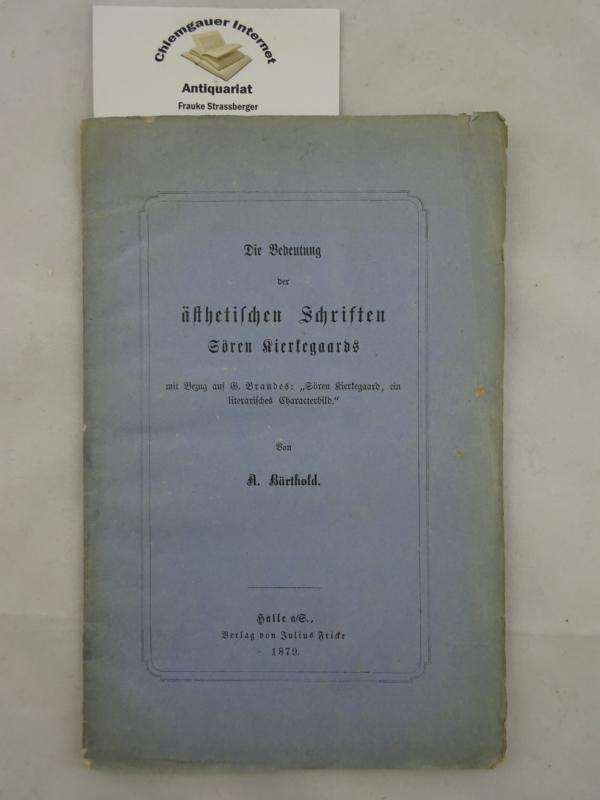
1879réf. 176980Halle, Fricke, 1879. 80 Seiten. 22 cm. Originalbroschur.
réf. 1019985674.Ghardcover. Good. Access codes and supplements are not guaranteed with used items. May be an ex-library book. hardcover
réf. 47014315like new. unknown
2003réf. BN213429Grevenberg 2003. 2003. Softcover. Zur Selbstprüfung der Gegenwart anbefohlen. Erbauliche Reden 1850/51. Urteilt selbst. Zur Selbstprüfung der Gegenwart anbefohlen. Erbauliche Reden 1850/51. Urteilt selbst. Sören Kierkegaard Grevenberg paperback
réf. 0243587163.Gpaperback. Good. Access codes and supplements are not guaranteed with used items. May be an ex-library book. paperback
réf. 0364135700.Ghardcover. Good. Access codes and supplements are not guaranteed with used items. May be an ex-library book. hardcover
réf. B9781167626890New. unknown
réf. 0428173446.Gpaperback. Good. Access codes and supplements are not guaranteed with used items. May be an ex-library book. paperback
réf. 1167626893.Gpaperback. Good. Access codes and supplements are not guaranteed with used items. May be an ex-library book. paperback
réf. 1020259647.Ghardcover. Good. Access codes and supplements are not guaranteed with used items. May be an ex-library book. hardcover