2.292 Ergebnisse
2000Best.-Nr. BN498448Gads Forlag 2000. 2000. Sören Kierkegaards Skrifter: Kommentarer til Journalerne 17 und 18 17 AA-BB-CC-DD und 18 EE-FF-GG-HH-JJ-KK Sören Kierkegaards Skrifter: Kommentarer til Journalerne 17 und 18 17 AA-BB-CC-DD und 18 EE-FF-GG-HH-JJ-KK Sören Kierkegaard Forskiningscenteret Gads Forlag unknown
2006Best.-Nr. BN500674Gads Forlag 2006. 2006. Sören Kierkegaards Skrifter: 11 Lilien paa Marken og Fuglen under Himlen. Tvende ethisk-religieuse Smaa-Afhandlinger. Sygdommen til Døden. "Ypperstepræsten" - "Tolderen" - "Synderinden Sören Kierkegaards Skrifter: 11 Lilien paa Marken og Fuglen under Himlen. Tvende ethisk-religieuse Smaa-Afhandlinger. Sygdommen til Døden. "Ypperstepræsten" - "Tolderen" - "Synderinden" Sören Kierkegaard Forskiningscenteret Gads Forlag unknown
1997Best.-Nr. BN496226Gads Forlag 1997. 1997. Sören Kierkegaards Skrifter: Kommentarer til K1 bis K5 4 Bücher K1 Af en endnu Levendes Papirer Om Begrebet Ironi K2-3 Enten-Eller; Gjentagelsen Frygt og Baeven Philosophiske Smuler Begrebet Angest Forord; K5 Opbyggelige Taler 18431844 Tre Taler ved taenkte Leiligheder Sören Kierkegaards Skrifter: Kommentarer til K1 bis K5 4 Bücher K1 Af en endnu Levendes Papirer Om Begrebet Ironi K2-3 Enten-Eller; Gjentagelsen Frygt og Baeven Philosophiske Smuler Begrebet Angest Forord; K5 Opbyggelige Taler 18431844 Tre Taler ved taenkte Leiligheder Sören Kierkegaard Forskiningscenteret Gads Forlag unknown
Best.-Nr. 1396659579.Ghardcover. Good. Access codes and supplements are not guaranteed with used items. May be an ex-library book. hardcover
Best.-Nr. 1391325915.Gpaperback. Good. Access codes and supplements are not guaranteed with used items. May be an ex-library book. paperback
Best.-Nr. 0428218520.Gpaperback. Good. Access codes and supplements are not guaranteed with used items. May be an ex-library book. paperback
Best.-Nr. 20145Bazoges-en-Pareds, 1941, in 8° broché, 268 pages.
1956Best.-Nr. 97983-JB142P., Albin Michel, 1956. 1 vol. br. 316 pages. Exemplaire de Jean Brun, auteur de l'Introduction à l'édition des Oeuvres complètes de Kierkegaard. Quelques passages proprement soulignés par ses soins.
1956Best.-Nr. 33182Paris Albin Michel 1956 in-12°
Best.-Nr. 26311Albin Michel, 1956, 377 pp., broché, couverture légèrement défraîchie, traces de scotch en première et dernière page, non coupé, état satisfaisant.
1960Best.-Nr. F109129Erlangen, 1960 194pp., 21cm., softcover, text in German, Doctoral dissertation (Inaugural-Dissertation der Philosophischen Fakultät der Friedrich-Alexander-Universität zu Erlangen), stamp at verso of title page, text is clean and bright, good condition, F109129
Best.-Nr. 1023932164.Ghardcover. Good. Access codes and supplements are not guaranteed with used items. May be an ex-library book. hardcover
Best.-Nr. 50618765like new. unknown
1859Kbh., 1859 + 1851. Indb. m. Til Selvprøvelse. Samtiden anbefalet. Tredie Udgave. K., 1856. i et samt. hldrbd. m. rygforgyldn. Ryg m. brugsspor. False nænsomt restaurerede. Indvendig ren. (2), 114 + 20 + 92 pp.
1859K., 1859. Ubeskåret, uden omsl. Det meste af den orig. ryg bevaret. Ren.
1859Best.-Nr. 63630Kjøbenhavn 1859. 8vo. Nice contemporary black half calf with four raised bands to gilt spine. Spine and corners worn. Light occasional brownspotting. 4 114 1 pp. First edition of Kierkegaard’s final work on his own authorship. Kierkegaard had published only one of his three works on his own authorship namely the short resumé On My Work as an Author of the present work which he did not dare publish because he was afraid of being misunderstood by his contemporaries. The work constitutes a frank account of his method of authorship and also serves as a paramount piece of autobiography. In 1846 Kierkegaard had started using a protocol as his journal. This is the first of the journals denoted NB that he continued throughout the rest of his life. These journal entries amounting to 36 volumes in all are filled with attempts at understanding himself his purpose the meaning of his writings and not least how he himself understood his authorship and wished for it to be understood in posterity. These latter considerations are the basis of the” The Point of View for My Work as an Author” which Kierkegaard left unpublished not wishing to be viewed as self-glorifying to be published posthumously by Peter Kierkegaard Søren’s brother. The considerations of whether to let “The Point of View for My Work as an Author” – which Kierkegaard also calls “The Confession of one Dying” – remain unpublished until after his death fill a lot in the notebooks from 1849 eg. NB 10:6; NB 10:60; NB 10:169; NB 11:123; NB 11:195 clearly showing how much this work meant to Kierkegaard who finally decided that it could indeed only be published posthumously. Himmelstrup 292. hardcover
1859Best.-Nr. 24489Kbh. 1859 1851. Indb. m. Til Selvprøvelse. Samtiden anbefalet. Tredie Udgave. K. 1856. i et samt. hldrbd. m. rygforgyldn. Ryg m. brugsspor. False nænsomt restaurerede. Indvendig ren. 2 114 20 92 pp. 2 originaludgaver. Himmelstrup 292 132. unknown
1859Best.-Nr. PERnsKIE27Copenhagen: C.A.Reitzel 1859. 1859. 8vo. pp. 2 p.l. 114 1 leaferrata. title vignette. contemporary half roan gilt back head of spine worn tail repaired front hinge strengthened light foxing small hole in second leaf affecting several letters of one word in table. First Edition. The Point of View for My Work as an Author was written by Kierkegaard in 1848 but not published until four years after his death by his brother. Appended is 'The Individual'. Two 'Notes' concerning my Work as an Author written in 1846 revised and enlarged to accompany Edifying Discourses but finally also left unpublished until 1859. Himmelstrup 292. F. Hardcover. Copenhagen: C.A.Reitzel, 1859. Hardcover
1859Best.-Nr. 22860K., 1859. Ubeskåret, uden omsl. Det meste af den orig. ryg bevaret. Ren.
1859Best.-Nr. 24489Kbh., 1859 + 1851. Indb. m. Til Selvprøvelse. Samtiden anbefalet. Tredie Udgave. K., 1856. i et samt. hldrbd. m. rygforgyldn. Ryg m. brugsspor. False nænsomt restaurerede. Indvendig ren. (2), 114 + 20 + 92 pp.
1859Best.-Nr. 63630Kjøbenhavn, 1859. 8vo. Nice, contemporary black half calf with four raised bands to gilt spine. Spine and corners worn. Light occasional brownspotting. (4), 114, (1) pp.
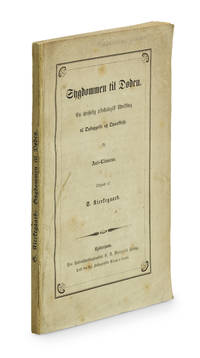
1849Best.-Nr. 63617Kjøbenhavn Reitzel 1849. 8vo. 8 136 pp. Uncut in the original printed wrappers. The front wrapper with the text of the title-page all except the year repeated inside a double-line border inside which a line-border with ornamental corner-pieces. Back-wrapper with the year inside the same frame. Excellently rebacked and with a closed tear to the front wrapper. Wrappers with light brownspotting. Some brownspotting mostly to first and last leaves. With the ownership signature of Henning Kehler to front free end-paper. A magnificent copy of the first edition in the extremely rare original wrappers with a very interesting provenance. Sickness unto Death is one of the main works of Christian existentialism. It is this monumental work which introduces the new pseudonym of Anti-Climacus that we find Kierkegaard’s concept of despair and it is here that he develops his theory of “the sin of despair”. Together with Training in Christianity Kierkegaard considered Sickness Unto Death ”the most valuable I have produced” and indeed many consider this work the most perfect of all of his works. Here Christianity is expressed in its most idealized form. Kierkegaard suffered daily from worries that publishing the work would convey that he was himself an ideal Christian and he long left it unpublished. Finally after more than a year of worries and considerations he decided that as with his major philosophical works this too would have a pseudonymous author and himself merely as the publisher. The pseudonym here however had another purpose than the earlier ones. Instead of deceiving or qualifying the work esthetically the pseudonym is chosen for Kierkegaard not to present himself as the perfect Christian. He chose a new pseudonym that perfectly contrasted the author of Philosophical Fragments and Concluding Unscientific Postscript Johannes Climacus who did not see himself as a Christian namely Johannes Anti-Climacus and finally after more than a year of hesitation Kierkegaard could publish his religious masterpiece with peace of mind. “Anti-Climacus is also the author of Practice in Christianity. He might be considered the author of Kierkegaard’s greatest religious works just as Johannes Climacus is the author of the great pseudonymous esthetic works. H. Hong remarks “The prefix Anti- does not mean ‘against.’ An old form of ‘ante’ before as in ‘anticipate’ the prefix denotes a relation of rank as in ‘before me’ in the First Commandment”. In his journals Kierkegaard said “Climacus is lower denies he is a Christian. Anti-Climacus is higher a Christian on an extraordinarily high level”. Kierkegaard considered this work and Practice in Christianity to be among his most important. The Sickness Unto Death is a companion piece to the Concept of Anxiety which is also a “psychological” work and moves beyond the earlier preliminary psychological considerations of anxiety in the face of freedom or anxiety derived from and leading to sin. Like its companion this work is short but very dense. Here Kierkegaard considers the spiritual aspects of despair. As anxiety is related to the ethical despair is related to the religious that is to the eternal.” D. Anthony Storm Commentary on Kierkegaard. Kehler Henning 1891-1979 was a critic journalist and book collector. He was an important literary critic and especially influential in the years between to two world wars where he excelled in sharp conservative criticism of contemporary affairs. He wished to revitalize Danish culture and was worried about the contemporary materialism and lack of God. Kehler’s collection broadly focused on Danish literature included a significant collection of Kierkegaard. The present copy is no. 71 in Girsel's "Kierkegaard" The Catalogue which can be found here. unknown
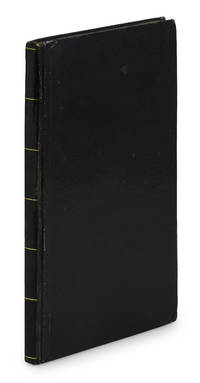
1849Best.-Nr. 63616Kjøbenhavn Reitzel 1849. 8vo. 8 136 pp. Original gift-binding of the black glitted paper and printed on fine paper. Neatly rebacked in a slightly more brownish black tone recreating the gilt lines of the original spine. Edges slightly bumped and light signs of wear overall. Light scattered brownspotting. With the ownership signature of N. Chr. M. Bredsdorff to front free end-paper. Excellent copy of the first edition in the original gift-binding presumably being one of the five copies that Kierkegaard had in his possession when he died. This is with all likelihood one of the copies Kierkegaard had bound to give away but then never did meaning that it was to be found in the auction of his books after he died. Only one buyer of any of the five copies he had in his collection was registered the other four are registered as having paid cash and are not registered by name. This is presumably one of those four copies possibly bought by Bredsdorff who was out of a family of priests and himself became a theologian. Sickness unto Death is one of the main works of Christian existentialism. It is this monumental work which introduces the new pseudonym of Anti-Climacus that we find Kierkegaard’s concept of despair and it is here that he develops his theory of “the sin of despair”. Together with Training in Christianity Kierkegaard considered Sickness Unto Death ”the most valuable I have produced” and indeed many consider this work the most perfect of all of his works. Here Christianity is expressed in its most idealized form. Kierkegaard suffered daily from worries that publishing the work would convey that he was himself an ideal Christian and he long left it unpublished. Finally after more than a year of worries and considerations he decided that as with his major philosophical works this too would have a pseudonymous author and himself merely as the publisher. The pseudonym here however had another purpose than the earlier ones. Instead of deceiving or qualifying the work esthetically the pseudonym is chosen for Kierkegaard not to present himself as the perfect Christian. He chose a new pseudonym that perfectly contrasted the author of Philosophical Fragments and Concluding Unscientific Postscript Johannes Climacus who did not see himself as a Christian namely Johannes Anti-Climacus and finally after more than a year of hesitation Kierkegaard could publish his religious masterpiece with peace of mind. “Anti-Climacus is also the author of Practice in Christianity. He might be considered the author of Kierkegaard’s greatest religious works just as Johannes Climacus is the author of the great pseudonymous esthetic works. H. Hong remarks “The prefix Anti- does not mean ‘against.’ An old form of ‘ante’ before as in ‘anticipate’ the prefix denotes a relation of rank as in ‘before me’ in the First Commandment”. In his journals Kierkegaard said “Climacus is lower denies he is a Christian. Anti-Climacus is higher a Christian on an extraordinarily high level”. Kierkegaard considered this work and Practice in Christianity to be among his most important. The Sickness Unto Death is a companion piece to the Concept of Anxiety which is also a “psychological” work and moves beyond the earlier preliminary psychological considerations of anxiety in the face of freedom or anxiety derived from and leading to sin. Like its companion this work is short but very dense. Here Kierkegaard considers the spiritual aspects of despair. As anxiety is related to the ethical despair is related to the religious that is to the eternal.” D. Anthony Storm Commentary on Kierkegaard. Kierkegaard had six copies of Sickness Unto Death in his possession when he died Auction Catalogue 2159-63 all in gift bindings i.e. the black glitted paper bindings. The present copy is no. 70 in Girsel's "Kierkegaard" The Catalogue which can be found here. unknown
1849Best.-Nr. 63616Kjøbenhavn, Reitzel, 1849. 8vo. (8), 136 pp. Original gift-binding of the black glitted paper and printed on fine paper. Neatly rebacked in a slightly more brownish black tone, recreating the gilt lines of the original spine. Edges slightly bumped and light signs of wear overall. Light scattered brownspotting. With the ownership signature of N. Chr. M. Bredsdorff to front free end-paper.