2 323 résultats
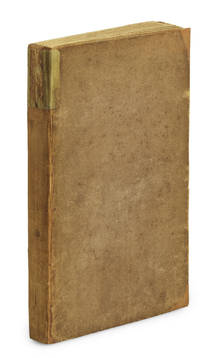
1841K., 1841. Lidt senere beskedent hshirtbd., permer betrukne m. grønt, krokodillelignende papir. Indvendig indimellem noget brunplettet. (8), 350 pp.
1841K.jøbenhavn, P.G. Philipsen, 1841. Indbundet ubeskåret med det originale blå blanke bagomslag i et smukt senere halvlæderbind (pastichebind af Anker Kyster) med rig tidstypisk rygforgyldning og skønt samtidigt moirépræget papir over permerne. Topguldsnit. Gammelt ejernavn på titelbladet. (IV)+350pp.
1841Kjøbenhavn, P. G. Philipsens Forlag, 1841. Indbundet i et pænt nyere papbind med forgyldt titeletiket. (Sign. Erik Olsen). Indre margin af de to første blade forstærket. Verso af titelbladet forstærket med japanpapir. Enkelte brunpletter især på de første og sidste blade. (8),350 pp.MED THESER?
1841réf. 13889K., 1841. 8vo. Nydeligt samtidigt helvlæderbind med rygforgyldning. Kapitæler slidt. En del brunplettet.Paul Rubows eksemplar. (2), 350pp.
1841réf. 28170K., 1841. Lidt senere beskedent hshirtbd., permer betrukne m. grønt, krokodillelignende papir. Indvendig indimellem noget brunplettet. (8), 350 pp.
1841réf. 57278Kjøbenhavn, P. G. Philipsens Forlag, 1841. Indbundet i et pænt nyere papbind med forgyldt titeletiket. (Sign. Erik Olsen). Indre margin af de to første blade forstærket. Verso af titelbladet forstærket med japanpapir. Enkelte brunpletter især på de første og sidste blade. (8),350 pp.
1841réf. 61204Kjøbenhavn, P.G. Philipsen, 1841. 8vo. Elegant later (ca. 1920) brown half calf with four raised bands and gilt morocco title-label to gilt spine. With Paul Rubow's ownership signature to front free end-paper. Clean and fresh both in- and externally, with no signs of wear to the exterior and only faint brown spots to a few pages. (4), 350 pp.
1841réf. 62111Kjøbenhavn, P.G. Philipsens Forlag, 1841. 8vo. (8), 350 pp. Gift binding of elaborately blindpatterned full cloth with single gilt line-border to boards and single gilt lines to spine. All edges gilt and printed on fine paper. The slightest touch of wear to corners and capitals, but apart from that a complete fresh, clean, bright and tight copy. It looks like it has hardly been opened and seems like it just came from the binder. No markings of any kind.
1841réf. 62112Kjøbenhavn, P.G. Philipsens Forlag, 1841. 8vo. (4), 350 pp., 1 f. (blank), 2 pp. (advertisements). Completely uncut and partly unopened in the original brown cardboard binding. Rebacked with paper perfectly matching that of the boards. Corners restored. Title-page evenly browned and a few leaves with a bit of brownspotting, but overall in unusually nice condition, clean, fresh, and bright. Completely unmarked.
1841réf. 46401675Kjobenhavn, Philipsen, 1841 ; in-8, demi-basane brune, coins, dos orné, tranches bleues. (Reliure danoise de l’époque) 4 ff. n. ch., 350 pp.ÉDITION ORIGINALE. PREMIER TIRAGE de TOUTE RARETÉ non mis dans le commerce.Le Concept d’ironie constamment rapporté à Socrate est la thèse de doctorat du jeune Kierkegaard. Il l’avait déposée le 16 juillet 1841 et brillamment soutenue le 29 septembre devant la Faculté de Copenhague. Il obtint le grade de Magister artium. C’est le second livre de l’auteur. La première partie est consacrée à l’ironie grecque, la seconde concerne l’ironie des romantiques allemands, les théories de Fichte, Hegel, Schlegel...EXEMPLAIRE DU TOUT PREMIER TIRAGE. Le titre porte la mention : Soutenu pour le grade de Magister. Au verso il porte une citation latine de Sibbern. Il est suivi d’un second titre en latin : Theses dissertationi danicae de notione ironiae annexae quas ad jura magistri artium in Universitate Hafniensi rite obtinenda die XXIX (cette date est manuscrite) Septemb. Publico colloquio defendere conabitur Severinus Aabye Kierkegaard theol. cand. MDCCCLXI (pour MDCCCXLI). -Suit 1 f. avec une liste de 15 thèses en latin. Himmelstrup n°8.Exemplaire dans sa première reliure. Dos un peu épidermé, la dorure du décor est passée.
1841réf. 46401681Kjobenhavn, Philipsen, 1841 ; in-8, cartonnage papier bleu muet, entièrement non rogné. Titre, 1 f. de table, 350 pp., 1 f. blanc, 1 f. catalogue de l’éditeur.ÉDITION ORIGINALE de Le Concept d’ironie constamment rapporté à Socrate est la thèse de doctorat du jeune Kierkegaard. Il l’avait déposée le 16 juillet 1841 et brillamment soutenue le 29 septembre devant la Faculté de Copenhague. Il obtint le grade de Magister artium. C’est le second livre de l’auteur. La première partie est consacrée à l’ironie grecque, la seconde concerne l’ironie des romantiques allemands, les théories de Fichte, Hegel, Schlegel. Himmelstrup n°8.Exemplaire du 2e état, celui qui fut mis dans le commerce. Ces exemplaires n’ont pas la mention Soutenu pour le grade de magiser sur le titre, et le verso est blanc. Sur le titre on trouve une citation du De Republica de Platon. Ils n’ont pas non plus les 2 ff. de titre en latin et liste des thèses.Après le dernier feuillet blanc on trouve 1 f. de catalogue de l’éditeur avec des titres danois. Himmelstrup ne signale pas ce feuillet.Exemplaire à toutes marges dans un modeste cartonnage bleu de l’époque (dos renforcé par une bande de papier.) Ex-libris manuscrit sur la garde Joachim Voss.
1841réf. 62111Kjøbenhavn P.G. Philipsens Forlag 1841. 8vo. 8 350 pp. Gift binding of elaborately blindpatterned full cloth with single gilt line-border to boards and single gilt lines to spine. All edges gilt and printed on fine paper. The slightest touch of wear to corners and capitals but apart from that a complete fresh clean bright and tight copy. It looks like it has hardly been opened and seems like it just came from the binder. No markings of any kind. A truly splendid copy of the first edition of Kierkegaard's dissertation being a completely fresh copy in the daintiest of the gift-bindings presumably one of the two daintily bound copies that Kierkegaard had in his own collection nr. 2110-11 in the auction catalogue. The copy is with the Thesis and both the day and the time has been filled in by hand. Kierkegaard's dissertationconstitutes the culmination of three years’ intensive studies of Socrates and “the true point of departure for Kierkegaard’s authorship” Brandes. The work is of the utmost importance in Kierkegaard’s production not only as his first academic treatise but also because he here introduces several themes that will be addressed in his later works. Among these we find the question of defining the subject of cognition and self-knowledge of the subject. The maxim of “know thyself” will be a constant throughout his oeuvre as is the theory of knowledge acquisition that he deals with here. The dissertation is also noteworthy in referencing many of Hegel’s theses in a not negative context something that Kierkegaard himself would later note with disappointment and characterize as an early uncritical use of Hegel. Another noteworthy feature is the fact that the thesis is written in Danish which was unheard of at the time. Kierkegaard felt that Danish was a more suitable language for the thesis and hadto petition the King to be granted permission to submit it in Danish rather than Latin. This in itself poses as certain irony as the young Kierkegaard was known to express himself poorly and very long-winded in written Danish. One of Kierkegaard’s only true friends his school friend H.P. Holst recounts in 1869 how the two had a special school friendship and working relationship in which Kierkegaard wrote Latin compositions for Holst while Holst wrote Danish compositions for Kierkegaard who “expressed himself in a hopelessly Latin Danish crawling with participial phrases and extraordinarily complicatedsentences” Garff p. 139. When Kierkegaard in 1838 was ready to publish his famous piece on Hans Christian Andersen see nr. 1 & 2 above which was to appear in Heiberg’s journal Perseus Heiberg had agreed to publish the piece although he had some severe critical comments about the way and the form in which it was written – if it were to appear in Perseus Heiberg demanded at the very least the young Kierkegaard would have to submit it in a reasonably readable Danish. “Kierkegaard therefore turned to his old schoolmate H. P. Holst and asked him to do something with the language…” Garff p. 139. From their school days Holst was well aware of the problem with Kierkegaard’s Danish and he recounts that over the summer he actually “translated” Kierkegaard’s article on Andersen into proper Danish. The oral defense was conducted in Latin however. The judges all agreed that the work submitted was both intelligent and noteworthy. But they were concerned about its style which was found to be both tasteless long-winded and idiosyncratic. We already here witness Kierkegaard’s idiosyncratic approach to content and style that is so characteristic for all of his greatest works. Both stylistically and thematically Kierkegaard’s and especially a clear precursor for his magnum opus Either-Or that is to be his next publication. In many ways Either-Or is born directly out of The Concept of Irony and is the work that brings the theory of Irony to life. Part One of the dissertation concentrates on Socrates as interpreted by Xenophon Plato and Aristophanes with a word on Hegel and Hegelian categories. Part Two is a more synoptic discussion of the concept of irony in Kierkegaard’s categories with examples from other philosophers. The work constitutes Kierkegaard’s attempt at understanding the role of irony in disrupting society and with Socrates understood through Kierkegaard we witness a whole new way of interpreting the world before us. Wisdom is not necessarily fixed and we ought to use Socratic ignorance to approach the world without the inherited bias of our cultures. With irony we will be able to embrace the not knowing. We need to question the world knowing we may not find an answer. The moment we stop questioning and just accept the easy answers we succumb to ignorance. We must use irony to laugh at ourselves in order to improve ourselves and to laugh at society in order to improve the world. The work was submitted to the Philosophical Faculty at the University of Copenhagen on June 3rd 1841. Kierkegaard had asked for his dissertation to be ready from the printer’s in ample time for him to defend it before the new semester commenced. This presumably because he had already planned his sojourn to Berlin to hear the master philosopher Schelling. On September 16th the book was issued and on September 29th the defense would take place. The entire defense including a two hour long lunch break took seven hours during which ”an unusually full auditorium” would listen to the official opponents F.C. Sibbern and P.O. Brøndsted as well as the seven “ex auditorio” opponents F.C. Petersen J.L. Heiberg P.C. Kierkegaard Fr. Beck F.P.J. Dahl H .J.Thue og C.F. Christens not to mention Kierkegaard himself. The work appeared in two states – one with the four pages of “Theses” for academics of the university whereas the copies without the theses were intended for ordinary sale. These sales copies also do not have “Udgivet for Magistergraden” and “theologisk Candidat” on the title-page. The first page of the theses always contains the day “XXIX” of September written in hand and sometimes the time “hora X” is also written in hand but not always. In all 11 presentation-copies of the dissertation are known and of these only one is signed that for Holst all the others merely state the title and name of the recipient. As is evident from the auction catalogue of his collection Kierkegaard had a number of copies of his dissertation in his possession when he died. Five of them were bound and two of them were “nit. M. Guldsnit” i.e. daintily bound and with gilt edges. These two copies were obviously meant as presentation-copies that he then never gave away. The gift copies of the dissertation were given two types of bindings both brownish cloth one type patterned the other one plain and some of them have gilt edges but most of the plain ones do not. There exist two copies on thick vellum paper – one being Kierkegaard’s own copy the other being the copy for H.C. Ørsted discoverer of electromagnetism and then principle of the University of Copenhagen. “As already implied two works of the authorship stand out in the sense that Kierkegaard sent his presentation-copies to a special circle of people: The dissertation from 1841.” Posselt Textspejle p. 91 translated from Danish. Most of the copies were given to former teachers and especially to people who due to leading positions personified the university. “For this circle of initiated we can now due to registered copies confirm that Kierkegaard gave copies with handwritten dedications to the headmaster of the University H.C. Ørsted printed on thick paper Kolderup-Rosenvinge and to J.L. Heiberg. It is granted that Sibbern Madvig and F.C. Petersen were also given the dissertation as a gift. but these copies are not known yet.” Posselt Textspejle pp. 93-94 translated fromDanish. N.b. We have since handled the copy given to Petersen and can thus confirm that it exists. Only a few months after Kierkegaard died 11th of November 1855 at the beginning of April 1856 his books were put up for sale. The sale was an event which created stir among scholars all over Denmark and the event drew large crowds. Everyone wanted a piece of the recently deceased legend and bidding was lively. The average price for the single items was nearly a rix-dollar a very high price for that time. As the old Herman Lynge wrote in a letter on the 22nd of May The Royal Library Recent Letters D. to the famous collector F.S. Bang “At the sale of Dr. Søren Kierkegaard’s books everything went at very high prices especially his own works which brought 2 or 3 times the published prices”.” Rohde Auction Catalogue p. LVIJ. Many authors philosophers and scholars were present in the auction room which was completely full as was the Royal Library who bought ca 80 lots. “Many of the books not only his own were paid for with much higher prices than in the book shops” In Morgenposten no. 99 30. April 1856 written by “P.” translated from Danish. "Some books were bought by libraries where they still are today others were bought by private people who sometimes wrote their names in the front of the books and thus indirectly stated that they came from Kierkegaard’s book collection… The edition of the auction catalogue 1967 registers all books from Kierkegaard’s book collection that it has hitherto been possible to identify – either in public or in private ownership… All in all nearly a couple of hundred volumes – i.e. ca. 10 % – of the Kierkegaardian book collection is said to be rediscovered…" Rohde. Thus today books from Kierkegaard’s library are of the utmost scarcity. Only very few are still possible to acquire and they hardly ever appear on the market. Himmelstrup 8 hardcover
1841réf. 66757Kbh. 1841. 8vo. Nyere marmorert kartonasjebind. 4 350 2 bl. s. Paa Boghandler P. G. Philipsens Forlag. Trykt i Bianco Lunos Bogtrykkeri Dansk. Himmelstrup 8. Ren og fin materie. unknown
1841réf. 62112Kjøbenhavn P.G. Philipsens Forlag 1841. 8vo. 4 350 pp. 1 f. blank 2 pp. advertisements. Completely uncut and partly unopened in the original brown cardboard binding. Rebacked with paper perfectly matching that of the boards. Corners restored. Title-page evenly browned and a few leaves with a bit of brownspotting but overall in unusually nice condition clean fresh and bright. Completely unmarked. A fabulous copy of the first edition of Kierkegaard’s dissertation here in the original binding which is of the utmost scarcity. We have only seen it in this state once before. And of all the copies we have handled of the Irony over the last decades we have only once before come across a copy with the advertisement-leaf in the back. This is virtually never present. This completely uncut copy is approximately 1 cm taller and wider than regular copies. The spines of the original Kierkegaard cardboard bindings are always just thin paper directly glued on the block making them extremely fragile especially on the thicker volumes. If one finds these original bindings the spines are almost always more or less disintegrated. Kierkegaard's dissertation constitutes the culmination of three years’ intensive studies of Socrates and “the true point of departure for Kierkegaard’s authorship” Brandes. The work is of the utmost importance in Kierkegaard’s production not only as his first academic treatise but also because he here introduces several themes that will be addressed in his later works. Among these we find the question of defining the subject of cognition and self-knowledge of the subject. The maxim of “know thyself” will be a constant throughout his oeuvre as is the theory of knowledge acquisition that he deals with here. The dissertation is also noteworthy in referencing many of Hegel’s theses in a not negative context something that Kierkegaard himself would later note with disappointment and characterize as an early uncritical use of Hegel. Another noteworthy feature is the fact that the thesis is written in Danish which was unheard of at the time. Kierkegaard felt that Danish was a more suitable language for the thesis and hadto petition the King to be granted permission to submit it in Danish rather than Latin. This in itself poses as certain irony as the young Kierkegaard was known to express himself poorly and very long-winded in written Danish. One of Kierkegaard’s only true friends his school friend H.P. Holst recounts in 1869 how the two had a special school friendship and working relationship in which Kierkegaard wrote Latin compositions for Holst while Holst wrote Danish compositions for Kierkegaard who “expressed himself in a hopelessly Latin Danish crawling with participial phrases and extraordinarily complicatedsentences” Garff p. 139. When Kierkegaard in 1838 was ready to publish his famous piece on Hans Christian Andersen see nr. 1 & 2 above which was to appear in Heiberg’s journal Perseus Heiberg had agreed to publish the piece although he had some severe critical comments about the way and the form in which it was written – if it were to appear in Perseus Heiberg demanded at the very least the young Kierkegaard would have to submit it in a reasonably readable Danish. “Kierkegaard therefore turned to his old schoolmate H. P. Holst and asked him to do something with the language…” Garff p. 139. From their school days Holst was well aware of the problem with Kierkegaard’s Danish and he recounts that over the summer he actually “translated” Kierkegaard’s article on Andersen into proper Danish. The oral defense was conducted in Latin however. The judges all agreed that the work submitted was both intelligent and noteworthy. But they were concerned about its style which was found to be both tasteless long-winded and idiosyncratic. We already here witness Kierkegaard’s idiosyncratic approach to content and style that is so characteristic for all of his greatest works. Both stylistically and thematically Kierkegaard’s and especially a clear precursor for his magnum opus Either-Or that is to be his next publication. The year 1841 is a momentous one in Kierkegaard’s life. It is the year that he completes his dissertation and commences his sojourn in Berlin but it is also the defining year in his personal life namely the year that he breaks off his engagement with Regine Olsen. And finally it is the year that he begins writing Either-Or. In many ways Either-Or is born directly out of The Concept of Irony and is the work that brings the theory of Irony to life. Part One of the dissertation concentrates on Socrates as interpreted by Xenophon Plato and Aristophanes with a word on Hegel and Hegelian categories. Part Two is a more synoptic discussion of the concept of irony in Kierkegaard’s categories with examples from other philosophers. The work constitutes Kierkegaard’s attempt at understanding the role of irony in disrupting society and with Socrates understood through Kierkegaard we witness a whole new way of interpreting the world before us. Wisdom is not necessarily fixed and we ought to use Socratic ignorance to approach the world without the inherited bias of our cultures. With irony we will be able to embrace the not knowing. We need to question the world knowing we may not find an answer. The moment we stop questioning and just accept the easy answers we succumb to ignorance. We must use irony to laugh at ourselves in order to improve ourselves and to laugh at society in order to improve the world. The work was submitted to the Philosophical Faculty at the University of Copenhagen on June 3rd 1841. Kierkegaard had asked for his dissertation to be ready from the printer’s in ample time for him to defend it before the new semester commenced. This presumably because he had already planned his sojourn to Berlin to hear the master philosopher Schelling. On September 16th the book was issued and on September 29th the defense would take place. The entire defense including a two hour long lunch break took seven hours during which ”an unusually full auditorium” would listen to the official opponents F.C. Sibbern and P.O. Brøndsted as well as the seven “ex auditorio” opponents F.C. Petersen J.L. Heiberg P.C. Kierkegaard Fr. Beck F.P.J. Dahl H .J.Thue og C.F. Christens not to mention Kierkegaard himself. Two weeks later on October 12th Kierkegaard broke off his engagement with Regine Olsen for the implications of this event see the section about Regine in vol. II. The work appeared in two states – one with the four pages of “Theses” for academics of the university whereas the copies without the theses were intended for ordinary sale. These sales copies also do not have “Udgivet for Magistergraden” and “theologisk Candidat” on the title-page. The present copy is one of the sales-copies without theses. Himmelstrup 8 The present copy is no. 11 in Girsel's "Kierkegaard" The Catalogue which can be found here. hardcover
1841réf. 891Kjøbenhavn: P.G. Philipsens Forlag 1841. First Edition. Hardcover. Very good. KIERKEGAARD Soren. Om Begrebet Ironi med stadigt Hensyn til Socrates On the Concept of Irony with Constant References to Socrates P.G. Philipsens Forlag Kjøbenhavn 1841. TP 1 leaf = Indhold half-title 3-350 small Octavo. First Edition Second trade Issue Himmelstrup 8 The trade issue. "Kierkegaard's second book his dissertation in theology presented at the University of Copenhagen. In this work Kierkegaard invidiously contrasts the irony of Socrates with the comparatively palliated and world-weary irony of the romantics. Irony constitutes the first in that series of multivalent existential categories the exception the Extraordinary the incommensurate Angst the leap faith the absurd the 'offense' the moment deployed against the Hegelian System. Indeed irony and the figure of the ironist are central to Kierkegaard's entire 'aesthetic' corpus. Socrates was a figure to whom Kierkegaard would regularly return as an antidote to the 'speculative disease' in philosophy." Wronoski p. 9 CONDITION: Very good in contemporary half-cloth with marbled boards. Scuffing and wear to covers. Some minor fraying to head and heel of spine cloth. Spine with handscripted label. Remnants of original blue card covers to inner edge of title page. Pages browned as usual. P.G. Philipsens Forlag hardcover
1841réf. 61204Kjøbenhavn P.G. Philipsen 1841. 8vo. Elegant later ca. 1920 brown half calf with four raised bands and gilt morocco title-label to gilt spine. With Paul Rubow's ownership signature to front free end-paper. Clean and fresh both in- and externally with no signs of wear to the exterior and only faint brown spots to a few pages. 4 350 pp. First edition of Kierkegaard's dissertation as it appeared in the normal trade without the preliminary Theses which were intended for academics attending the defence. Kierkegaard’s dissertation constitutes the culmination of three years’ intensive studies of Socrates and “the true point of departure for Kierkegaard’s authorship” Brandes. The work is of the utmost importance in Kierkegaard’s production not only as his first academic treatise but also because he here introduces several themes that will be addressed in his later works. Among these we find the question of defining the subject of cognition and self-knowledge of the subject. The maxim of “know thyself” will be a constant throughout his oeuvre as is the theory of knowledge acquisition that he deals with here. The dissertation is also noteworthy in referencing many of Hegel’s theses in a not negative context something that Kierkegaard himself would later note with disappointment and characterize as an early uncritical use of Hegel. Another noteworthy feature is the fact that the thesis is written in Danish which was unheard of at the time. Kierkegaard felt that Danish was a more suitable language for the thesis and had to petition the King in order to gain permission to submit it in Danish rather than Latin. This in itself contains as certain irony as the young Kierkegaard was known to express himself poorly and very long-winded in written Danish. Both stylistically and thematically Kierkegaard’s dissertation is a seedbed of his subsequent work and especially a clear precursor for his magnum opus Either-Or that is to be his next publication. The year 1841 is a momentous one in Kierkegaard’s life. It is the year that he completes his dissertation and commences his sojourn in Berlin but it is also the defining year in his personal life namely the year that he breaks off his engagement with Regine Olsen. And finally it is the year that he begins writing Either-Or In many ways Either-Or is born directly out of “The Concept of Irony” and is the work that brings the theory of Irony to life. Part One of the dissertation concentrates on Socrates as interpreted by Xenophon Plato and Aristophanes with a word on Hegel and Hegelian categories. Part Two is a more synoptic discussion of the concept of irony in Kierkegaard’s categories with examples from other philosophers. The work constitutes Kierkegaard’s attempt at understanding the role of irony in disrupting society and with Socrates understood through Kierkegaard we witness a whole new way of interpreting the world open before us. Wisdom is not necessarily fixed and we ought to use Socratic ignorance to approach the world without the inherited bias of our cultures. Kierkegaard's dissertation appeared in two states – one with the four pages of “Theses” for academics of the university whereas the copies without the theses were intended for ordinary sale. These sales copies also do not have “Udgivet for Magistergraden” and “theologisk Candidat” on the title-page. Himmelstrup 8. hardcover
réf. 1015896162.Ghardcover. Good. Access codes and supplements are not guaranteed with used items. May be an ex-library book. hardcover
1841réf. 57278Kjøbenhavn P. G. Philipsens Forlag 1841. Indbundet i et pænt nyere papbind med forgyldt titeletiket. Sign. Erik Olsen. Indre margin af de to første blade forstærket. Verso af titelbladet forstærket med japanpapir. Enkelte brunpletter især på de første og sidste blade. 8350 pp. Oiginaludgaven med teser. Himmelstrup 8. unknown
1841réf. 28170K. 1841. Lidt senere beskedent hshirtbd. permer betrukne m. grønt krokodillelignende papir. Indvendig indimellem noget brunplettet. 8 350 pp. Originaludgave med Teser. Himmelstrup 8. unknown
1841réf. 13889K. 1841. 8vo. Nydeligt samtidigt helvlæderbind med rygforgyldning. Kapitæler slidt. En del brunplettet.Paul Rubows eksemplar. 2 350pp. Originaludgave. Himmelstrup 8. unknown
1841réf. 269Kjøbenhavn: P.G. Philipsens Forlag 1841. First printing. Hardcover. Very Good . The Rare First Edition First Issue of Kierkegaards Second Book KIERKEGAARD Soren. Om Begrebet Ironi med stadigt Hensyn til Socrates On the Concept of Irony with Constant References to Socrates P.G. Philipsens Forlag Kjøbenhavn 1841. TP with note regarding Kierkegaard's candidacy for Master of the Arts and the date above Sibbern's name on the verso of TP second TP in Latin with hand written date in Roman numerals i-ii = Theses in Latin iii = Indhold half-title 3-350 small Octavo. First Edition First Issue Himmelstrup 8. The rare early issue with the second title page in Latin. "Kierkegaard's second book his dissertation in theology presented at the University of Copenhagen. In this work Kierkegaard invidiously contrasts the irony of Socrates with the comparatively palliated and world-weary irony of the romantics. Irony constitutes the first in that series of multivalent existential categories the exception the Extraordinary the incommensurate Angst the leap faith the absurd the 'offense' the moment deployed against the Hegelian System. Indeed irony and the figure of the ironist are central to Kierkegaard's entire 'aesthetic' corpus. Socrates was a figure to whom Kierkegaard would regularly return as an antidote to the 'speculative disease' in philosophy." Wronoski p. 9 CONDITION: Very good in contemporary boards rebacked though not recently most likely early 20th c. Pages browned as usual. CONDITION: Very good in contemporary boards rebacked though not recently most likely early 20th c. Pages browned as usual. PHOTOS AVAILABLE UPON REQUEST P.G. Philipsens Forlag hardcover
réf. elala2702Copenhagen: P.G.Philipsens. 1841. First Edition Second Issue with the preliminary leaves reset and with an additional quotation on the title page of Kierkegaard's doctoral thesis on the concept of irony for which he obtained permission to write in Danish rather than the usually required Latin. The work is divided into two parts the first dealing with Socrates as an 'ironist' and the second with the concept of irony per se. ".Irony set the pattern for subsequent writings by its masterful and at times lyrical style its humour and satire. Because of its subtlety the dissertation has often been misunderstood. In particular it has commonly been viewed as a youthful Hegelian writing whereas actually it is an ironic attack on both Hegelianism and romanticism each being made to overwhelm the other. From the literary standpoint the book is rich in allusions to philosophic and general sources.". Arbaugh Kierkegaard's Authorship 1968 p. 47 Himmelstrup 8. Rand I p. 320. 8vo. pp. 2 p.l. 350 blank leaf. contemporary half roan rubbed front joint cracked some foxing to first gatherings title browned Copenhagen: P.G.Philipsens..., 1841 hardcover
1841réf. PERBKIER19Copenhagen: P.G.Philipsens. 1841. 1841. 8vo. pp. 4 p.l. 350. lacking final blank. contemporary half roan rubbed some foxing & browning. First Edition First Issue of Kierkegaard's doctoral thesis on the concept of irony for which he obtained permission to write in Danish rather than the usually required Latin. The work is divided into two parts the first dealing with Socrates as an 'ironist' and the second with the concept of irony per se. ".Irony set the pattern for subsequent writings by its masterful and at times lyrical style its humour and satire. Because of its subtlety the dissertation has often been misunderstood. In particular it has commonly been viewed as a youthful Hegelian writing whereas actually it is an ironic attack on both Hegelianism and romanticism each being made to overwhelm the other. From the literary standpoint the book is rich in allusions to philosophic and general sources.". Arbaugh Kierkegaard's Authorship 1968 p. 47 Himmelstrup 8. Rand I p. 320. F. Copenhagen: P.G.Philipsens. 1841. unknown
réf. 45461992like new. unknown
1996EDITORIALE SCIENTIFICA 1996 180 PP. LIEVISSIMI SEGNI DEL TEMPO, VOLUME PERFETTO E INTONSO