553 resultados
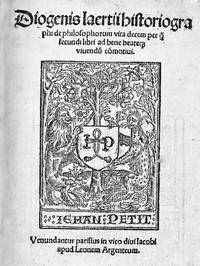
1509ref. 797Paris: Guy or Jean Marchant for Jean Petit 1509. Modern binding in 3/4 calf marbled boards marbles end leaves. With the . Ex libris of Jos Nève. Portrait of a philosopher at his writing table on verso of title page.see back cover of this catalogue. Charming woodcut on last page Marchant's device. Some nice woodcut initials. Marginal annotations and underlinings. https://data.cerl.org/istc/id00226000 GW VII Sp.436a Goff D226; H 6197; Aquilon p. 91; Frasson-Cochet 106; Moreau I 317: Moreau Brigitte. Inventaire chronologique des éditions parisiennes du XVIe siècle. I:1501 -1510 #68; 367; GüntL 2256; Döring-Fuchs D-51; Walsh 3631b; BMCFr p.135; Erscheinungsjahr: um 1509. Panzer VIII 211. 272 G BM STC French; 1470-1600 S. 135; Moreau Inventaire chronologique des éditions parisiennes du XVIe siècle Bd.; 1 S. 317 Nr. 68 ; Iehan Petit Renouard 883. - Jean Marchant Renouard 708 Renouard ICP II 1333; Haebler III marques de P. Gaudoul et de J. Petit; Renouard 337 et 881 marques de P. Gaudoul et de J. Petit Jean Petit's 4th device on t.p.; Guy Marchant's device Silvestre 39 IA; 153.795;. ærtius divides all the Greek philosophers into two classes: those of the Ionic and those of the Italic school. He derives the first from Anaximander the second from Pythagoras. After Socrates he divides the Ionian philosophers into three branches: a Plato and the Academics down to Clitomachus; b the Cynics down to Chrysippus; c Aristotle and Theophrastus. The series of Italic philosophers consists after Pythagoras of the following: Telanges Xenophanes Parmenides Zeno of Elea Leucippus Democritus and others down to Epicurus. The first seven books are devoted to the Ionic philosophers; the last three treat the Italic school. The work of Diogenes is a crude contribution towards the history of philosophy. It contains a brief account of the lives doctrines and sayings of most persons who have been called philosophers; and though the author is limited in his philosophical abilities and assessment of the various schools the book is valuable as a collection of facts which we could not have learned from any other source and is entertaining as a sort of pot-pourri on the subject. Diogenes also includes samples of his own wretched poetry about the philosophers he discusses. Diogenes is generally as reliable as whatever source he happens to be copying from at that moment. Especially when Diogenes is setting down amusing or scandalous stories about the lives and deaths of various philosophers which are supposed to serve as fitting illustrations of their thought the reader should be wary. The article on Epicurus however is quite valuable since it contains some original letters of that philosopher which comprise a summary of the Epicurean doctrines. IEP. Guy or Jean Marchant, for Jean Petit hardcover
1758ref. 32123-123Amsterdam J. H. Schneider 1758. With 3 engr. frontispieces by Christian Friedrich Fritzsch 4 engr. title-vignettes 1 vignette and 28 engr. portrait plates. 12mo. Contemp. red morocco flat spines richly gilt with tiny stars and dotted lines wide gilt border composed of small stars and fleurons fillets dotted lines and arabesques around sides gilt outer and inner dentelles edges gilt by Derome le jeune. Amsterdam J. H. Schneider 1758. Fine set in an elegant binding of the lives of the most famous philosophers of antiquity by the historian and epicurean philosopher Diogenes Laërtius fl. c. A.D. 222-235. Not much is know about him he is also sometimes thought to have been a Christian. The work is divided into two sections dealing with the Ionian and the Italian schools. The present edition is illustrated with 28 fine full-page portraits; the plates are not signed but they might be the work of Christian Friedrich Fritzsch c. 1719-1774 who was active for Amsterdam publishers for some time and did portraits. As to the translator Hoefer knows one Jacques-Georges de Chauffepié 1702-1786 from Leeuwarden a biographer and protestant minister who translated mostly from the English; he maybe identical to the present assumed de Chaufepied. - Quérard La France littéraire II 564 mentions Chaufepied as translator; Brunet II 721; Lewine 147; Barbier 1028 c mentions Schneider as translator. LITERATURE: FRENCH ; ILLUSTRATED BOOKS BEFORE 1900 ; Amsterdam, J. H. Schneider unknown
1533ref. 26505Basel: Hieronymus Froben e Nikolaus Episcopius 1533. The Editio Princeps the first printing of the work in the original Greek. Greek and roman type. Woodcut printer’s device of Johann Froben by Hans Holbein der Jünger The Younger on the title-page and on fol. CC4v Heitz-Bernoulli 50. Woodcut decorated headpieces decorated and animated initials on black ground from different alphabets designed by Holbein; on fol. a1r 8-line initial showing Heraclitus and Democritus from the capital Latin alphabet of May 1520 drawn by Holbein and by Jacob Faber cfr. Hollstein’s German xivB n. 119. 4to 210x146 mm. In a very rarely encountered contemporary binding of Dutch blind-tooled leather over wooden boards. The covers are framed by two borders of blind tooled fillets a floral tool at each corner; the central panel is divided into diamond designs with rosettes on the upper cover and fleur-de-lys on the rear. Turn–ins and cords fixed at the inner boards. Antique spine and clasps renewed at a somewhat later date and accomplished with the greatest skill. The guard leaves are composed of two bifolia from a 14th-century manuscript breviary. Collation: 1 2 3 4 a-z4 A-Z4 aa-zz4 AA-CC4 fols. 1v CC4r blank. 8 573 3 pp A beautiful and fine broad-margined copy in a wonderful contemporary binding faint water staining to the inner corner of the first quires a minor repair to the gutter of the first leaves two tiny wormholes in the last three quires. Provenance: John Alfred Spranger 1889-1968; book-plate on front pastedown and stamp on title-page. EXTREMELY RARE FIRST PRINTING OF THE EDITIO PRINCEPS OF THIS REMARKABLY IMPORTANT BOOK AND A COPY WHICH IS OF THE VERY FINEST STATE AND CONDITION. The editio princeps of Diogenes Laertius’ Lives of the Famous Philosophers is the most important source of our knowledge in the history of Greek philosophy from Thales to Pyrrho. The text was known only in the Latin translation by Ambrogio Traversari 1386-1439 which made its first appearance in print in Rome around 1472 and which was widely reprinted during the fourteenth and the first decades of the sixteenth century. This is the first printing of the book in its original language. The edition is dedicated by the typographers Froben and Episcopius to the scholars and in their epistle they declare their publishing plan: to print at least a work per year able to combine usefulness and pleasure. The text follows a manuscript provided by the professor of Greek and Hebrew at the University of Wittenberg Matthaeus Goldhahn 1480-1553 called Aurigallus probably a copy of the codex Raudnitzianus Lobkowicensis vi.F.c.38 at the time preserved in Komotau Bohemie in the house of the politician Bohuslav Lobkowitz von Hassenstein c. 1460-1510 and presently in the Library Národní Knihovna of Prague. Hieronymus Froben e Nikolaus Episcopius hardcover
