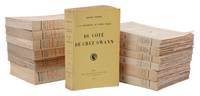
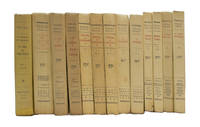
3.575 Ergebnisse
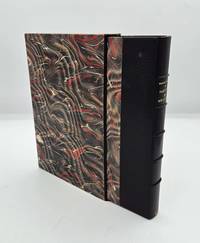
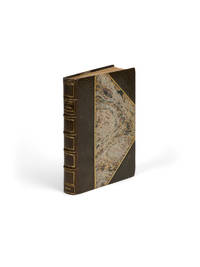
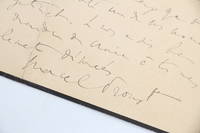
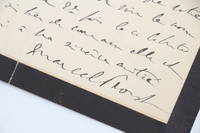
Best.-Nr. 20824P., Éditions de la N.R.F., 1922, in-8, broché, chemise étui fantaisie de toile écossaise, pièce de titre de box noir, gardes de toile rouge (Atelier Devauchelle), 230 p. Édition originale. Envoi autographe signé à Gus BOFA : à Monsieur Gus Bofa, Sympathique admiratif hommage, Marcel Proust. Gus Bofa collabora au Crapouillot de 1922 à 1936 non en qualité de dessinateur mais de critique littéraire. Le titre de sa chronique s’intitulait Les Livres à lire et les autres. Elle paraît du 15 janvier 1922 jusqu’en 1939. Son article sur Sodome et Gomorrhe est paru dans le numéro du 16 juin 1922. Reste que tout le monde a en mémoire le célèbre portrait de Proust par Bofa; à contre-jour dans une boutique d’horloger dont l’enseigne : “À la Recherche du temps perdu” se lit inversé sur la vitrine. Penché, loupe en main, il examine le meilleur rouage d’un monticule de montres en pièces détachées. Synthèses littéraires et extra-littéraires paraît en 1923, c’est un recueil de 40 compositions d’une grande originalité et d’une grande inventivité. L’artiste réussit à donner sa vision, une synthèse à la fois de l’écrivain et de son œuvre, de quelques-uns des plus célèbres acteurs de la littérature. Les portraits n’ont pas été publiés au préalable dans la presse. Proust mort le 18 novembre 1922 n’a pu malheureusement en prendre connaissance.Huysmans, Kipling, Nietzsche, Proust, Morand, etc. Les Synthèses était une commande de l'éditeur Mornay, des bois gravés étaient prévus pour être finalement remplacés par des dessins au trait, coloriés au pochoir. Les portraits n'ayant pas été publiés au préalable dans la presse, Proust étant mort le 18 novembre 1922, n'a pu en prendre connaissance.
1918Best.-Nr. 89560Paris: Nrf 1918. Fine. Nrf Paris 1918 12.8 x 19.5 cm Relié First edition on ordinary paper without edition statement bearing the correct colophon dated 30 November 1918. The 128 deluxe paper copies would only be issued six months later during the summer of 1919. Light spotting to the margins of the endleaves small l and a faint dampstain to the title page and following leaves a bluish stain to the margins of pp. 339-340 inherent to the quality of the paper. Bound in contemporary half forest-green morocco over corners spine with five raised bands ruled in black gilt date at foot cats-eye patterned paper boards comb-marbled endpapers and pastedowns original wrappers and spine preserved top edge gilt binding signed by Huser. A handsome copy in a well-executed binding. Nrf hardcover
Best.-Nr. 74831London: Chatto and Windus and Alfred A. Knopf 1922-31. Modern literature in translation COMPLETE FIRST EDITIONS IN ENGLISH first impressions. Complete in 11 volumes 19 x 14 x 42cm. Handsomely bound in half dark blue calf with twin brown morocco title labels lettered in gilt five raised bands gilt rules matching blue cloth-covered sides sewn endbands and top edges gilt. Contents clean but for some light expected foxing exteriors unmarked. A scarce set in an attractive recent leather binding. The author's most prominent and influential literary work now difficult to find in the first English translation. London: Chatto and Windus and Alfred A. Knopf, 1922-31 unknown
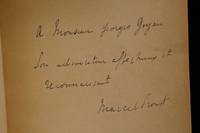
1904Best.-Nr. 46291Paris: Mercure de France 1904. Fine. Mercure de France Paris 1904 12 x 19 cm relié La Bible d'Amiens The Bible of AmiensMercure de France Paris 1904 12 x 19 cm half morocco First edition of Marcel Proust's translation of Ruskin's work into French. One of the first issue copies numbered at the press there were only seven copies printed on Hollande luxury paper. Half brown hard-grained morocco covers preserved. Contemporary binding. Rare autograph inscription from Marcel Proust to Georges Goyau: à Monsieur Georges Goyau. Son admirateur affectueux et reconnaissant Marcel Proust To Monsieur Georges Goyau. His affectionate and grateful admirer Marcel Proust The latter was a French historian and essayist who contributed notably to the Revue des deux mondes and was also the husband of Lucie Faure-Goyau one of Marcel Proust's childhood friends. On 18 December 1904 Goyau published an article praising La Bible d'Amiens in the newspaper Le Gaulois following a request from Proust himself which was probably enclosed with the copy. In the acknowledgement letter that followed the publication of this article Marcel Proust confided to Georges Goyau his philosophical conception of the work of a translator: You know what admiration I have for Ruskin. And as I believe that each of us is responsible for the souls he loves in particular responsible for making them known and loved for sparing them the chafing of misunderstandings and the night the darkness as they say of oblivion you know with what hands scrupulous but pious and as gentle as I could I have touched this one. Precious copy with an affectionate autograph inscription from Marcel Proust on his first translation of Ruskin. Mercure de France unknown
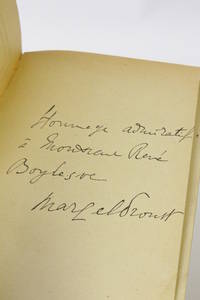
1919Best.-Nr. 52983Paris: Nrf 1919. Fine. ""An homage of admiration"" by Proust Nrf Paris 1919 13 x 19 cm broché sous chemise-étui First edition on ordinary paper despite a false statement of third edition. Handsome copy signed and inscribed by Marcel Proust to René Boylesve. Housed in a half kaki morocco over marbled paper boards chemise and slipcase with flaps spine very slighlty faded with gilt inscriptions of provenance at foot lined with light green paper. One very pale angular dampstain. Provenance : Heilbronn's library with his ex-libris. René Boylesve discovered the work of Marcel Proust in 1913 upon the publication of the first volume of the Recherche. Initially disconcerted by Proust's writing he soon became an enthusiastic admirer: ""Our own writing is ruined by his. We have labored in vain. Proust obliterates the literature of the past fifty years"" quoted by Émile Gérard-Gailly ""Note liminaire"" in René Boylesve Marcel Proust Quelques échanges et témoignages 1931 p. 24. As for Proust his admiration for Boylesve mentioned in this copy's inscription is not feigned; a few months before his death Proust praised Boylesve's novels celebrating not only ""an art seemingly so simple yet saying everything"" but also ""a supreme refinement of technique"" Marcel Proust Correspondance vols. XX and XXI 1991 pp. 332 and 778. The two men were not close but corresponded from 1917 onward. In sending Boylesve a copy of his Pastiches et mélanges Proust must have delighted him: aside from his activies as a writer Boylesve was a seasoned bibliophile. Thus regarding another of his works Proust showed this delicate consideration: ""I had some hesitation concerning your copy. Usually those printed for me without publisher's mark are somewhat finer than the 'regular copies.' This time the superiority is not apparent to me; and as I am incapable of distinguishing 'pur fil' from the rest I do not know which of the two sorts of copies is preferable. . You would be infinitely kind to tell me what you would like. It is because I know you to be a bibliophile that I write to you about a book of mine a matter of little importance ."" Marcel Proust op. cit. vol. XXII pp. 156-157. Nrf hardcover
1919Best.-Nr. 640315Paris: Editions de la Nouvelle Revue Française 1919. Very Good. octavo. First edition on standard paper despite a false statement of third edition. Signed by Proust to a blank preliminary page and dedicated to the novelist Lucien Descaves who was a member of the Prix Goncourt and who actually voted against Proust in 1919 the year he was awarded the prize for 'À l’ombre des jeunes filles en fleurs'. There is no evidence that the two novelists ever met but Proust did send Descaves signed copies of all of his books from 'Du côté de chez Swann' onwards. This copy has been beautifully rebound in three quarter calf over marbled boards with gilt top edge by Goy & Vilaine with the original covers bound in and with matching slip-case. An absolutely stunning copy of Proust's playful accounts of the Lemoine case. Editions de la Nouvelle Revue Française hardcover
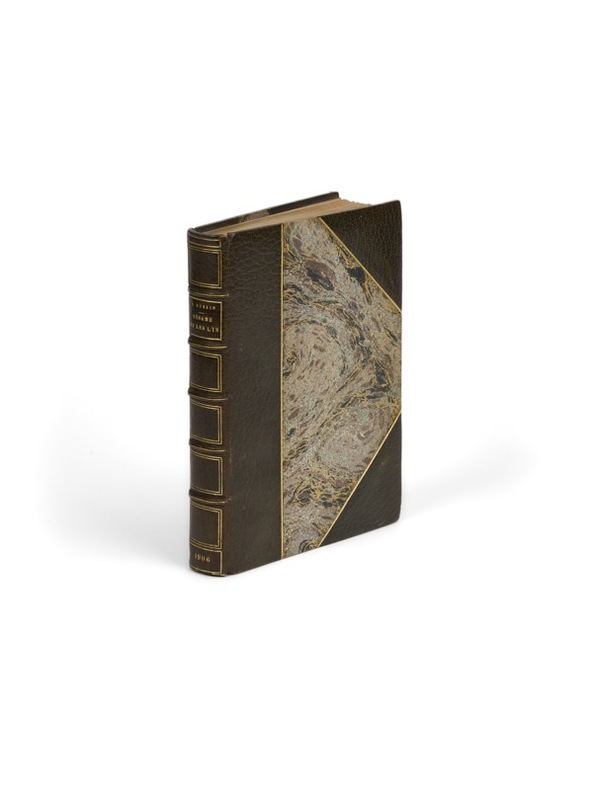
1906Best.-Nr. 30855Un des 12 rares grands papiers, imprimés sur hollande Paris, Mercure de France, (12 mai) 1906. 1 vol. (135 x 190 mm) de 224 p., [1] et 1 f. Demi-maroquin taupe à coins, filets dorés sur les plats, dos à nerfs ornés de caissons d'encadrement, tête dorée, date en pied, couvertures et dos conservés (reliure signée de [Jean] Duval). Édition originale de la traduction française par Marcel Proust. Longue préface inédite de Proust : « Sur la lecture ». Un des 12 premiers exemplaires sur hollande (n° 9).
Best.-Nr. 30855Paris Mercure de France 12 mai 1906. 1 vol. 135 x 190 mm de 224 p. 1 et 1 f. Demi-maroquin taupe à coins filets dorés sur les plats dos à nerfs ornés de caissons d'encadrement tête dorée date en pied couvertures et dos conservés reliure signée de Jean Duval. Édition originale de la traduction française par Marcel Proust. Longue préface inédite de Proust : « Sur la lecture ». Un des 12 premiers exemplaires sur hollande n° 9. Marcel Proust commence à s’intéresser aux ouvrages de Ruskin à l’automne 1899 lorsqu’il se plonge dans la lecture de celui qu’il appelle « ce grand homme » après avoir découvert le chapitre intitulé « La lampe de la mémoire » des Sept Lampes de l’architecture. Une révélation. Apprenant quelques mois plus tard la mort du critique d’art il écrit à Marie Nordlinger une amie anglaise cousine de Reynaldo Hahn pour lui exprimer outre sa tristesse son désir de pérennité des ouvrages de l’écrivain : il prépare alors plusieurs hommages à Ruskin sous forme d’articles nécrologiques et de notes qui deviendront avec des modifications amplifiées les péritextes de sa future traduction de la Bible d’Amiens. Une tâche ardue puisque Proust connaît à peine l’anglais : c’est madame Proust mère qui fait le ‘mot à mot’ collaborant ainsi d’une manière capitale à la traduction de La Bible d’Amiens. Malade elle fut remplacée par Marie Nordlinger dans ce rôle de défricheuse lorsque Proust aborda Sésame et les lys aidée par Robert d’Humières le traducteur de Kipling au Mercure de France. Après la mort de sa mère Proust reprit les épreuves et écrivit à Marie Nordlinger : « J’ai clos à jamais l’ère des traductions que Maman favorisait ». Il désirait de son propre aveu se consacrer à son œuvre personnelle et décide dans cette idée de faire précéder sa traduction d’une préface ô combien importante un texte délicieux intitulé « Sur la lecture » : « Il n’y a peut-être pas de jours de notre enfance que nous ayons si pleinement vécus que ceux que nous avons cru laisser sans les vivre ceux que nous avons passés avec un livre préféré. Je n’ai essayé dans cette préface que de réfléchir à mon tour sur le même sujet qu’avait traité Ruskin : l’utilité de la lecture. Ruskin a donné à sa conférence le titre symbolique de Sésame la parole magique qui ouvre la porte de la caverne des voleurs étant l’allégorie de la lecture qui nous ouvre la porte de ces trésors où est enfermée la plus précieuse sagesse des hommes : les livres ». Remaniées ces 52 pages prendront ensuite place dans Pastiches et mélanges sous le titre « Journée de lecture ». Précieux exemplaire sur hollande celui de Jeanne Jacquemin. Peintre autodidacte elle enflamme la critique à sa première exposition en 1892 et étonne par son physique androgyne et sensuel : la jeune femme rousse « aux yeux préraphaéliques » incarne parfaitement le symbolisme. Membre de la société de la Rose-Croix elle est admirée par Huysmans Verlaine Odilon Redon et noue avec Stéphane Mallarmé une relation d’amitié et d’admiration réciproque. La « peintresse aux yeux verts » ainsi qu’il la surnomme est souvent citée dans le Journal d’Edmond de Goncourt ; elle donnera plusieurs lithographies pour L’Estampe moderne et illustrera La Mandragore un « Conte de Noël » de Jean Lorrain publié en 1894. Dépressive elle est soignée par le docteur Samuel Pozzi le père français de la gynécologie qui connaissait à merveille le Tout-Paris. Amant de Sarah Bernard surnommé « Docteur Dieu » c’est un ami de la famille Proust ; du père le Pr. Adrien Proust épidémiologiste de renom comme de ses fils Robert qui fut son élève à l’hôpital Broca et Marcel à qui il procura en 1914 la dispense lui évitant d’être envoyé au front. Il encouragea le développement de la radiothérapie essentiellement à l’hôpital Tenon où le service d’oncologie-radiothérapie porte désormais son nom. Il soigna Jeanne Jacquemin des années durant. L’exemplaire passa ensuite entre les mains du libraire Ronald Davis – c’est probablement lui qui fit établir la reliure comme il fit exécuter à la fin des années 1920 tout un ensemble des œuvres de Proust Christie’s Londres 2007 lot n° 133 dont un Swann et ce volume sur hollande. Sur ce même papier on ne connaît par ailleurs que les exemplaires suivants : Léon Blum conservé à la BnF ; n° 2 reliure de Maylander collections Simonson-Hayoit-Leroy ; n° 8 collection R. et B. Loliée. Aucun des 12 ne figurait à l’exposition Proust et son temps de 1971. De la bibliothèque de Jeanne Jacquemin ex-libris. Paris, Mercure de France, (12 mai) 1906. 1 vol. (135 x 190 mm) de 224 p., [1] et 1 f. Demi-maroquin taupe à coins, filets doré unknown
1908Best.-Nr. 86094s. l. 1908. Fine. Proust and the future of pastiche: ""it seems to me that it could perhaps become a more discreet more fragile and more elegant form of literary criticism"" s. l. s. d. 1908 ou 1919 11.60 x 17.80 cm 4 pages sur un feuillet remplié Autograph letter signed by Marcel Proust to his friend Maurice de Fleury a psychiatrist and famed man of letters close to Émile Zola who wrote a collection of short stories as well as various medical works on neurasthenia insomnia epilepsy Chiara Carraro Philip Kolb. Four pages written in black on a bifolium with ""Island Mill"" watermark and framed in black. Usual traces of folds. Published in Kolb VIII no. 32 p. 74-75. Superb letter extolling the merits of literary pastiche by one of the greatest writers of the genre: Marcel Proust. The writing of this letter may coincide with the publication of Proust's series of pastiches on the Lemoine Affair a scam set up by a French engineer of that name who claimed to be able to make genuine diamonds. The articles were printed on the front page of the literary supplement of 'Le Figaro' between 1908 and 1909 or date from its publication in volume under the title 'Pastiches et mélanges' in 1919. The autograph letter is presented in a midnight blue half morocco chemise with marbled paper boards beige suede lined pastedowns and a slipcase edged with the same morocco. Proust warmly thanks his correspondent Maurice de Fleury whom he describes as a ""scholar and writer"" for his favorable reception of his ""little pastiches"": ""Your double merit should make you doubly severe: and you excuse pastiche that inferior genre!"" Votre double mérite devrait vous rendre doublement sévère : et vous excusez le pastiche ce genre inférieur ! acknowledging with irony the still precarious place of this unusual genre although popular during Proust's lifetime. Pastiche was perceived more as a stylistic musing or even a student exercise than a true creation worthy of literary praise. Yet here the writer considers it here a refreshing addition to the strict hierarchy of genres that still prevailed: ""Handled however by your hands more beautiful than mine it seems to me that it could perhaps become a more discreet more fragile and more elegant form of literary criticism. Very proud minds could devote themselves to it and very fine minds like yours very attached to greatness seriousness duty as wise could take pleasure in it and follow these games."" Manié pourtant par vos mains plus belles que les miennes il me semble qu'il pourrait peut-être devenir comme une forme indirecte plus discrète plus frêle et plus élégante de critique littéraire. Des esprits très fiers pourraient s'y adonner et des esprits très fins. comme le vôtre très attraché par la grandeur le sérieux le devoir aussi sage pourrait s'y plaire suivre ces jeux. With these words Proust asserts the interest of 'critical pastiche' which was already well established and acted as an empirical analysis of an author's style. Since his years as a student in Condorcet the writer had regularly indulged in this activity with according to him varying degrees of success: ""I have also sometimes made pastiches of medical literature! these writings are now lost If I could have found them again or started them again but all that is too far away I would have published them if I had known that you read this for fun. I don't need to tell you that considered inimitable you are not among the authors I pastiched. But . others are less perfect and combined some very interesting qualities with small flaws that could be imitated and caricatured."" J'ai été aussi quelques fois à faire des pastiches de littérature médicale ! Si j'avais pu les retrouver ou les recommencer mais tout cela est trop loin je les aurais publiés si j'avais su que vous lisiez cela pour vous amuser. Je n'ai pas besoin de vous dire que jugé inimitable vous n'y figurez pas. Mais . d'autres sont moins parf hardcover
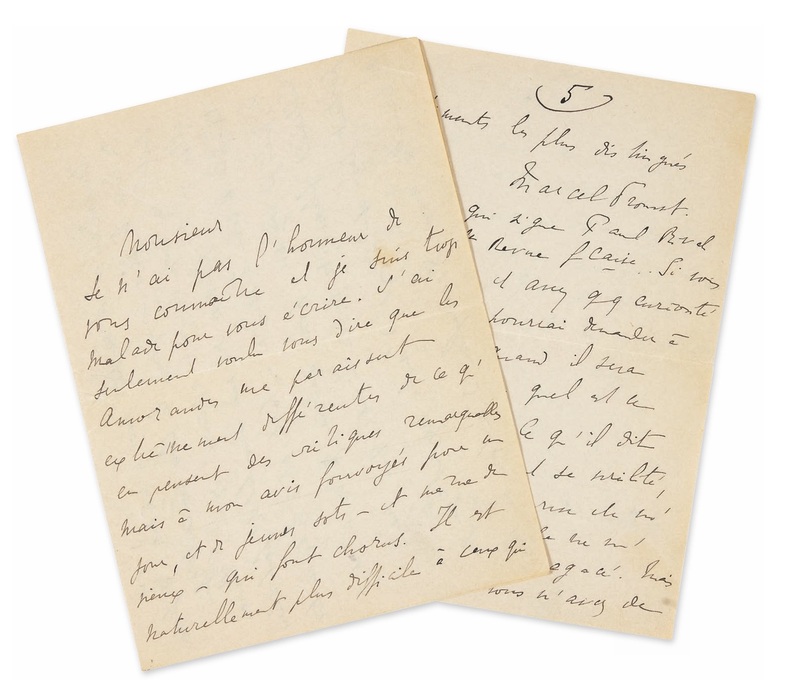
1922Best.-Nr. YQV-45S.l.n.d. [Paris], vers le 7 août 1922 [cf. le cachet postal] ; 6 pages in-8 (180 × 137 mm) ; avec enveloppe
1904Best.-Nr. 84876s. l. 1904. Fine. Because I also want success I am extremely material in my wishes for those I love and I wish them every pleasure from the highest to the crudest. s. l. mardi 25 octobre 1904 12.60 x 20.40 cm 12 pages sur 3 bifeuillets Autograph letter signed by Marcel Proust addressed to René Peter. Twelve pages written in black ink on three bifolia framed in black. Tears at the ends along the folds of the bifolia not affecting the text. Published in Kolb IV n°168. A very long letter from Proust full of innuendo to the playwright René Peter. Praising Peter's success Proust confesses to his own vanity as a writer and his literary ambitions. He subtly lets his jealousy for Peter's mistress shine through and declares his absolute devotion to Reynaldo Hahn. This is one of the first letters he sends to his childhood friend after recently reconnecting with him. Proust eternally plagued by ailments remains a recluse and apologizes for missing the rehearsal of Peter's new play Le Chiffon. Peter's three-act comedy with music by Reynaldo Hahn premiered at the Athénée the following month and was a huge success with around sixty performances before the end of the year. The young Proust relies on the glowing opinion of Hahn who had attended the rehearsals and the missive becomes a love letter for the composer and his impeccable judgement: ""Reynaldo told me that your play was delightful and ravishing which is not quite the same thing that he laughed and cried in it as he never laughs or cries in the theater and that the language was exquisite. Of that I was certain. But knowing nothing about you I couldn't know if you had dramatic genius. I am certain of it now because even if I do not know a judge as severe as ridiculously severe as Reynaldo I also do not know one who has more taste giving his enthusiasm very great value in my eyes. In a characteristic tangle of confession and denial Proust barely hides his ambitions and his quest for recognition. He hopes and prays for the same laurels he places on Peter's head: your poor and charming mother who like all those who love and who have lived life bruising all our tenderness has suffered so much is witnessing this great happiness these first rays of glory on your charming forehead which Vauvenargues says softer as the rising sun. I only speak of them in quotations having never known them myself! He will even end up instilling his own literary vocation into the fictional life of the narrator of In Search of Lost Time although the narrator's journey as a man of letters is more marked by disappointments than rays of glory so long awaited by Proust himself. However it culminates in Time Regained with an epiphany: the narrator now knows what to write and above all how to write it. The letter marks the beginnings of the Proust-Peter-Hahn trio whose complicity was such that they formed a special vocabulary of which only they had the secret. The river of words in this letter perfectly illustrates the undeniable link between desire and intellectual admiration: Because I also want success I am extremely material in my wishes for those I love and I wish them every pleasure from the highest to the crudest. Despite these displays of generosity the writer cannot however mask a certain jealousy towards Robert Danceny the fictional co-author of Le Chiffon who was none other than Peter's mistress Mme Dansaërt. Proust elegantly but explicitly refers to her: It makes me happy to think that the charming woman who I am assured is hiding under the male name of your collaborator shares half of your work. I am not talking about your success because whether she worked with you or not she would always have shared your success with her heart having I believe a deep friendship for you. Typical of a Proust transposing his desires through fiction the writer will form various dramatic and morbid scenarios between Peter and this young woman in the following years: I unknown
1896Best.-Nr. 83A BEAUTIFUL PRESENTATION COPY WARMLY INSCRIBED BY THE AUTHOR TO THE GREAT BIBLIOPHILE HORACE DE LANDAU. PROUST Marcel. Les Plaisirs et les jours. Illustrations de Madeleine Lemaire. Preface d'Anatole France. Quatre pieces pour piano de Reynaldo Hahn. Paris Calmann Levy 1896. FIRST EDITION. 4to pp. 2 X 271 pp. 2; with 14 plates out of the text and several illustrations in the text. Landau's bookplate. Beautiful dedication on the initial blank by Proust to Baron Landau: "A Monsieur Horace de Landau comme un hommage de ma respecteuse admirative et reconnaisante amitié Marcel Proust". Contemporary binding in half purple morocco publisher's printed wrappers preserved. Pasteboard slipcase. Fine copy. Horace de Landau was an important 19th century banker and a great collector and bibliophile. Part of his famous library was donated to the city of Florence the other was auctioned by Hoepli in 1945. The work is a collection of poems and prose on the world of the Parisian salons and cultural gatherings that Proust used to frequent. This is almost a representation in embryo of his immensely celebrated "Recherche". Calmann Levy
1942Best.-Nr. 1-2514331942. Couverture souple. Assez bon . Gallimard collection 1942. 1 volume brochés format In-12 correct Envoi avec numéro de Suivi - shipping with tracking number. Gallimard unknown
1913Best.-Nr. 89908Grasset pour le volume I Gallimard pour les suivants | Paris 1913-1927 | 12 x 19 cm | 13 volumes brochés
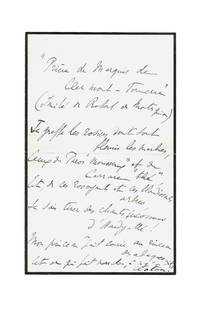
1908Best.-Nr. Proust26PROUST Marcel 1871-1922 Autograph pastiche-poem signed " Marcel Proust " to the marquis Philibert de Clermont-Tonnerre N.p.n.d c. summer 1908 2 p. in-8° watermarked mourning paper Watermark : " Original / Turkey Mill / Kent " Central fold mark A rare and admirable poem-pastiche by Proust in the manner of Robert de Montesquiou whose style he somewhat mocks " "Prière du Marquis de Clermont-Tonnerre"¹ Imité de Robert de Montesquiou Je greffe les rosiers dont sont fleuris les marbres Ceux du Paros "mousseux" et du Carrare "thé" Et de ces rosoyants et ces blondissants arbres Je sais tirer des chants inconnus d'Hardy-Thé !² Mon pinceau fait courir au rinceau des abaques Cet or qui fait marcher à ce qu'on dit Cloton !³ Trianonâ´ Vézelay ne sont que des baraques Quand l'esprit les compare au Palais Lauriston !âµ Seigneur si vous daignez m'admettre dans les Salles Où le Juste rompra le Pain Essentiel Que de marbre aussi pur étincellent vos stalles ! De Glisolles et d'Ancyâ¶ que soit digne le Ciel ! pour copie conformeâ· Marcel Proust " Through this pastiche Proust takes up the floral motif abundantly used by Robert de Montesquiou 1855-1921 in his works and poems. When the latter published his first collection Les Chauves-souris in 1893 Proust 22 years old at the time wrote to him on 29 April 1893 that "Never have the vain flowers of gardens smelled so good" Corr. t. I p. 206. The two men met for the first time a few days earlier at Madeleine Lemaire's house on April 13 1893. Dandy with a pure profile a fascinating look… Proust fell under the admiration of Montesquiou the future model of Charlus. This was followed by an abundant often flattering correspondence. If the young Proust never ceased to praise Montesquiou's taste for the erudite display of names cultural references and the rare word we observe through the present poem-pastiche a touch of mockery with regard to the style of the dandy-poet. The two would however maintain a friendship that would last until Montesquiou's last days in 1921. At the time when Proust was thinking of resuming his pastiche of Saint-Simon "Fête chez Montesquiou" Textes retrouvés ed. P. Kolb Gallimard p. 191-195 he wrote to Montesquiou on February 16 1909 without forgetting the usual precautions: "Basically the pastiche that would amuse me the most to make when I can write a little without prejudice to more serious studies is a pastiche of you! But in the first place it would perhaps annoy you and I don't want anything of me to ever make you angry …!" Corr. t. IX p. 34. The epistle addressed to the Marquis Philibert de Clermont-Tonnerre 1871-1940 was published by his wife Elisabeth de Clermont-Tonnerre née de Gramont in 1955 in the Bulletin Marcel Proust. The latter who first met the writer in 1903 had previously published a study of Robert de Montesquiou and Marcel Proust Flammarion 1925. 1 The title recalls Robert de Montesquiou's Prières de tous 1902 illustrated by Madeleine Lemaire. 2 Lucien Hardy-Thé composer and singer socialite 3 Clotilde Legrand 1857-1944 born de Fournès nicknamed "Cloton". 4 In 1908 Montesquiou acquired the Palais Rose du Vésinet a reduced copy of the Grand Trianon in Versailles. 5 The Clermont-Tonnerres lived in their hotel at 74 rue de Lauriston in Paris. 6 Duke Aimé Gaspard Marie de Clermont-Tonnerre 1779-1865 owned a castle built in the eighteenth century at Glisolles in the Eure and another built in the sixteenth century at Ancy-le-Franc in the Yonne. 7 Proust indicates "pour copie conforme" a practice he used for his pastiches and common at the time. Provenance: Philibert de Clermont-Tonnerre destinataire Elisabeth de Clermont-Tonnerre née de Gramont par descendance Bibliography: BSAMPAC n°5 1955 p. 5 publié par Elisabeth de Clermont-Tonnerre Correspondance t. VIII Kolb Plon p. 207 n°111 Essais éd. Antoine Compagnon 2022 Pléiade p. 630 Source: Marcel Proust I – Biographie Jean-Yves Tadié Folio pp. 283-295 Essais éd. Antoine Compagnon 2022 Pléiade p. 1605-1606
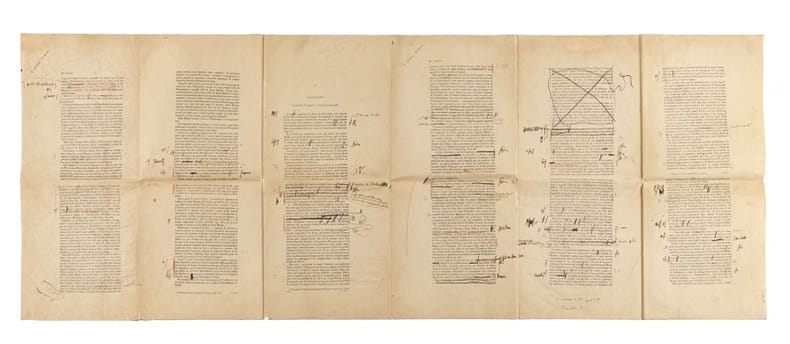
1903Best.-Nr. 26139Épreuves corrigées S.l., [circa février 1903]. 12 p. in-8, montées sur papier et formant un placard de 49 x 130 cm, sous étui à rabats de Julie Nadot. Rares épreuves corrigées de passages de La Bible d'Amiens, pour la parution dans la revue littéraire La Renaissance latine du 15 février 1903. Nombreuses corrections autographes, donnant plusieurs variantes inédites, qui témoignent du soin méticuleux porté par Proust à cette traduction dont le succès l'encouragera à se prêter une seconde fois à l'exercice avec Le Sésame et les Lys deux ans plus tard.
Best.-Nr. 26139S.l. circa février 1903. 12 p. in-8 montées sur papier et formant un placard de 49 x 130 cm sous étui à rabats de Julie Nadot. . Rares épreuves corrigées de passages de La Bible d'Amiens pour la parution dans la revue littéraire La Renaissance latine du 15 février 1903. Nombreuses corrections autographes donnant plusieurs variantes inédites qui témoignent du soin méticuleux porté par Proust à cette traduction dont le succès l'encouragera à se prêter une seconde fois à l'exercice avec Le Sésame et les Lys deux ans plus tard. . Marcel Proust commence à s'intéresser aux ouvrages de Ruskin à l'automne 1899 dès son retour d'Évian-les-Bains en se plongeant dans la lecture intensive de celui qu'il appelle « ce grand homme » après avoir découvert le chapitre intitulé « La Lampe de la mémoire » des Sept Lampes de l'architecture. Une révélation. Quelques mois plus tard il apprend la mort la mort du critique d'art dans Le Figaro du 21 janvier 1900 et écrit immédiatement à Marie Nordlinger une ami anglaise de Manchester et cousine de Reynaldo Hahn lui exprimant outre sa tristesse son désir de pérennité des ouvrages de l'écrivain : il prépare alors plusieurs hommages à Ruskin sous formes d'articles nécrologiques et de notes qui deviendront avec des modifications amplifiées les péritextes de sa future traduction de La Bible d'Amiens. Les premiers - et seuls - extraits paraissent en février et mars 1903 un an avant la parution en volume. Le texte de ces épreuves évoquent des épisodes de l'hagiographie des saints Martin Geneviève et Jérôme et parurent dans la revue littéraire La Renaissance latine numéro du 15 février 1903 du Prince de Brancovan malgré les réticences de ce dernier qui le moquait encore le mois précédent pour sa traduction qu'il jugeait « légère ». Proust lui fera alors cette belle réponse : « Je crois que cette traduction non pas à cause de mon talent qui est nul mais de ma conscience qui a été infinie - sera une traduction comme il y en a très peu une véritable reconstitution . À force d'approfondir le sens de chaque mot la portée de chaque expression le lien de toutes les idées je suis arrivé à une connaissance si précise de ce texte que chaque fois que j'ai consulté un Anglais - ou un Français sachant à fond l'anglais - sur une difficulté quelconque - il était généralement une heure avant de voir surgir la difficulté et me félicitait de savoir l'anglais mieux qu'un Anglais. En quoi il se trompait. Je ne sais pas un mot d'anglais parlé et je ne lis pas bien l'anglais. Mais depuis quatre ans que je travaille sur la Bible d'Amiens je la sais entièrement par coeur et elle a pris pour moi ce degré d'assimilation complète de transparence absolue où se voient seulement les nébuleuses qui tiennent non à l'insuffisance de notre regard mais à l'irréductible obscurité de la pensée contemplée ». Mais la tâche fut ardue en effet puisque Proust connaît à peine l'anglais : sa mère fait le « mot à mot » qu'il remanie avec les conseils de Marie Nordlinger et de Robert d'Humières traducteur de Kipling. Au terme de ces longues années d'un travail acharné et d'un commentaire personnel sur l'art et la création Proust achève enfin sa préface la traduction et les notes dont certaines se développent sur plusieurs pages. L'ouvrage qui sera achevé un an plus tard en février 1904 portera une dédicace à Adrien Proust qui vient de mourir au lieu de celle destinée à Reynaldo Hahn : « à la mémoire de mon père frappé en travaillant le 24 novembre 1903 mort le 26 novembre cette traduction est dédiée ». Il s'en excusera dans la dédicace personnelle lorsqu'il offrira un exemplaire à Hahn « tant son petit Papa désirait le voir paraître que maintenant j'ai mieux aimé vous le retirer pour le lui offrir ». Proust néanmoins lui dédicacera la second texte de Ruskin qu'il traduira trois ans plus tard Les Sésames et les Lys. S.l., [circa février 1903]. 12 p. in-8, montées sur papier et formant un placard de 49 x 130 cm, sous étui à rabats de Julie unknown
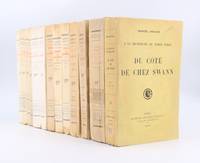
1913Best.-Nr. 89908Paris: Grasset first volumeGallimard other volumes 1913. Fine. Grasset first volume Gallimard other volumes Paris 1913-1927 12 x 19 cm 13 volumes brochés First edition for each volume. Fine copy of Du côté de chez Swann in first edition second printing with all identifying points front cover dated 1913 table of contents present no publisher's catalogue at end; copy in first edition bearing the mention ""quatrième édition"" for À l'ombre des jeunes filles en fleurs with the correct colophon dated November 30 1918; although bearing the same colophon dated November 30 1918 the 128 reimposed copies were not actually printed until a year later together with the large paper copies of the Swann reissue; for the following 11 volumes numbered copies on pur fil wove paper the only large paper copies apart from the reimposed ones. The complete first edition of À la recherche du temps perdu comprises the first two volumes on ordinary paper with the particularities mentioned above followed by deluxe copies for the subsequent volumes. These deluxe copies on pur fil are in the same format as the first two volumes. Restorations with losses filled on the spine and boards of the first and second volumes spine of third volume browned small tears or slight losses of no consequence at foot of certain spines rear board of fifth volume partially sunned some foxing on fore-edge of sixth volume manuscript ex-libris inscriptions in upper right corners of front cover and title page of first volume. This complete set of La Recherche comprises the following titles: Du côté de chez Swann À l'ombre des jeunes filles en fleurs Le Côté de Guermantes 2 volumes Sodome et Gomorrhe 3 volumes La Prisonnière 2 volumes Albertine disparue 2 volumes and Le Temps retrouvé 2 volumes. Fine complete set all volumes in first edition as published. Grasset (first volume)Gallimard (other volumes) hardcover
1927Best.-Nr. 140949507Paris: Bernard Grasset Nouvelle Revue Francaise 1927. First Edition. Near Fine. First edition first printing of each of seven books in 13 volumes complete. Text in French. First volume bound in publisher Grasset's yellow wraps lettered in black; subsequent volumes bound in publisher NRF's cream wraps stamped in black and red. Near Fine with with light wear and soiling and light to moderate toning to covers minimal creasing to spines. Light foxing to textblock edges of La Prisonniere and Le Cote de Guermantes I; more pronounced foxing impinging slightly on margins and covers to both volumes of Sodome et Gomorrhe II. Some pages unopened copy number slips from 2 volumes laid in with consequent offsetting. Pencil inscription to half-title of Du cote de chez Swann Swann's Way narrow dampstaining to lower margin of first 60 pages. An uncommon assemblage of the first appearances of Marcel Proust's seven-part novel published in 13 volumes over 14 years. Proust struggled to get editors to accept the first part of his manuscript and arranged with publisher Bernard Grasset to cover the cost of printing Swann's Way himself. The book was a critical success but the next installment was stalled by the onset of the Great War. Grasset was called up and the lead of his printing press was melted down for ordnance. The publisher Gaston Gallimard had finagled his way out of military service and offered to publish the remainder of Proust's novel under his imprint NRF which had rejected Swann's Way a few years previously. That remainder grew and grew and Proust died before his novel was completed. After he succumbed to an illness in 1922 his final three books were published under the aegis of his brother and editor. The publication history of this sprawling masterpiece can be read in these first printings the paper quality of which improved with time as the author's stature grew and France emerged from wartime rationing. Key colophon information as follows: Du cote de chez Swann: November 8 1913 A l'ombre des jeunes filles en fleurs: November 30 1918 Le Cote de Guermantes I: August 17 1920; copy #434 Le Cote de Guermantes II & Sodome et Gomorrhe I: April 30 1921; copy #883 Sodome et Gomorrhe II 1: April 3 1922; copy #104 Sodome et Gomorrhe II 2: April 3 1922; copy #639 Sodome et Gomorrhe II 3: April 3 1922; copy #104 La Prisonniere 1: November 14 1923; copy #192 La Prisonniere 2: November 14 1923; copy #37 Albertine disparue 1: November 30 1925; copy #68 Albertine disparue 2: November 30 1925; copy #64 Le temps retrouve 1: September 22 1927; copy #979 Le temps retrouve 2: September 22 1927; copy #979 A beautiful set of first printings in much better condition than commonly found. Bernard Grasset, Nouvelle Revue Francaise unknown
1927Best.-Nr. 140949507Paris: Bernard Grasset Nouvelle Revue Francaise 1927. First Edition. Near Fine. First edition first printing of each of seven books in 13 volumes complete. Text in French. First volume bound in publisher Grasset's yellow wraps lettered in black; subsequent volumes bound in publisher NRF's cream wraps stamped in black and red. Near Fine with with light wear and soiling and light to moderate toning to covers minimal creasing to spines. Light foxing to textblock edges of La Prisonniere and Le Cote de Guermantes I; more pronounced foxing impinging slightly on margins and covers to both volumes of Sodome et Gomorrhe II. Some pages unopened copy number slips from 2 volumes laid in with consequent offsetting. Pencil inscription to half-title of Du cote de chez Swann Swann's Way narrow dampstaining to lower margin of first 60 pages. An uncommon assemblage of the first appearances of Marcel Proust's seven-part novel published in 13 volumes over 14 years. Proust struggled to get editors to accept the first part of his manuscript and arranged with publisher Bernard Grasset to cover the cost of printing Swann's Way himself. The book was a critical success but the next installment was stalled by the onset of the Great War. Grasset was called up and the lead of his printing press was melted down for ordnance. The publisher Gaston Gallimard had finagled his way out of military service and offered to publish the remainder of Proust's novel under his imprint NRF which had rejected Swann's Way a few years previously. That remainder grew and grew and Proust died before his novel was completed. After he succumbed to an illness in 1922 his final three books were published under the aegis of his brother and editor. The publication history of this sprawling masterpiece can be read in these first printings the paper quality of which improved with time as the author's stature grew and France emerged from wartime rationing. Key colophon information as follows: Du cote de chez Swann: November 8 1913 A l'ombre des jeunes filles en fleurs: November 30 1918 Le Cote de Guermantes I: August 17 1920; copy #434 Le Cote de Guermantes II & Sodome et Gomorrhe I: April 30 1921; copy #883 Sodome et Gomorrhe II 1: April 3 1922; copy #104 Sodome et Gomorrhe II 2: April 3 1922; copy #639 Sodome et Gomorrhe II 3: April 3 1922; copy #104 La Prisonniere 1: November 14 1923; copy #192 La Prisonniere 2: November 14 1923; copy #37 Albertine disparue 1: November 30 1925; copy #68 Albertine disparue 2: November 30 1925; copy #64 Le temps retrouve 1: September 22 1927; copy #979 Le temps retrouve 2: September 22 1927; copy #979 A beautiful set of first printings in much better condition than commonly found. Bernard Grasset, Nouvelle Revue Francaise unknown books
1914Best.-Nr. 68610Paris: Bernard Grasset 1914. A La Recherche du Temps Perdu. Paris: Bernard Grasset 1914 i.e. 1913; Éditions de la Nouvelle Revue Française 1918-1927. A complete set of first editions. First issue of Du Cots de Chez Swann with the date 1913 on the front wrapper and 1914 on the title-page printer's imprint dated "le huit novembre mil neuf cent treize" on the verso of p. 523 and with 8 pp. of ads at the end. With the printer's misprint on the title-page and no table of contents. 4 523 1 printer's imprint 8 ads pp. Swann's Way. Together thirteen octavo volumes. Original glassine on all volumes. All volumes numbered on except for A l'Ombre des Jeunes Filles en Fleurs as there was no numbered print for this volume. "A l'ombre des Jeunes Filles en Fleurs" is first edition on regular paper after 64 large paper copies; all other volumes are in numbered first edition bearing the indication "Edition originale" on the cover. The set comprises: Du Cote de Chez Swann; A l'Ombre des Jeunes Filles en Fleurs; Le Cote de Guermantes I one of 800 numbered copies for the Amis de L' Edition Originale #760; Le Cote de Guermantes II and Sodome et Gomorrhe I one of 800 numbered copies for the Amis de L'Edition Originale #168; Sodome et Gomorrhe II three volumes one of 30 numbered copies for the Exemplaires D'Auteur Hors Commerce Marques For the author not for sale all three numbered 855; La Prisonniere two volumes one of 875 numbered copies for the Amis de L'Edition Originale both volumes nymbered 293; Albertine Disparue two volumes one of 1200 numbered copies for the Amis de L'Edition Originale Both volumes numbered 346; and Le Temps Retrouve two volumes one of 1200 numbered copies for the Amis de L'Edition Originale both volumes numbered 845. Original buff wrappers printed in red and black. Du Cote de Chez Swann in yellow wrappers printed in black. Volume I of Sodome et Gomorrhe II with previous owner's ink notes on front blank ink bleeding a bit onto the half-title. Overall fine copies of all volumes. Each volume individually housed in chemises with red morocco spines over gray paper boards and black paper slipcases with red morocco edges. "Du cote de chez Swann is the first volume of Proust's monumental opus A la recherche du temps perdu the most important French novel of the twentieth century and a masterpiece of European literature. This first volume described the narrator's childhood and contains the celebrated madeleine episode. Publication of subsequent volumes was interrupted by the war. This novel famously turned by Gide for the N.R.F was published at the author's expense by Grasset. By 1918 the N.R.F had realised its huge blunder and published A l'ombre des jeunes filles en fleurs which won the Prix Goncourt and established Proust as a major literature figure" From Stendhal to Rene Char: Le Cabinet de livres de Renaud Gillet Sotheby's 27 October 1999 lot 64. "Translated by Scott Moncreiff as Swann's Way etc. Proust's great novel A la recherche du temps perdu is something that happens once in a hundred years like Les Fleurs du Mal or War and Peace. He combined tragic poetical insight with the gift of creating comic characters in the round like Shakespeare. He is consistently both intelligent and poetic. Bergsonian philosophy of time gives depth Ruskinian aesthetics texture. Embittered by his homosexual bias and disabling asthma he shows some deterioration in the unrevised volumes though not enough to upset this magisterially executed conception of a master-mind in which art erects its monument to dead loves using for material only thought and the passage of time. 'It appeals to our sense of wonder and gains our hommage by its veiled greatness. I don't think there ever has been in the whole of literature such an example of the power of analysis' Conrad" Connolly The Modern Movement. BN Proust 402 445 484 489 531 533 and 536. Connolly The Modern Movement 23. HBS 68610. $35000. Bernard Grasset unknown
1914Best.-Nr. 68610Paris: Bernard Grasset 1914. A La Recherche du Temps Perdu. Paris: Bernard Grasset 1914 i.e. 1913; Éditions de la Nouvelle Revue Française 1918-1927. A complete set of first editions. First issue of Du Cots de Chez Swann with the date 1913 on the front wrapper and 1914 on the title-page printer's imprint dated "le huit novembre mil neuf cent treize" on the verso of p. 523 and with 8 pp. of ads at the end. With the printer's misprint on the title-page and no table of contents. 4 523 1 printer's imprint 8 ads pp. Swann's Way. Together thirteen octavo volumes. Original glassine on all volumes. All volumes numbered on except for A l'Ombre des Jeunes Filles en Fleurs as there was no numbered print for this volume. "A l'ombre des Jeunes Filles en Fleurs" is first edition on regular paper after 64 large paper copies; all other volumes are in numbered first edition bearing the indication "Edition originale" on the cover. The set comprises: Du Cote de Chez Swann; A l'Ombre des Jeunes Filles en Fleurs; Le Cote de Guermantes I one of 800 numbered copies for the Amis de L' Edition Originale #760; Le Cote de Guermantes II and Sodome et Gomorrhe I one of 800 numbered copies for the Amis de L'Edition Originale #168; Sodome et Gomorrhe II three volumes one of 30 numbered copies for the Exemplaires D'Auteur Hors Commerce Marques For the author not for sale all three numbered 855; La Prisonniere two volumes one of 875 numbered copies for the Amis de L'Edition Originale both volumes nymbered 293; Albertine Disparue two volumes one of 1200 numbered copies for the Amis de L'Edition Originale Both volumes numbered 346; and Le Temps Retrouve two volumes one of 1200 numbered copies for the Amis de L'Edition Originale both volumes numbered 845. Original buff wrappers printed in red and black. Du Cote de Chez Swann in yellow wrappers printed in black. Volume I of Sodome et Gomorrhe II with previous owner's ink notes on front blank ink bleeding a bit onto the half-title. Overall fine copies of all volumes. Each volume individually housed in chemises with red morocco spines over gray paper boards and black paper slipcases with red morocco edges. "Du cote de chez Swann is the first volume of Proust's monumental opus A la recherche du temps perdu the most important French novel of the twentieth century and a masterpiece of European literature. This first volume described the narrator's childhood and contains the celebrated madeleine episode. Publication of subsequent volumes was interrupted by the war. This novel famously turned by Gide for the N.R.F was published at the author's expense by Grasset. By 1918 the N.R.F had realised its huge blunder and published A l'ombre des jeunes filles en fleurs which won the Prix Goncourt and established Proust as a major literature figure" From Stendhal to Rene Char: Le Cabinet de livres de Renaud Gillet Sotheby's 27 October 1999 lot 64. "Translated by Scott Moncreiff as Swann's Way etc. Proust's great novel A la recherche du temps perdu is something that happens once in a hundred years like Les Fleurs du Mal or War and Peace. He combined tragic poetical insight with the gift of creating comic characters in the round like Shakespeare. He is consistently both intelligent and poetic. Bergsonian philosophy of time gives depth Ruskinian aesthetics texture. Embittered by his homosexual bias and disabling asthma he shows some deterioration in the unrevised volumes though not enough to upset this magisterially executed conception of a master-mind in which art erects its monument to dead loves using for material only thought and the passage of time. 'It appeals to our sense of wonder and gains our hommage by its veiled greatness. I don't think there ever has been in the whole of literature such an example of the power of analysis' Conrad" Connolly The Modern Movement. BN Proust 402 445 484 489 531 533 and 536. Connolly The Modern Movement 23. HBS 68610. $35000. Bernard Grasset unknown books
1918Best.-Nr. 93031918 Au total 15 volumes in-8° (151 x 200 mm), Paris, NRF, 1918 à 1927. Jolies demi-reliures postérieures en veau maroquiné lilas, plats de papier marbré, dos à nerfs, tranches ébarbées. Les plats et les dos des brochures ont été soigneusement conservés. Collection en parfait état. Dans le détail, elle se présente ainsi:Volume I: A la Recherche du temps perdu. Tome I. Du Côté de chez Swann [1ere: partie: Combray; 2emepartie : Un Amour de Swann; 3eme partie: Noms de Pays, Le Nom], Paris, Editions de la Nouvelle Revue Française, 35 & 37 rue Madame, [1919]. «Achevé dimprimer par limprimerie Bellenand à Fontenay-aux-Roses, le 14 juin 1919". 386+[2] pages. Deuxième édition, sur papier courant jauni.Volume II: A la Recherche du temps perdu. Tome II. A lOmbre des jeunes filles en fleurs [1ere partie: Autour de Swann; 2emepartie : Noms de Pays, Le Pays], Paris, Editions de la Nouvelle Revue Française, 35 & 37 rue Madame [1918]. «Achevé dimprimerle 30 novembre 1918 par limprimerie La Semeuse à Etampes». 443+[1bl]+[2] pages. Seconde émission de lédition originale, sur papier courant jauni, parue en librairie seulement le 21 juin 1919. Le dos de la brochure porte létiquette «Majoration temporaire cinquante pourcent», qui est la marque des 2000 exemplaires de la seconde émission. A la grande surprise des milieux littéraires, louvrage fut couronné par le Prix Goncourt le 10 décembre 1919 ; et, en dépit des commentaires parfois outrés quelle suscita, cette nomination assura le succès définitif de loeuvre. Volume III: A la Recherche du temps perdu. Tome III. Le Côté de Guermantes I, Edition originale. Paris, Editions de la Nouvelle Revue Française, 35 & 37 rue Madame, 1920. «Achevé dimprimer par limprimerie Louis Bellenand à Fontenay-aux-Roses le 17 août 1920». Exemplaire sur vélin pur fil Lafuma Navarre no 232, réservé aux «Amis de lédition originale». 279+[1] pages.Volume IV: A la Recherche du temps perdu. Tome IV. Le côté de Guermantes II, Sodome et Gomorrhe I, Edition originale. Paris, Editions de la Nouvelle Revue Française, 35 & 37 rue Madame, 1921. «Achevé dimprimer par limprimerie Louis Bellenand à Fontenay-aux-Roses le trente avril 1921». Exemplaire sur vélin pur fil Lafuma Navarre no 232, réservé aux «Amis de lédition originale». 282+[1]+[1bl]. Volume V: A la Recherche du temps perdu. Tome V. Sodome et Gomorrhe II*, Edition originale. Paris, Editions de la Nouvelle Revue Française, 3 rue de Grenelle, 1922. «Achevé dimprimer le 3 avril 1922 par F. Paillart à Abbeville, Somme». Exemplaire in-16° Jésus sur vélin pur fil Lafuma Navarre no 232, réservé aux «Amis de lédition originale». 230+[1]+[1bl] pages.Volume VI : A la Recherche du temps perdu. Tome V. Sodome et Gomorrhe II**, Edition originale. Paris, Editions de la Nouvelle Revue Française, 3 rue de Grenelle, 1922. «Achevé dimprimer le 3 avril 1922 par F. Paillart à Abbeville, Somme». Exemplaire in-16° Jésus sur vélin pur fil Lafuma Navarre no 232, réservé aux «Amis de lédition originale». 236+[1]+[1bl] pages.Volume VII:A la Recherche du temps perdu. Tome V. Sodome et Gomorrhe II***, Edition originale. Paris, Editions de la Nouvelle Revue Française, 3 rue de Grenelle, 1922. «Achevé dimprimer le 3 avril 1922 par F. Paillart à Abbeville, Somme». Exemplaire in-16° Jésus sur vélin pur fil Lafuma Navarre no 232, réservé aux «Amis de lédition originale». 237+[1bl]+[1]+[1bl] pages.Volume VIII: A la Recherche du temps perdu. Tome VI. La Prisonnière (Sodome et Gomorrhe III)*, Edition originale. Paris, Editions de la Nouvelle Revue Française, 3 rue de Grenelle. «Achevé dimprimer le 14 novembre 1923 par F. Paillart à Abbeville, Somme». Exemplaire sur pur fil Lafuma Navarre no 232, réservé aux «Amis de lédition originale». 280+[1]+[1bl] pages.Volume IX: A la Recherche du temps perdu. Tome VI. La Prisonnière (Sodome et Gomorrhe III)**, Edition originale. Paris, Editions de la Nouvelle Revue Française, 3 rue de Grenelle. «Achevé dimprimer le 14 novembre 1923 par F. Paillart à Abbeville, Somme». Exemplaire sur pur fil Lafuma Navarre no 232, réservé aux «Amis de lédition originale». 287+[1bl]+[1]+[1bl] pages.Volume X: A la Recherche du temps perdu. Tome VII. Albertine disparue. *, Edition originale. Paris, Librairie Gallimard, Editions de la Nouvelle Revue Française, 3 rue de Grenelle (VIe), [1925]. «Achevé dimprimer le 30 novembre 1925 par F. Paillart à Abbeville, Somme». Exemplaire sur pur fil Lafuma Navarre no 554, réservé aux «Amis de lédition originale». 225+[1bl]+[1]+[1bl] pages.Volume XI: A la Recherche du temps perdu. Tome VII. Albertine disparue. **, Edition originale. Paris, Librairie Gallimard, Editions de la Nouvelle Revue Française, 3 rue de Grenelle (VIe), [1925]. «Achevé dimprimer le 30 novembre 1925 par F. Paillart à Abbeville, Somme». Exemplaire pur fil Lafuma Navarre no 554, réservé aux «Amis de lédition originale». 213+[1bl]+[1]+[1bl] pages.Volume XII: A la Recherche du temps perdu. Tome VIII. Le Temps retrouvé. *, Edition originale. Paris, Librairie Gallimard, Editions de la Nouvelle Revue Française, 3 rue de Grenelle (VIe), [1927]. «Achevé dimprimer le 22 septembre 1927 par F. Paillart à Abbeville». Exemplaire sur vélin pur fil Lafuma Navarre no 386, réservé aux «Amis de lédition originale». 237+[1bl]+[1]+[1bl] pages. Volume XIII: A la Recherche du temps perdu. Tome VIII. Le Temps retrouvé. **, Edition originale. Paris, Librairie Gallimard, Editions de la Nouvelle Revue Française, 3 rue de Grenelle (VIe), [1927]. «Achevé dimprimer le 22 septembre 1927 par F. Paillart à Abbeville». Exemplaire sur vélin pur fil Lafuma Navarre no 386, réservé aux «Amis de lédition originale». 261+[1bl]+[1]+[1bl] pages. Volume XIV: Pastiches et mélanges. Paris, Editions de la Nouvelle Revue Française, 35 & 37 rue Madame, [1919]. «Achevé dimprimer par limprimerie Bellenand à Fontenay-aux-Roses le vingt-cinq mars 1919». 272+[3]+[1bl]+[1] pages. Edition originale sur papier normal. Il sagit dun recueil de préfaces et darticles de presse de Proust parus principalement dans le Figaro à partir de 1908, rassemblés en un volume à la demande de Gaston Gallimard. Volume XV: Chroniques. Paris, Librairie Gallimard, Editions de la Nouvelle Revue Française, 3 rue de Grenelle (Vie), [1927]. «Achevé dimprimer le 10 octobre 1927 par F. Paillart à Abbeville (Somme)». 242+[1]+[1bl] pages. Edition originale sur papier normal. Il sagit dun ensemble darticles de Proust, pour la plupart publiés dans le Figaro entre 1892 et 1921.

Best.-Nr. 640316Paris: Grasset & Nrf. 1st Edition. Paperback. Very Good. octavo. A superb set of Proust's masterpiece with the rare first issue of Du côté de chez Swann being signed and dedicated to blank preliminary page before the half-title and accompanied by a fragment of the original manuscript of Du côté de chez Swann. A mixed set the three signatures being dedicated to different recipients housed in stunning matching black solander boxes with Du côté de chez Swann also housed in a slipcase within the solander.Du côté de chez Swann – first edition first issue with the printing error in the Grasset imprint 1913 Signed by Proust to a blank preliminary page and dedicated to the novelist Lucien Descaves who was a member of the Prix Goncourt and who actually voted against Proust in 1919 the year he was awarded the prize for 'À l’ombre des jeunes filles en fleurs'.A l’ombre des juenes filles en fleurs – first edition though with the false edition statement to the cover so not the first issue 1918. Le côté de Guermantes I – third edition first edition on standard paper 1920 Signed and dedicated to the poet critic and writer Andre Salmon.Le côté de Guermantes II / Sodome et gomorrhe I – sixth edition Signed and dedicated also to Andre Salmon.Sodome et gomorrhe II i - first edition 1922 #276.Sodome et gomorrhe II ii - first edition 1922 #533.Sodome et gomorrhe II iii - first edition 1922 #553.La Prisonnière I – first edition 1925 #334.La Prisonnière II – first edition 1925 #334.Albertine disparue I – first edition 1925 #767.Albertine disparue II – first edition 1925 #767.Le Temps retrouvé I – first edition 1927 #293.Le Temps retrouvé II – first edition 1927 #293.Manuscript fragment from Du côté de chez Swann being an excerpt from concerning Françoise and the walks near Méséglise. This fragment presents a different version of the printed text Marcel Proust In Search of Lost Time Bouquins vol. I pp. 141-142. It is a working manuscript and more likely given its size a rough draft.This set was put together by the art dealer Karsten Schubert and is a truly outstanding collection. Grasset & Nrf paperback
Best.-Nr. AMA-1159Cliché Chalot. Tirage albuminé d'époque. Format cabinet.