3 981 résultats
réf. 054715Paris Georges Crés & Cie, éditeurs 1916 in 16 (15x10) 1 volume broché, 120 pages [9], des rousseurs éparses sur les premières et les dernières pages. Marie-Ernest-Augustin Gaubert de Valette de Favier, dit Ernest Gaubert, Saint-André-de-Sangonis (Hérault) 1881 - Paris 1945, journaliste, romancier et poète français. Collection '' Bellum ''. Bel exemplaire
1994réf. 118304La Quinzaine Litteraire, Louis Vuitton, coll. « Voyager avec... » 1994 In-8 broché 21,6 cm sur 15,3. 375 pages. Bon état d’occasion.
réf. 1263La quinzaine Littéraire-Louis Vuitton, Paris, 1994. 1 volume in-8 broché, 375 pages. Bon état.
1996Mm 130x215 Europe: revue littéraire mensuelle, 74 année, n° 804, Avril 1996. Brossura editoriale di 237 pagine. Copia molto buona. Testo in lingua francese - french text. SPEDIZIONE IN 24 ORE DALLA CONFERMA DELL'ORDINE.
1984réf. 165076(Frankf.M.), Insel, (1984). 274 S., 2 Bl. OBr. (Publ. d. Marcel Proust Ges. 3).
1984réf. 136917[Frankfurt (Main)] : Insel-Verlag. 1984. 273 S. 24*16 cm. OBroschur.
1984réf. 1049107Insel Vlg., 1984. 273 S.; 8°; kart.
1995réf. BN70548Suhrkamp Verlag 1995. 1995. Werke. Frankfurter Ausgabe: Werke II. Band 2: Auf der Suche nach der verlorenen Zeit 2. Im Schatten junger Mädchenblüte 2. Auf der Suche nach der verlorenen Zeit ; Bd. 2. Im Schatten junger Mädchenblüte Suhrkamp Verlag unknown
1997réf. BN69833Suhrkamp Verlag 1997. 1997. Werke. Frankfurter Ausgabe: Werke III. Band 3: Gegen Sainte-Beuve Werke III. Band 3: Gegen Sainte-Beuve Suhrkamp Verlag unknown
réf. BN494569Suhrkamp. Softcover. Werke. Frankfurter Ausgabe Werke II. Band 1: Auf der Suche nach der verlorenen Zeit 1. Unterwegs zu Swann Werke. Frankfurter Ausgabe Werke II. Band 1: Auf der Suche nach der verlorenen Zeit 1. Unterwegs zu Swann Marcel Proust Suhrkamp paperback
réf. 7200591-nnew. unknown
1998réf. 130140Frankfurt am Main : S. Fischer, 1998. 234 S. OPp., gebundene Ausgabe, Lesebändchen.
1997réf. 63751Frankfurt/M., S.Fischer Verlag, 1997. origi.Pappband mit Schutzumschlag, 8°, 234 Seiten.
1998réf. 1130808Frankfurt am Main: S. Fischer, 1998. 234 S. Gebundene Ausgabe mit Schutzumschlag.
1998réf. 1621ABFrankfurt/M, S. Fischer, (1998). 8°. 234 S., 3 Blatt. Grauer Original-Pappband mit farbig illustriertem OUmschlag.
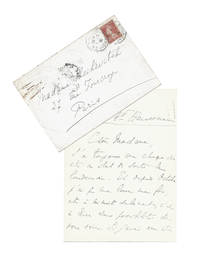
1915réf. Proust14PROUST Marcel 1871-1922 Autograph letter signed " Marcel Proust " to Marie Scheikévitch Paris 102 boulevard Haussmann 1st February 1915 post mark 4 p. in-8° in black in on laid paper With autograph envelope Paper clip marks on upper margin and envelope see scans With compunction Proust prefers to suffer in bed rather than lead an "easy life" and thinks of the soldiers mobilized at the front " Chère Madame J'ai toujours cru chaque soir être en état de sortir le lendemain. Et depuis octobre j'ai pu me lever une fois et à minuit seulement1 c'est à dire sans possibilité de vous voir. Si j'avais cru être aussi incapable de bouger je vous aurais écrit plus tôt. Mais je ne voulais pas vous répondre qu'il m'était impossible de fixer d'avance un jour mes crises étant si imprévues parce que j'espérais que cela allais devenir possible. L'expérience du passé ne m'a pas découragé d'espérer un avenir qui ne lui ressemble pas. Et même maintenant au moment où je vous écris cette lettre j'espère encore qu'une chance me permettra de vous la porter. En attendant je ne cesse de penser à vous. Je mets tout mon espoir dans votre fils2 et je pense que seule au monde sa faiblesse aura la force de vous aider à porter votre croix. Tout ce que vous me dites du frère que vous avez perdu et que je ne savais pas rend mon chagrin plus vif encore en me faisant mieux imaginer votre désespoir3. Mais la décision de votre plus jeune frère me navre4. Je l'admire. Mais j'aurais préféré que sa douleur se consacrât à la vôtre au lieu de l'accroître d'une telle angoisse. En attendant qu'on se décide à me faire passer un conseil de contre-réforme qui ne saurait je crois tarder je bénis la maladie de me faire souffrir car si cette souffrance ne sert à personne du moins elle m'évite celle plus grande que me donnerait le bien-être la vie facile pendant que souffrent et meurent tous ceux que ma pensée ne quitte pas. Quand vous aurez le temps de dicter pour moi une une ligne où vous me diriez "mon frère va bien et est moins exposé mon fils va bien j'ai du courage" vous rendrez bien heureux votre respectueux admirateur. Marcel Proust " 1 – Proust went to Madame Edwards's house that evening at midnight as he states in a letter to Lucien Daudet sent the night before. 2 – André Carolus-Duran 1902-1972 son of Marie Scheikévitch 3 – This is one of Mrs. Scheikovich's brothers Victor Scheikovich 1885-1914 a lawyer at the Court of Paris who fell a few days after being proposed as captain on 15 September 1914 at Tracy-le-Val 4 – Here is the youngest brother of Mrs. Sheikevich Valentin Sheikevich. He had left as medical officer of a battalion of cyclists attached along the way to General Lanrezac's staff and had just been sent to the front line at his request as surgeon-major of the 2nd Infantry Battalion Mangin division. He was to be cited at Neuville-Saint-Vaast. Proust and the War: This letter was a direct follow-up to the one sent to Marie Scheikovich three weeks earlier on 9 January. Proust was shocked to learn of the death of Victor Scheikévich the younger brother of his correspondent who had been killed at the front in the early hours of the war. He is sorry to know that her younger brother Valentin Sheikevich has also been mobilized. When the war came the writer was in the middle of writing the sequel to Swann's way which had been published in November 1913. He was not called to the front because of illness and followed the progress of the conflict from his Parisian apartment at 102 boulevard Haussmann. The conflict as we know had a direct impact on the course of his novel. He turned the church of Combray into a German observatory which was destroyed by the French and the English. "Proust was following closely the entire duration of the conflict in the first place to study the behavior of the society that he frequented during the war. He reads seven newspapers a day … war is a constant concern" Nathalie Mauriac Dyer An intimate of Proust who did much effort in using her network for the publication of the first volume of The Search : Marie Scheikevitch 1882-1964 was the daughter of a wealthy Russian magistrate and art collector who settled in France in 1896. George D. Painter described her as "one of the smartest and most prominent ladies of the new generation." Patron of artists and writers she frequented salons and then founded her own. She was friends with Jean Cocteau Anna de Noailles Reynaldo Hahn the Arman de Caillavet family among others. A feeling of singular quality united Marcel Proust to Marie Scheikévitch. Although they met briefly in 1905 in Mme Lemaire's salon it was in 1912 that they really get to know eachother. There followed a correspondence that lasted until 1922 the year of the writer's death. Seeing each other "almost every day" as she would later say friends writing all the less as they see each other more we know only 28 letters from Proust addressed to her. She opened to him the doors of her salon frequented by all that Paris had of illustrious personalities in literature and arts so that he paid tribute to her in Sodome et Gomorrhe under the veil of Madame Timoléon d'Amoncourt "a charming little woman of a spirit like her beauty so ravishing that only one of the two would have succeeded in pleasing ". A fervent admirer of the writer she spent a great deal at the time of the publication of the first volume of The Search trying everything to put Proust in touch with the Parisian personalities she considered most capable of helping him. It was she who recommended him to her lover Adrien Hébrard the influential director of the newspaper Le Temps to obtain the famous interview of November 12 1913 by Élie-Joseph Bois on the eve of Swann's publication: This was the first significant article published in the major press and devoted to The Search. To thank her Proust sent her a major inscription recently acquired by the BnF when Swann was published. Provenance: Catalogue Andrieux vente du 12 mars 1928 n°175 Bibliography: Lettres à Madame Scheikévitch 1928 p. 51 – 52 Correspondance Kolb t. XIV n°15 Source: Marcel Proust II – Biographie Jean-Yves Tadié Folio pp. 391-392
2017réf. Gyan-9789379634818Facsimile Publisher 2017. Hardcover. New. 22.59 x 14.34 x 4.08 cm. English Facsimile Publisher hardcover
2019réf. Gyan-9789379638465Facsimile Publisher 2019. Vol. 2. Hardcover. New. 22.59 x 14.34 x 3.68 cm. English Facsimile Publisher hardcover
2017réf. Gyan-9789379634818Facsimile Publisher 2017. Hardcover. New. 22.59 x 14.34 x 4.08 cm. English Facsimile Publisher hardcover
2019réf. Gyan-9789379638465Facsimile Publisher 2019. Vol. 2. Hardcover. New. 22.59 x 14.34 x 3.68 cm. English Facsimile Publisher hardcover
1930réf. 26020081First Modern Library edition stated in Toledano 5 binding. Blue balloon cloth is faded scuffed and soiled. Heavy sunning to spine though gilt spine titling and grapevine colophon intact. Gilt cover colophon lightly rubbed but intact. Shelfwear to edges corners bumped with a bit of loss to tail of spine some fraying to bottom edge of rear board and some chips at foreedge of rear board near top corner. Topstain faded edges of textblock soiled toned and foxed. Interior age-toned with toning and some foxing and soiling to endpapers and front matter. First signature from title page to page 20 is starting. Binding otherwise sound. The Modern Library hardcover
réf. ria9788119214327_inpHardcover. New. New Book; Fast Shipping from UK; Not signed; Not First Edition; "The bonds that unite us to another human being are sanctified when he or she adopts the same point of view as ourselves in judging one of our imperfections." ¿ Marcel Proust Within a Budding Grove Within a Budding Grove 1919 by Marc hardcover
réf. B9788119214327Hardback. New. hardcover
réf. 0701139889.Ghardcover. Good. Access codes and supplements are not guaranteed with used items. May be an ex-library book. hardcover
1930réf. 56412New York NY Random House: Modern Library 1930. Hardcover Modern Library First Edition 1930 as stated on the copyright page. Modern Library First Edition 1930 as stated on the copyright page. Good: shows a hint of wear to the extremities; faint mottling to the frongtpanel; light sunning to the backstrip which also shows a single crease and a bit of wrinkling; text pages show the expected tanning due to aging; a former owner's name neatly printed at the rear pastedown endpaper; the binding leans ever so slightly but remains secure; the text is clean. Free of any underlining hi-lighting or marginalia or marks in the text. Free of underlining hi-lighting notations or marginalia. A handsome little volume structurally sound and tightly bound showing mild wear and some cosmetic flaws. NOT a Remainder Book-Club or Ex-Library. 8vo. 7.25 x 5 x 1.25 inches. 356 pages. Translated by C.K. Scott Moncrieff. Language: English. Weight: 15.5 ounces. Modern Library 172. Brown Cloth over Flexible Boards with gilt Modern Library Logo at the front panel and gilt titles and designs at the backstrip. Brown decorated endpapers. First published in Thomas Selzer in 1924. Hardback: Flexible Cloth over Boards. Lacks DJ if indeed it ever had one. We apply "classic" and "masterpiece" too liberally but regardless of how loosely or strictly we deploy the terms Marcel's Proust's extraordinary novel belongs to the shortest of short lists deserving such description. At the risk of hyperbole though I do not think it is hyperbolic Proust is the one writer of the 20th century who perhaps belongs to the ages more than to his own time who belongs with Shakespeare and Dante and Homer. Many are put off Proust by not understanding the structure of his work and his writing strategy. The book to many seems to have no point and no plot. The novel actually does have a plot albeit a simple and not easy to discern one: Will the narrator usually termed "Marcel" become a writer Through seven long volumes we watch Marcel variously resolve to write and then forsake his resolve we see him even forget for enormous lengths of time his intent to write. Through love affairs through events with his friends through reflections on all matter of subjects and experiences of every kind Marcel finally comes in the final volume to rediscover his vocation and the subject of his work. Random House: Modern Library, hardcover