George SANDBiblio.com
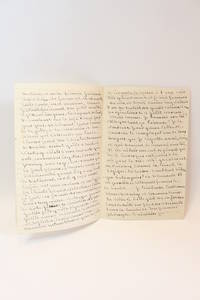
1867rif. 71232Nohant Nohant-Vic 1867. Fine. Nohant Nohant-Vic 21 décembre 1867 13.40 x 20.70 cm deux feuillets sous chemise et étui Autograph letter from George Sand to Gustave Flaubert dated December 21 1867 8 pages on two lined leaves. Published in Sand's Correspondance XX pp. 642-645. From one of the finest literary correspondences of the century this letter written on Christmas Eve 1867 is a sublime testament to the frank friendship between George Sand the old troubadour and Gustave Flaubert christened cul de plomb leaden ass after declining his invitation to Nohant to complete L'Éducation sentimentale. Despite their seventeen year-age gap opposing temperaments and divergent outlooks on life the reader is gripped by the tenderness and astonishing verve of George Sand's long confession to Flaubert. At the height of her literary fame and enjoying her theater in Nohant Sand talks at length about politics their separation their conception of the writer's work and life itself. In this stream-of-consciousness letter Sand naturally and freely sets down on paper eight pages of conversations with Flaubert who made only too rare and brief appearances in Nohant: But how I chat with you! Do you find all this amusing I'd like a letter to replace one of our suppers which I too miss and which would be so good here with you if you weren't a cul de plomb leaden ass who won't let yourself be dragged along to life for life's sake whereas Flaubert's motto then busy writing L'Éducation sentimentale was rather art for art's sake. In the end of 1867 Sand grieved the death of an almost brother François Rollinat which Sand appeased with letters to Flaubert and lively evenings at Nohant: This is how I've been living for the last 15 days since I stopped working . Ah'! . Ah! when you're on vacation work logic and reason seem like strange swings. Sand was quick to criticize him for working tirelessly in his robe the enemy of freedom while she was running up and down mountains and valleys from Cannes to Normandy even to Flaubert's own home which she had visited in September. On this occasion Sand had happily reread Salammbô where she picked up a few lines for her latest novel Mademoiselle Merquem. Their literary and virile friendship similar to Rollinat's defied the old guard of literati who declared the existence of a sincere affair between man and woman utterly impossible. Sand who has been described in turn as a lesbian a nymphomaniac and made famous for her resounding and varied love affairs began a long and intense correspondence with Flaubert for whom she was a mother and an old friend. She called herself in their letters old troubadour or old horse and no longer even considered herself a woman but a quasi-man recalling her youthful cross-dressing and formidable contempt for gender norms. To Flaubert had compared the female writers as Amazons denying their femininity: To better shoot with the bow they crushed their nipples Sand replied in this letter: I don't share your idea that you have to do away with the breast to shoot with the bow. I have a completely opposite belief for my own use which I think is good for many others probably for the majority. A warrior yes but a peaceful warrior Sand willingly adopted the customs of a world of misogynistic intellectuals while remaining true to herself: I believe that the artist should live in one's nature as much as possible. To the man who loves struggle war; to the man who loves women love; to the old man who like me loves nature travel and flowers rocks great landscapes children too family everything that moves everything that fights moral anemia she then adds. A fine evocation of her green period this passage marks the time of Sand's country novels when mellowed by the years she gave herself over entirely to contemplation to write François le Champi La Mare au diable and La Petite Fadette. But her love of nature didn't stop unknown
1833rif. YQV-142 volumes in-8 (207 x 122 pp) de 4 ff.n.ch. (faux-titre, titre, dédicace, exergue) et 350 pp. pour le premier volume ; 3 ff.n.ch. (faux-titre, titre, vers d Alfred de Musset) et 383 pp. pour le second (comme dans la plupart des exemplaires reliés à l époque, le relieur a supprimé le dernier feuillet blanc du tome I et le premier feuillet blanc du tome II) ; demi-veau fauve, dos lisses, compartiments de filets et chaînettes ornés de grands fleurons géométriques dorés, roulette en pied, plats recouverts de papier marbré, tranches marbrées dans les mêmes tons (reliure de l époque).
1846rif. 88172Desessart | Paris 1846 | 12.80 x 20.80 cm | 2 volumes reliés
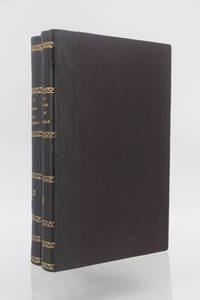
1846rif. 88172Paris: Desessart 1846. Fine. Desessart Paris 1846 12.80 x 20.80 cm 2 volumes reliés Rare and highly sought-after first edition. Contemporary binding in black half shagreen flat spines richly decorated with gilt ornamental rolls discreet and skilful restoration to the foot of one joint black paper-covered boards marbled endpapers and pastedowns sprinkled edges. Discreet restoration to the lower hinge of the first volume. Exceptionally clean copy virtually free of foxing a rarity according to Clouzot who notes that most copies are usually heavily spotted. Provenance: from the libraries of Saint-Germain with printed crowned bookplate beneath the titles on the half-titles; Count de Bonvouloir with his printed bookplate Château de Magny in Calvados above the title on the half-title of the second volume and above the next bookplate on an endpaper of the first volume; Charles-Albert Gigault de Crisonoy de Lyonne with his bookplate mounted on a pastedown and endpaper; and more recently Max Brun with his bookplate mounted on the front pastedown of the first volume. Shelving labels mounted at the top of the rear pastedowns minor losses to white paper and some corner stains on the endpapers. A rare copy preserved in a strictly contemporary binding. Desessart hardcover
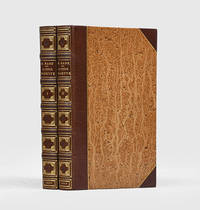
1849rif. 178642Paris: Michel Lévy Frères Libraires-Éditeurs 1849. Beautifully preserved in a fine Parisian binding First edition fine paper issue of the author's major novel one of her best known today. Together with La Mare au diable 1846 and François le Champi 1848 La Petite Fadette is one of Sand's pastoral "rustic novels" which drew inspiration from the author's love of the countryside and sympathy for the rural poor. In these works "the familiar theme of Sand's work - love transcending the obstacles of convention and class - regained pride of place" Ency. Brit. The fine bindings were executed by the Parisian master bookbinder Émile Mercier 1855-1910 the apprentice and successor to Francisque Cuzin 1836-1890. Mercier worked for Cuzin for eight years during which they established the elegant "Cuzin style" characterized by fine gilding and finishing. Following his mentor's death Mercier took over his workshop and sustained the firm's reputation for two decades signing bindings "Mercier Successeur de Cuzin". Mercier's bindings are "noted for the excellence of their tooling" and the binder himself was celebrated in Paris as "l'artiste impeccable" Coutts & Stephen p. 182. Provenance: Paul Villeboeuf b. c. 1856 with his bookplate. Villeboeuf was a distinguished collector of Romantic literature and fine bindings mostly by Cuzin and Mercier. He was the father of the artist André Villeboeuf. 2 vols octavo 227 x 150 mm. Late 19th- or early 20th-century straight-grain half morocco by Mercier spines lettered and decorated in gilt covers ruled in gilt marbled sides and endpapers edges untrimmed original wrappers bound in. Binding and contents exceptionally well-preserved a fine copy. Henry T. Coutts & George A. Stephen Manual of Library Bookbinding: Practical and Historical 1911. unknown
rif. 14713In 8 broché 195x150mm,faux titre,VIII,208 pages, quelques illustrations hors texte sur papier couché.P.CARRERE maître imprimeur Rodez,E de BOCARD Paris.15 janvier 1927.Quelques rousseurs éparses