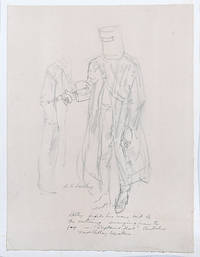
1969rif. 1724461969. Tell 'em I died game An absorbing collection of accomplished portraits and location sketches by the Australian artist George Crossley 1919-1973 executed during the making of Tony Richardson's Ned Kelly 1970 which "appeared at the beginning of what is considered a renaissance in Australian cinema" and at a moment when Kelly was the cynosure of "related constructions of the Australian past and identity" Basu p. 131. The film starred Mick Jagger as the iconic bushranger and he is pictured in two drawings: "Mick Jagger as 'Ned Kelly' addressing the Jury Braidwood Courthouse 27th Aug '69. Ned Kelly Location Rehearsals" and "Mick Jagger in the courtroom Braidwood Ned Kelly location. Aug '66". Approximately 54 drawings are finely executed close up portraits of cast members extras and crew including Jagger's stuntman Bill Peter caught during breaks from filming each meticulously captioned giving the sitter's identity and the location. A group of half a dozen feature members of the folk band the Wild Colonial Boys some of whom appear in the film and are pictured in performance. Kelly's final gun fight is recorded in an action sequence of looser pencil drawings: "Rehearsals for the Ambush of Kelly" "Kelly fights his way out of the cutting emerging from the fog" and finally "Kelly overcome with loss of blood weakens and collapses". A single pencil drawing depicts Kelly's famous bulletproof armour. Richardson himself makes an appearance in "Kelly's collapse when wounded and identification - by Inspector Nicholson - Glenrowan location. Tony Richardson directing". Crossley was born in Perth and studied at the Melbourne National Gallery School under the renowned portraitist William Dargie. Afterwards he worked as a television artist for the BBC in London. He held exhibitions in Europe the Middle East and Australia. His work is represented in a number of Australian institutions. Ned Kelly was filmed entirely in Australia largely around Braidwood New South Wales. The supporting cast of mainly Australians actors included Frank Thring as the colonial judge Sir Redmond Barry who sentenced Kelly to hang. Thring remains best known for his unforgettable high camp performances in a string of Hollywood blockbusters: Ben-Hur King of Kings and El Cid. Ian McKellen was originally considered for the role of Kelly but the studio wanted a bankable "big personality" and it was offered to Mick Jagger. The film "garnered a lot of attention for the bushranger both at home and abroad as well as causing a fracas for having as lead and director not only non-Australians but Britons Although none of the producers of Kelly products from this period was directly associated with the New Left it is clear that through Kelly they were intervening in related constructions of the Australian past and identity. They situated their past firmly within the structural inequalities necessitated by colonialism at a time when British colonies in Africa and the Caribbean were rapidly gaining independence and affirmed a national identity not only separate from 'Britishness' but in opposition to it" Basu p. 122-25. "Ned Kelly was transformed with the help of the telegraph wire and the early mass media from a regional folk hero into a romanticised media celebrity He has progressed from outlaw to national hero. to international icon. The still-enigmatic slightly saturnine and ever-ambivalent bushranger is the undisputed if not universally admired national symbol of Australia" Seal pp. 99-100. As the Australian Dictionary of Biography concludes "The legend still persists and seemingly has a compelling quality that appeals to something deeply rooted in the character of the 'average' Australian". Together 99 drawings most of them signed by the artist as "G. S. Crossley" the majority executed in black ink on paper some with pencil under drawing and occasional watercolour wash various sizes from 370 x 500 mm to 240 x 310 mm; all laid down on card and with detailed captioning often with a first version jotted down in situ when the drawing were created and a second more formal caption. With a small quantity of research material compiled by a previous owner. Occasional marks but overall in very good condition. Laura Basu Ned Kelly as Memory Dispositif: Media Time Power and the Development of Australian Identities 2012; Graham Seal Outlaw Heroes in Myth and History 2011. unknown
1919rif. 408155Atlantic City 1919. Softcover. Good. Octavo. Measuring 7" x 9". String-tied decorative paper wrappers. Contains 48 black and white or sepia toned gelatin silver photographs measuring 3.5" x 5.5" with captions. Additionally included is a certificate issued to Richardson and signed by one of Stinson's daredevil pilots attesting to his taking a 33-minute flight with a newspaper article written by Richardson about the flight laid in. The album is good only with considerable edgewear lacking the back cover with near fine photographs. A photo album compiled by William H. Richardson a journalist and amateur historian who published a number of monographs about New Jersey. The photographs document Richardson's arrival at the barnstorming event with his friend W.C. Cobb. The photos show the men in flight jackets and leather helmets as well as Eddie Stinson and his pilots and crew. The album features Stinson's seaplanes and ground aircraft and many in-flight scenes and bird's-eye views of Atlantic City. The newspaper article and album label note that Richardson was the first civilian from Jersey City to take aerial photographs. Stinson was an early Wright-trained aviator and served as a flight instructor for the U.S. Army during World War I. Following the war he started a barnstorming troupe and during one year earned over $100000 as a stunt pilot. He set a world endurance record for flight in 1921 and eventually founded the Stinson Aircraft Company of Dayton and Detroit which produced a number of very popular aircraft. Stinson accumulated more than 16000 hours of flight time - the most of any pilot in his lifetime - but he died in a 1932 airplane crash at Chicago. A very pleasing collection of early aviation stunt pilots and aerial photos of New Jersey. unknown
1919rif. 408155Atlantic City 1919. Softcover. Good. Octavo. Measuring 7" x 9". String-tied decorative paper wrappers. Contains 48 black and white or sepia toned gelatin silver photographs measuring 3.5" x 5.5" with captions. Additionally included is a certificate issued to Richardson and signed by one of Stinson's daredevil pilots attesting to his taking a 33-minute flight with a newspaper article written by Richardson about the flight laid in. The album is good only with considerable edgewear lacking the back cover with near fine photographs. A photo album compiled by William H. Richardson a journalist and amateur historian who published a number of monographs about New Jersey. The photographs document Richardson's arrival at the barnstorming event with his friend W.C. Cobb. The photos show the men in flight jackets and leather helmets as well as Eddie Stinson and his pilots and crew. The album features Stinson's seaplanes and ground aircraft and many in-flight scenes and bird's-eye views of Atlantic City. The newspaper article and album label note that Richardson was the first civilian from Jersey City to take aerial photographs. Stinson was an early Wright-trained aviator and served as a flight instructor for the U.S. Army during World War I. Following the war he started a barnstorming troupe and during one year earned over $100000 as a stunt pilot. He set a world endurance record for flight in 1921 and eventually founded the Stinson Aircraft Company of Dayton and Detroit which produced a number of very popular aircraft. Stinson accumulated more than 16000 hours of flight time - the most of any pilot in his lifetime - but he died in a 1932 airplane crash at Chicago. A very pleasing collection of early aviation stunt pilots and aerial photos of New Jersey. unknown books
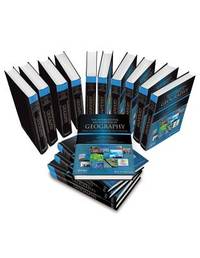
2017rif. 2-0470659637Blackwell Pub 2017. Hardcover. New. 8217 pages. 11.50x11.00x17.75 inches. Blackwell Pub hardcover
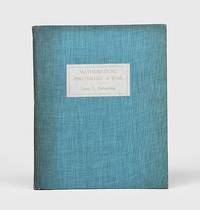
1919rif. 162531Oxford: Wm. Hunt 1919. With presentation letter First edition first impression of Richardson's first and pioneering paper on the subject; presentation copy with an autograph letter from the author loosely inserted. The letter is addressed to "Mr Bartlett" probably Frederic Bartlett one of the forerunners of cognitive psychology written on the author's home stationery and dated 20 September 1928. "You may like a copy of 'The Mathematical Psychology of War' if I have not already sent you one. If so you can pass it on. L. F. Richardson". In a postscript Richardson notes that this is his only published work but soon there may be two papers by him in the Journal of General Psychiatry. In the work the mathematician and pacifist Lewis Fry Richardson 1881-1953 developed a mathematical model for describing the change in animosity between two opposing sides during a war and "postulated that the rate of increase of the warlike activity of one nation depended on the current activity of the opposing nation" ODNB. It was published at the author's own expense costing him £35 for 300 copies in total. It contains Bertrand Russell's 20-line contribution "Problem: To Produce in Two Nations a Mutual Will to War" pp. 15-16. "Russell had been impressed with the manuscript which Stanley Unwin had forwarded him although he thought that Richardson's subject required a more extended treatment and that he should 'eliminate dogmatic statements of his metaphysical opinions where they are irrelevant'. But otherwise 'Mr. Richardson's main ideas appear to me true original and important' 29 December 1918. Russell's 'Problem' was enclosed with this letter to Unwin with instructions that it be passed on to the author 'for his amusement'" Rempel & Haslam p. 405. Quarto. Roneo typescript pp. 3 50. Original blue cloth printed paper label to front cover. Slight sunning to spine contents a little toned. A very good copy. Blackwell & Ruja B9. Richard A. Rempel & Beryl Haslam "Appendix I" in their critical edition of Russell's Uncertain Paths to Freedom 2000. hardcover
1901rif. 030407new york: Croscup & Sterling 1901. Book. Illus. by Walter McCall. Near Fine. Hardcover. 8vo - over 7¾ - 9¾" tall. Twenty 20 volumes in gilt lettered half blue morocco leather over marbled boards with matching endpapers.Top edge gilt. Edition limited to56 copies of the autograph edition of which this is copy #28. THe first volume is also signed by William Lyon Phelps who has written the introduction and a life of the author. Each Volume has a hand coloured frontis several of which are signed by the artist. All of the above on Holland hand made paper. The set consists of 3 long novels Pamela Sir Charles Grandison and Clarissa Harlowe. A beautiful set in wonderful condition with just a little edgewear. Croscup & Sterling Hardcover
1901rif. 249757New York: Croscup & Sterling 1901. Limited. hardcover. very good. Life of the Author and Introductions by by William Lyon Phelps. 20 volumes. Illustrated. Handsomely bound in full green morocco spines faded to brown elaborated stamped in gilt with red inlays & inlaid leather doublures by Stikeman. silk moire flyleaves t.e.g. New York: Croscup & Sterling 1901. Limited Edition. Edition de Bibliophile limited to 20 named copies on hand-made Japan paper exclusively for American subscribers and the type distributed. This is the "Aaron Hill" copy Croscup & Sterling unknown
1901rif. 249757New York: Croscup & Sterling 1901. Limited. hardcover. very good. Life of the Author and Introductions by by William Lyon Phelps. 20 volumes. Illustrated. Handsomely bound in full green morocco spines faded to brown elaborated stamped in gilt with red inlays & inlaid leather doublures by Stikeman. silk moire flyleaves t.e.g. New York: Croscup & Sterling 1901. Limited Edition. Edition de Bibliophile limited to 20 named copies on hand-made Japan paper exclusively for American subscribers and the type distributed. This is the "Aaron Hill" copy Croscup & Sterling unknown books
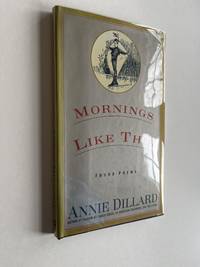
1995rif. ABE-1593565789213Harpercollins 1995. 1st Edition. Hardcover. Very Good/Very Good. The inscription reads: "For Bob the love and light of my life Annie." The relationship between Annie Dillard and her husband Robert D. Richardson is a remarkable and well-known story. Both were married to different people when Dillard sent Richardson a fan letter out of the blue prompted by a book he wrote Henry Thoreau: A Life of the Mind. Dillard wrote her Master's thesis at Hollins College on Walden and Henry and the transcendentalists of course have majorly influenced her work starting with Pilgrim at Tinker Creek. Richardson is one of our foremost literary biographers having written also about Emerson and William James the latter book earned him the Bancroft Prize. As Dillard described it she and Richardson had "two lunches and three hand shakes" and then both got divorces so they could get married in 1988. The next book she wrote The Writing Life is fittingly dedicated "For Bob" and they remain one of America's foremost literary and transcendental couples. Richardson has even gone on to write the biography of Dillard a short one. As for condition: the book is very good because of some light foxing to upper and outer edges of the text block and some extremely minor sunning or soiling to the upper and lower edges of the boards; the jacket is very good because of some moderate sunning to the spine. Dillard left a second signature her public more-perfunctory style above her name on the title page. All in all the book presents extremely well and its association is the ultimate knot. A copy inscribed to a life partner is always de facto a dedication copy and when it comes to having "mornings like this" Richardson would know better than anyone. Please inquire for photos. Harpercollins hardcover
1920rif. 5360171920. Hardcover. Near Fine. Oblong octavo 8 ½" x 5". Contemporary screw-bound black pebbled cloth covers. Contains 132 gelatin silver prints 3" x 4" including some gold toned neatly mounted on the rectos and versos of black paper leaves. Without captions or dates. Slight silvering at the edges of some prints else fine. A remarkable album of female nudes photographed by H.R. Cremer as goddesses and sprites. His images feature one two or three nude women in various subtle or striking poses taken outdoors in various gardens and wooded areas including lakes on open fields and hilltops and along an ocean coast. Among the models are several images of an Asian woman. Also included are six early studio portraits of individual female nudes. A third generation photographer based in Philadelphia and New York Cremer studied at the Pennsylvania Academy of Fine Arts and first exhibited his photographs in 1924. Inspired by the Art Deco aesthetic Cremer incorporated Native American motifs Aztec and Maya as well as Greek and Roman mythology in his photographs of women. A beautiful well-preserved album in fine condition featuring Cremer's best work from the 1920s-30s. hardcover
1920rif. 5360171920. Hardcover. Near Fine. Oblong octavo 8 ½" x 5". Contemporary screw-bound black pebbled cloth covers. Contains 132 gelatin silver prints 3" x 4" including some gold toned neatly mounted on the rectos and versos of black paper leaves. Without captions or dates. Slight silvering at the edges of some prints else fine. A remarkable album of female nudes photographed by H.R. Cremer as goddesses and sprites. His images feature one two or three nude women in various subtle or striking poses taken outdoors in various gardens and wooded areas including lakes on open fields and hilltops and along an ocean coast. Among the models are several images of an Asian woman. Also included are six early studio portraits of individual female nudes. A third generation photographer based in Philadelphia and New York Cremer studied at the Pennsylvania Academy of Fine Arts and first exhibited his photographs in 1924. Inspired by the Art Deco aesthetic Cremer incorporated Native American motifs Aztec and Maya as well as Greek and Roman mythology in his photographs of women. A beautiful well-preserved album in fine condition featuring Cremer's best work from the 1920s-30s. hardcover books
1964rif. 131051Beverly Hills CA: Metro-Goldwyn-Mayer MGM 1964. Draft script for the 1965 film based on the 1948 novel by Evelyn Waugh legendarily co-written by Terry Southern and Christopher Isherwood. Deluxe working script belonging to uncredited crew member William Todd Mason with his name and phone number in manuscript ink on the title page and some brief penciled annotations on three pages. Laid in is a corner stapled three-page Staff and Crew list with two name additions in manuscript red ink on the second page. Included is a vintage studio still photograph from the film. An early draft issued nearly two years prior to the film's October 1965 release with substantial differences from the finished film. The sister film to "Dr. Strangelove" and in the eyes of many just as much a masterpiece of exquisitely wrought black humor. Made in the US but in a dense British-American style. Ostensibly a satire on the funeral business in which a young British poet winds up in a Hollywood cemetery as part of an inheritance arrangement-but in reality a satire of Hollywood itself as well as the Western malaise of the mid 1960s. Script: Self wrappers presumably as this draft was issued. Title page present rubber stamped copy No. 70 dated July 21 1964 with credits for screenwriters Southern and Isherwood. 158 leaves mimeograph duplication with blue revision pages throughout dated 7-22-64. Pages Fine wrapper Fine bound with two gold brads. Staff and Crew listing: two leaves slightly worn with annotations on the second page. Metro-Goldwyn-Mayer [MGM] unknown
First edition, small folio (285 x 180 mm), [12], 99, [7], 239, [11], 55, [1], [6], 34pp., signature A incorrectly bound in after signature B, complete with the engraved title page, the printed title page, a double-page engraved map of Chester, a double-page engraved plan and inset prospect of Chester by Wenceslaus Hollar, a double-page engraved map of the Isle of Man with 8 inset prospects, 2 double-page engraved plates (one with repair to a closed tear), 15 other engraved plates, including armorial plates, and engravings in the text, small piece of blank lower corn of title page torn-away, finely bound in nineteenth-century green straight-grained morocco, gilt tooled dentelles, boards with a gilt roll tooled floral border, spine with five raised bands, two compartments lettered in gilt direct, others ornately tooled, all edges gilt, fine. Frances Mary Richarson Currer's copy in a fine morocco binding. A choice copy with a fine provenance and bound in a sumptuous full green morocco binding. "In 1656 King published in London The Vale-Royall of England, or, The County Palatine of Chester Illustrated, for which he wrote the preface. In it he printed for the first time two essays on Chester written by William Smith and William Webb more than forty years earlier, as well as an essay on the Isle of Man by James Chaloner. This book was illustrated with etchings mostly by Wenceslaus Hollar, which were unsigned and for this reason have often been attributed to King himself."?(Oxford DNB). Frances Mary Richardson Currer (1785-1861) was England's earliest female bibliophile and was described by Dibdin as the "head of all female book collectors in Europe.". Currer inherited both the library of her great grandfather, Richard Richardson (1663-1741) and her grandfather Mathew Wilson of Eshton Hall. With the additions added by Currer the library became of considerable importance, and in its day, it was surpassed only by those of Earl Spencer, the duke of Devonshire, and the duke of Buckingham. Most of the books in her library were auctioned at Sotheby's in 1862, realising ?6,000. A second sale took place in 1916 which raised more than ?3700, and the residue of her library was sold in 1979 and 1994. Provenance: Contemporary signature of Joseph Hopkinson to head of engraved title; The front pastedown has the armorial bookplates of Mathew Wilson and his grand-daughter Frances Mary Richardson Currer. Wing, K488; Upcott I, p.61; Cubbon I, p.461.
rif. 10245London. First edition first issue. Folding map with small tears not affecting printed map and 10 tinted lithograph plates mostly of indigineous people with illustrations in the text. Two volumes. Pp.vii 413 32 ads. dated March 31st 1851 ; vii 426. 8vo. original brown cloth spine repaired Cruising Association gilt cypher and stamp on the spines and boards.First edition of this account of a voyage to the Arctic regions in search Sir John Franklin's expedition by Sir John Richardson 1787-1865. Richardson studied in the medical department of the University of Edinburgh entered the navy as assistant surgeon in 1807 and was at the taking of Copenhagen. He was surgeon and naturalist to Sir John Franklin in his arctic expeditions in 1819-'22 and 1825-'7. He commanded one of the three expeditions to which this work is dedicated that went in search of Sir John Franklin in 1848 and returned in November 1849. Sir John Franklin b. 1786 had departed in 1845 with an expedition of 129 men on board of the 'Erebus' and the 'Terror' to find the northwest passage from the Atlantic to the Bering Straits. Nothing was heard from him again. No less then 40 expeditions were send out to find him. Many of these expeditions resulted in very useful geographical information: in 1850 for example the Northwest route was actually found by McClure. In 1859 the remains of the expedition were found at Cape Victoria proving that Franklin had died in 1847. In 1930 further remains were located in King Williamsland by a Canadian airman. The work includes a number of images of a sub-Arctic Athapaskan tribe the Kutchin whom Richardson visited in far northwest Canada in 1848. These published images and Murray's original drawings known to scholars only through photostats in the British Columbia Provincial Archives are the best early images of the tribe. Part two contains an appendix devoted to the physical geography climatology flora insects and vocabularies of the polar regions and concludes with an explanation of the two plates with leaves in the first part. Sabin 71025. hardcover
rif. 98046London Longman 1851. . First edition; 2 vols 8vo; 2 coloured lithograph frontispieces 8 lithograph plates folding coloured map; later dark blue half morocco gilt original cloth sides bound-in at end neat restoration to outer edge first three leaves circa 3 mm a very good set; viii 413; vii 1 426 pp. 32 pages ads end vol. I. Richardson the noted naturalist accompanied Franklin on his first and second expeditions. The present work includes the journals of Richardson and Rae on the MacKenzie Arctic and Coppermine rivers in 1849. The appendix contains a comparative table of dialects spoken by the Eskimo. The book also contains one of the earliest listings of Canadian and Arctic plants. Arctic Bibliography 14489; Sabin 71025; Wagner-Camp 203:1; Hill 1452. London, Longman, 1851. hardcover
2004rif. 2196NY: Little Brown 2004. First edition. Hardcover. Very good/Very good. A wonderful association copy inscribed by both Annie Dillard and her husband Robert Richardson on the half-title page in the year of publication: "For Liz and Deems may you flourish long as trees! Love Annie Christmas 2004"; "I will never see it seems a tree as nice as Liz and Deems. Bob." A unique item that would we suggest make a standout holiday gift. The association is fitting considering Dillard's place in nature writing and in particular her affection for trees. She is in fact a contributor to this book which highlights on page 35 a passage about a sycamore from her Pulitzer Prize-winning Pilgrim at Tinker Creek . One also thinks of her famous "tree with the lights in it" from Pilgrim see this brief commentary from the Harvard Divinity School. The recipients were their friends Liz Lear and her partner Deems Webster; Liz was on the board of the Key West Literary Seminars and was an important member of the Key West writing community where Dillard and Richardson wintered a brief tribute to Lear by writer Joy Williams. In this book Ansel Adam's magnificent tree photos are gathered along with arboreal writing from some the greats including Dillard John Muir Wendell Berry Walt Whitman Diane Ackerman Wallace Stevens John Fowles Gary Snyder Edwin Way Teale Hal Borland Robinson Jeffers Henry David Thoreau William Wordsworth Walt Whitman Ralph Waldo Emerson William Carlos Williams and of course Ansel Adams himself. Likely one of Annie Dillard's own contributor copies. Richardson was an accomplished biographer of Thoreau Emerson and William James the latter of which won a Bancroft Prize. Quarto in green cloth with silver lettering to spine. Photographic endpapers with his classic image of an orchard in Portola Valley CA. Very good or better with very light bumping to corners top board edges slightly faded and the top face of the text block with a light speckle of foxing. In a very good price-clipped jacket with a little creasing to corners and spine ends and light wear to top edges. Unique. More about the book: "The legendary artist Ansel Adams was a keen photographer of trees and forest woodlands distilling their essence in striking black-and-white images. This book presents some 50 of Adam's finest photographs of trees-a personal vision ranging from stirring portraits of the giant oaks in Yosemite Valley to the shimmering beauty of an aspen grove in New Mexico; majestic pine forests to leafy deciduous woods; exquisite details of bark and wood to snow-laden branches against the sky; and of course many a portrait of the ancient trees of the Sierra and the American West. Little, Brown hardcover
rif. 24059London: John Murray. 1828. First edition. First edition. 4to. Publisher's original red cloth with printed paper title label to the spine. Expertly re-backed with the original spine laid down to matching cloth. Page edges untrimmed. Publisher's prospectus for 'North American Views during the land Arctic Expeditions in 1819-1826 under the command of Captain Franklin' bound in at the front. Illustrated with 31 plates engraved by Edward Finden after drawings by George Back & E. N. Kendall with tissue-guards and six folding engraved maps one partially hand-coloured. A near fine copy the binding square and firm with fading to the spine and to the edges of the boards and with a touch of wear to the corners. The contents with some light scattered foxing to the preliminary pages and occasionally to thepage edges are otherwise wonderfully clean and bright throughout. The engraved plates are clean and crisp and the folding maps are in excellent condition with just a little toning remaining free from tears or damage. The first edition of Franklin's account of his second Canadian overland expedition which formed his third expedition to the Arctic. The aim of the expedition was to reach the mouth of the Mackenzie River from which Franklin would follow the coast westward and attempt to meet Frederick William Beechey who would sail northeast from the Bering Strait. Franklin's companion John Richardson meanwhile would follow the coast east from the Mackenzie to the mouth of the Coppermine River. After reaching Great Slave Lake using the existing known route Franklin took a reconnaissance trip 1000 miles down the Mackenzie becoming on 16th August 1825 the second European to reach its mouth. Here he erected a flagpole and buried letters for Parry beneath. Following this success he returned to winter at Fort Franklin on Great Bear Lake heading back downriver the following summer where he found the ocean frozen. He then worked his way west for several hundred miles giving up on 16th August 1826 at Return Reef when he was about 150 miles east of Beechey's Point Barrow and headed back to Fort Franklin reaching safety on 21st September. The present work contains both Franklin's and Richardson's narratives of the expedition and includes descriptions of the lands traversed the weather endured and the numerous encounters with the Esquimaux and Dogrib Indians. The six large handsome folding maps provide extensive cartographical detail of the expedition and the finely engraved plates wonderfully illustrate the experiences of its members. "The beauty of the typography is rivalled by that of the engravings each of which is a splendid specimen of art. Nine of these illustrations represent some incident in the intercourse of the explorers with the Esquimaux" Field. A splendid copy scarce in the publisher's original cloth. Hill 636; Arctic Bibliography 5198; Sabin 25628; Field 561. Further details and images for any of the items listed are available on request. All items are catalogued by humans. Lucius Books welcomes direct contact with our customers. London: John Murray. 1828 hardcover
1919rif. 135563Oxford: Wm. Hunt 1919. Mr. Richardson's main ideas appear to me true original and important" Russell First edition of Richardson's first and pioneering paper on the subject containing Russell's 20-line contribution "Problem: To Produce in Two Nations a Mutual Will to War" pp. 15-16. It was published at the author's own expense costing him £35 for 300 copies total. In this fifty-page essay the mathematician and pacifist Lewis Fry Richardson 1881-1953 developed a mathematical model for describing the change in animosity between two opposing sides during a war and "postulated that the rate of increase of the warlike activity of one nation depended on the current activity of the opposing nation" ODNB. "Russell had been impressed with the manuscript which Stanley Unwin had forwarded him although he thought that Richardson's subject required a more extended treatment and that he should 'eliminate dogmatic statements of his metaphysical opinions where they are irrelevant'. But otherwise 'Mr. Richardson's main ideas appear to me true original and important' 29 December 1918. Russell's 'Problem' was enclosed with this letter to Unwin with instructions that it be passed on to the author 'for his amusement'" Rempel & Haslam p. 405. Loosely inserted is a clipping from The Friend of April 7 1961 reviewing the posthumous publication of two volumes of Richardson's works; Arms and Insecurity and Statistics of deadly Quarrels. Quarto. Roneo typescript pp. 3 50. Original dark blue cloth-backed blue buckram boards printed paper label to front board. Ownership inscription dated 1919 to front pastedown with a typed letter signed loosely inserted returning the book to him. Spine ends worn and corners lightly rubbed Blackwell & Ruja B9. See Richard A. Rempel & Beryl Haslam's critical edition of Russell's Uncertain Paths to Freedom: Russia and China 1919-22 Routledge 2000 Appendix I. hardcover
2017rif. __0470659637Blackwell Pub 2017. Hardcover. New. 8217 pages. 11.50x11.00x17.75 inches. Blackwell Pub hardcover
1853rif. 144972London: Admiralty 1853. Notes: Folio 34cm one sheet folded 3 printed pages on pale blue stock paper a fine copy very rare. With regard to the Admiralty letters McGahern says "We found no standard references auction records or listings. They are not listed in WorldCat or Amicus. These letters are mentioned in George W. Corner's biography of Kane "Doctor Kane and the Arctic Seas" 1972 p116. 'From England he Kane received letters of advice and encouragement from the experienced Arctic travellers Sir William Parry Sir John Richardson Sir James Ross and Colonel later Sir Edward Sabine.' only reference located. WorldCat shows one copy at the University of Illinois at Urbana Champaign as part of a collection of 3 items Richardson Parry and Sir John Ross sic: this should be James Clark Ross. Described as "Three letterpress copies of letters addressed to Sir Francis Beaufort hydrographer of the British Admiralty… The letters were presumably printed for distribution by the Admiralty each on blue paper bifoliate leaves." OCLC #1114338177. In early 1853 Kane was preparing for the Second Grinnell Expedition and apparently he or the US Navy Dept. solicited advice on suitable equipment and technique from the British Admiralty. In response the Admiralty sent letters to several of the better known Arctic explorers of the time their replies being forwarded to Kane in printed form. These letters are filled with detailed suggestions regarding clothing with particular attention to feet fuel sledges tents travelling etc. McGahern Plimer Catalogue #375. 1853 Admiralty hardcover
1760rif. 73880London:: Printed for J. Rivington R. Baldwin and 12 others 1760. Early edition. 19th c. dark blue straight-grain morocco. Lacking one engraved plate as noted. Tiny old ink name partially effaced from title; old signature practiced on the verso of one plate not visible on recto and ink calculations at the bottom margin of one page of text; neat repair to one torn leaf; some light spots and inoffensive soiling. Joints partially cracked; edges and corners quite rubbed; still sound. . 12mo. Engraved illustrated title page. Containing Two Hundred and Forty i.e. 230 Fables with a Cut Engrav'd on Copper to each Fable. The engravings were printed ten to a page and this copy is unfortunately lacking one of the 24 plates Plate XIII. . And the Life of Aesop prefixed by Mr. Richardson. Printed for J. Rivington, R. Baldwin [and 12 others], unknown
rif. Biblio238PATRIOTIC & ECCENTRIC COLLECTOR OF AMERICANA RODE WASHINGTON'S CARRIAGE IN THE STATUE OF LIBERTY PARADE. 7 ½ x 9 ½ inches. Photograph by Oscar G. Mason. Very good condition with deep rich tones. Archivally framed. Born in England in 1812 Benjamin Richardson became an American citizen in 1839. In 1849 he came to San Francisco during the Gold Rush and he bought two waterfront lots at the first sale of real estate held in San Francisco. Richardson later sold these lots to the railroads for $400000 and moved to New York. One of the great eccentrics of his day Richardson was instantly recognizable by his waist-length flowing silvery beard and his 210-pound five feet six inch frame. The bearded eccentric tirelessly pursued and surrounded himself with relics of American history including Lincoln relics and Washington's carriage which he rode in the Statue of Liberty procession. This wonderful photograph shows Richardson and his great-grandson as they appeared in the Statue of Liberty Celebration parade. This photograph is accompanied by the sheet music of Richardson's song Uncle Ben's Liberty Celebration Song which used the photograph as an illustration. Benjamin Richardson
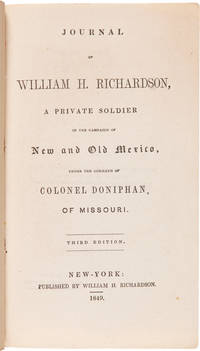
1849rif. 57547New York: William H. Richardson 1849. Scarce Mexican-American War Journal and Santa Fe Trail Overland The second printing of the third edition of this work after the very rare first edition of 1847 and the second edition of 1848. Richardson's Journal is considered one of the most reliable and valuable works on the Doniphan expedition and New Mexico during the Mexican-American War and beginning with the second edition it was accompanied by a facsimile letter written by Doniphan praising it for its accuracy. Richardson enlisted as a mounted volunteer due to patriotism engendered on the 4th of July in Carrollton Missouri. He took part in Doniphan's expedition over the Santa Fe Trail in the fall of 1846 heading south to El Paso by the first of the New Year then on to Chihuahua and eventually to Matamoros where the command shipped by boat to New Orleans. By July 10 1847 Richardson was back home in Anne Arundel County Maryland having completed a journey of over 5500 miles. The Mexican-American War is generally considered the first American war to receive extensive media coverage and public demand for news and information about the conflict was insatiable. The first edition of this fascinating and quite popular journal-cum-overland was published before the end of 1847 in Baltimore and it went through two more editions and four more printings by 1850. OCLC records this second printing of the third edition at eleven institutions and all editions are scarce in the market. Original pictorial wrappers. Slightly chipped at foot of spine. Light scattered foxing and staining. A very good copy. HOWES R262 "aa." WAGNER-CAMP 137:4. GRAFF FIFTY TEXAS RARITIES 33 1st ed. CLARK II: 164. TUTOROW 2630. HAFERKORN p.50. RITTENHOUSE 480 note. SABIN 71093. unknown
rif. 01915Londres Paris: Chez Jean Osborne Didot 1742. Virtue Rewarded - and Fully Told" The First Complete French Edition of Richardson's Pamela A Superb Copy in Contemporary French Mottled Calf RICHARDSON Samuel. Paméla ou la vertu recompensée. Traduit de l'anglois. Londres Paris: Chez Jean Osborne Didot 1742. First complete edition first printing in French of Richardson's celebrated epistolary novel incorporating the continuation published in English as Parts III and IV in 1741. The translation traditionally attributed to the Abbé Prévost has also been attributed by modern scholarship to François-Alexandre Aubert de La Chesnaye des Bois. Four twelvemo volumes 6 7/16 x 3 3/4 inches; 165 x 94 mm. xxiii 1 271 1; 4 324; 4 298; 4 302 pp. Title-pages printed in red and black. Two leaves belonging at the end of Volume III misbound into the final gathering of Volume IV; the text is complete. Contemporary French mottled calf covers with blind-ruled borders. Spines with five gilt-tooled raised bands dividing six compartments each decorated with an unusual gilt floral tool of a lily with eight leaves and central annular dot enclosed within a double-fillet frame with foliate sprigs as corner-pieces. Maroon morocco spine labels lettered in gilt; volume labels decorated with gilt roseates with lateral floral volutes above and below the lettering. Original French marbled endpapers. All edges stained red. Original green silk bookmark ribbons. Small oval stain 1 3/4 x 1 1/4 inches to upper board of Volume IV otherwise an absolutely stunning set tight bright and clean inside and out. The first complete French edition of one of the foundational novels of eighteenth-century literature published only two years after Richardson's original English edition and almost immediately after the appearance of its continuation. Samuel Richardson's Pamela; or Virtue Rewarded first appeared in London in 1740. Written principally in the form of letters by its young heroine Pamela Andrews the novel recounts her determined resistance to the sexual advances of her employer Mr. B. and her eventual transformation from servant into wife. Richardson's epistolary technique allowing his characters seemingly to record their thoughts and experiences almost as events occur gave the narrative an extraordinary immediacy and proved enormously influential upon the development of the eighteenth-century novel. The success of Pamela was immediate and sensational. Editions followed rapidly together with imitations unauthorized continuations attacks and parodies - not least Henry Fielding's Shamela. Richardson himself continued Pamela's story in two further volumes published in 1741 and concerned with her married life and conduct in high society. The First Complete Pamela in French: The French publication history is particularly interesting. A translation containing the first two parts had appeared in 1741. It was published after the fifth English edition at precisely the time when Richardson was revising his text for the handsome English octavo edition. According to the translator's preface Richardson himself supplied a number of additions and corrections for incorporation into the French text. The present four-volume edition of 1742 is the first French edition to contain the complete work incorporating the continuation represented by Richardson's English Parts III and IV. The circumstances surrounding its appearance in France are equally intriguing. The edition was already being offered for sale by January 12 1742 when fifty copies were seized from the bookseller Guérin. It subsequently appears to have circulated with the tacit consent of the authorities and was offered at six livres in sheets. The "Londres: Chez Jean Osborne" imprint was false. Evidence for its actual production in Paris by Didot was discovered in an advertisement leaf preserved with an incomplete copy at the British Library listing a number of Didot publications for sale. The Translator: The identity of the French translator has long been the subject of bibliographical uncertainty. The translation was traditionally attributed to Antoine-François Prévost the celebrated author of Manon Lescaut. It has subsequently also been attributed to François-Alexandre Aubert de La Chesnaye des Bois 1699-1783 the prolific author compiler and former Capuchin friar. Modern cataloguing continues to associate both names with the translation. It is therefore preferable to acknowledge the competing attributions rather than assign the work categorically to either translator. What is certain is that the French Pamela became an important vehicle for Richardson's extraordinary reception on the Continent. The appearance of this complete translation in 1742 scarcely two years after the English first edition demonstrates both the speed with which Richardson's reputation crossed the Channel and the remarkable international demand for the novel. The present copy is especially desirable for its condition. Complete eighteenth-century sets of the edition are scarce and the survival of all four volumes in such handsome uniform contemporary French mottled calf retaining their original marbled endpapers red edges and green silk bookmark ribbons is particularly appealing. A superb copy of the first complete French edition of Richardson's masterpiece - an important document in the European dissemination of the English novel. Sale 15n p. 29; Rochedieu pp. 279-280. Londres [Paris]: Chez Jean Osborne [Didot], 1742 unknown
rif. 334824New York: Holt Rinehart and Winston 1976. First Edition. 8vo. Brown cloth. Fine in fine yellow dust jacket. First Edition. 8vo. Incsribed on the half-Title: To Archie Cox with warmest regards and great Admiration Elliot." While serving as Nixon's Attorney General Richardson insisted on appointing Archibald Cox as Special Prosecutor for the Watergate break-in case. As Cox compiled damning evidence Nixon insisted that Richardson or his deputy William Ruckelshaus fire Cox. Rather than do so both Richardson and his deputy resigned leaving Solicitor General Robert Bork to fire Cox resulting in what came to be known as The Saturday Night Massacre. Richardson devotes an 11 page section of this book to the event. A terrific Watergate association. Holt Rinehart and Winston unknown