1,089 results
1895ref. 109911Paris, A La Librairie Illustrée 1895 2 volumes. In-4 31 x 25 cm. Reliures demi-chagrin rouge, dos à nerfs encadrés de petits fers dorés, 494-392 pp., 13 planches hors texte, nombreuses illustrations dans et hors texte, table des matières à la fin de chaque volume. Faibles rousseurs, intérieur très frais. Bel exemplaire.
1888ref. 13374Paris: Decaux 1888. In-4 p. mm. 295 x 200 mz. pelle coeva con angoli dorso a cordoni con decoraz. e titolo oro taglio superiore dorato conservata la bella brossura originale a colori pp. 4III4044 molto ben illustrato dalle pregevoli composizioni di Robida: sono 317 nel testo e 48 tavole fuori testo di cui numerose a colori. "Prima edizione". Cfr. Brun1074 - CarteretIV343: "Edition recherchée" - BenezitIX15: "Albert Robida 1848-1926 dessinateur de talent était aussi un érudit". Esemplare ben conservato. Decaux, unknown
ref. 201403759Paris, Librairie illustrée Jules Tallandier éditeur, s.d. ; in-4, 488-480VIII, cartonnage de l'éditeur. Les 2 volumes. En bon état demi-cuir marron a coisn dos a 5 ners orné en bon état un peu passé - 2 volumesOeuvres de Rabelais, en 2 volumes. non daté. Edition conforme aux derniers textes revus par l'Auteur. Une notice et un glossaire par Pierre Jannet. 600 illustrations dans le texte.
1904ref. 67831Henry Floury | Paris 1904 | 25 x 32.50 cm | broché
1895ref. 67796Librairie illustrée | Paris 1895 | 24 x 32.50 cm | relié
ref. 693533A La Librairie Illustrée Paris 1889 In-4 ( 280 X 205 mm ) de 53 pages, demi-maroquin bleu-nuit à coins, dos à nerfs janséniste, tête dorée, couvertures conservées. Illustrations en noir dans et hors-texte par Albert ROBIDA. EDITION ORIGINALE, exemplaire sur papier du Japon nacré non justifié. Rousseurs passim sur la couverture et les gardes, bel exemplaire enrichi d'UN BEAU DESSIN ORIGINAL signé à l'encre de chine avec envoi autographe signé d' André ROBIDA au Baron DE VAUX.
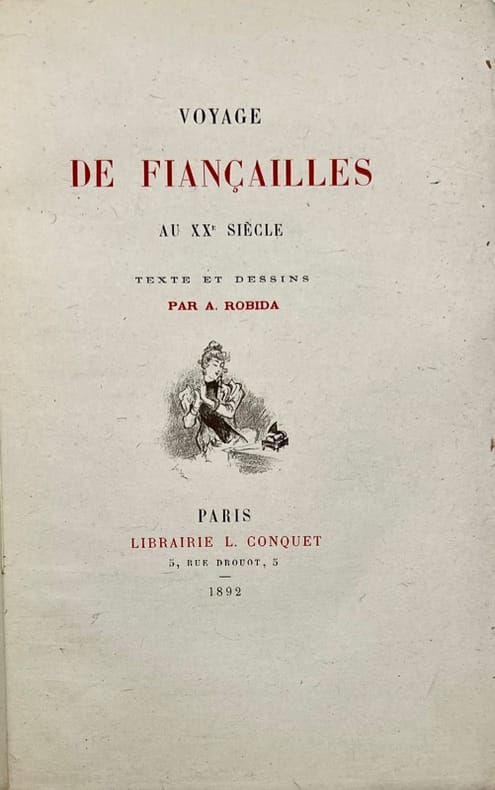
1892ref. 323Texte et dessins par A. Robida. Paris. Librairie L. Conquet. 1892. Petit in-8 de 1 frontispice, titre, 83 pp., couvertures conservées : demi-maroquin vert mousse à coins, à la Bradel, tête dorée.
1888In-4 p. (mm. 295 x 200), mz. pelle coeva con ang., dorso a cordoni con decoraz. e tit. oro, taglio super. dorato, conserv. la bella brossura originale a colori, pp. (4),III,404,(4), molto ben illustrato dalle pregevoli composizioni di Robida: sono 317 nel t. e 48 tavv. f.t., di cui numerose a colori. "Prima edizione". Cfr. Brun,1074 - Carteret,IV,343: "Edition recherchée" - Benezit,IX,15: "Albert Robida (1848-1926) dessinateur de talent, était aussi un érudit". Esempl. ben conservato.
ref. 21533Paris A la Librairie illustrée sans date ( vers 1895 ) 1895 in 4 (31,5x24) 1 volume reliure demi maroquin vert lierre de l'époque, dos à nerfs, tête dorée, couverture illustrée entierement conservée, frontispice gravé à l'eau-forte, 412 pages. Ouvrage illustré par Albert Robida de 250 dessins, avec 24 lithographies hors-texte, dont 7 en couleurs (complet). Reliure signée de Affolter. Très bel exemplaire, finement relié ( Photographies sur demande / We can send pictures of this book on simple request )
1913ref. 18286Le tirage de cette édition grand in-4° contenant les Illustrations marginales et les Gravures in-texte aquarellées à la main est strictement limité à 100 exemplaires. Celui-ci (n°35) sur Hollande teinté, contenant une Suite à part sur Chine de toutes les gravures.14 eaux-fortes originales et toutes les pages enluminées par de larges dessins d'Albert Robida avec serpentes.Paris, Imprimé pour Charles Meunier, 1913 - 38 pages.Superbe reliure plein veau blond de l'époque. Dos à nerfs mosaïqué. Tête doré. Filets dorés sur les plats. Roulette sur les plats intérieurs. Couverture conservée. Pas de rousseur. Parfait état. Format in-4°(32x25).
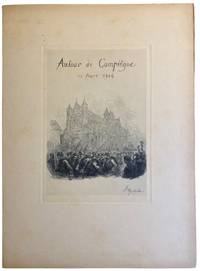
1915ref. 5304France S.P. 1915 Première édition. Boîtier cartonné avec des planches gravées. Édition limitée à 125 exemplaires seulement (il s'agit de l'exemplaire n° 113). Chaque planche est signée, les titres sont écrits à la main au crayon par Robida, au pied de la carte : "Les Evacués italiens", "Départ des territoriaux", "Le dernier jour du Pont de Compiègne", "les Fugitifs", "Le Prisonnier", "Convoi belge échappé de Namur", "Le Premier Taube !". L'étui crème comporte un feuillet de titre collé, avec une vue d'un soldat sur un quai regardant un pont détruit. Les planches sont légèrement assombries et marquées, et le dos de la pochette est assez endommagé. Il a été renforcé à l'intérieur avec du ruban adhésif d'archivage. Les attaches d'origine sont présentes. À l'intérieur, l'uvre se trouve dans une chemise en carton rigide (légèrement assombrie) avec un titre montrant des soldats défilant devant une cathédrale. Elle est signée au crayon par Robida. Le premier rassemblement est constitué des feuilles de texte (4 pages, dont trois sont imprimées) avec l'image de la première planche reproduite. Les bords sont assombris, mais l'ouvrage est propre. Les sept planches sont en très bon état, chacune d'entre elles étant accompagnée d'un papier de garde. Une pièce rare d'illustration de la première guerre mondiale. Compiègne, dans l'Oise, était la ville natale de Robida. Il ne pouvait pas savoir, lorsqu'il créa cette uvre, que Compiègne jouerait un rôle profondément symbolique et stratégique en tant que lieu de l'armistice qui mit fin au conflit. La célèbre signature de l'armistice a eu lieu dans la forêt de Compiègne. La ville était proche du front occidental et a été le théâtre de nombreux mouvements de troupes et de bombardements. Albert Robida (1848-1926) est un illustrateur, caricaturiste, lithographe et romancier français, célèbre à la fois comme artiste et comme commentateur social visionnaire de la Belle Époque. En 1880, Robida a cofondé et publié La Caricature.
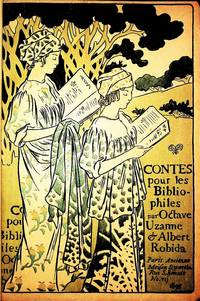
1895ref. AMO-673SUPERBE ET RARE ESTAMPE DE GEORGES AURIOL, L'UN DES MAÎTRES DE L'ORNEMENTATION ART NOUVEAU FRANÇAISE. LITHOGRAPHIE EN COULEURS DE 1895 ÉPREUVE NON UTILISÉE POUR UN VOLUME, A TOUTES MARGES, NON REMPLIÉE. DIMENSIONS 56 X 38 CM. PLI CENTRAL Cette lithographie a été dessinée pour servir de couverture aux CONTES POUR LES BIBLIOPHILES d'Octave UZANNE et Albert ROBIDA publiés chez Quantin à Paris en 1895. RARISSIME DANS CETTE CONDITION. VOIR PHOTOS POUR SUJET ET ETAT DE CONSERVATION.
1895ref. 23023Paris, Ancienne Maison Quantin, Librairies Imprimeries Réunis, May & Motteroz 1895. Fort in-8 relié. Reliure demi-maroquin vert foncé, avec plats en papier marbré. Pages de gardes en papier marbré. Dos à 5 nerfs avec filets, fleurons & titres dorés & gravés. Tête dorée. Couvertures conservées. 228 pages au format 21 x 30 x 3 cm. Frontispice, petite illustration de titre en couleur, 12 grands titres illustrés, 158 illustrations in-texte, 17 planches hors texte dont 4 en couleurs & deux eaux-fortes intitulées " L'Almanach des Muses 1789 " & " Le bibliothécaire hypnotiseur ". A noter que la planche " Les Fricatrices " tirée à 300 exemplaires vendue à part chez l’éditeur, est comme toujours absente. Un des 1000 exemplaires sur vélin ( n° 920 ), après 50 sur japon de luxe. Infimes rousseurs éparses. Exemplaire en état superbe de fraicheur. Rare édition originale en belle reliure d'époque.
1892ref. 15459Paris, Librairie L. Conquet, 1892. In-12 broché de (4)-83-(1) pp., titre en rouge et noir, couverture rempliée illustrée.
1915ref. 5304France: S.P. 1915. First edition. Hardback slipcase with engraved plates. Limited edition of only 125 this is copy #113. Each plate is signed the titles are hand written in pencil by Robida at the foot of the card: "Les Evacués italiens" "Départ des territoriaux" "Le dernier jour du Pont de Compiègne" "les Fugitifs" "Le Prisonnier" "Convoi belge échappé de Namur" "Le Premier Taube!" The cream slipcase has a pasted on title sheet with a view of soldier on a quayside looking at a destroyed bridge. A little darkening and marking to the boards and the spine of the folder is quite damaged. This has been reinforced from the inside with archival tape. Original closure ties are present. Inside the work is in a stiff card folder slightly darkened with a title showing soldiers marching past a cathedral. This is signed by Robida in pencil. The first gather is the text sheets 4 pages three of which are printed with the image from the front board replicated. This is darkened to the edges but clean. The seven plates are in lovely condition each with a tissue guard. A scarce piece of world war one illustration. Compiègne in the Oise department was Robida's home town. He could not have known when he created this work that Compiègne would play a deeply symbolic and strategic role as the site of the armistice that ended the conflict. The famous signing of the armistice was in the Forest of Compiègne. The town was close to the Western Front and saw many troop movements and bombardments. Albert Robida 1848–1926 was a French illustrator caricaturist lithographer and novelist celebrated both as an artist and as a visionary social commentator of the Belle Époque period. In 1880 Robida co-founded and edited La Caricature. Première édition. Boîtier cartonné avec des planches gravées. Édition limitée à 125 exemplaires seulement il s'agit de l'exemplaire n° 113. Chaque planche est signée les titres sont écrits à la main au crayon par Robida au pied de la carte : "Les Evacués italiens" "Départ des territoriaux" "Le dernier jour du Pont de Compiègne" "les Fugitifs" "Le Prisonnier" "Convoi belge échappé de Namur" "Le Premier Taube !". L'étui crème comporte un feuillet de titre collé avec une vue d'un soldat sur un quai regardant un pont détruit. Les planches sont légèrement assombries et marquées et le dos de la pochette est assez endommagé. Il a été renforcé à l'intérieur avec du ruban adhésif d'archivage. Les attaches d'origine sont présentes. À l'intérieur l'œuvre se trouve dans une chemise en carton rigide légèrement assombrie avec un titre montrant des soldats défilant devant une cathédrale. Elle est signée au crayon par Robida. Le premier rassemblement est constitué des feuilles de texte 4 pages dont trois sont imprimées avec l'image de la première planche reproduite. Les bords sont assombris mais l'ouvrage est propre. Les sept planches sont en très bon état chacune d'entre elles étant accompagnée d'un papier de garde. Une pièce rare d'illustration de la première guerre mondiale. Compiègne dans l'Oise était la ville natale de Robida. Il ne pouvait pas savoir lorsqu'il créa cette œuvre que Compiègne jouerait un rôle profondément symbolique et stratégique en tant que lieu de l'armistice qui mit fin au conflit. La célèbre signature de l'armistice a eu lieu dans la forêt de Compiègne. La ville était proche du front occidental et a été le théâtre de nombreux mouvements de troupes et de bombardements. Albert Robida 1848-1926 est un illustrateur caricaturiste lithographe et romancier français célèbre à la fois comme artiste et comme commentateur social visionnaire de la Belle Époque. En 1880 Robida a cofondé et publié La Caricature. S.P. hardcover
1895ref. 002280Paris: Libraire Illustree 1895. First . Hardcover. Very Good/No Jacket. Folio. A.Robida. 8 412 with 25 plates eau-forte couleur 8. lithographie with tissue guards and c. 248 illustrations in-text. Original illustrated paper covers front back and spine mounted on sheets at the back. Full vellum gilt titles to spine and dentelles teg marbled eps. A little spotting of prelims and fore edge spine bleached boards dust stained bookplates of Edward Penton and Charles M. Hutt on fpd. Folio Libraire Illustree hardcover
1909ref. 6544Paris: Ancienne Librairie Furne/Boivin & Cie Editeurs 1909. First Edition Thus. Hardcover. Near Fine. No DJ as Issued. First Edition Thus. Hardcover. Part of the series "Collection d'Albums Historiques". Text in French. 38 full page plates including double page. A very handsome copy. Light shelf/edge wear touch of gilt toning at spine else tight bright and unmarred. Teal cloth boards gilt and black ink lettering gilt and full color pictorial elements blue paper endpages chromolitho textblock on tabs aeg. Small fo. 80pp. Illus. color plates. Index of Plates. Ancienne Librairie Furne/Boivin & Cie, Editeurs hardcover
1909ref. 6544Paris: Ancienne Librairie Furne/Boivin & Cie Editeurs 1909. First Edition Thus. Hardcover. Near Fine. No DJ as Issued. First Edition Thus. Hardcover. Part of the series "Collection d'Albums Historiques". Text in French. 38 full page plates including double page. A very handsome copy. Light shelf/edge wear touch of gilt toning at spine else tight bright and unmarred. Teal cloth boards gilt and black ink lettering gilt and full color pictorial elements blue paper endpages chromolitho textblock on tabs aeg. Small fo. 80pp. Illus. color plates. Index of Plates. Ancienne Librairie Furne/Boivin & Cie, Editeurs hardcover books
1904ref. 67831Paris: Henry Floury 1904. Fine. Henry Floury Paris 1904 25 x 32.50 cm broché First edition one of 25 numbered copies on Japan paper deluxe copy and first printing of Albert Robida's illustrations. Fine copy. Work illustrated with large compositions forming frames around each page by Albert Robida. Henry Floury unknown
1895ref. 67796Paris: Librairie illustrée 1895. Fine. Librairie illustrée Paris 1895 24 x 32.50 cm relié First edition one of 50 numbered copies on Japan paper deluxe copy and first printing of Albert Robida's illustrations. Contemporary binding in red half cloth with corners smooth spine decorated with a central gilt fleuron double gilt fillet and gilt date at foot long black morocco title label illustrated pink covers preserved binding signed Carayon. A very fine copy. Librairie illustrée hardcover
1885In-4 gr. (mm. 377x267), mz. tela, tit. oro al dorso, pp. 8 cad. numero, interamente illustrato in b.n. e anche a colori nel t. Celebre rivista settimanale di carattere satirico, fondata da Decaux e di cui Robida fu il direttore dal 1880 al 1892. Offriamo l’annata completa del 1885 (con Indici): dal n. 262 (3 gennaio) al n. 313 (26 dicembre), completa dei 7 magnifici “Supplementi” a tema (ai nn. 265, 267, 272, 276, 279, 293 e 301). Sono 7 grandi tavole a colori, più volte ripieg., realizzate da: Gino “La marine au branle-bas de combat” - Draner “Costumes de Carnaval” - Robida “Un restaurant pendant la nuit de la mi-careme” - Job “Au concours hippique” - Trock “Le monde des théatres” - Sorel “Paris en noir” - Caran D’Ache “Manoeuvres d’automne de l’armée allemande”. Solo 2 tavv. restaur. per strappi, altrim. esemplare ben conservato.
1910ref. 66916Angelo Mariani | Paris 1910 | 23.50 x 33.50 cm | relié
1908ref. 58732Transcription nouvelle d'après l'édition de 1480 par Jean d'Albignac, illustré par Albert Robida, Etude par Pierre Sales, exemplaire sur papier vergé des Usines d'Arches, Fabriqué spécialement pour la Librairie Moderne, tirage unique à 100 exemplaires, un des 50 exemplaires d'hommages numérotés de 51 à 100 (n° 87), 1 vol. grand in-8 reliure de l'époque demi-chagrin maroquiné rouge, dos à 5 nerfs dorés orné, toutes tranches dorées, couvertures conservées, Librairie Moderne Maurice Bauche, Librairie Ancienne Lucien Dorbon, Paris, 1908, XII-246 pp. et 1 f.
1895ref. 1298Paris: Ancienne Maison Quantin Librairies-Imprimeries Reunis 1895. First printing. LIMITED FRENCH EDITION SUMPTUOUS COLLECTION OF STORIES ILLUSTRATED WITH ORIGINAL ETCHINGS LITHOGRAPHS AND PHOTOGRAVURES INCLUDES "THE END OF BOOKS"--PREDICTING TODAY'S eBOOKS AND AUDIOBOOKS. 12 inches tall hardcover 3/4 green pebbled leather binding gilt rules marbled paper covered boards decorative gilt title to spine marbled endpapers 2x2.5 inch photographic bookplate to front free endpaper "Ex. Lib. E. C. 1895" original art deco color lithographed paper covers by Auriol bound in title page with hand colored vignette by Robida and facing limitation notice volume 467 of 1000 printed on Japanese vellum iv 230 pp colophon printed on presses of the former Quantin Paris November 27 1894. 17 plates comprising 2 original etchings by Robida and 15 photogravures or lithographs including 4 handcolored 170 figures in text. Wear to cover edges and corners binding tight light browning to pages text and plates unmarked bright and clean with tissue guards intact. Very good in custom archival mylar cover. CONTENTS: Un Almanach des Muses de 1789; L'Heritage Sigismond; Le Bibliothecaire van der Boecken de Rotterdam; Un Roman de chevalerie franco-japonais; Les Romantiques inconnus; Le Carnet de notes de Napoleon 1er; La Fin des Livres; Poudriere et bibliotheque; L'Enfer du chevalier de Kerhany; Les Estrennes du poete Scarron; Histoires de Momies recits authentiques. OCTAVE UZANNE 181-1931 was a 19th-century French bibliophile writer publisher and journalist. He founded the Société des Bibliophiles Contemporaines of which he was president. In the early 1890s Uzanne was considered to be ". the best authority that book lovers know on subjects specially interesting to book lovers". In contrast to most bibliophiles of his time Uzanne was chiefly interested in the creation of new luxurious bibliophile works collaborating closely with printers binders typographers and artists especially the Symbolists and early Art Nouveau artists. Among them were such painters as James McNeill Whistler Adolphe Lalauze and Jules Barbey d'Aurevilly. Uzanne's bibliophile activity in the early 1880s coincided with the gradual abandonment of manual methods of printing illustrations kin favour of photomechanized methods. As a journalist sometimes employing the pseudonym "la Cagoule" Uzanne wrote for L'Écho de Paris Le Gaulois and other newspapers. In addition for other French and foreign magazines like The Studio Magazine of Art and Scribner's Magazine for which he wrote in 1894 an article "The End of Books" which he thought would come because of the rise of phonography where he predicted the rise of radio and television. The original illustrated La fin des Livres is included in Contes des Bibliophiles offered here. Uzanne was fascinated by modern technology and the possibilities it offered for the reproduction and dissemination of words sounds and images which was evidenced not only in that article or in his groundbreaking work in book publishing but also in an article he wrote in 1893 for the French newspaper Le Figaro about a visit he made to US President Grover Cleveland and the inventor Thomas Edison during the EXPO Chicago 1893 where he witnessed the Kinetograph shortly before it went public. Contes Pour les Bibliophiles offered here was translated into English as Tales for bibliophiles Chicago The Caxton Club 1929. ALBERT ROBIDA 1848-1926 was a French illustrator etcher lithographer caricaturist and novelist. He edited and published La Caricature magazine for 12 years. Through the 1880s he wrote an acclaimed trilogy of futuristic novels. These works drew comparison with Jules Verne. Unlike Verne he proposed inventions integrated into everyday life not creations of mad scientists and he imagined the social developments that arose from them often with accuracy: social advancement of women mass tourism pollution etc. His La Guerre au vingtième siècle describes modern warfare with robotic missiles and poison gas. His Téléphonoscope was a flat screen television display that delivered the latest news 24-hours a day the latest plays courses and teleconferences. GEORGE AURIOL 1863-1938 was a French poet songwriter graphic designer type designer and Art Nouveau artist. He worked in many media and created illustrations for the covers of magazines books and sheet music. Ancienne Maison Quantin, Librairies-Imprimeries Reunis hardcover
1895ref. 1298Paris: Ancienne Maison Quantin Librairies-Imprimeries Reunis 1895. First printing. LIMITED FRENCH EDITION SUMPTUOUS COLLECTION OF STORIES ILLUSTRATED WITH ORIGINAL ETCHINGS LITHOGRAPHS AND PHOTOGRAVURES INCLUDES "THE END OF BOOKS"--PREDICTING TODAY'S eBOOKS AND AUDIOBOOKS. 12 inches tall hardcover 3/4 green pebbled leather binding gilt rules marbled paper covered boards decorative gilt title to spine marbled endpapers 2x2.5 inch photographic bookplate to front free endpaper "Ex. Lib. E. C. 1895" original art deco color lithographed paper covers by Auriol bound in title page with hand colored vignette by Robida and facing limitation notice volume 467 of 1000 printed on Japanese vellum iv 230 pp colophon printed on presses of the former Quantin Paris November 27 1894. 17 plates comprising 2 original etchings by Robida and 15 photogravures or lithographs including 4 handcolored 170 figures in text. Wear to cover edges and corners binding tight light browning to pages text and plates unmarked bright and clean with tissue guards intact. Very good in custom archival mylar cover. CONTENTS: Un Almanach des Muses de 1789; L'Heritage Sigismond; Le Bibliothecaire van der Boecken de Rotterdam; Un Roman de chevalerie franco-japonais; Les Romantiques inconnus; Le Carnet de notes de Napoleon 1er; La Fin des Livres; Poudriere et bibliotheque; L'Enfer du chevalier de Kerhany; Les Estrennes du poete Scarron; Histoires de Momies recits authentiques. OCTAVE UZANNE 181-1931 was a 19th-century French bibliophile writer publisher and journalist. He founded the Société des Bibliophiles Contemporaines of which he was president. In the early 1890s Uzanne was considered to be ". the best authority that book lovers know on subjects specially interesting to book lovers". In contrast to most bibliophiles of his time Uzanne was chiefly interested in the creation of new luxurious bibliophile works collaborating closely with printers binders typographers and artists especially the Symbolists and early Art Nouveau artists. Among them were such painters as James McNeill Whistler Adolphe Lalauze and Jules Barbey d'Aurevilly. Uzanne's bibliophile activity in the early 1880s coincided with the gradual abandonment of manual methods of printing illustrations kin favour of photomechanized methods. As a journalist sometimes employing the pseudonym "la Cagoule" Uzanne wrote for L'Écho de Paris Le Gaulois and other newspapers. In addition for other French and foreign magazines like The Studio Magazine of Art and Scribner's Magazine for which he wrote in 1894 an article "The End of Books" which he thought would come because of the rise of phonography where he predicted the rise of radio and television. The original illustrated La fin des Livres is included in Contes des Bibliophiles offered here. Uzanne was fascinated by modern technology and the possibilities it offered for the reproduction and dissemination of words sounds and images which was evidenced not only in that article or in his groundbreaking work in book publishing but also in an article he wrote in 1893 for the French newspaper Le Figaro about a visit he made to US President Grover Cleveland and the inventor Thomas Edison during the EXPO Chicago 1893 where he witnessed the Kinetograph shortly before it went public. Contes Pour les Bibliophiles offered here was translated into English as Tales for bibliophiles Chicago The Caxton Club 1929. ALBERT ROBIDA 1848-1926 was a French illustrator etcher lithographer caricaturist and novelist. He edited and published La Caricature magazine for 12 years. Through the 1880s he wrote an acclaimed trilogy of futuristic novels. These works drew comparison with Jules Verne. Unlike Verne he proposed inventions integrated into everyday life not creations of mad scientists and he imagined the social developments that arose from them often with accuracy: social advancement of women mass tourism pollution etc. His La Guerre au vingtième siècle describes modern warfare with robotic missiles and poison gas. His Téléphonoscope was a flat screen television display that delivered the latest news 24-hours a day the latest plays courses and teleconferences. GEORGE AURIOL 1863-1938 was a French poet songwriter graphic designer type designer and Art Nouveau artist. He worked in many media and created illustrations for the covers of magazines books and sheet music. Ancienne Maison Quantin, Librairies-Imprimeries Reunis hardcover books