1.044 Ergebnisse
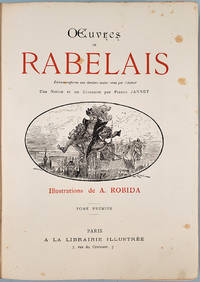
1885Best.-Nr. 22340Paris Librairie illustrée 1885 -in-4 demi-chagrin 2 volumes, reliure demi-chagrin rouge in-quarto (binding half red shagreen in-quarto) (23 x 31,2 cm), dos à nerfs (spine with raised bands), décorations "or" et à froid, titre et tomaison frappés "or" avec un filet "or" de part et d'autre, entre-nerfs à fleuron "or" avec un double filet "or" de part et d'autre, filet perlé "or" en place des nerfs avec un filet à froid et un double filet "or" de part et d'autre des nerfs, filet "or" et filet perlé "or" en tête et en pied, papier marbré rouge et noir aux plats (cover with marbled paper), toutes tranches lisses, ÉDITION ILLUSTRÉE de 49 PLANCHES hors-texte d'Albert ROBIDA, dont 8 en couleurs et 41 monochromes tirées en bleu, vert ou sépia + Près de 600 dessins en noir dans le texte, fines et trés légères rousseurs, (VIII-494) + (VIII-484) pages, sans date [1885-1886] Paris : Librairie illustrée Editeur,
Best.-Nr. 023502Paris Librairie illustrée, sans date (vers 1890) 0 deux volumes grand in-4°, 494 et 484 pp. Reliure ancienne en demi-chagrin marron foncé, dos à nerfs orné de pièces de titre et de tomaisons, de filets, de palette et de fers dorés, gardes " old dutch ". (dos insolés, coupes, coiffes et plats frottés par endroits, quelques rousseurs sur les gouttières, plusieurs feuillets faiblement, brunis). Titres imprimés en rouge et en noir. Un frontispice en deux tons au tome I et de nombreux dessins en noir & blanc d'Albert Robida.
Best.-Nr. 2354Paris, A la Librairie Illustrée, non daté (fin XIXème siècle). 22x31 cm. Ouvrage en 2 volumes (494 et 484 pages), richement illustré de gravures in-texte et hors-texte par A. ROBIDA. Reliures en demi-chagrin marron. Plats recouverts de toile beige. Dos à 5 nerfs, portant le nom de l'auteur et la tomaison en lettres dorées. Quelques rousseurs éparses et traces de restauration, sinon intérieur propre. Traces de frottement sur les mors et les nerfs, sinon ensemble en bon état général et solide.
Best.-Nr. 3492Paris, Tallandier, s.d., 17x23, deux volumes. Très élégantes reliures en demi chagrin bleu roi à grands coins. Dos à 4 nerfs, joliment décorés de filets dorés. Titre, auteur et tomaison en lettres dorées. Tranches supérieures dorées. Couverture d'origine conservée. Richement illustrés de gravures par Robida, donc 16 hors-texte en héliogravure. Reliures magnifiques, papier propre, sans rousseurs.
1920Best.-Nr. 9998646Tallandier Paris Jules Tallandier SD, 2 forts volumes In-8 brochés, xlvi + 494 + 481 pages. Illustrées par Albert ROBIDA. Edition reproduisant le texte et les illustrations de la premiére édition donnée par ROBIDA et ornée de 16 hors-texte en héliogravure. Introduction par Octave UZANNE. Parfait état.
Best.-Nr. 98508Paris, À la Librairie illustrée, (1885-1886), in-folio, 2 vol. in folio : 494 p. + 484 pp, Percaline rouge de l'éditeur, plats supérieur et dos ornés de compositions dorées avec rehauts de gris et noir, seconds plats décorés de médaillons et encadrements en noir, "L'appétit vient en mangeant, la soif s'en va en buvant" (Gargantua). Première édition illustrée par Robida. Quelques frottements et taches, rousseurs Carteret IV, 329. Vicaire VI, 930. Couverture rigide
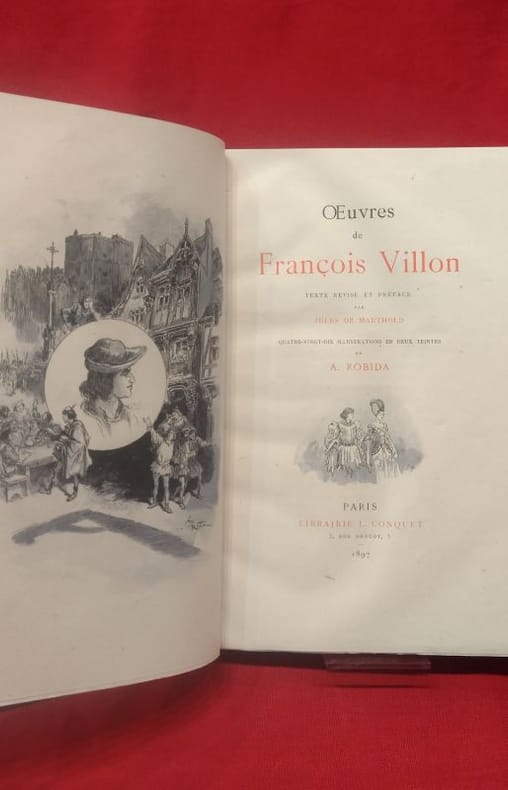
1897Best.-Nr. 003359Paris, L. Conquet, 1897. In-4 (227 x 175 mm.), I ff. n. ch. 340 pp., 3 ff. n. ch., reliure maroquin bordeaux, dos à cinq nerfs orné d'encadrements de filets or et d'un listel de maroquin vert, plats ornés d'encadrements de filets or et d'un cadre de maroquin verchif.t, frappé à froid d'une guirlande végétale, double filet de coupes, contreplats ornés de soie moirée bordeaux encadrée de filets or et à froid et d'un listel de maroquin vert, gardes de soie, doubles gardes papier bigarré, couverture illustrée en couleurs sur le premier plat, et dos, tranches dorées (reliure signée Blanchetière). Ouvrage illustré de quatre-vingt-dix illustrations en deux tons de Albert ROBIDA. Tirage limité à 350 exemplaires numérotés, celui-ci un des 150 imprimés sur papier de Chine fort contenant en supplément un état à part des illustrations, sur le même papier. Envoi autographe au crayon bleu signé par l'éditeur Léopold Carteret. (légères marques du décollage d'un ex-libris sur la première page de garde).
1897Best.-Nr. 118494conquet 1897 stroobants Paris, Librairie L. Conquet, 1897, 1 volume petit in-4 de 160x255 mm environ, (4) ff., XXXIV, 339 pages, tirage à 350 exemplaires, un des 150 exemplaires sur papier de Chine fort. Reliure signée Stroobants, demi-maroquin rouge à coins, dos à cinq nerfs portant titres dorés et caissons richement ornés, tranche de tête dorée, gardes marbrées, couvertures conservées. Dos très légèrement décoloré, sinon très bel exemplaire, intérieur en bon état.
1897Best.-Nr. 4259Paris, Lib. L. Conquet, 1897. 1 vol. in-4 de XXXIV-339-[6] pages, demi-maroquin rouge à coins, dos à nerfs orné de lyres dorées, tête dorée, doubles filets dorés ornant les plats, couverture et dos conservés. Mors très légèrement frottés, pour le reste en bien belle condition. Reliure de Gènther & Baumann.
Best.-Nr. 847044Librairie L. Conquet Paris 1897 Grand in-8 ( 250 X 160 mm ) de ( 1 )f. bl., ( 2 )ff., XXXVI, 340pp., ( 1 )f. bl., ( 1 )f., maroquin chocolat, dos à nerfs orné de caissons et fleurons dorés, double filet et importante dentelle d'encadrement avec fleurons aux écoinçons dorés sur les plats, coupes et coiffes filetées d'or, dentelle intérieure dorée, doublures de vélin crème avec semis de fleurs de lys doré, tranches dorées sur témoins, couvertures et dos conservés, étui bordé ( Reliure signée de Bernard DOR ). Premier tirage des 90 compositions de ROBIDA gravées sur bois dans le texte. Un des 30 exemplaires de tête numérotés sur Chine fort celui-ci N°7, comportant une suite des tirages à part du trait et une suite coloriée. Cet exemplaire présente donc les illustrations en TRIPLE ETAT. Très bel exemplaire fort bien relié en maroquin doublé de Bernard DOR enrichi hors-justification d'un beau DESSIN ORIGINAL en couleurs signé et légendé par Albert ROBIDA. Carteret, Le Trésor du bibliophile romantique et moderne, IV, 401.
1885Best.-Nr. 65556Paris: La librairie illustrée 1885. Fine. La librairie illustrée Paris 1885 - 1886 24.50 x 32 cm 2 volumes reliés Illustrated edition by Robida first printing with 49 plates 8 in color 35 in camaieu and 6 in black and numerous text illustrations approximately 600. Publisher's polychrome illustrated boards signed Souze and bound by Engel. Special gilt and blue plate on red ground. Spine similar. Rear board with a half-timbered house in a central roundel and blind angular cornerpieces. Front board of first volume very good that of the second with a 1cm diameter stain and soiling to the upper part of the black border. Lower corners bumped others rubbed. A tear to the spine of the first volume. Headcaps rubbed those at head turned in. Soiling to rear boards. Scattered and unevenly distributed foxing. Some leaves sprung. Despite flaws a handsome copy overall of this rare binding. Robida's masterpiece of illustration with genuine imaginative profusion baroque and delightfully exuberant. La librairie illustrée hardcover
Best.-Nr. 51904Paris: Librairie Illustrée. Rabelais François between 1483-94 - 1553. Oeuvres de Rabelais. 2 vols. 4 viii 494 2; 4 484pp. 42 plates some in color; text illustrations by Albert Robida 1848-1926. Paris: Librairie Illustrée 1885-86. 313 x 227 mm. Original publisher's binding of red cloth elaborately stamped in blue black and gilt signed "Engel rel." in the binding; slipcase. Slight edgewear hinges a trifle weak traces of bookplate removal on front endpapers of both volumes but a fine example with the covers clean and bright. First Robida Edition. Robida an illustrator and caricaturist provided the artwork for this famous edition of the works of Rabelais including the design for the striking publisher's binding. . Librairie Illustrée unknown
1920Paris Jules Tallandier SD, 2 forts volumes In-8 brochés, xlvi + 494 + 481 pages. Illustrées par Albert ROBIDA. Edition reproduisant le texte et les illustrations de la premiére édition donnée par ROBIDA et ornée de 16 hors-texte en héliogravure. Introduction par Octave UZANNE. Parfait état.
Best.-Nr. 51904Paris: Librairie Illustrée. Rabelais François between 1483-94 - 1553. Oeuvres de Rabelais. 2 vols. 4 viii 494 2; 4 484pp. 42 plates some in color; text illustrations by Albert Robida 1848-1926. Paris: Librairie Illustrée 1885-86. 313 x 227 mm. Original publisher's binding of red cloth elaborately stamped in blue black and gilt signed "Engel rel." in the binding; slipcase. Slight edgewear hinges a trifle weak traces of bookplate removal on front endpapers of both volumes but a fine example with the covers clean and bright. First Robida Edition. Robida an illustrator and caricaturist provided the artwork for this famous edition of the works of Rabelais including the design for the striking publisher's binding. . Librairie Illustrée unknown books
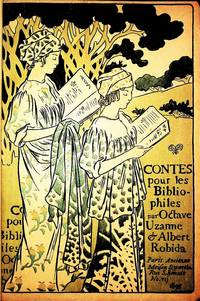
1895Best.-Nr. 1298Paris: Ancienne Maison Quantin Librairies-Imprimeries Reunis 1895. First printing. LIMITED FRENCH EDITION SUMPTUOUS COLLECTION OF STORIES ILLUSTRATED WITH ORIGINAL ETCHINGS LITHOGRAPHS AND PHOTOGRAVURES INCLUDES "THE END OF BOOKS"--PREDICTING TODAY'S eBOOKS AND AUDIOBOOKS. 12 inches tall hardcover 3/4 green pebbled leather binding gilt rules marbled paper covered boards decorative gilt title to spine marbled endpapers 2x2.5 inch photographic bookplate to front free endpaper "Ex. Lib. E. C. 1895" original art deco color lithographed paper covers by Auriol bound in title page with hand colored vignette by Robida and facing limitation notice volume 467 of 1000 printed on Japanese vellum iv 230 pp colophon printed on presses of the former Quantin Paris November 27 1894. 17 plates comprising 2 original etchings by Robida and 15 photogravures or lithographs including 4 handcolored 170 figures in text. Wear to cover edges and corners binding tight light browning to pages text and plates unmarked bright and clean with tissue guards intact. Very good in custom archival mylar cover. CONTENTS: Un Almanach des Muses de 1789; L'Heritage Sigismond; Le Bibliothecaire van der Boecken de Rotterdam; Un Roman de chevalerie franco-japonais; Les Romantiques inconnus; Le Carnet de notes de Napoleon 1er; La Fin des Livres; Poudriere et bibliotheque; L'Enfer du chevalier de Kerhany; Les Estrennes du poete Scarron; Histoires de Momies recits authentiques. OCTAVE UZANNE 181-1931 was a 19th-century French bibliophile writer publisher and journalist. He founded the Société des Bibliophiles Contemporaines of which he was president. In the early 1890s Uzanne was considered to be ". the best authority that book lovers know on subjects specially interesting to book lovers". In contrast to most bibliophiles of his time Uzanne was chiefly interested in the creation of new luxurious bibliophile works collaborating closely with printers binders typographers and artists especially the Symbolists and early Art Nouveau artists. Among them were such painters as James McNeill Whistler Adolphe Lalauze and Jules Barbey d'Aurevilly. Uzanne's bibliophile activity in the early 1880s coincided with the gradual abandonment of manual methods of printing illustrations kin favour of photomechanized methods. As a journalist sometimes employing the pseudonym "la Cagoule" Uzanne wrote for L'Écho de Paris Le Gaulois and other newspapers. In addition for other French and foreign magazines like The Studio Magazine of Art and Scribner's Magazine for which he wrote in 1894 an article "The End of Books" which he thought would come because of the rise of phonography where he predicted the rise of radio and television. The original illustrated La fin des Livres is included in Contes des Bibliophiles offered here. Uzanne was fascinated by modern technology and the possibilities it offered for the reproduction and dissemination of words sounds and images which was evidenced not only in that article or in his groundbreaking work in book publishing but also in an article he wrote in 1893 for the French newspaper Le Figaro about a visit he made to US President Grover Cleveland and the inventor Thomas Edison during the EXPO Chicago 1893 where he witnessed the Kinetograph shortly before it went public. Contes Pour les Bibliophiles offered here was translated into English as Tales for bibliophiles Chicago The Caxton Club 1929. ALBERT ROBIDA 1848-1926 was a French illustrator etcher lithographer caricaturist and novelist. He edited and published La Caricature magazine for 12 years. Through the 1880s he wrote an acclaimed trilogy of futuristic novels. These works drew comparison with Jules Verne. Unlike Verne he proposed inventions integrated into everyday life not creations of mad scientists and he imagined the social developments that arose from them often with accuracy: social advancement of women mass tourism pollution etc. His La Guerre au vingtième siècle describes modern warfare with robotic missiles and poison gas. His Téléphonoscope was a flat screen television display that delivered the latest news 24-hours a day the latest plays courses and teleconferences. GEORGE AURIOL 1863-1938 was a French poet songwriter graphic designer type designer and Art Nouveau artist. He worked in many media and created illustrations for the covers of magazines books and sheet music. Ancienne Maison Quantin, Librairies-Imprimeries Reunis hardcover
1895Best.-Nr. 1298Paris: Ancienne Maison Quantin Librairies-Imprimeries Reunis 1895. First printing. LIMITED FRENCH EDITION SUMPTUOUS COLLECTION OF STORIES ILLUSTRATED WITH ORIGINAL ETCHINGS LITHOGRAPHS AND PHOTOGRAVURES INCLUDES "THE END OF BOOKS"--PREDICTING TODAY'S eBOOKS AND AUDIOBOOKS. 12 inches tall hardcover 3/4 green pebbled leather binding gilt rules marbled paper covered boards decorative gilt title to spine marbled endpapers 2x2.5 inch photographic bookplate to front free endpaper "Ex. Lib. E. C. 1895" original art deco color lithographed paper covers by Auriol bound in title page with hand colored vignette by Robida and facing limitation notice volume 467 of 1000 printed on Japanese vellum iv 230 pp colophon printed on presses of the former Quantin Paris November 27 1894. 17 plates comprising 2 original etchings by Robida and 15 photogravures or lithographs including 4 handcolored 170 figures in text. Wear to cover edges and corners binding tight light browning to pages text and plates unmarked bright and clean with tissue guards intact. Very good in custom archival mylar cover. CONTENTS: Un Almanach des Muses de 1789; L'Heritage Sigismond; Le Bibliothecaire van der Boecken de Rotterdam; Un Roman de chevalerie franco-japonais; Les Romantiques inconnus; Le Carnet de notes de Napoleon 1er; La Fin des Livres; Poudriere et bibliotheque; L'Enfer du chevalier de Kerhany; Les Estrennes du poete Scarron; Histoires de Momies recits authentiques. OCTAVE UZANNE 181-1931 was a 19th-century French bibliophile writer publisher and journalist. He founded the Société des Bibliophiles Contemporaines of which he was president. In the early 1890s Uzanne was considered to be ". the best authority that book lovers know on subjects specially interesting to book lovers". In contrast to most bibliophiles of his time Uzanne was chiefly interested in the creation of new luxurious bibliophile works collaborating closely with printers binders typographers and artists especially the Symbolists and early Art Nouveau artists. Among them were such painters as James McNeill Whistler Adolphe Lalauze and Jules Barbey d'Aurevilly. Uzanne's bibliophile activity in the early 1880s coincided with the gradual abandonment of manual methods of printing illustrations kin favour of photomechanized methods. As a journalist sometimes employing the pseudonym "la Cagoule" Uzanne wrote for L'Écho de Paris Le Gaulois and other newspapers. In addition for other French and foreign magazines like The Studio Magazine of Art and Scribner's Magazine for which he wrote in 1894 an article "The End of Books" which he thought would come because of the rise of phonography where he predicted the rise of radio and television. The original illustrated La fin des Livres is included in Contes des Bibliophiles offered here. Uzanne was fascinated by modern technology and the possibilities it offered for the reproduction and dissemination of words sounds and images which was evidenced not only in that article or in his groundbreaking work in book publishing but also in an article he wrote in 1893 for the French newspaper Le Figaro about a visit he made to US President Grover Cleveland and the inventor Thomas Edison during the EXPO Chicago 1893 where he witnessed the Kinetograph shortly before it went public. Contes Pour les Bibliophiles offered here was translated into English as Tales for bibliophiles Chicago The Caxton Club 1929. ALBERT ROBIDA 1848-1926 was a French illustrator etcher lithographer caricaturist and novelist. He edited and published La Caricature magazine for 12 years. Through the 1880s he wrote an acclaimed trilogy of futuristic novels. These works drew comparison with Jules Verne. Unlike Verne he proposed inventions integrated into everyday life not creations of mad scientists and he imagined the social developments that arose from them often with accuracy: social advancement of women mass tourism pollution etc. His La Guerre au vingtième siècle describes modern warfare with robotic missiles and poison gas. His Téléphonoscope was a flat screen television display that delivered the latest news 24-hours a day the latest plays courses and teleconferences. GEORGE AURIOL 1863-1938 was a French poet songwriter graphic designer type designer and Art Nouveau artist. He worked in many media and created illustrations for the covers of magazines books and sheet music. Ancienne Maison Quantin, Librairies-Imprimeries Reunis hardcover books
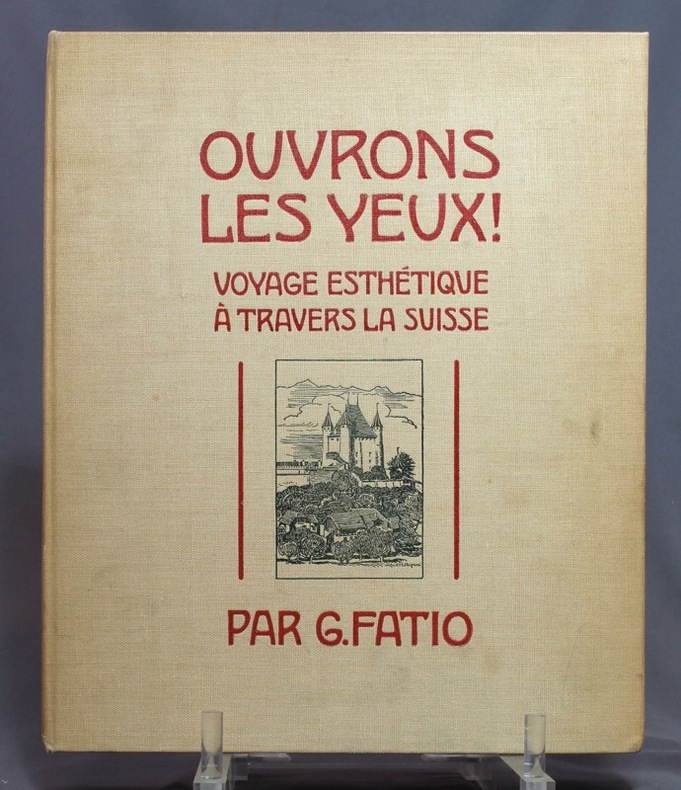
1904Best.-Nr. 14030Genève, Atar, 1904. Grand in-4 de 177-[9] pages, cartonnage d'éditeur orné d'une vignette à chaque plat.
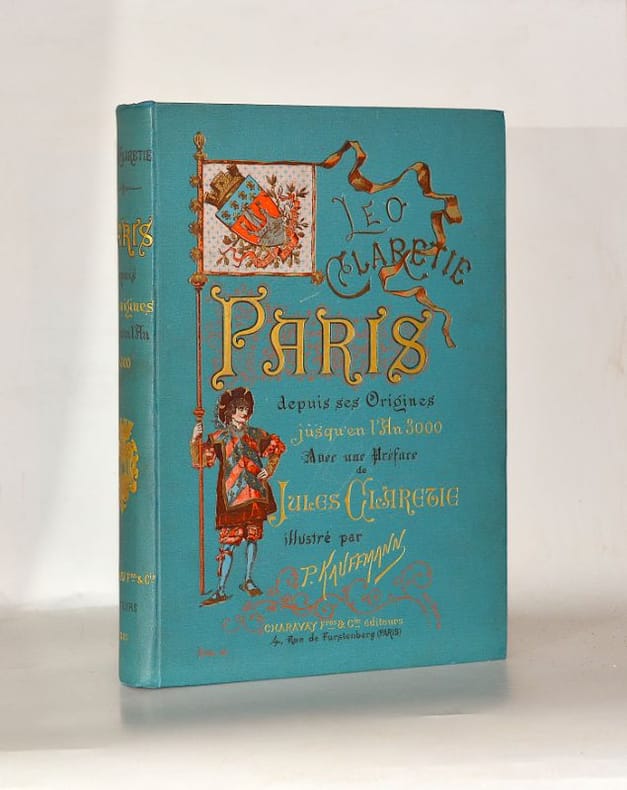
1886Best.-Nr. 8841Paris, Charavay Frères et Cie éditeurs sans date (1886). In-4 cartonnage éditeur pleine toile avec superbe plat polychrome. Dos rond avec titre doré par Léo Claretie. Tête et tranches dorées. Frottis et petits tassements aux coins. Plats avec petites taches brunes. Quatrième plats avec " Ors " de la Ville de saint Denis, et tache rouge. Intérieur assez frais avec de petites rousseurs. Texte de Léo Clartetie avec une préface de Jules Claretie. Etude sur Paris, illustré de deux cents dessins dans le texte par P. Kauffmann et de onze compositions hors texte par MM. F. Calmettes, L. Glaize, E. Grasset, Kaemmerer, Leloir père, M. Leloir, Rejchan et Albert Robida, gravées sur bois par Prunaire. Recherché pour le dernier chapitre, purement conjectural, proposant un Paris futuriste. Livre de prix. Rare édition originale en bel état général.
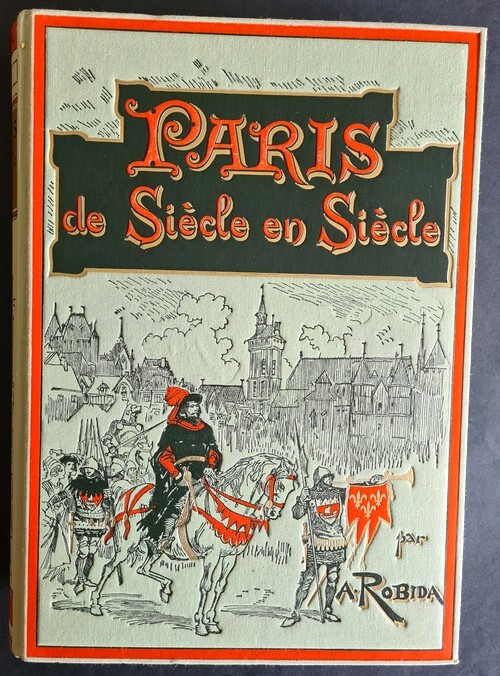
1986Best.-Nr. 15677Editions Jules Tallandier 1986. Fort in-4 cartonnage éditeur pleine toile verte, de 414 pages au format 31 x 5,5 x 23 cm. Couverture illustrée polychrome en superbe état. Dos rond illustré avec titre, présentant un petit frottis et enfoncement au bas. Quatrième plat avec blason de la Ville de Paris, présentant une bande d'insolation sur tout le bas et un tassement au coin inférieur gauche. Intérieur frais.Couverture, textes, frontispice, 24 planches hors-texte en couleurs, 250 illustrations in-texte et nombreux culs de lampe, vignettes, bandeaux, en couleurs et en noir par Albert Robida. Tirage unique limité à 2050 exemplaires numérotés ( n° 328 ). Superbe édition en fac similé anastatique, de l'édition originale parue en 1895. Luxueuse réalisation en superbe état général. Rare.
Best.-Nr. 33845P., Librairie Illustrée, sans date (vers 1898), fort in 4° relié demi-basane marron, dos lisse, 808 pages ; papier terni, comme toujours ; menus frottis.
1886Best.-Nr. 141328Couverture rigide. Fort volume de 364 pages. 20 x 28 cm. Reliure toile de l'éditeur légèrement défraîchie. Quelques rousseurs intérieures.
1886Best.-Nr. 0031661886 Paris, Charavay frères et Cie, sans date [1886]. Grand in-8 (202 X 285 mm) percaline bleu ciel de l'éditeur orné sur le premier plat d'une plaque polychrome et dorée de Paul SOUZE, dos lisse orné d'un large fleuron doré représentant les armes de Paris, auteur, titre, éditeur et lieu d'édition dorés ou estampés en noir, dessin estampé en noir au second plat, tranches dorées (ENGEL REL.) ; XVI-364 pages, (1) f. de nom de l'imprimeur, (1) f. blanc.
1895Best.-Nr. GITa502Paris à la Librairie Illustrée sd v 1895. Grand in-8 808pp. Demi basane rouge, dos lisse à faux nerfs orné de filets dorés, rel époque. Très nombreuses illustrations dans le texte de Robida.
Best.-Nr. 21533Paris A la Librairie illustrée sans date ( vers 1895 ) 1895 in 4 (31,5x24) 1 volume reliure demi maroquin vert lierre de l'époque, dos à nerfs, tête dorée, couverture illustrée entierement conservée, frontispice gravé à l'eau-forte, 412 pages. Ouvrage illustré par Albert Robida de 250 dessins, avec 24 lithographies hors-texte, dont 7 en couleurs (complet). Reliure signée de Affolter. Très bel exemplaire, finement relié ( Photographies sur demande / We can send pictures of this book on simple request )
1895Best.-Nr. 35747Paris Librairie Illustre sans date (1895) In-4, demi-maroquin vert coins, plats de papier marbr, dos nerfs orn petits fers dors avec de petites fleurs mosaques en maroquin rouge; doublures et gardes de papier marbr, tte dore, non rogn, couverture illustre (V. Champs).Edition originale, et premier tirage du frontispice grav l'eau-forte, des 8 lithographies en noir, des 25 hors-texte (dont 8 en couleurs et 4 en camaeu) et des 250 dessins dans le texte. Un des trs rares exemplaires sur papier de Chine, comportant les 8 lithographies en noir tires sur chine coll. Exemplaire offert par l'auteur Charles Normand avec, reli en tte du livre, un cahier supplmentaire de quatre pages sur japon comportant sur la premire page une superbe aquarelle originale en couleurs lgende et signe par Robida reprsentant Le Conntable de Clisson entrant dans Paris aprs la rvolte des maillotins, et sur la troisime page une ddicace spcialement imprime pour monsieur Charles Normand qui tait secrtaire gnral des Amis des Monuments parisiens. Exemplaire dans une reliure absolument contemporaine la sortie du livre, signe Victor Champs dont l'atelier exista Paris de 1868 1912. Quelques rousseurs.