KIPLING, RudyardBiblio.com

6,206 results
1913ref. 187925New York: Doubleday Page & Company 1913-1926. A stately array of bindings The Seven Seas Edition number 63 of 1050 sets printed on watermarked paper and signed by the author on the half-title of Volume I. Intended as the American counterpart to Macmillan's Bombay Edition this deluxe signed limited edition was issued in 27 volumes. This set has been finely bound likely by the publishers in 51 slimmer and more readable volumes. 27 vols expanded to 51 octavo. Title pages printed in red and black rubricated initials in some vols illustrations to text of children's works. Likely publisher's deluxe red crushed morocco spines lettered in gilt compartments and corners of boards richly gilt wide turn-ins with multiple gilt rolls dark blue crushed morocco doublures with richly gilt frames cream silk flyleaves top edges gilt fore and bottom edges uncut cream bookmarkers. Bookplate of John Francis Neylan 1885-1960 attorney to William Randolph Hearst to first blanks. Spots of rubbing hear hinge of From Sea to Sea volume I part II cracked. Overall a fine set. Richards D15; Stewart pp. 573-4. hardcover
1907ref. 896Q1New York: Doubleday Page & Company 1907 . First edition. Cloth. Very Good. 8.5" by 6". None. The first edition of Kipling's book of collected verse with the author's ink annotations and edits. Bound in the publisher's original burgundy cloth. An extremely scarce-to-see copy of this collection of Rudyard Kipling's poetry with annotations and edits by the author throughout. This work was originally published in October 1907. From the library of A. P. Watt & A. S. Watt of A. P. Watt and Son literary agent of Rudyard Kipling.Throughout this copy of collected verse Kipling reworked the order layout contents and the occasional wording of the poems. Some of the changes to wording such as substituting "hansoms" for "traffic" in the final verse of 'The Broken Men' made the final version of the poem however others such as changing the name "Mary Pollock" to "Margaret Pollock" in 'The Derelict' did not showing Kipling's thought process in his editing. Annotations include: A line through the publisher on the title page. A line through the page opposite the title page entitled "Other Books by Rudyard Kipling". The third verse of "The Fires" has been removed xi. Punctuation amendments to most pages substituting comas exclamation marks and semi-colons. The occasional change to the wording used such as alternating "hansoms" for "traffic" in the final verse of "The Broken Men". On page 85 Kipling has written "To printer smaller type for all these sub-heads of song of the English R. K." "The Sacrifice of Er-hets" has a vertical line through it p168. "Service Songs" has been crossed out p190. The second verse of "The Gift of the Sea" has been crossed out p248.Pencil annotation not in Kipling's hand to p1 with "Dedication from "Barrack Room Ballads"" crossed out. On page 8 "Song of the Wise Children" is directed "To follow Sestina of the Tramps Royal" with similar directions given to "Buddha at Kamakura" p10 "The Broken Man" p13 "The "Mary Gloster"" p45 "South Africa" p118 "Dirge of Dead Sisters" p126 "Cleared" p132 "General Joubert" p145 "Before a Midnight Breaks in Storm" p193 "The Lesson" p200 "Rimmon" p210 "The Three-Decker" p220 "The Rhyme of the Three Captains" p222 "The Conundrum of the Workshops" p227 "Evarra and his Gods" p229 "In the Neolithic Age" p231 "The Story of Ung" p233 "The Fires" p236 "The Legends of Evil" p238 "Tomlinson" p241 "The Explanation" p246 "The Answer" p247 "The Gift of the Sea" p248 "The King" p250 and "The Last Rhyme of True Thomas" p252. Bound in the publisher's original burgundy cloth. Externally very good with light bumping to the extremities and a little rubbing to the head and tail of the spine. The occasional mark to cloth mainly to the rear board. Internally firmly bound. Pages bright with the author's ink edits and annotations throughout. Very Good Doubleday, Page & Company hardcover
1902ref. 49105London: Macmillan & Co 1902. First Edition. Hardcover. Fine/very good. 249p quarto illustrated. A fine bright copy in a very good dust jacket. The design on the dust jacket differs from the design on the covers of the book. Just So Stories was Kipling's only self illustrated book. A fine bright copy with none of the usual flaking to the white pigment on the binding; armorial bookplate of George Jefferson Mersereau with the bookplate of A. Edward Newton above it on the front paste down. The extremely rare dust jacket is complete with only minor wear and tear and with a few archival tape reinforcements o the inside of the spine. Preserved in a custom cloth chemise and morocco-tipped slipcase Macmillan & Co hardcover
1902ref. 33101Toronto: George S. Morang & Co. Limited 1902. 1st Edition. Rudyard Kipling. Rudyard Kipling. 1st Edition. Signed by Author. From TBCL's Children's Bookcase. Kipling Rudyard. JUST SO STORIES FOR LITTLE CHILDREN. Signed. Illustrated by the Author. Toronto: George S. Morang & Co. Limited. 1902. Unique Copy. First Canadian Edition. Sm. 4to. 249p. With 22 plates & many in-text illustrations. Cream cloth covered boards with titles & illustrations on the spine & upper cover stamped in black. An extraordinary example with three key manuscript highlights tipped-in: 1 - Opposite page 141 Kipling on a piece of club size stationery has written out in fact decoded the runes of Taffimai in 2 columns of 18 lines with the added "This is the identical tusk-on-uitch the tale of Taffimai ouas ritten. Etched by the author. / See Page 141 / Just So Stories / Double Day Page Edn 1902." 2 - Tipped opposite page 197 on a piece of club size stationery Kipling has deciphered the runes on the Mutton Bone illustrated in the story: The Cat That Walked By Himself. Inscribed: "On the mutton bone / page 197. Just So Stories". Two columns of decoding followed by: " I Rudyard Kipling drew this but because there was no mutton bone in the house I faked the anatomy from memory. R.K." 3 - One page als true copy neatly written & signed in blue fountain pen on the letterhead of the Canadian Copper Company Sussex dated Nov. 30th 1912 addressed to: David H. Brown esq. " Dear Sir / Many thanks for your amusing letter of the 12th. I am sorry that any of my handicraft should have disturbed your dinner. I should imagine it would be quite hopeless to find one in the small drawing what the runes meant but I have looked up the original pictures and found that on the cross bar of the H I put myself on record as having also written all the plays ascribed to Mrs. Gallop. I hope now that you and your friends will be able to return to their respective vocations. / Yours very sincerely / Rudyard Kipling". An extremely good example showing light use. Stewart 261. Notes binding is usually brown/orange cloth. First published in London by Macmillan in 1902 this is the uncommon Canadian edition of Kipling's most famous collection of twelve animal stories & twelve poems including "How the Camel Got His Hump" and "How the Leopard Got His Spots" "How the Whale Got his Throat" "The Elephant's Child" & "The Butterfly That Stamped." "Just So Stories has achieved nursery immortality because a genius has married two of the most tried and trusted media - the fable and the fairy-story" Muir 107. Stewart 260. BMC No.1 1984; 'Edwardian Children's Books'. 30820. George S. Morang & Co., Limited unknown
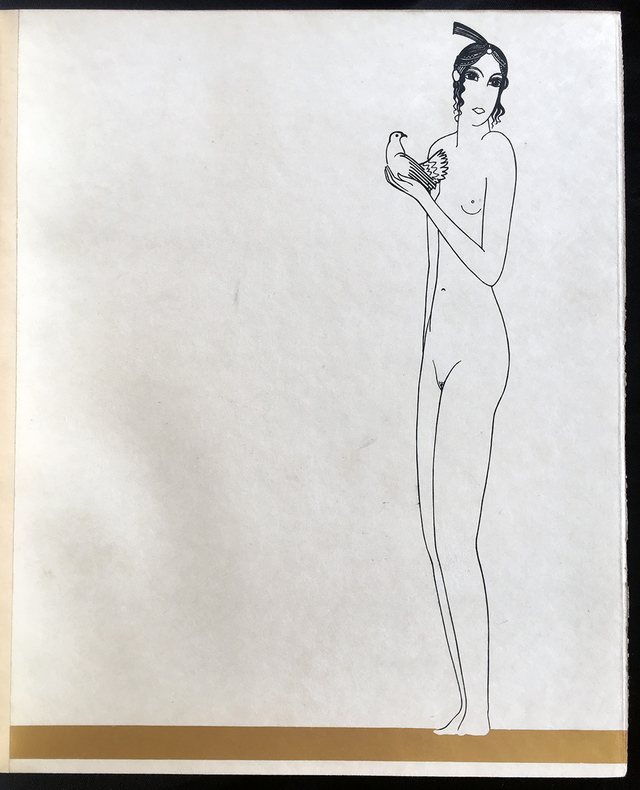
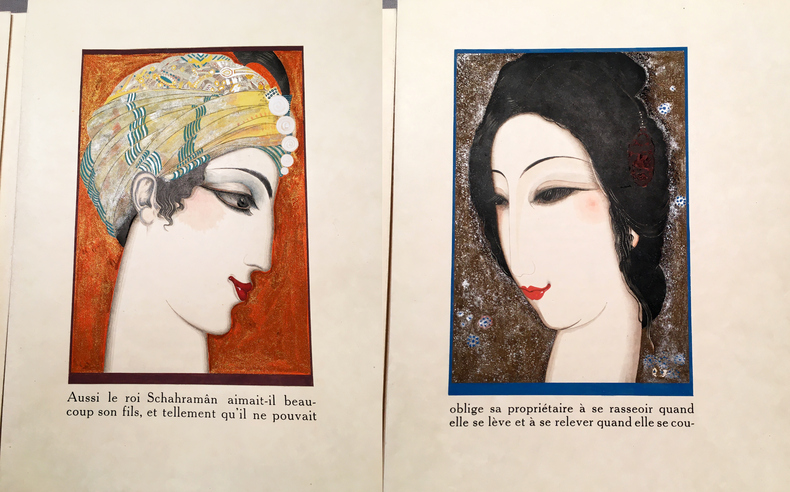
1927ref. 1833Paris, François-Louis Schmied, 1927. Un volume in-4, reliure plein maroquin bleu, doublure et gardes de soie brochée gris-bleu sertie d’un jeu de filets dorés, dos lisse orné, couverture, tranches dorées, étui bordé de même maroquin (G. Cretté succ. de Marius Michel). Édition originale et tirage unique de ce conte oriental de Joseph Charles Mardrus magnifiquement illustrée et ornementée par François-Louis Schmied qui assura lui-même la mise en page et l'impression de ce chef d'œuvre du livre Art déco : le trait des planches a été gravé sur bois, la peinture en a été exécutée à la main, d'après les originaux, dans les ateliers de laquage de Jean Dunand. Cette illustration se compose d'une couverture illustrée, un frontispice, 7 illustrations à pleine page, une grande planche dépliante formant un triptyque, 29 bandeaux horizontaux dont 22 grands, la plupart en-tête, 32 lettrines ornées ou petites vignettes dans le texte, 6 petits bandeaux verticaux et de nombreux bandeaux et lettres mis en couleurs et dorés. TIRAGE UNIQUE À 25 EXEMPLAIRES SUR JAPON, SIGNÉS PAR SCHMIED. Celui-ci (n° XXV) comporte l’une des rares suites des bois tirés en noir sur Japon. L'ouvrage est entièrement monté sur onglet.
1926ref. 1290Paris, [Schmied], 1926. Un volume in-4 (27,7 x 20 cm), en feuilles, 102 pages, n.ch., couverture rempliée, chemise et étui décoré de l’éditeur, emboîtage de maroquin vert doublé de maroquin jonquille, dos titré (G. Cretté succ. de Marius Michel). Édition originale de la plus grande rareté, tirée à seulement 20 exemplaires numérotés sur japon. Splendide illustration en couleurs de François-Louis Schmied: environ 50 bois dont 18 de très grande taille, dans le texte, TOUS ENTIÈREMENT PEINTS À LA MAIN dans les ateliers de laquage de Jean Dunand ; près de 300 lettrines et bouts de lignes peintes à la main dans le texte, dans des harmonies de couleurs variant selon les pages, avec rehauts d'or, d'argent ou de blanc, traçant des motifs géométriques ou érotiques. Tirage unique à 20 exemplaires numérotés et signés du monogramme en rouge de FLS, tous sur papier Japon, celui-ci n° 13. Conservé à l'état d'origine dans un splendide coffret en maroquin doublé de Cretté. - Notes bibliographiques (pour ceux qui prennent le temps): « La Princesse Boudour est regardée par ceux qui savent voir, comme le livre capital de ce premier quart de siècle. Par sa graphie et sa technique générale, elle est une exception préméditée dans le faire de son auteur. Pour la réaliser, il s’est véritablement amusé, cette fois – en tant que lecteur enthousiaste des Mille nuits et une nuit - à commenter graphiquement le texte qu’il connaît si bien et dont il est comme imbibé [...]. Il nous a [...] octroyé le délectable cadeau de trois cent quatre-vingt-dix vignettes et en couleur, et toutes différentes, et qui se rapportent au texte [...]. Et cette munificence schmiedienne n’est-elle pas, en définitive, l’exaltation de notre modernité, et en conformité avec nos goûts, du faire des imagiers incomparables de l’Orient ? [...]. Avec quel attendrissement, avec quelle passion sourde et contenue, qui n’appartient qu’à lui, il a rendu, au moyen des fragiles outils du graveur et du coloriste, la grâce masculine des adolescents, et la tendre chair de banane des radieuses jouvencelles ! [...] Je pense que s’il fallait absolument appliquer une épithète au sourire des adolescentes schmiediennes, et même à celui des adolescents, rien ne leur conviendrait mieux que le mot ambigü... Une atmosphère de pures délices enveloppe cette oeuvre boudourienne, multiple, voluptueuse, spirituelle, et d’une telle essence d’authentique Orient qu’elle nous fait vraiment respirer tous les parfums de l’Arabie. » (Préface du catalogue de l’exposition Schmied à la galerie Arnold Seligmann Rey à New York, mars 1927, pp. 34-37).