Kipling, RudyardBiblio.com

7,631 results
1902ref. 49105London: Macmillan & Co 1902. First Edition. Hardcover. Fine/very good. 249p quarto illustrated. A fine bright copy in a very good dust jacket. The design on the dust jacket differs from the design on the covers of the book. Just So Stories was Kipling's only self illustrated book. A fine bright copy with none of the usual flaking to the white pigment on the binding; armorial bookplate of George Jefferson Mersereau with the bookplate of A. Edward Newton above it on the front paste down. The extremely rare dust jacket is complete with only minor wear and tear and with a few archival tape reinforcements o the inside of the spine. Preserved in a custom cloth chemise and morocco-tipped slipcase Macmillan & Co hardcover
1888ref. 05443RARE TYPESCRIPT COLLECTION being 17 typed manuscripts with the authors own hand corrections 11 of which were originally published in "TURNOVERS" and the Civil and Military Gazette 1 from the St. James Gazette and 5 that have just been recently published for the first time in 1986. They total 74 leaves with the upper right corner of some of them exhibiting wear and tear never entering anywhere near the text. All were published initially in the period 1884 thru 1891 these being later typed copies and represent a truly rare opportunity of acquisition for the serious collector. They are: A DAY OFF A SELF MADE MAN HOT WEATHER COUNCILS TILL THE DAY BREAK THE BURDEN OF NINEVEH THE HOUSE OF SHADOWS AN INTERESTING CONDITION THE PIT THAT THEY DIGGED AN IMPORTANT DISCOVERY THE LONGEST WAY ROUND THE OLD STATION THE KILLING OF HATIM-TAI IN GILDED HALLS HIMALAYAN COUNCILS THAT DISTRICT LOG BOOK THE CASE OF ADAMAH and THE HILL OF ILLUSION. An historic gathering which at one time was sent by the authors British agency to his American publisher in an attempt to thwart another piracy by the Dodge Publishing Co. e.g. ABAFT THE FUNNEL. Authors photograph included. Housed in most handsome custom made tray-case. More information available upon request. N.p. unknown
1943ref. 123104Chicago: Consolidated Book Publishers Inc. 1943. First edition second issue of this classic World War II-era short story collection containing J.D. Salinger's third published short story and first appearance in book form. 12mo original illustrated boards illustrated. Complied by R.M. Barrows edited by E. X. Pastor and with contributions from J.D. Salinger Richard Armour Hurd Barrett Pat Frank O. Henry Rudyard Kipling Jack Leonard and Damon Runyan among others. Signed by J.D. Salinger on the first page of his contribution The Hang of It on page 332. A commercial tale of a soldier who just can't seem to get "the hang of it" the story was first published in the July 12 1941 issue of Collier's magazine and subsequently in the 1942 and 1943 editions of The Kit Book For Soldiers marking Salinger's first appearance in book form. Salinger was drafted into the army in the spring of 1942 several months after the United States entered World War II where he saw combat with the 12th Infantry Regiment 4th Infantry Division. He was present at Utah Beach on D-Day in the Battle of the Bulge and the Battle of Hurtgen Forest. During the campaign from Normandy into Germany Salinger arranged to meet with Ernest Hemingway who was then working as a war correspondent in Paris. The meeting had a profound effect on Salinger and the development of his writing style; Hemingway was impressed by what Salinger shared with him of his early writing and the two corresponded frequently throughout the war. Salinger was later assigned to the 4th Counter Intelligence Corps in which he used his proficiency in French and German to interrogate prisoners of war and later witnessed the liberation of one of the Dachau Concentration Camps. In very good condition. Housed in the original box which is in near fine condition. Housed in a custom half morocco clamshell box. From the collection of a WWII soldier who had this signed by Salinger while the two were stationed overseas at the time of publication. An exceptional example signed by Salinger at a pivotal time in his life and before his almost complete withdrawal from society. Best-known for his novel The Catcher in the Rye American author J.D. Salinger published several short stories and five books throughout his lifetime. In a contributor's note Salinger gave to Harper's Magazine in 1946 he wrote: "I almost always write about very young people" a statement that has been referred to as his credo. Adolescents are featured or appear in all of Salinger's work from his first published short story "The Young Folks" 1940 to The Catcher in the Rye and his Glass family stories. In 1961 the critic Alfred Kazin explained that Salinger's choice of teenagers as a subject matter was one reason for his appeal to young readers but another was "a consciousness among youths that he speaks for them and virtually to them in a language that is peculiarly honest and their own with a vision of things that capture their most secret judgments of the world." For this reason Norman Mailer once remarked that Salinger was "the greatest mind ever to stay in prep school." Consolidated Book Publishers, Inc. hardcover books
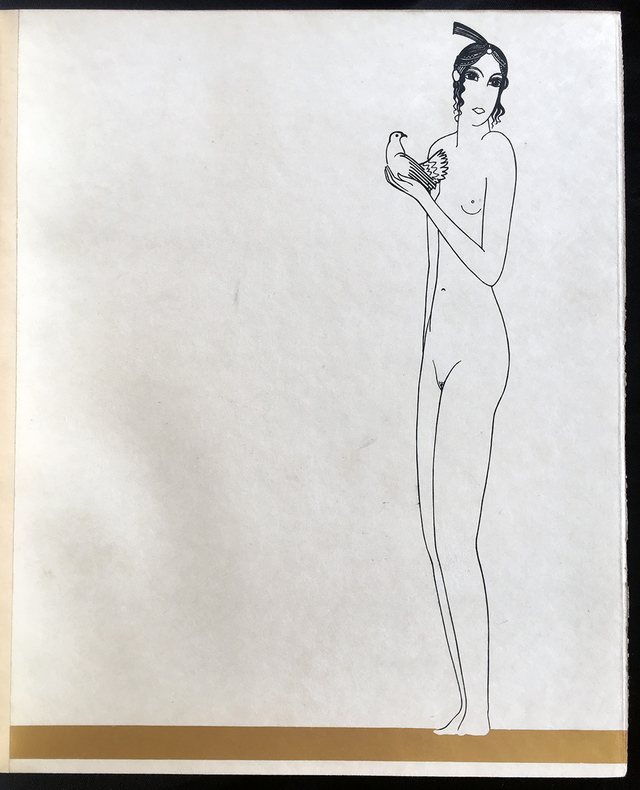
1927ref. 1833Paris, François-Louis Schmied, 1927. Un volume in-4, reliure plein maroquin bleu, doublure et gardes de soie brochée gris-bleu sertie d’un jeu de filets dorés, dos lisse orné, couverture, tranches dorées, étui bordé de même maroquin (G. Cretté succ. de Marius Michel). Édition originale et tirage unique de ce conte oriental de Joseph Charles Mardrus magnifiquement illustrée et ornementée par François-Louis Schmied qui assura lui-même la mise en page et l'impression de ce chef d'œuvre du livre Art déco : le trait des planches a été gravé sur bois, la peinture en a été exécutée à la main, d'après les originaux, dans les ateliers de laquage de Jean Dunand. Cette illustration se compose d'une couverture illustrée, un frontispice, 7 illustrations à pleine page, une grande planche dépliante formant un triptyque, 29 bandeaux horizontaux dont 22 grands, la plupart en-tête, 32 lettrines ornées ou petites vignettes dans le texte, 6 petits bandeaux verticaux et de nombreux bandeaux et lettres mis en couleurs et dorés. TIRAGE UNIQUE À 25 EXEMPLAIRES SUR JAPON, SIGNÉS PAR SCHMIED. Celui-ci (n° XXV) comporte l’une des rares suites des bois tirés en noir sur Japon. L'ouvrage est entièrement monté sur onglet.
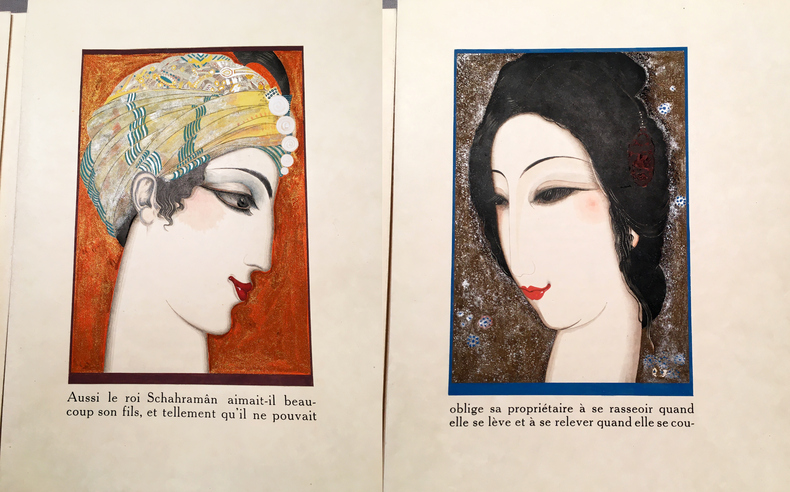
1926ref. 1290Paris, [Schmied], 1926. Un volume in-4 (27,7 x 20 cm), en feuilles, 102 pages, n.ch., couverture rempliée, chemise et étui décoré de l’éditeur, emboîtage de maroquin vert doublé de maroquin jonquille, dos titré (G. Cretté succ. de Marius Michel). Édition originale de la plus grande rareté, tirée à seulement 20 exemplaires numérotés sur japon. Splendide illustration en couleurs de François-Louis Schmied: environ 50 bois dont 18 de très grande taille, dans le texte, TOUS ENTIÈREMENT PEINTS À LA MAIN dans les ateliers de laquage de Jean Dunand ; près de 300 lettrines et bouts de lignes peintes à la main dans le texte, dans des harmonies de couleurs variant selon les pages, avec rehauts d'or, d'argent ou de blanc, traçant des motifs géométriques ou érotiques. Tirage unique à 20 exemplaires numérotés et signés du monogramme en rouge de FLS, tous sur papier Japon, celui-ci n° 13. Conservé à l'état d'origine dans un splendide coffret en maroquin doublé de Cretté. - Notes bibliographiques (pour ceux qui prennent le temps): « La Princesse Boudour est regardée par ceux qui savent voir, comme le livre capital de ce premier quart de siècle. Par sa graphie et sa technique générale, elle est une exception préméditée dans le faire de son auteur. Pour la réaliser, il s’est véritablement amusé, cette fois – en tant que lecteur enthousiaste des Mille nuits et une nuit - à commenter graphiquement le texte qu’il connaît si bien et dont il est comme imbibé [...]. Il nous a [...] octroyé le délectable cadeau de trois cent quatre-vingt-dix vignettes et en couleur, et toutes différentes, et qui se rapportent au texte [...]. Et cette munificence schmiedienne n’est-elle pas, en définitive, l’exaltation de notre modernité, et en conformité avec nos goûts, du faire des imagiers incomparables de l’Orient ? [...]. Avec quel attendrissement, avec quelle passion sourde et contenue, qui n’appartient qu’à lui, il a rendu, au moyen des fragiles outils du graveur et du coloriste, la grâce masculine des adolescents, et la tendre chair de banane des radieuses jouvencelles ! [...] Je pense que s’il fallait absolument appliquer une épithète au sourire des adolescentes schmiediennes, et même à celui des adolescents, rien ne leur conviendrait mieux que le mot ambigü... Une atmosphère de pures délices enveloppe cette oeuvre boudourienne, multiple, voluptueuse, spirituelle, et d’une telle essence d’authentique Orient qu’elle nous fait vraiment respirer tous les parfums de l’Arabie. » (Préface du catalogue de l’exposition Schmied à la galerie Arnold Seligmann Rey à New York, mars 1927, pp. 34-37).