KIPLING, RudyardBiblio.com

9,638 results
ref. 65418London: Macmillan and Company 1937-39. LIMITED EDITION 119/525 SIGNED BY THE AUTHOR. 35 vols 8vo. 24 x 16 cm. Titles printed in white within russet frames printed on handmade paper with watermark Ganesha original saddle tan morocco by James Burn & Co. covers with double gilt-fillet border spines gilt-lettered in six compartments marbled endpapers top edges gilt on rough others uncut Presentation inscription to first blank "Darling Rick /from /Mummy & Daddy with best love/ Anberley Court/Stroud/ Gloucestershire/ May 1937-38" Very slight variable fading to spines as uual. A fine set. The ulitimate deluxe and definitive edition of Kipling's works including two volumes of previously unpublished prose and verse. Supposedly many unbound sets of the text were destroyed during the Blitz further reducing the actual limitation. Richards D23 London: Macmillan and Company, 1937-39. unknown
1937ref. 165903London: Macmillan and Company 1937-39. The most desirable collected edition The Sussex Edition number 72 of 525 sets only signed by the author in the first volume and containing two volumes of previously uncollected prose. Published after Kipling's death on 18 January 1936 this magnificent posthumous edition saw a small limitation and became even rarer following the destruction of many unsold sheets during the German bombing of London. In his last years and with his health failing Kipling remained determined to finish editing this "great retrospective work" which was first proposed in 1928. The edition was "fuller than that of any other. Kipling saw the proofs of at least 21 of the edition's 35 volumes before his death" and it is now "among the most prized and most expensive of all modern editions" Pinney p. 231. 35 vols large octavo. Printed on handmade paper with Ganesha watermark. Fly-titles printed in orange. Original full russet niger by James Burn & Co. spines lettered in gilt raised bands ruled in blind twin gilt fillet bordering covers turn-ins ruled in gilt and blind marbled endpapers top edges gilt and red on the rough other edges uncut. Bindings slightly darkened occasional light scuffs and internal marks otherwise clean. A near-fine set. Richards D23; Stewart pp. 577-80. Thomas Pinney The Letters of Rudyard Kipling vol. 6 1990. hardcover
1913ref. 187925New York: Doubleday Page & Company 1913-1926. A stately array of bindings The Seven Seas Edition number 63 of 1050 sets printed on watermarked paper and signed by the author on the half-title of Volume I. Intended as the American counterpart to Macmillan's Bombay Edition this deluxe signed limited edition was issued in 27 volumes. This set has been finely bound likely by the publishers in 51 slimmer and more readable volumes. 27 vols expanded to 51 octavo. Title pages printed in red and black rubricated initials in some vols illustrations to text of children's works. Likely publisher's deluxe red crushed morocco spines lettered in gilt compartments and corners of boards richly gilt wide turn-ins with multiple gilt rolls dark blue crushed morocco doublures with richly gilt frames cream silk flyleaves top edges gilt fore and bottom edges uncut cream bookmarkers. Bookplate of John Francis Neylan 1885-1960 attorney to William Randolph Hearst to first blanks. Spots of rubbing hear hinge of From Sea to Sea volume I part II cracked. Overall a fine set. Richards D15; Stewart pp. 573-4. hardcover
1914ref. 1172901914. EXCEPTIONAL DELUXE BINDING KIPLING Rudyard. The Works of Rudyard Kipling. Twenty-seven volumes expanded to fifty-one. 8vo. 237 x 152 mm bound in full deluxe red morocco elaborate gilt borders spines elaborately gilt silk moire endleaves turn-ins inlaid with blue morocco gilt extra with wide dentelles composed of small ornamental tools and large flowers t.e.g. Garden City N.Y.: Doubleday Page & Co. 1914-1920. The Seven Seas Edition one of 1050 sets printed signed by the author. An extremely fine copy in a full red morocco binding of the absolute highest quality. Leather bound sets of this quality are very rarely seen on the market. The Seven Seas Edition is one of the most respected and sought-after collected works of Kipling ever printed. It includes: Wee Willie Winkie The Phantom Rickshaw and Other Stories Captains Courageous The Jungle Book The Second Jungle Book Puck of Pook's Hill Plain Tales from the Hills Life's Handicap The Day's Work Stalky & Co. Kim Just So Stories and much more. Ordinary copies were issued in cloth in twenty-seven volumes. This copy has been exquisitely bound and expanded to fifty-one volumes. PROVENANCE: John Francis Neylan with his bookplate designed by William H. Wilke and printed by John Henry Nash the famous California printer. Neylan 1885-1960 was a noted San Francisco lawyer who was chairman of the Board of Regents of the University of California. Additionally he was William Randolph Hearst's chief attorney with close ties to the Hearst newspapers and thus had enormous political clout and considerable wealth. Stewart Kipling pp. 573-574. hardcover books
1907ref. 896Q1New York: Doubleday Page & Company 1907 . First edition. Cloth. Very Good. 8.5" by 6". None. The first edition of Kipling's book of collected verse with the author's ink annotations and edits. Bound in the publisher's original burgundy cloth. An extremely scarce-to-see copy of this collection of Rudyard Kipling's poetry with annotations and edits by the author throughout. This work was originally published in October 1907. From the library of A. P. Watt & A. S. Watt of A. P. Watt and Son literary agent of Rudyard Kipling.Throughout this copy of collected verse Kipling reworked the order layout contents and the occasional wording of the poems. Some of the changes to wording such as substituting "hansoms" for "traffic" in the final verse of 'The Broken Men' made the final version of the poem however others such as changing the name "Mary Pollock" to "Margaret Pollock" in 'The Derelict' did not showing Kipling's thought process in his editing. Annotations include: A line through the publisher on the title page. A line through the page opposite the title page entitled "Other Books by Rudyard Kipling". The third verse of "The Fires" has been removed xi. Punctuation amendments to most pages substituting comas exclamation marks and semi-colons. The occasional change to the wording used such as alternating "hansoms" for "traffic" in the final verse of "The Broken Men". On page 85 Kipling has written "To printer smaller type for all these sub-heads of song of the English R. K." "The Sacrifice of Er-hets" has a vertical line through it p168. "Service Songs" has been crossed out p190. The second verse of "The Gift of the Sea" has been crossed out p248.Pencil annotation not in Kipling's hand to p1 with "Dedication from "Barrack Room Ballads"" crossed out. On page 8 "Song of the Wise Children" is directed "To follow Sestina of the Tramps Royal" with similar directions given to "Buddha at Kamakura" p10 "The Broken Man" p13 "The "Mary Gloster"" p45 "South Africa" p118 "Dirge of Dead Sisters" p126 "Cleared" p132 "General Joubert" p145 "Before a Midnight Breaks in Storm" p193 "The Lesson" p200 "Rimmon" p210 "The Three-Decker" p220 "The Rhyme of the Three Captains" p222 "The Conundrum of the Workshops" p227 "Evarra and his Gods" p229 "In the Neolithic Age" p231 "The Story of Ung" p233 "The Fires" p236 "The Legends of Evil" p238 "Tomlinson" p241 "The Explanation" p246 "The Answer" p247 "The Gift of the Sea" p248 "The King" p250 and "The Last Rhyme of True Thomas" p252. Bound in the publisher's original burgundy cloth. Externally very good with light bumping to the extremities and a little rubbing to the head and tail of the spine. The occasional mark to cloth mainly to the rear board. Internally firmly bound. Pages bright with the author's ink edits and annotations throughout. Very Good Doubleday, Page & Company hardcover
ref. 122541London Macmillan and Co. 1902. . First edition first impression second issue binding; large 4to 240 x 190 mm; 22 full-page illustrations by the author faint partial offsetting to endpapers faint contemporary gift inscription to front flyleaf discreet bookseller's label to front pastedown occasional minor thumb-soiling to blank fore-margins a hint of spotting to fore-edge of text block; publisher's red decorated cloth lettered in white minor rubbing to spine tips and corners front cover only slightly bowed pictorial dust-jacket a few closed tears and nicks to extremities loss to head of spine panel costing two letters small triangular area of loss to centre of spine panel long closed tears to head of front and rear panels discreetly repaired on verso traces of earlier repair to corners and head and foot of spine early inscription in black ink to front panel; a very good copy in the rare dust-jacket. A lovely copy in the exceptionally rare dust-jacket which unusually for the period reproduces an image different from that of the blocking on the boards. With a contemporary gift inscription to the front flyleaf: 'Alice M. L. Russell / from / John S. Russell / October 1902'. Followed by another endearing inscription presumably from the mother of the recipient to the front panel of the dust-jacket: 'This is the first edition of / Just So Stories / Dad went to great trouble to get it / therefore keep carefully'. Kipling's famous stories include: How the Whale Got His Throat How the Camel Got His Hump How the Rhinoceros Got His Skin How the Leopard Got His Spots The Elephant's Child The Sing-Song of Old Man Kangaroo The Beginning of the Armadilloes How the First Letter Was Written How the Alphabet Was Made The Crab that Played with the Sea The Cat that Walked by Himself and The Butterfly that Stamped. The Chinese white pigment commonly used for the decorative blocking on the first issue binding famously tended to flake off and a new ink was used for the more commonly encountered second issue. Richards A181. London, Macmillan and Co., 1902. hardcover
1902ref. 49105London: Macmillan & Co 1902. First Edition. Hardcover. Fine/very good. 249p quarto illustrated. A fine bright copy in a very good dust jacket. The design on the dust jacket differs from the design on the covers of the book. Just So Stories was Kipling's only self illustrated book. A fine bright copy with none of the usual flaking to the white pigment on the binding; armorial bookplate of George Jefferson Mersereau with the bookplate of A. Edward Newton above it on the front paste down. The extremely rare dust jacket is complete with only minor wear and tear and with a few archival tape reinforcements o the inside of the spine. Preserved in a custom cloth chemise and morocco-tipped slipcase Macmillan & Co hardcover
1902ref. 33101Toronto: George S. Morang & Co. Limited 1902. 1st Edition. Rudyard Kipling. Rudyard Kipling. 1st Edition. Signed by Author. From TBCL's Children's Bookcase. Kipling Rudyard. JUST SO STORIES FOR LITTLE CHILDREN. Signed. Illustrated by the Author. Toronto: George S. Morang & Co. Limited. 1902. Unique Copy. First Canadian Edition. Sm. 4to. 249p. With 22 plates & many in-text illustrations. Cream cloth covered boards with titles & illustrations on the spine & upper cover stamped in black. An extraordinary example with three key manuscript highlights tipped-in: 1 - Opposite page 141 Kipling on a piece of club size stationery has written out in fact decoded the runes of Taffimai in 2 columns of 18 lines with the added "This is the identical tusk-on-uitch the tale of Taffimai ouas ritten. Etched by the author. / See Page 141 / Just So Stories / Double Day Page Edn 1902." 2 - Tipped opposite page 197 on a piece of club size stationery Kipling has deciphered the runes on the Mutton Bone illustrated in the story: The Cat That Walked By Himself. Inscribed: "On the mutton bone / page 197. Just So Stories". Two columns of decoding followed by: " I Rudyard Kipling drew this but because there was no mutton bone in the house I faked the anatomy from memory. R.K." 3 - One page als true copy neatly written & signed in blue fountain pen on the letterhead of the Canadian Copper Company Sussex dated Nov. 30th 1912 addressed to: David H. Brown esq. " Dear Sir / Many thanks for your amusing letter of the 12th. I am sorry that any of my handicraft should have disturbed your dinner. I should imagine it would be quite hopeless to find one in the small drawing what the runes meant but I have looked up the original pictures and found that on the cross bar of the H I put myself on record as having also written all the plays ascribed to Mrs. Gallop. I hope now that you and your friends will be able to return to their respective vocations. / Yours very sincerely / Rudyard Kipling". An extremely good example showing light use. Stewart 261. Notes binding is usually brown/orange cloth. First published in London by Macmillan in 1902 this is the uncommon Canadian edition of Kipling's most famous collection of twelve animal stories & twelve poems including "How the Camel Got His Hump" and "How the Leopard Got His Spots" "How the Whale Got his Throat" "The Elephant's Child" & "The Butterfly That Stamped." "Just So Stories has achieved nursery immortality because a genius has married two of the most tried and trusted media - the fable and the fairy-story" Muir 107. Stewart 260. BMC No.1 1984; 'Edwardian Children's Books'. 30820. George S. Morang & Co., Limited unknown
1888ref. 05443RARE TYPESCRIPT COLLECTION being 17 typed manuscripts with the authors own hand corrections 11 of which were originally published in "TURNOVERS" and the Civil and Military Gazette 1 from the St. James Gazette and 5 that have just been recently published for the first time in 1986. They total 74 leaves with the upper right corner of some of them exhibiting wear and tear never entering anywhere near the text. All were published initially in the period 1884 thru 1891 these being later typed copies and represent a truly rare opportunity of acquisition for the serious collector. They are: A DAY OFF A SELF MADE MAN HOT WEATHER COUNCILS TILL THE DAY BREAK THE BURDEN OF NINEVEH THE HOUSE OF SHADOWS AN INTERESTING CONDITION THE PIT THAT THEY DIGGED AN IMPORTANT DISCOVERY THE LONGEST WAY ROUND THE OLD STATION THE KILLING OF HATIM-TAI IN GILDED HALLS HIMALAYAN COUNCILS THAT DISTRICT LOG BOOK THE CASE OF ADAMAH and THE HILL OF ILLUSION. An historic gathering which at one time was sent by the authors British agency to his American publisher in an attempt to thwart another piracy by the Dodge Publishing Co. e.g. ABAFT THE FUNNEL. Authors photograph included. Housed in most handsome custom made tray-case. More information available upon request. N.p. unknown
1943ref. 123104Chicago: Consolidated Book Publishers Inc. 1943. First edition second issue of this classic World War II-era short story collection containing J.D. Salinger's third published short story and first appearance in book form. 12mo original illustrated boards illustrated. Complied by R.M. Barrows edited by E. X. Pastor and with contributions from J.D. Salinger Richard Armour Hurd Barrett Pat Frank O. Henry Rudyard Kipling Jack Leonard and Damon Runyan among others. Signed by J.D. Salinger on the first page of his contribution The Hang of It on page 332. A commercial tale of a soldier who just can't seem to get "the hang of it" the story was first published in the July 12 1941 issue of Collier's magazine and subsequently in the 1942 and 1943 editions of The Kit Book For Soldiers marking Salinger's first appearance in book form. Salinger was drafted into the army in the spring of 1942 several months after the United States entered World War II where he saw combat with the 12th Infantry Regiment 4th Infantry Division. He was present at Utah Beach on D-Day in the Battle of the Bulge and the Battle of Hurtgen Forest. During the campaign from Normandy into Germany Salinger arranged to meet with Ernest Hemingway who was then working as a war correspondent in Paris. The meeting had a profound effect on Salinger and the development of his writing style; Hemingway was impressed by what Salinger shared with him of his early writing and the two corresponded frequently throughout the war. Salinger was later assigned to the 4th Counter Intelligence Corps in which he used his proficiency in French and German to interrogate prisoners of war and later witnessed the liberation of one of the Dachau Concentration Camps. In very good condition. Housed in the original box which is in near fine condition. Housed in a custom half morocco clamshell box. From the collection of a WWII soldier who had this signed by Salinger while the two were stationed overseas at the time of publication. An exceptional example signed by Salinger at a pivotal time in his life and before his almost complete withdrawal from society. Best-known for his novel The Catcher in the Rye American author J.D. Salinger published several short stories and five books throughout his lifetime. In a contributor's note Salinger gave to Harper's Magazine in 1946 he wrote: "I almost always write about very young people" a statement that has been referred to as his credo. Adolescents are featured or appear in all of Salinger's work from his first published short story "The Young Folks" 1940 to The Catcher in the Rye and his Glass family stories. In 1961 the critic Alfred Kazin explained that Salinger's choice of teenagers as a subject matter was one reason for his appeal to young readers but another was "a consciousness among youths that he speaks for them and virtually to them in a language that is peculiarly honest and their own with a vision of things that capture their most secret judgments of the world." For this reason Norman Mailer once remarked that Salinger was "the greatest mind ever to stay in prep school." Consolidated Book Publishers, Inc. hardcover books
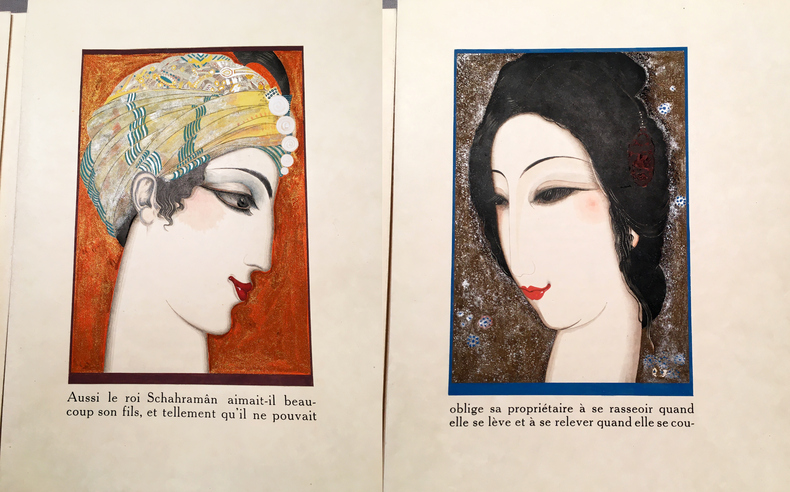
1927ref. 1833Paris, François-Louis Schmied, 1927. Un volume in-4, reliure plein maroquin bleu, doublure et gardes de soie brochée gris-bleu sertie d’un jeu de filets dorés, dos lisse orné, couverture, tranches dorées, étui bordé de même maroquin (G. Cretté succ. de Marius Michel). Édition originale et tirage unique de ce conte oriental de Joseph Charles Mardrus magnifiquement illustrée et ornementée par François-Louis Schmied qui assura lui-même la mise en page et l'impression de ce chef d'œuvre du livre Art déco : le trait des planches a été gravé sur bois, la peinture en a été exécutée à la main, d'après les originaux, dans les ateliers de laquage de Jean Dunand. Cette illustration se compose d'une couverture illustrée, un frontispice, 7 illustrations à pleine page, une grande planche dépliante formant un triptyque, 29 bandeaux horizontaux dont 22 grands, la plupart en-tête, 32 lettrines ornées ou petites vignettes dans le texte, 6 petits bandeaux verticaux et de nombreux bandeaux et lettres mis en couleurs et dorés. TIRAGE UNIQUE À 25 EXEMPLAIRES SUR JAPON, SIGNÉS PAR SCHMIED. Celui-ci (n° XXV) comporte l’une des rares suites des bois tirés en noir sur Japon. L'ouvrage est entièrement monté sur onglet.
1926ref. 1290Paris, [Schmied], 1926. Un volume in-4 (27,7 x 20 cm), en feuilles, 102 pages, n.ch., couverture rempliée, chemise et étui décoré de l’éditeur, emboîtage de maroquin vert doublé de maroquin jonquille, dos titré (G. Cretté succ. de Marius Michel). Édition originale de la plus grande rareté, tirée à seulement 20 exemplaires numérotés sur japon. Splendide illustration en couleurs de François-Louis Schmied: environ 50 bois dont 18 de très grande taille, dans le texte, TOUS ENTIÈREMENT PEINTS À LA MAIN dans les ateliers de laquage de Jean Dunand ; près de 300 lettrines et bouts de lignes peintes à la main dans le texte, dans des harmonies de couleurs variant selon les pages, avec rehauts d'or, d'argent ou de blanc, traçant des motifs géométriques ou érotiques. Tirage unique à 20 exemplaires numérotés et signés du monogramme en rouge de FLS, tous sur papier Japon, celui-ci n° 13. Conservé à l'état d'origine dans un splendide coffret en maroquin doublé de Cretté. - Notes bibliographiques (pour ceux qui prennent le temps): « La Princesse Boudour est regardée par ceux qui savent voir, comme le livre capital de ce premier quart de siècle. Par sa graphie et sa technique générale, elle est une exception préméditée dans le faire de son auteur. Pour la réaliser, il s’est véritablement amusé, cette fois – en tant que lecteur enthousiaste des Mille nuits et une nuit - à commenter graphiquement le texte qu’il connaît si bien et dont il est comme imbibé [...]. Il nous a [...] octroyé le délectable cadeau de trois cent quatre-vingt-dix vignettes et en couleur, et toutes différentes, et qui se rapportent au texte [...]. Et cette munificence schmiedienne n’est-elle pas, en définitive, l’exaltation de notre modernité, et en conformité avec nos goûts, du faire des imagiers incomparables de l’Orient ? [...]. Avec quel attendrissement, avec quelle passion sourde et contenue, qui n’appartient qu’à lui, il a rendu, au moyen des fragiles outils du graveur et du coloriste, la grâce masculine des adolescents, et la tendre chair de banane des radieuses jouvencelles ! [...] Je pense que s’il fallait absolument appliquer une épithète au sourire des adolescentes schmiediennes, et même à celui des adolescents, rien ne leur conviendrait mieux que le mot ambigü... Une atmosphère de pures délices enveloppe cette oeuvre boudourienne, multiple, voluptueuse, spirituelle, et d’une telle essence d’authentique Orient qu’elle nous fait vraiment respirer tous les parfums de l’Arabie. » (Préface du catalogue de l’exposition Schmied à la galerie Arnold Seligmann Rey à New York, mars 1927, pp. 34-37).
1892Kipings