Rudyard Kipling (a cura di Luigi Berti)MareMagnum

7 631 résultats
Opera con segni del tempo sulla sovracopertina che presenta strappi e mancanze. Interno normale ingiallimento della carta dovuta al fattore tempo ma opera discretamente conservata. Non comune
Quaderni della voce raccolti da Giuseppe Prezzolini p. 73
In very good condition. - Introduction -- Knowingness, Practical Jokes and the Use of Superior Knowledge in Kiplings Short Stories -- A useful consideration of this subjecc, one of the most unavoidable and intriguing in any examination of Kiplings work, should deai wich two tnattets. First, it is necessary to showwfiat thc existing frame of refer-ence is in which scholars and critics have discussed the topic and how current ways of understandingKipling's use of superior knowledge have taken shape. Second, it is essential to define the position and emphases of rhe present study in order to show how its approach differs from recenr and contemporary scholarship. For the lattcr purpose, it would be helpful to summarise rhe contents of the book, and to indicate its argument. -- Those who have explored Kiplings intcrest in and employment of superior knowledge have differed in the terminologies they have employed. Yet, in spite of changes down ehe years, there has been continuity in the direction, cone and attitude many critics have displayed. One of the pur-poses of the present study is to question these underlying, persistent as-sumptions and what they imply. -- The present State of the question, regarding the topic of this study, results from an unfolding of concerns present in the earliest responses to Kipling as a writer. Those who reviewed his eariiest produetions were de-lighted by the new kinds of experience they offered readers, by the pres-entation ofpreviously little-known Indian and army life. Yet, many critics were troubled or repelled by ehe tone the new author adopted when offering or commencing upon his discoveries. From the beginning, those who discussed Kipling's work Struck a note ofmoral disapproval that continued to so und. The commentators aecused the young writer of brutality, brashness and cynicism. They reproached him for his precocious worldiiness, which questioned that one so young should have had such experiences, or that he possessed a pretence of knowledge that could only be a tiresome mannerism. Given the outmoded moralistic tone and language of many of diese com-plaints, they inevitably sound naive, evcn foolish. Yet, it would be wrong to ignore diis revulsion where it oecurred, or to dismiss as merely siüy the energy with which diese writers expressed it. AJthough subsequent crities found more sophisticated and, for a while, fashionable formulae in which to show their suspicion or disgust, their complaints were often cognate widi those expressed in die 1890s and in the years immcdiately following. -- Hostile views of Kiplings tone often grew from a dislike of the pretence, or die reality of the worldly wisdom the young man displayed. It would be tempting to dismiss Robert Buchanan's notorious artack as apiece of fos-sihsed spite, or ignorant and dated polemic, if, in more restrained forms, ks complaints had not gone on sounding in Kiplingerideism. Buchanan's diatribe against thedrunken, bragging, boastful hooiiganisin1 of Kiplings fiction and his assertion that the new writer represented all that was ignorant, selfish, base and brutal [140] in human nature reappeared, in more temperate forms, in die discussions of later writers. -- Most of the early attacks on Kiplings work are pertinent to a con-sideration of his knowingness. Impiicit in die aecusations of brutal inso-lence, vulgarity or cynicism was the rage ofthose whosc liberal values, and sensitive humane attitude^s, or wha.t they wished to sec as such, Kipling dismissed as sentiment and illusion. In these critics' eyes, it compounded the offence that Kipling rejeeted dieir views and pereeptions on the ba.sis of his superior knowledge. He not only asserted, but often demonstrated, that he was better informed than diey were about the nature of die British common soldier; die inner workings and convoluted, hidden praetkes of the Imperial Administration; the society life of hill scations, and, most ob-jectionable of all, the motives of men and women, considered both apart from and in relation to cach other. After such knowledge, what forgivencss ? -- The problem posed by Kiplings superior knowledge and his knowing tone would have been less vexing for some of his critics but for an intractable fact. Where it could be chccked, his knowledge proved to be accurace and, for many rcaders, his understanding of hiiman characcer was overwhelm-ingly convincing, as well as refreshingly honest. The reviewer of Kim, in 1901, expressed a common view when he spoke of the 'patient industry, the protracted observacion, the thorough knowledge' [271] that informed ehe three pages describing die wayfarers on ehe Grand Trimk Road. The same wrirer's view that the traics and motives of the novels characters, a 'portrait-gaüery of unusual extent and intcresc' [270], were uteerly convincing commanded an equaily wide assent. The reviewer makes thepointwith the confidence ofone who knows that his readers will agree with him: 'You do not stop to inquire whether' Kipling's characcers are 'true to life. You know they are; you acetpt them all without questkm or reservation'.2 -- Given that k was not easy to dismiss the aecuraey of Kiplings in-formation or, in many areas, his understanding of motive or characters, critics who objeeted to his knowingness initially adopted moral disap-proval as their weapon of attack. However, terms like vulgarity, cynicism, brutal insolcnee and hooligan viciousness had limited long-rerm use. It was impossible, in such phrascology, to make a discriminacing point about a writer, who, like him or not, was a considerable figure, clearly talented and widely read. In any case, such abusive language soon began to seem dated. It drew its force from a politically quite understandable revulsion against [he South African War and against Kipling seen, rightly or wrongly, as die embodiment and spokesman of forces that had driven Britain into an Bgly and degrading conflict. Whether such an attitude to Kipling was fair "i not, the political hears of 1899 to 1902 which had fed it began tocool. I hose wbom, for various reasons, Kipling ofFended required orher more snphisticated tools to sap the power he exerted on his readers. From an culy point in Kiplingscareer, critics began tomovefrorastraightforward moral outrage at the young writer 's knowingness, towards varied psycho-logii ,il speculations about theorigins, meaningandeffectsofthis feature ¦ i( 111 s wricing. In the long run, this has proved more effective and damaging than the angry criesofrfie eariiermoralists. ISBN 9781800793415
I "fanciulli selvaggi" incarnano la speranza di un impossibile ritorno alla natura, a una selvatichezza libera e incontrollata, e interpretano un mito che continua a parlare alle nostre coscienze. Il tema che questo saggio si propone di affrontare si concentra sul rapporto tra l'idea di feral child espressa da Kipling nel celeberrimo personaggio di Mowgli e quella che emerge nelle opere del narratore e poeta australiano David Malouf. Mowgli cela in sé un'idea di conciliazione, ma anche di violento contrasto tra la maturità inglese e l'infanzia indiana del suo autore, sintetizzate in una identità imperiale. Per contro la visione offerta da Malouf è quella di un puer in grado di destabilizzare, di mettere in discussione identità e ruoli imperiali acquisiti come inderogabili. Da un lato, quindi, si analizza un mito coloniale e, dall'altro, una sua sfuggente ed elusiva interpretazione postcoloniale. Matteo Baraldi collabora con il Centro Studi Omeoglotti dell'Università di Bologna occupandosi principalmente di letteratura e cultura australiana. Autori: Matteo Baraldi.
br. Questo libro è per tutti gli amanti di Kim, il capolavoro con cui Ruyard Kipling celebrò la vita del subcontinente indiano, il "fardello dell'uomo bianco" imperiale e inglese, il duello fra la Corona e lo Zar nel "Grande Gioco", nome reso celebre proprio da lui, per il controllo dell'Asia centrale. Affascinato sin dall'adolescenza da questo strano racconto di un ragazzino orfano e del suo reclutamento nell'Indian Secret Service, Peter Hopkirk ripercorre le tracce di Kim nell'India di Kipling per vedere quanto di esse rimanga e dove portino. Rispetto a un eroe di finzione si tratterebbe di una ricerca vana, ma Kim è molto più di un romanzo inventato, perché fu ispirato da figure e luoghi reali che rendono impercettibile il confine fra verità e immaginazione. Libro di viaggi e insieme detective story letteraria, il libro di Hopkirk riporta alla luce le ombre di un passato pieno di intrighi e di colpi di scena, combina una sorprendente erudizione con una qualità di narratore, e ci consegna un'immagine indimenticabile dell'India di ieri, dell'India di sempre.
1920réf. 10257Paris, Editions De La Sirène, 1920. 1010 g Grand in-4 broché, couvertures rempliées, [1] fb., 115 pp., [1] f., [2] ffb.. Illustré de 23 compositions en couleurs de Kees Van Dongen dont 18 à pleine page. L'artiste a également composé les ornements et les maquettes de cet ouvrage tiré à 300 exemplaires, celui-ci un des 250 exemplaires numérotés sur vélin de Rives à la forme. Les illustrations ont été coloriées par l'atelier Marty. L'impression a été réalisée par Louis Kaldor. Carteret, Trésor du Bibliophile, 1875 à 1945, IV, 221; Mahé, Bibliographie des livres de luxe, II, 511-512. Quelques feuillets non coupés. Très légère fente et petits défauts sur le dos mais bon exemplaire. . (Catégories : Livres illustrés, Littérature, Contes, )
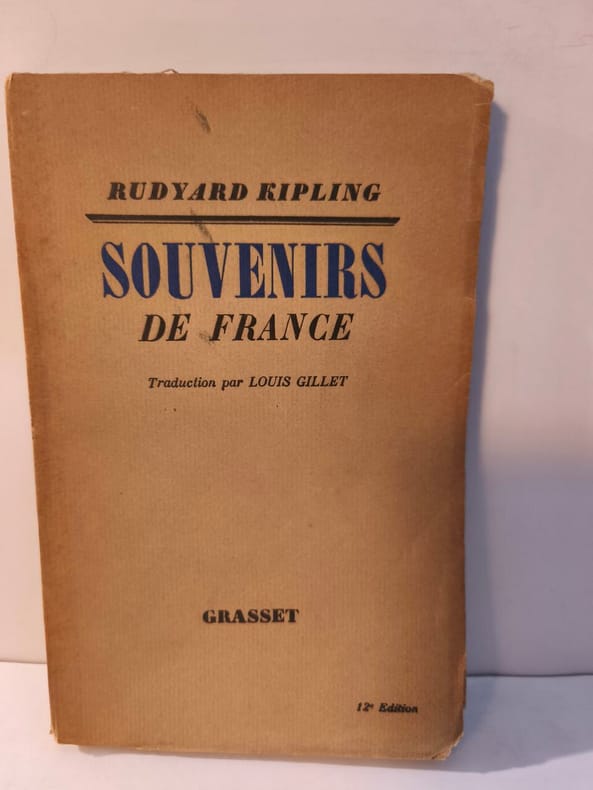
1933réf. 441Grasset 1933 128 pages in8. 1933. broché. 128 pages.
1928réf. 1411MERCURE DE FRANCE 1928 356 pages in8. 1928. reliure demi chagrin a coins. 356 pages.
1925réf. 2233Mercure de France 1925 359 pages in8. 1925. demi cuir dos a nerf. 359 pages.
1968réf. 3643Éditions rombaldi 1968 291 pages in8. 1968. Reliure editeur cartonnée. 291 pages.
réf. 7952Les Éditions Universelles 144 pages IN4. Sans date. Broché couverture rempliée. 144 pages. Cette nouvelle de Rudyard Kipling raconte l'histoire de Charlie Mears un jeune employé de banque sans talent littéraire qui demande conseil à un écrivain pour écrire une histoire qu'il a imaginée. Le récit explore les thèmes de la mémoire de la réincarnation et de l'obsession créatrice tout en interrogeant avec humour le mystérieux processus de la création littéraire
1960réf. 12694DELAGRAVE 1960 246 pages in4. 1960. pleine toile éditeur. 246 pages. Le roman suit Kim un jeune orphelin irlandais vivant en Inde sous domination britannique qui se lie d'amitié avec un lama tibétain en quête d'une rivière sacrée. Tout en accompagnant le lama comme disciple Kim est recruté par les services secrets britanniques pour participer au 'Grand Jeu' de l'espionnage naviguant entre spiritualité orientale et rationalisme occidental
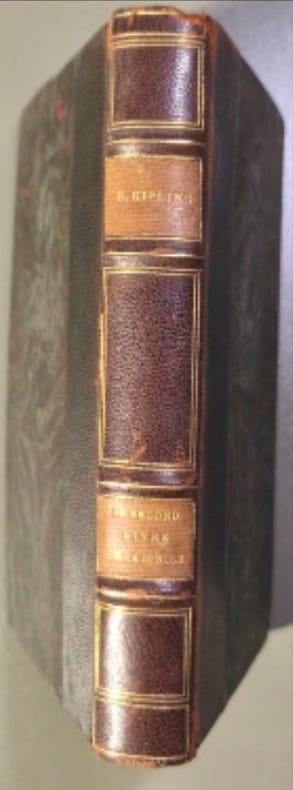
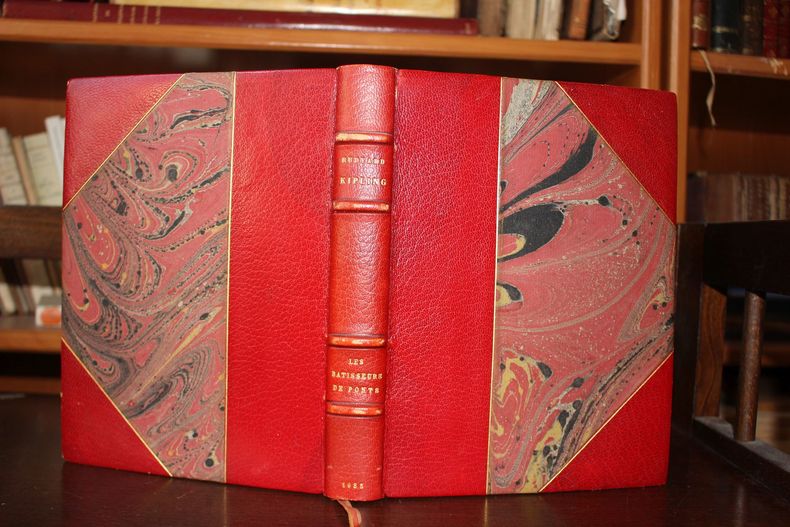
réf. 25537Paris, Mercure de France, 1925 13.4x19 cm., 281 pp., Relie demi-maroquin noir a coins, signee par Laurent Peeters - Anvers. Traduit par Louis Fabulet. Filet dore cernant les plats de pap., dos a 5 nerfs et finnement fleuronnes dores (decor floral), tete doree, couverture imprimee d'editeur. Tirage a 550 exemplaires sur verge de fil Montgolfier, numerotes de 38 a 587. Justification du tirage.
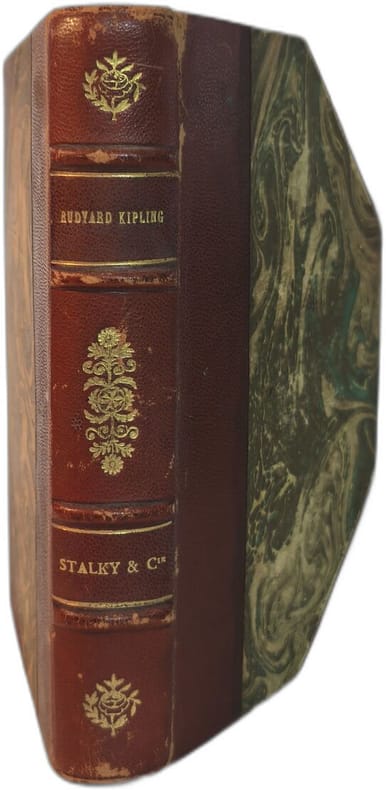
réf. 36623Paris, Paul Ollendorff, s/d Relie, demi-tissu beige/papier marbre, dos orne, dos a 3 nerfs, traduit de l'Anglais, 18.2x11.5 cm., 315 pp.
réf. 36625London, Heineman and Balestier, 1891 Bound, half-linen/marbled paper, ornate back, back 3 veins, 15.8x11.5 cm., 278 pp.
réf. 37149Antwerpen , De Vries , 2012 Gebonden, 191pp. ISBN 9789059273092.
1945réf. 2483Paris, Mercure de France, 1945, in-8, broché, 274 pages. Bon état.
1959réf. 2941Paris, Mercure de France. Le Club Français du Livre. , 1959, in-8, Cartonnage éditeur., 374 pages. Illustrations de Jacques Daniel. Exemplaire numéroté, N°3849. Bon état.
1937réf. 18198Paris, Mercure de France. Coll. Libertés françaises, 1937, in-8, broché,, 219 pages. Petits manques en coiffe. Bon état.
1956réf. 69656Paris, Le Club du Meilleur Livre. 1956, in-8, cartonnage éditeur, sous rodhoïd.,, 204 & 248 pages. Edition limitée à 4600 ex. numérotés. Bon état. Reliure d'après Martius
1959réf. 74741Paris, Mercure de France. Le Club Français du Livre. , 1959, in-8, Cartonnage éditeur sous rodhoïd, 374 pages. Illustrations de Jacques Daniel. Exemplaire numéroté, N°3849. Bon état.
2001réf. 76873Paris, Bibliothèque de la Pléiade, 2001, in-12, pleine reliure cuir sous rodhoïd et étui illustré, 1831 pages. Très bon état.
1922réf. 83983Paris Payot & Cie, 1922, in-8, broché, 348p. Couverture passée. Intérieur bon, sans annotations. Bon exemplaire d'étude.
réf. 007143Paris, Mornay, 1935. In-8, 263p. Belle édition illustrée par Deluermoz, tirage à 1700 exemplaires, un des exemplaires sur Rives. Reliure signée Mériot, demi-maroquin cerise à coins, filet doré en bordure, dos à nerfs, tête dorée, couvertures et dos conservés. Nerfs frottés, cuir plus foncé sur le haut du dos (probablement une mouillure, sans incidence à l'intérieur). Bel exemplaire néanmoins.